
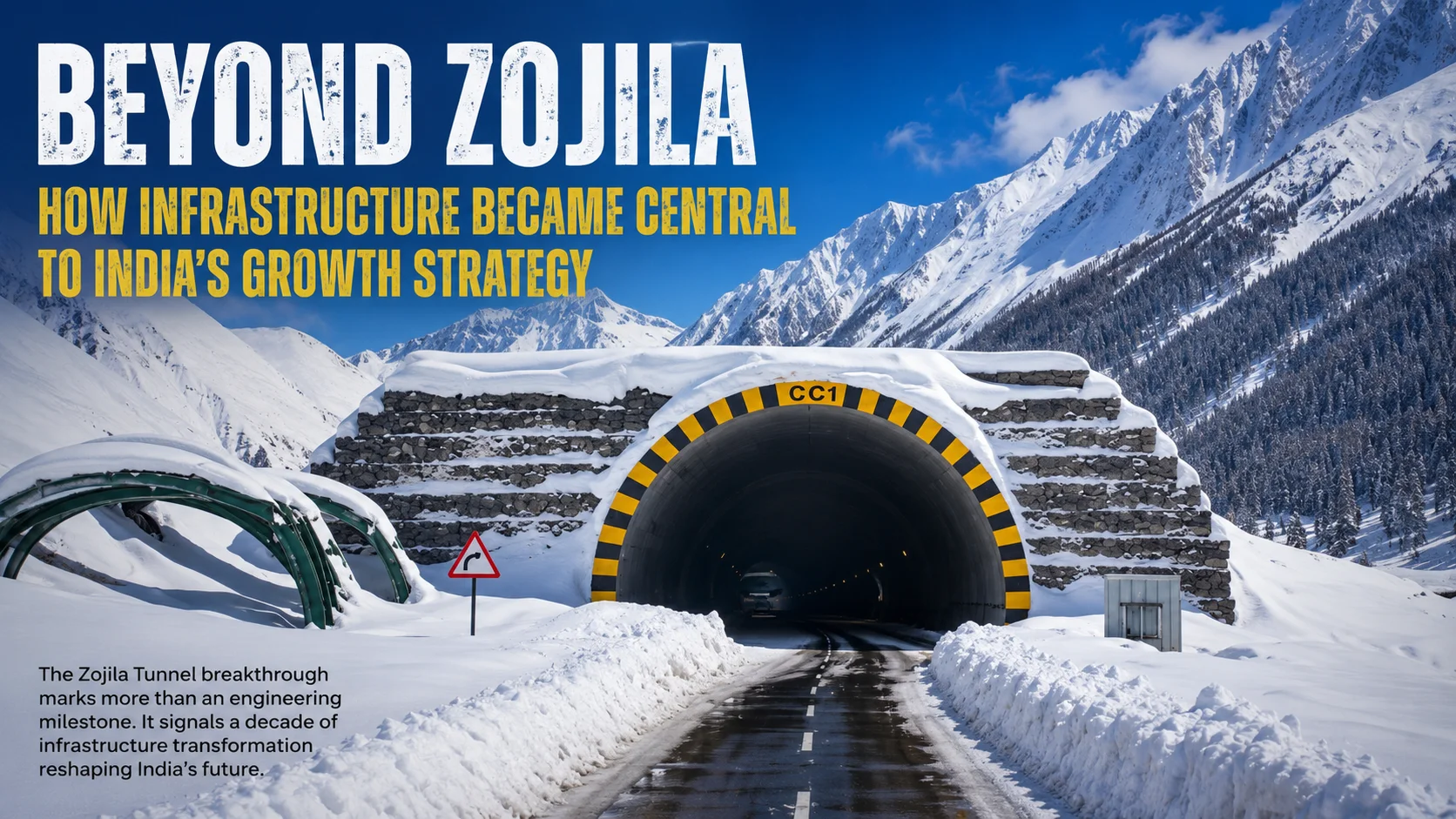
When engineers blasted through the final rock barrier inside the Zojila Tunnel on June 9, 2026, it marked more than the completion of a difficult phase of construction. The breakthrough represented another milestone in India’s decade-long effort to overcome geography, improve connectivity and strengthen access to some of its most strategically important regions.
Few projects illustrate that ambition better than the Zojila Tunnel.
Once operational, the 13.15-kilometre tunnel on the Srinagar-Leh National Highway will provide all-weather connectivity between Kashmir and Ladakh, significantly reducing travel time while ensuring year-round access to a region that remains vulnerable to prolonged winter isolation.
The Engineering Milestone Beneath the Himalayas
For decades, the Zojila Pass has been one of India’s most difficult connectivity challenges.
Situated at an altitude of more than 11,500 feet, the mountain pass is routinely battered by heavy snowfall, avalanches and extreme weather conditions, forcing it to shut for several months every year. During winter, Ladakh’s road link with Kashmir and the rest of India is severely disrupted, making air transport the only reliable option for people, supplies and military logistics.
That is why the Zojila Tunnel is far more than a transportation project. It is a strategic piece of infrastructure with implications for national security, border connectivity and regional economic development. Once operational, the tunnel will provide year-round access between Kashmir and Ladakh, improving civilian mobility, tourism, trade and military logistics in one of India’s most sensitive frontier regions.
The project itself has been nearly a decade in the making. Although it received official approval in 2013, construction has faced enormous engineering challenges. To navigate unstable Himalayan geology, frequent landslides and temperatures that can plunge below minus 35 degrees Celsius, engineers relied heavily on the New Austrian Tunnelling Method (NATM), a technique designed to use the surrounding rock mass to stabilize excavation.
Construction accelerated after work began in 2020, and the successful breakthrough achieved this week marks the completion of the most challenging phase of excavation, bringing the project closer to operational readiness.
Strategic Outlook: Infrastructure as a Security Asset
Having covered India’s policy, security and development landscape for more than two decades, one lesson stands out: infrastructure is no longer merely a development tool. In sensitive frontier regions, it has become an integral component of national security.
The military significance of the Zojila Tunnel extends well beyond transportation.
For years, the seasonal closure of the Zojila Pass forced the Indian Armed Forces into an intensive advance winter stocking cycle. Large quantities of fuel, rations, ammunition and essential supplies had to be moved into Ladakh before snowfall cut off the region from the Kashmir Valley.
The tunnel fundamentally changes that equation.
By creating a secure, year-round corridor through terrain that was previously vulnerable to weather disruptions, the project enhances logistical flexibility, improves supply-chain reliability and strengthens India’s ability to maintain uninterrupted connectivity with strategically important frontier regions.
For military planners, the value of such infrastructure lies not only in mobility but also in predictability. A route that remains open throughout the year reduces uncertainty and strengthens operational readiness in an area that has gained increasing strategic significance over the past decade.
The Bigger Story: India’s Infrastructure Transformation
Yet the significance of the Zojila Tunnel extends far beyond Ladakh.
The project is part of a much larger infrastructure transformation that has unfolded across India over the past decade. From railway bridges in Kashmir and expressways in northern India to airports, ports, metro systems and logistics corridors, New Delhi has invested heavily in building the physical foundations of economic growth.
According to government data, public capital expenditure has increased from approximately ₹2 lakh crore in FY2014-15 to ₹12.2 lakh crore in FY2026-27. The spending surge has coincided with rapid expansion across multiple sectors.
India’s railway network is now nearly fully electrified. Modernization efforts include the expansion of Vande Bharat trains, station redevelopment projects and the rollout of the indigenous Kavach train safety system. Major projects such as the Chenab Rail Bridge and the Mumbai-Ahmedabad High-Speed Rail corridor reflect a broader effort to improve mobility, capacity and efficiency.
Road infrastructure has witnessed a similar transformation. National highways have expanded rapidly, economic corridors have shortened travel times between major cities, and strategic projects such as the Atal Tunnel, Sonamarg Tunnel and Zojila Tunnel have strengthened connectivity in geographically challenging regions.
The aviation sector has also changed dramatically. The number of operational airports has more than doubled since 2014, while the UDAN regional connectivity scheme has extended air access to smaller cities previously underserved by commercial aviation.
India’s metro footprint has expanded into dozens of urban centres, making it one of the largest urban transit networks in the world. At sea, port capacity has nearly doubled over the past decade, while inland waterways are increasingly being integrated into logistics planning as policymakers seek to reduce freight costs and improve supply-chain efficiency.
Why Logistics Matters
For years, India’s economic growth has been constrained by high logistics costs, fragmented transport networks and inadequate last-mile connectivity. Moving goods across the country often took longer and cost more than in competing manufacturing economies.
The challenge was never a lack of economic activity. It was the difficulty of efficiently connecting producers, consumers and export markets.
This is where initiatives such as PM GatiShakti, Bharatmala, Sagarmala and dedicated freight corridors become significant. Rather than treating roads, railways, ports and airports as isolated projects, policymakers have increasingly sought to integrate them into a unified logistics ecosystem designed to reduce bottlenecks and improve connectivity.
Supporters argue that these investments are laying the groundwork for sustained industrial growth and improved competitiveness. Critics, however, note that infrastructure alone cannot resolve challenges such as regulatory hurdles, land acquisition disputes and uneven implementation across states.
Both arguments contain an element of truth.
Modern infrastructure cannot guarantee economic transformation on its own. Yet without reliable transport and logistics networks, large-scale industrial expansion becomes significantly more difficult.
Beyond Concrete and Steel
The relationship between infrastructure and national capability is often overlooked.
Building tunnels beneath the Himalayas, constructing record-breaking railway bridges, expanding ports and developing freight corridors requires expertise in engineering, project management, advanced construction techniques and large-scale execution. Over time, these capabilities strengthen the broader industrial ecosystem and contribute to the country’s long-term economic resilience.
Whether India’s infrastructure push ultimately delivers the productivity gains and logistics efficiencies policymakers envision will become clearer over the coming years.
What is already evident, however, is that infrastructure has moved from being a supporting element of development policy to becoming one of the central pillars of India’s long-term economic and strategic ambitions.
The breakthrough inside the Zojila Tunnel is therefore more than an engineering milestone. It is another marker in a broader national effort to reshape how people, goods and opportunity move across India.