
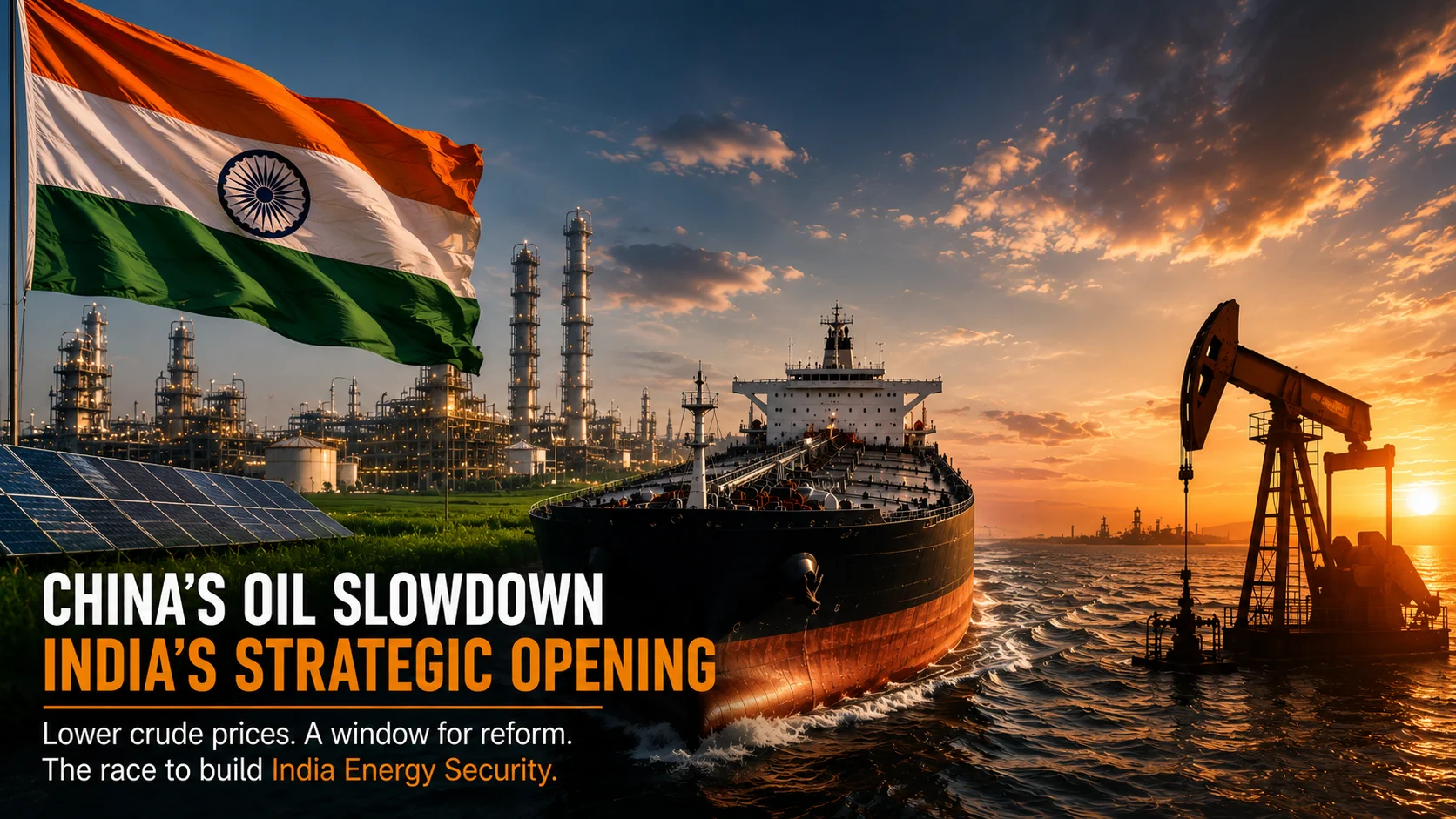
India Energy Security is receiving an unexpected boost from one of the world’s biggest economic slowdowns. While tensions in the Middle East continue to threaten global oil supplies, weaker Chinese demand has helped keep crude oil prices under pressure, giving New Delhi valuable breathing room as it accelerates efforts to reduce dependence on imported energy.
Conventional market logic suggests crude should be trading much higher.
The Strait of Hormuz remains vulnerable. Regional tensions continue to simmer. Shipping risks have not disappeared. Under normal circumstances, such conditions would be enough to push oil sharply higher and reignite fears of another global energy shock.
Yet the global energy complex remains remarkably restrained.
The insulation is not coming from Washington, Riyadh, or Brussels.
It is coming from Beijing.
China’s economic slowdown is doing something sanctions, diplomacy, and strategic reserves have struggled to achieve: suppressing crude oil prices despite persistent geopolitical risk. As industrial activity softens and refiners draw down inventories rather than aggressively import crude, the world’s largest oil importer has removed a significant source of demand from the market.
This shift is critical; oil prices are set at the margin. A few million barrels per day of missing demand can neutralize a surprising amount of geopolitical risk premium.
Why Lower Crude Prices Matter for India Energy Security
For India, the implications are immediate.
Every major oil shock eventually works its way into the Indian economy. Higher crude prices increase transportation costs, pressure inflation, widen the current account deficit, weaken the rupee, and complicate policymaking. With roughly 85% of its crude requirement sourced from abroad, India remains among the world’s most exposed large economies when energy markets become volatile.
Veteran observers of India’s energy sector will recognize how unusual this moment is. Previous geopolitical crises—from the Iraq War era to the energy disruptions that followed Russia’s invasion of Ukraine—typically translated into immediate concerns over inflation, fuel prices, and import costs.
This time, weaker China oil demand is absorbing part of that pressure.
The irony is difficult to miss. A weaker Chinese economy is hardly positive for global growth, yet it is helping contain one of India’s most persistent macroeconomic vulnerabilities.
From Energy Acquisition to Energy Resilience
That breathing room is arriving at an important moment.
For much of the past two decades, India’s energy strategy revolved around securing access to imported fuel. Policymakers focused on supply contracts, overseas partnerships, strategic reserves, and protection against disruptions in global energy markets.
Today, the conversation is changing.
The objective is no longer merely securing energy supplies. It is reducing dependence on them.
The shift reflects a broader recognition that energy security in the 21st century cannot rely solely on access to global markets. It also requires reducing vulnerability to those markets.
How Ethanol Blending Strengthens India Energy Security
Nowhere is that shift more visible than in India’s ethanol blending programme.
Earlier this month, the government launched E85 fuel across 48 public-sector retail outlets, marking the first phase of a nationwide rollout expected to expand to 500 outlets by the end of 2026 and around 5,000 outlets by the end of 2027.
E85 contains 80–85% ethanol and is designed for flex fuel vehicles capable of operating on higher ethanol blends. Unlike conventional petrol, most of its energy content originates from Indian agriculture rather than imported oil.
The scale of the transformation is becoming difficult to ignore.
India’s ethanol blending rate has risen from just 1.53% in 2014 to 20% today, achieving the government’s target five years ahead of schedule. According to government figures, the programme has already saved more than ₹1.84 lakh crore in foreign exchange while replacing nearly 302 lakh metric tonnes of crude oil imports.
If flex-fuel vehicle adoption accelerates, policymakers estimate annual demand for more than 312 crore litres of domestically produced ethanol could be created. The transition could direct approximately ₹12,403 crore toward farmers, save nearly ₹15,151 crore in foreign exchange each year, and reduce carbon emissions by 66.4 lakh metric tonnes annually.
Every litre of ethanol consumed is one less litre of imported petroleum. Every percentage point reduction in oil imports reduces India’s exposure to geopolitical crises unfolding thousands of kilometres beyond its borders.
Building Multiple Layers of India Energy Security
The same strategic logic is increasingly visible across other areas of energy policy.
Coal gasification projects are being promoted to convert domestic coal into synthetic natural gas, methanol, fertilizers, and industrial chemicals. Coal-market reforms are designed to improve transparency and efficiency. Renewable energy capacity continues to expand, while new small hydro initiatives aim to unlock part of India’s estimated 21 GW of untapped potential.
These initiatives operate under different ministries and policy frameworks, but they are moving in the same direction. The common objective is to reduce India’s dependence on imported energy and strengthen resilience against external shocks.
This is not simply an energy transition.
It is an energy-security doctrine.
The Strategic Outlook
China’s oil slowdown may be giving New Delhi an immediate macroeconomic cushion, but the more consequential story is unfolding inside India’s own energy policy.
China oil demand will eventually recover. Crude oil prices will remain vulnerable to geopolitical shocks. Future crises in the Middle East, the Indo-Pacific, or other strategic chokepoints cannot be ruled out.
The question confronting policymakers is not how to eliminate those risks. It is how to reduce their impact on the Indian economy.
That is precisely what India’s current energy strategy seeks to accomplish.
For decades, energy security meant ensuring access to enough imported oil. Increasingly, it means building an economy that needs less of it.
Strengthening India Energy Security through ethanol blending, domestic energy production, renewable expansion, and market reforms will not eliminate future energy shocks. It will, however, make the country far more resilient when they arrive.
That transition is already underway.