
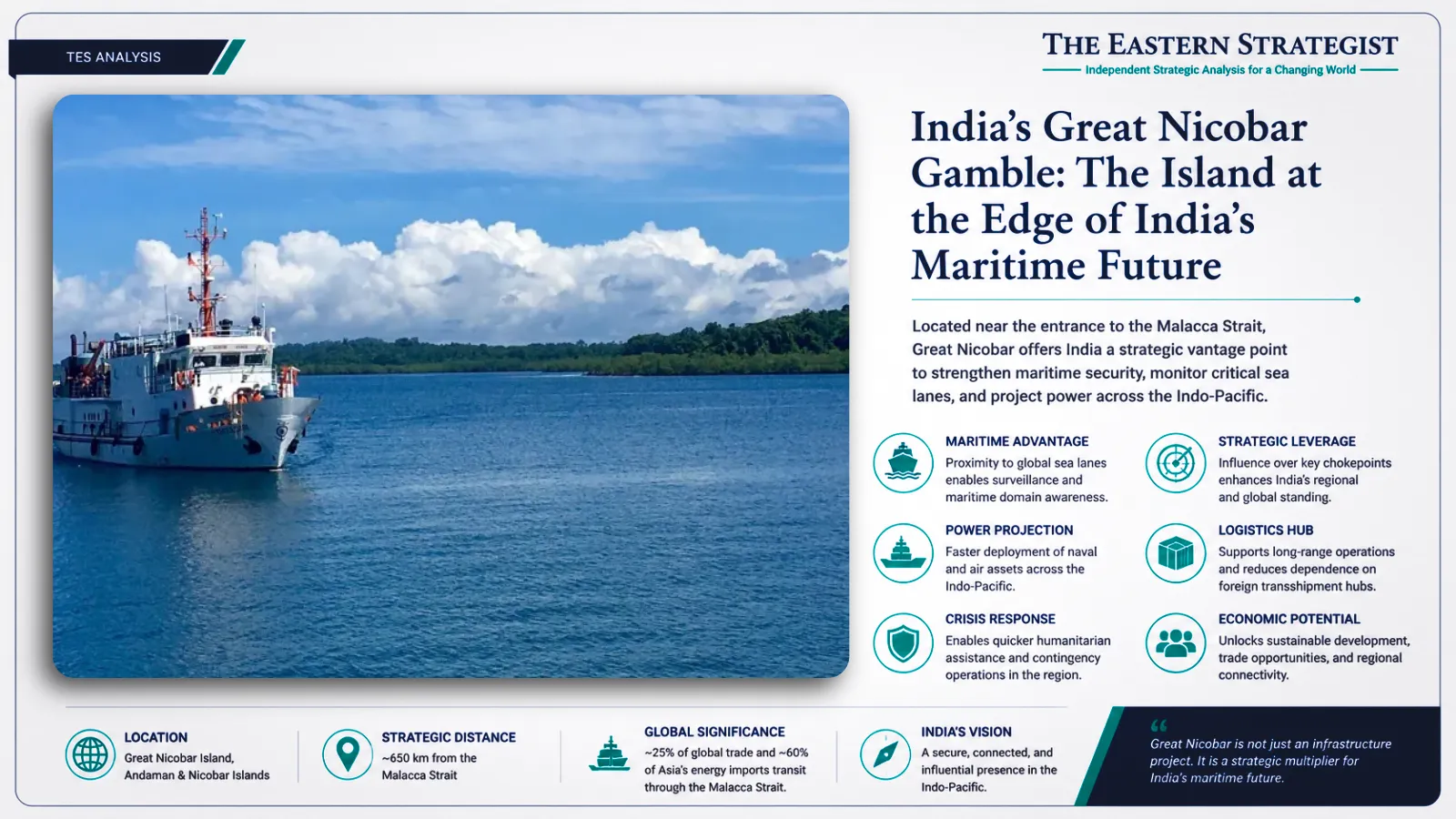
Great Nicobar Project: India’s Strategic Gateway to the Indo-Pacific
For decades, India viewed the Andaman and Nicobar Islands largely as distant territory — strategically useful, certainly, but never fully integrated into the country’s larger maritime vision. That approach is now changing rapidly. Great Nicobar, once seen as a remote outpost on the edge of the map, is increasingly being treated as a frontline strategic asset in an Indo-Pacific region shaped by rivalry, shipping competition, and expanding naval presence.
The proposed Great Nicobar infrastructure project reflects that shift more clearly than perhaps any other initiative currently underway in the Indian Ocean region.
Navy veteran and commentator Srikant Kesnur told The Eastern Strategist, “At the centre of the plan lies the proposed Galathea Bay transshipment terminal, alongside an international airport, power infrastructure, logistics facilities, and an ambitious urban development project. Together, they are intended to transform the island into a major economic and strategic hub positioned close to the western approaches of the Malacca Strait — one of the world’s most critical maritime chokepoints.”
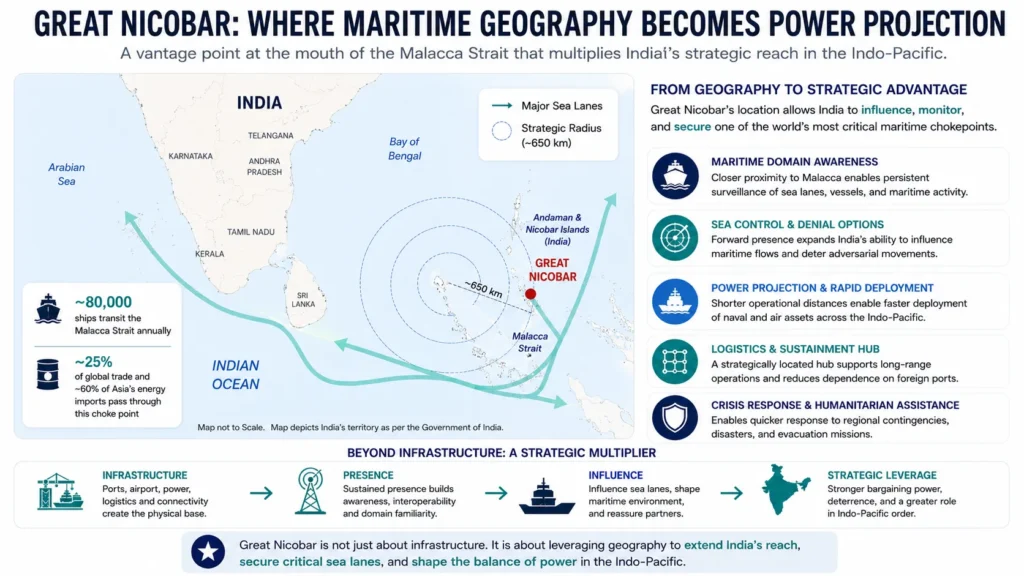
The geography alone explains why policymakers and strategic planners are paying attention. A substantial share of global trade and energy traffic moves through the Malacca Strait. For economies such as China, Japan, and South Korea, uninterrupted access through these waters is not merely commercial convenience; it is a matter of long-term economic and energy security.
That reality has major implications for India.
“Whoever maintains presence, infrastructure, and operational reach near these sea lanes gains strategic leverage during both peace and crisis,” Navy veteran and commentator Srikant Kesnur told The Eastern Strategist. “This is precisely why maritime powers have historically competed for influence around chokepoints — from Hormuz to Malacca. Great Nicobar gives India an opportunity it ignored for far too long: the ability to operate closer to the centre of Indo-Pacific maritime activity rather than observing it from a distance.”
China’s expanding footprint across the Indian Ocean has made this urgency even more visible. Over the past decade, Beijing has steadily deepened infrastructure and strategic ties across the region, including in Pakistan and Sri Lanka, while simultaneously increasing the operational reach of the People’s Liberation Army Navy. India’s maritime establishment has watched these developments carefully.
New Delhi’s response is no longer confined to diplomatic signaling. It increasingly involves hard infrastructure, logistics capability, naval modernization, and forward positioning.
This is where Great Nicobar becomes strategically significant.
The island is not simply about building a commercial port. It is part of a broader attempt to strengthen India’s maritime posture in the eastern Indian Ocean and reduce vulnerabilities in a region where strategic competition is intensifying. India also wants to reduce dependence on foreign transshipment hubs such as Singapore and Colombo, through which a considerable share of Indian cargo continues to move.
Still, the project’s supporters sometimes understate the scale of the environmental and social risks involved.
Great Nicobar is not an empty strategic canvas waiting for development. It is an ecologically fragile island system with dense tropical forests, coral ecosystems, and vulnerable biodiversity. The region’s seismic sensitivity — exposed dramatically during the 2004 tsunami — cannot simply be treated as a secondary concern in pursuit of infrastructure expansion.
Questions surrounding indigenous communities, particularly the Shompen tribe, also deserve more serious public discussion than they have received so far. Strategic necessity cannot automatically become a justification for bypassing ecological caution or local realities. India has every right to pursue maritime strength, but the durability of such projects ultimately depends on whether they are executed with restraint, transparency, and long-term planning rather than bureaucratic haste.
That is where the real test lies.
India’s strategic community broadly understands why Great Nicobar matters. The harder question is whether India’s institutions are capable of balancing strategic ambition with environmental responsibility in one of the most sensitive island ecosystems in the region.
The broader logic behind the project is difficult to ignore. Maritime competition in the Indo-Pacific is no longer theoretical. Supply chains, naval deployments, energy security, and trade routes are now deeply intertwined with geopolitics. Nations that fail to secure logistical depth and maritime reach risk strategic dependence in the decades ahead.
India appears determined not to make that mistake.
But projects of this scale are ultimately judged not only by the ports they build or the cargo they handle. They are judged by whether they strengthen national capability without creating irreversible ecological and social costs in the process.
Great Nicobar may well become one of the defining strategic projects of modern India. Whether it is remembered as a successful maritime transformation or as a warning about overreach will depend entirely on how carefully India proceeds from here.