
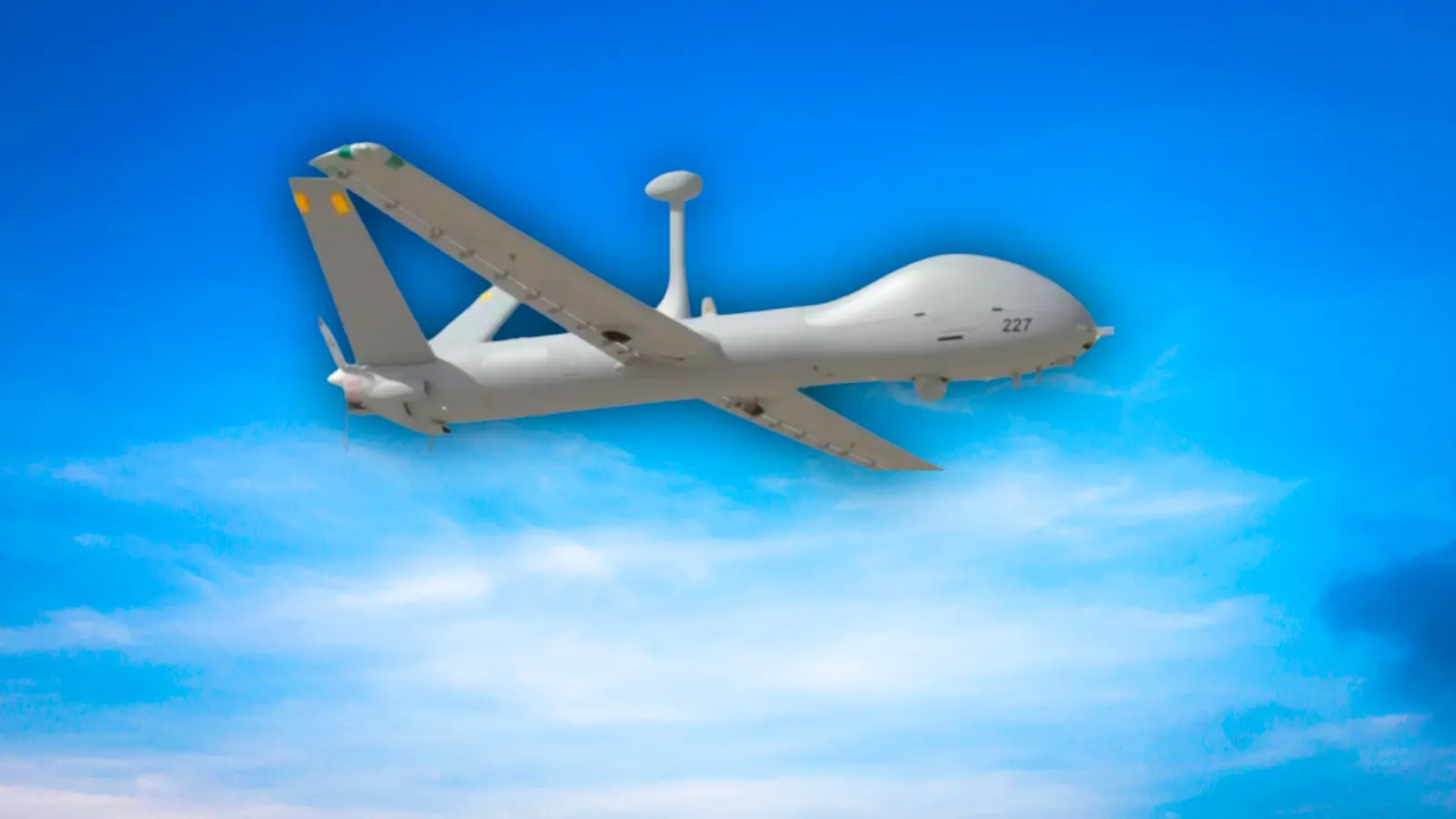
Executive Briefing
- The Operational Shift: The recent Indian Navy drone induction alters the fundamental geometry of anti-submarine warfare (ASW) in the Indian Ocean Region, shifting the initial detection phase from manned aircraft to autonomous, persistent platforms.
- The Unarmed Hunter: Despite carrying no torpedoes or depth charges, the Drishti-10 ASW capabilities allow it to serve as the critical forward node in the naval kill chain, acting as an acoustic and electronic relay for armed frigates.
- The Industrial Base: Produced by Adani Defence aerospace, the platform represents a successful Hermes Starliner technology transfer. This deployment is a direct operational result of the newly codified India-Israel defense roadmap, proving that high-end sensor integration is now achievable within domestic manufacturing corridors.
The Mechanics of Unarmed Submarine Hunting
A common operational misconception is that neutralizing a submarine requires an aircraft armed with heavy munitions. In modern naval doctrine, establishing a persistent track is the primary tactical hurdle; the kinetic engagement is merely the final step. Unarmed MALE UAV submarine tracking solves the endurance problem that traditionally limits manned aircraft like the P-8I Poseidon.
The Drishti-10 ASW capabilities rely entirely on the platform’s 36-hour loiter time and its advanced sensor architecture. Built to comply with NATO’s STANAG 4671 airworthiness standards, the drone safely integrates into civilian airspace while deploying synthetic aperture radar (SAR) to catch periscope wakes and highly sensitive signals intelligence (SIGINT) to intercept brief communication bursts. Acting as a high-altitude data relay for sonobuoys, the drone effectively turns every allied ship within a 100-mile radius into a guided weapon.
Sovereign Supply Chains and Network Integration
The successful execution of this kill chain dictates the broader strategic value of the Drishti-10 ASW capabilities. Prior to this, the Indian Navy was reliant on imported systems where proprietary software architectures often limited seamless data integration. The shift to domestic production ensures that the drone’s command and control (C2) links are natively hardened against regional electronic warfare threats.
| ASW Sensor Class | Tactical Application |
|---|---|
| Synthetic Aperture Radar (SAR) | Scans surface anomalies, distinguishing submarine wakes from standard maritime traffic. |
| Signals Intelligence (SIGINT) | Intercepts encrypted communications when the submarine establishes satellite uplinks. |
| Acoustic Data Relays | Receives underwater telemetry from sonobuoys and beams coordinates to striking frigates. |
Strategic Forecast
- Export Viability: As the Drishti-10 ASW capabilities are proven in the rigorous environment of the Indian Ocean, expect New Delhi to position this platform as a premier export offering. This will significantly expand the order books for Indian defence stocks and private aerospace firms operating within domestic manufacturing corridors.
- AI Integration: Future software upgrades will likely incorporate machine learning algorithms directly into the drone’s processing core, allowing it to autonomously classify acoustic and visual submarine signatures before transmitting data to command centers, significantly reducing kill chain latency.
Disclaimer: The information provided in this intelligence brief is for educational, research, and geopolitical analysis purposes only. The Eastern Strategist is not a SEBI-registered investment advisor. Mentions of defense industry segments, operational doctrines, or specific private industrial corporations are for macroeconomic analysis only and should not be construed as a financial recommendation to buy or sell any securities. Readers must conduct their own due diligence before making investment decisions.