
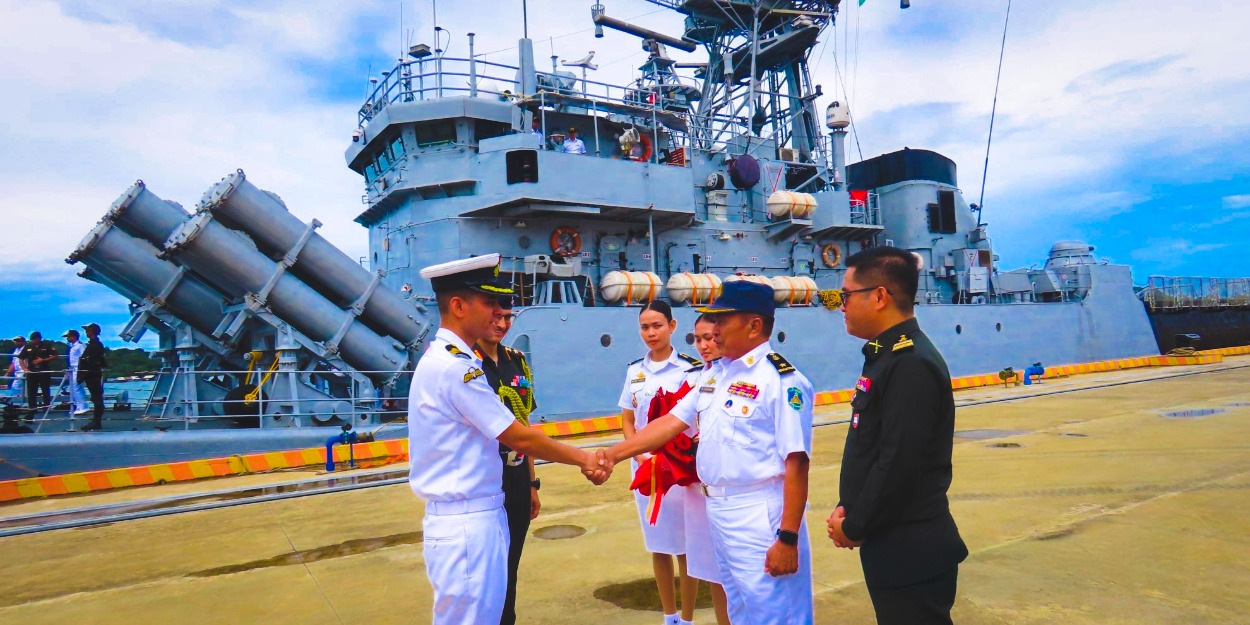
By docking a missile corvette at Cambodia’s Chinese-refurbished naval stronghold, the Indian Navy demonstrates reciprocal maritime reach, providing Southeast Asia with a vital non-aligned security alternative.
Executive Brief
The arrival of the Indian Navy’s guided-missile corvette INS Kulish at Ream Naval Base on 13 September 2026 marks one of the boldest deployments of India’s Act East naval diplomacy (IANS Live, India Strategic). Located on the Gulf of Thailand, Ream was extensively upgraded with Chinese funding and scrutinized by Western defense planners as a prospective forward operating enclave for the People’s Liberation Army Navy (PLAN). By docking INS Kulish at Ream Naval Base, New Delhi punctures the narrative of exclusive Chinese maritime suzerainty, operationalizing its vision of India’s Military Power in 2026 by projecting blue-water reach directly into Beijing’s maritime perimeter.
1. The Geopolitical Crucible: Why INS Kulish at Ream Naval Base Matters
For over five years, Cambodia’s Ream Naval Base in Sihanoukville has been a focal point in Indo-Pacific security discourse. Upgraded through concessional Chinese grants, dredging works, and drydock installations, foreign analysts widely anticipated that Ream would serve as Beijing’s second overseas military outpost after Djibouti, providing the PLA Navy with an uninhibited flank in the Gulf of Thailand.
The presence of INS Kulish at Ream Naval Base disrupts this narrative. Armed with 16 Kh-35 Uran anti-ship missiles and Otobreda naval guns, the 1,400-tonne Kora-class corvette arrived not as a spectator, but as an active partner conducting joint operational exchanges and professional cross-deck training with the Royal Cambodian Navy. This deployment demonstrates that Southeast Asian capitals actively seek diplomatic diversification to avoid single-nation hegemony.
2. Reciprocal Maritime Geopolitics: Balancing Beijing’s Indian Ocean Footprint
| Theater / Strategic Node | Adversary Maneuver | Indian Counter-Maneuver | Strategic Doctrine Impact |
|---|---|---|---|
| Gulf of Thailand (Ream Base) | Financed deep-water pier and repair facilities for PLAN surface combatants. | Operational port call of INS Kulish at Ream Naval Base for bilateral naval exercises. | Affirms open naval access; denies exclusive military monopolisation. |
| Northern Indian Ocean (Colombo/Hambantota) | Deploying Yuan Wang and Xiang Yang Hong tracking vessels. | Institutionalising Sri Lanka’s Coastal Surveillance Radar Network via BEL. | Secures India’s southern maritime flank under SAGAR doctrine. |
| South China Sea Littoral (Vietnam) | Coercive coast guard and maritime militia patrols across Vanguard Bank. | Transfer of INS Kirpan corvette; accelerating BrahMos coastal missile sales. | Builds distributed A2/AD sea-denial networks across the Western Pacific. |
3. Defence & Markets Crossover: Expanding Indian Naval Exports to ASEAN
The successful mission of INS Kulish at Ream Naval Base has immediate commercial ramifications across India’s expanding defence export ecosystem:
- Shipyard Export Portfolios: Indian public and private shipyards (Garden Reach Shipbuilders & Engineers, Goa Shipyard, L&T Shipbuilding) are aggressively bidding for offshore patrol vessel (OPV) and fast interceptor craft tenders across ASEAN. Demonstrating operational reliability in Southeast Asian waters validates Indian hull designs and mechanical survivability.
- C4ISR & Coastal Radar Systems: Bharat Electronics Limited (BEL) is positioning its Coastal Surveillance Radar Systems (CSRS) across regional littorals, creating unified radar integration compatible with India’s Information Fusion Centre – Indian Ocean Region (IFC-IOR). Explore our ongoing coverage in Latest Strategic Updates.
- Sub-Tier Ammunition Off-Take: Sustained naval operational deployments generate steady export requirements for domestic naval ammunition and electronic warfare suites (Solar Industries, Data Patterns).
Strategic Autonomy in Action: Why ASEAN Chooses Multi-Alignment
Smaller Southeast Asian states refuse to be reduced to pawns in a binary US-China confrontation. By welcoming INS Kulish at Ream Naval Base, Cambodia signals that its sovereign ports remain accessible to democratic, non-aligned partners. For India, engaging Cambodia without ideological preconditions demonstrates leadership of the Global South, proving that maritime security can be cooperative rather than coercive.
4. Historical Precedent: The Cold War Port-Call Protocol
The strategic logic behind the docking of INS Kulish at Ream Naval Base mirrors naval diplomacy during the Cold War. In contested regions such as the Mediterranean and the Horn of Africa, rival superpowers frequently attempted to designate third-party ports as exclusive spheres of influence.
The routine dispatch of naval surface combatants for friendly, non-belligerent port calls by independent powers proved vital to preventing unannounced annexation of sovereign waters. By dropping anchor at Ream, INS Kulish reaffirms the foundational maritime law of the sea: international waterways and sovereign ports cannot be converted into closed military lakes.
Frequently Asked Questions
Why is INS Kulish at Ream Naval Base significant?
Ream Naval Base was heavily upgraded with Chinese financial assistance, leading many Western analysts to fear it would become an exclusive Chinese naval enclave. The docking of INS Kulish at Ream Naval Base proves that Cambodia maintains multi-aligned maritime diplomacy and that Indian warships can operate within Southeast Asian waters unhindered.
What class of warship is INS Kulish?
INS Kulish (P63) is a Kora-class guided-missile corvette of the Indian Navy, displacing approximately 1,400 tonnes and armed with 16 Kh-35 Uran anti-ship cruise missiles and short-range surface-to-air missile defenses.
How does this fit into India’s Act East policy?
Under the Act East and SAGAR frameworks, India proactively deploys naval assets across ASEAN littorals to support capacity building, secure Sea Lines of Communication (SLOCs), and balance unilateral power projection in the Indo-Pacific.