
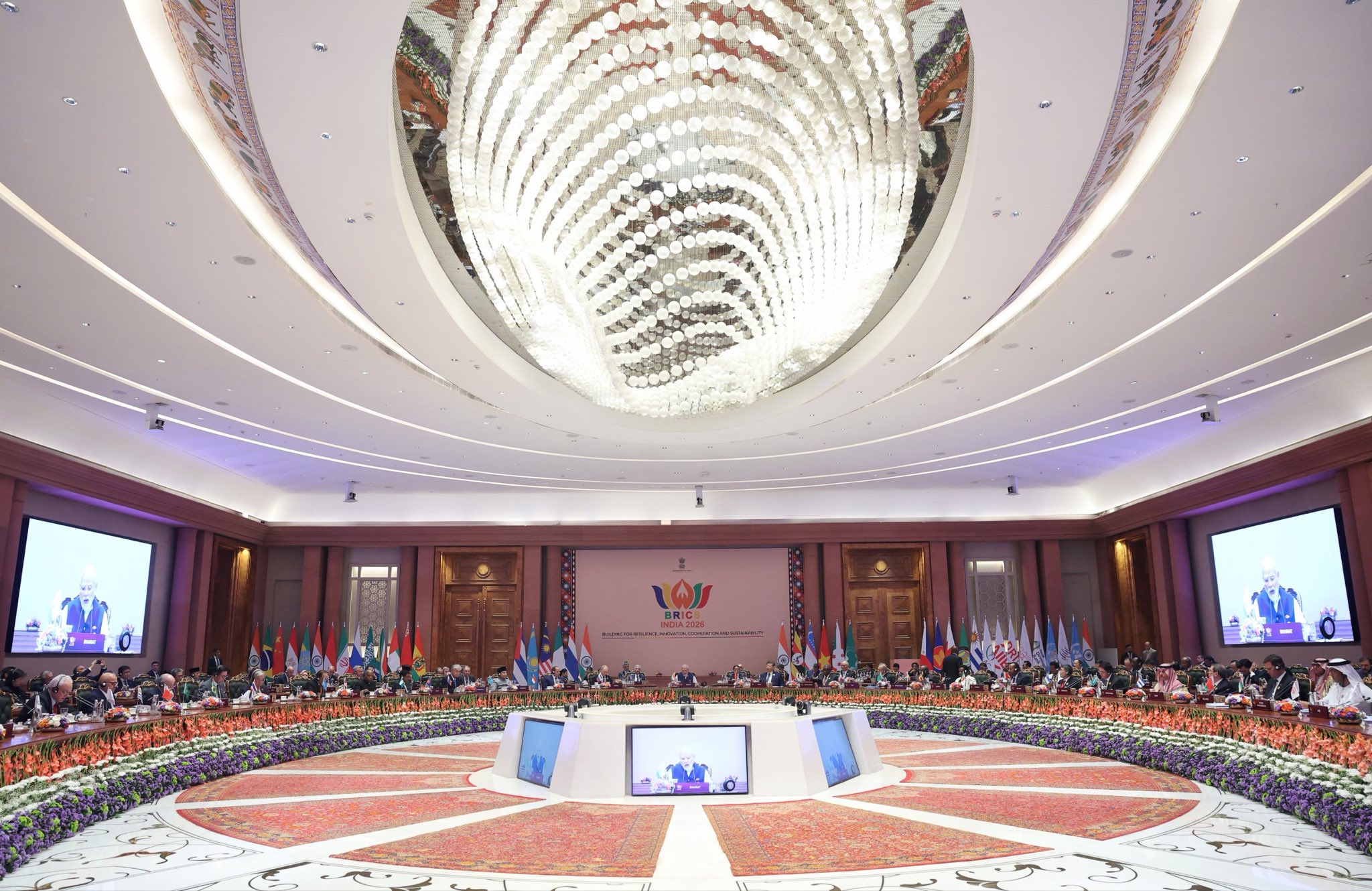
From bilateral currency rails and institutional cross-border clearing to sovereign critical mineral pacts, India’s chairship steers the expanded 10-member bloc into pragmatic economic multipolarity.
Executive Brief
The historic adoption of the BRICS New Delhi Declaration on 13 September 2026 marks a decisive turning point in global multilateral economic governance. Concluding two days of high-stakes diplomatic negotiations in New Delhi, the 140-article BRICS New Delhi Declaration (PM India) reconciled divergent positions between the UAE, Iran, and Egypt. As analysed in our strategic framework on India’s Military Power in 2026, New Delhi guided the expanded 10-member bloc toward practical non-dollar financial clearing and critical mineral corridors, anchoring strategic autonomy while resisting anti-Western polarization.

1. Beyond De-Dollarisation: How the BRICS New Delhi Declaration Builds Currency Rails
For years, Western financial analysts dismissed BRICS monetary discussions as symbolic rhetoric. However, the weaponization of SWIFT messaging rails, secondary US Treasury sanctions, and unilateral reserve freezes created an urgent necessity for non-G7 economies to construct redundant financial networks.
The 18th Summit avoided the ideological trap of proposing an artificial common currency. Instead, under Indian leadership, the BRICS New Delhi Declaration codified three actionable mechanisms:
- Interbank Local Currency Settlement: Mandating the expansion of bilateral currency mechanisms—such as the Reserve Bank of India’s Special Rupee Vostro Accounts (SRVA)—allowing member states to settle bilateral trades directly in national currencies (INR, Dirhams, Rubles, Yuan) without routing through intermediary US-dollar clearinghouses.
- Digital Payment System Interoperability: Integrating sovereign retail and interbank payment architectures (India’s UPI, UAE’s IPP, Brazil’s Pix) for friction-free cross-border trade invoices under the framework of the BRICS New Delhi Declaration.
- The BRICS Contingent Reserve Arrangement (CRA): Reinforcing mutual foreign-exchange liquidity buffers to insulate member states from global dollar-liquidity shortages and sovereign credit downgrades.
2. Strategic Minerals & Supply Chain Resilience in the BRICS New Delhi Declaration
With the accession of major resource powers (Saudi Arabia, UAE, Iran, Ethiopia, and Egypt alongside Brazil, Russia, India, China, and South Africa), the expanded BRICS bloc controls over 40% of global critical mineral reserves essential for aerospace, battery storage, and advanced defense systems.
| Resource Domain | BRICS Combined Share | BRICS New Delhi Declaration Directive | Indian Strategic Entity |
|---|---|---|---|
| Rare Earth Elements (REE) | >72% Global Output | Joint value-addition and permanent magnet manufacturing hubs outside Western export restrictions. | IREL (India) Limited, Midhani |
| Battery Nickel & Cobalt | ~55% Global Reserves | Mutual investment safeguards preventing unilateral export embargoes on high-grade battery materials. | Khanij Bidesh India Ltd (KABIL) |
| Overland Transit Corridors | INSTC & Northern Sea Route | Multimodal customs harmonization and non-dollar transit fee settlements via Chabahar Port. | India Ports Global Ltd (IPGL), CONCOR |
3. India’s Geopolitical Balancing: The Strategic Autonomy Triumph
Western capitals closely monitored the summit, concerned that the expanded membership would produce an anti-G7 confrontational pact. India’s diplomatic leadership proved decisive:
- Consensus on Anti-Terrorism: India secured unanimous phrasing in the BRICS New Delhi Declaration condemning cross-border terrorism without double standards, directly addressing regional safe havens.
- Bridging Middle Eastern Rivals: New Delhi mediated sensitive text between the UAE and Iran regarding Persian Gulf maritime security, preventing diplomatic deadlock.
- Preserving Quad Symmetry: By focusing the BRICS New Delhi Declaration on reform of multilateral institutions (IMF, World Bank) and sustainable trade, India proved it can lead BRICS while simultaneously advancing security coordination in the Quad. For detailed analysis, review our Strategic Intelligence Archives.
Defence & Markets Crossover: Commercial Realities of the Declaration
- Energy Settlement De-risking: The BRICS New Delhi Declaration provides legal and banking safeguards for Indian state refiners (IOCL, BPCL, HPCL) purchasing Russian and Gulf crude in non-dollar formats.
- Sovereign Mining Acquisitions: Provides legal framework stability for Khanij Bidesh India Ltd (KABIL) to acquire direct equity stakes in lithium and rare-earth mines across Latin America and Central Asia.
- Chabahar Logistics Volume: Institutionalizes container traffic flows along the International North-South Transport Corridor (INSTC), expanding terminal revenues for Indian port operators.
4. Historical Precedent: From Bandung 1955 to the BRICS New Delhi Declaration
The outcomes codified in the BRICS New Delhi Declaration represent the modern evolution of the 1955 Bandung Conference. At Bandung, newly independent nations across Asia and Africa declared non-alignment between the Western and Soviet Cold War blocs. However, Bandung was largely aspirational; it lacked economic mechanisms, central banks, and capital pooling to resist superpower financial pressure.
The BRICS New Delhi Declaration in 2026 transforms non-alignment into hard economic reality—equipped with sovereign wealth funds, critical mineral agreements, and alternative digital payment rails. By anchoring strategic autonomy in institutional trade infrastructure, India is shaping a genuine multipolar order.
Frequently Asked Questions
What is the BRICS New Delhi Declaration?
The BRICS New Delhi Declaration is the official 140-article consensus document adopted at the 18th BRICS Summit in New Delhi on 12–13 September 2026, establishing frameworks for local-currency trade settlement, cross-border digital payments, and critical mineral supply security.
Did the BRICS New Delhi Declaration launch a single common currency?
No. The summit rejected an artificial common currency, focusing instead on bilateral currency mechanisms, digital payment links, and expanding Special Rupee Vostro Accounts (SRVA) under the BRICS New Delhi Declaration.
Which countries adopted the BRICS New Delhi Declaration?
The declaration was unanimously adopted by Brazil, Russia, India, China, and South Africa, alongside new permanent members Saudi Arabia, the United Arab Emirates, Iran, Egypt, and Ethiopia.