
DEFENCE & STRATEGIC COMMUNICATIONS
The White House media ban on CNN, MS NOW and Politico landed in the same week that the Pentagon’s own watchdog confirmed what the White House had denied for months — the Iran war is running down American arsenals faster than they can be rebuilt. The timing deserves scrutiny.
President Donald Trump has barred CNN, MS NOW and Politico from the White House, and enforcement began within a day. The White House media ban landed three days after the Pentagon’s inspector general confirmed that the war against Iran has produced “strategic inventory shortfalls” in American munitions — a finding that contradicted months of administration denials. This analysis examines the collision between wartime information control and defence industrial reality, traces what the munitions arithmetic means for markets, and draws out the implications for India, which now faces both an opaque war and a new tariff threat over its Russian oil purchases.
Beyond the briefing room gates
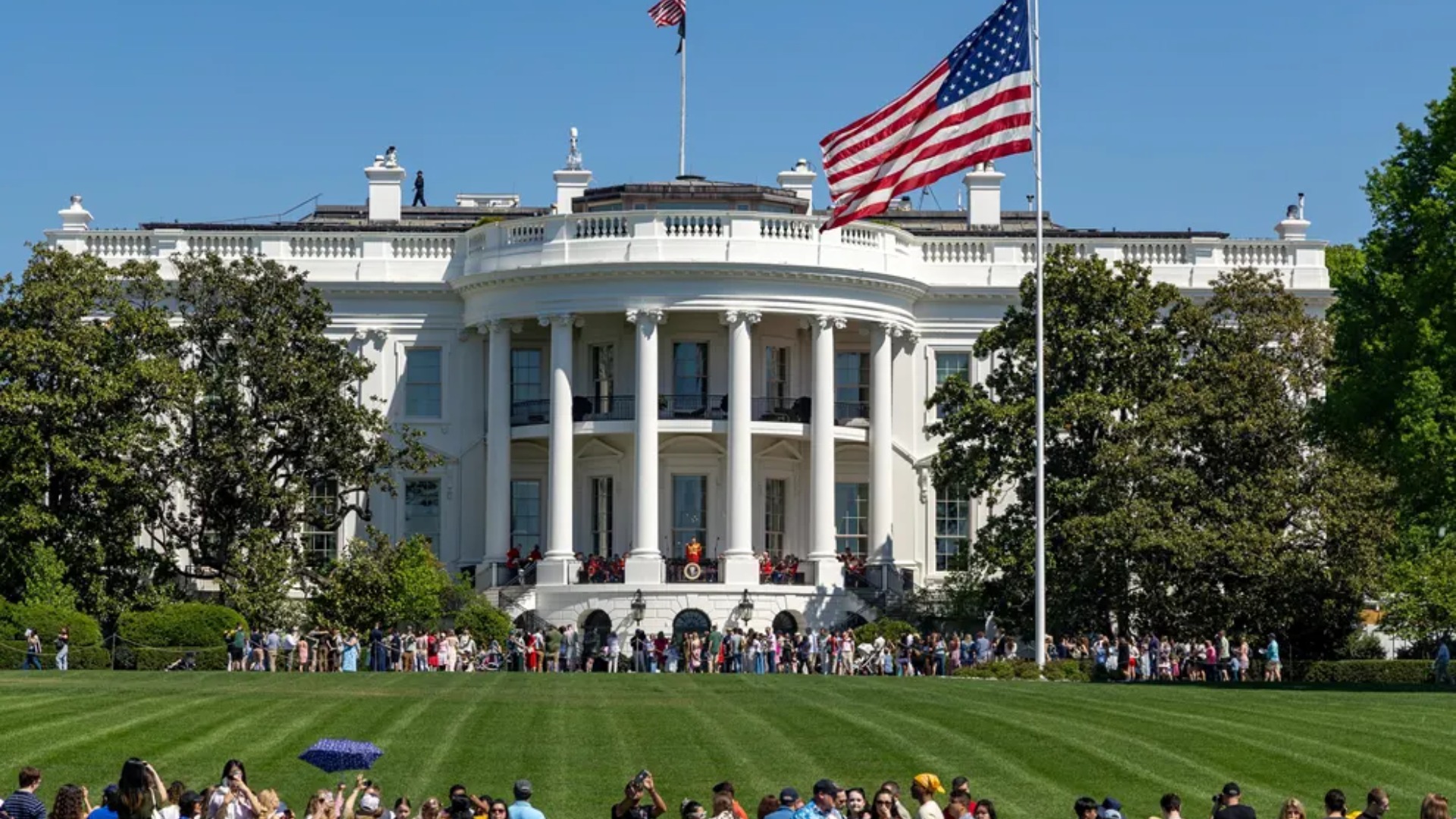
On 18 September 2026, President Trump announced on Truth Social that CNN, MS NOW and Politico were banned from the White House “effective immediately” for what he called reporting “FICTION and LIES.” The next morning the White House enforced the order, disabling an MS NOW correspondent’s press badge at the gate. The administration frames the ban as a response to hostile coverage; the outlets call it unconstitutional viewpoint discrimination. Defence analysts note that the White House media ban arrived three days after the Pentagon’s watchdog confirmed war-driven munitions shortfalls.
“I am proud to announce that, effective immediately, I am banning Fake News CNN, MSNOW…and Politico…from the White House,” the president wrote, adding that “Other Fake News Media Outlets to follow.” Asked later in the Oval Office what had prompted the decision, he said it was “really just cumulative stories over the last two years” and that the outlets “purposely write negative news.” He went on to name The New York Times and The Washington Post as fellow producers of what he calls fake news.
Enforcement followed within hours. MS NOW correspondent Akayla Gardner reported on 19 September that her badge was disabled at a White House entrance and that the officer at the gate told her the reason was “above him.” The network said it would take “any and all steps necessary” to defend its First Amendment rights. CNN called the ban an “illegal assault” on press freedom. Politico said it would “vigorously defend” its rights, and the White House Correspondents’ Association said it “stands in defense” of journalists singled out for doing their jobs.
The simplest reading of the episode is political, not strategic. The president’s approval ratings sit at record lows, his party risks losing Congress in November’s midterm elections, and this administration has spent two years pressuring unfavourable outlets through litigation against The New York Times, The Wall Street Journal and the BBC, through a licence fight with ABC, and through the regulatory review surrounding the Paramount–Warner Bros. Discovery merger, whose foreign-financing approval landed at the Federal Communications Commission in the same week as the ban. Nothing in the public record requires a military explanation for the timing.
Yet the only national security rationale anyone in the administration has offered came from Defence Secretary Pete Hegseth, who backed the ban and accused the outlets of having “endangered troops” with unspecified stories. That phrase deserves to be read against what those outlets were actually reporting.
What the White House media ban calls “endangering troops”
For months, American news organisations have documented that the war against Iran has consumed between one-half and two-thirds of US stocks of key missile-defence interceptors, exhausted most of the Army’s long-range strike missiles, and drained nearly half the global Tomahawk inventory. On 15 September 2026, the Defense Department inspector general confirmed “strategic inventory shortfalls” — after the administration had spent months denying the reporting.
On 29 July, CNN reported estimates from the Center for Strategic and International Studies that fewer than 827 Patriot interceptors and fewer than 278 THAAD (Terminal High Altitude Area Defense) interceptors remained in American stockpiles, against a pre-war Patriot inventory of roughly 2,200. On 4 August, Defense News reported that the Army had used “virtually all” of its ATACMS (Army Tactical Missile System) and PrSM (Precision Strike Missile) stocks, and a little under half the global supply of Tomahawk cruise missiles.
The administration’s response to that reporting was combative. Trump insisted the United States had “far more munitions than anyone in the world” and, at other moments, a “virtually unlimited” supply. The Pentagon said claims of munitions shortages were “false” and “only embolden enemies to attack American troops.” Hegseth publicly denied depletion reports roughly a month before his own inspector general confirmed them.
Then came the middle of September. On 13 September, CBS News published a detailed examination of the arsenal strain, quoting CSIS analyst Mark Cancian’s estimate that munitions already fired against Iran were worth around $25 billion. On 15 September, two official reports landed within hours of each other. The inspector general’s first congressionally mandated accounting of the war put its cost at $33.4 billion through 29 June, of which $22.3 billion was expended munitions, and stated plainly that the expenditure had “resulted in strategic inventory shortfalls and revealed industrial base bottlenecks for munitions resupply.” The Congressional Budget Office, in a parallel analysis, estimated the campaign had consumed between one-half and two-thirds of the combined US inventory of Patriot, THAAD, SM-3 and SM-6 interceptors, and that rebuilding those stocks would take at least five years even if production rates increase.
On 18 September, the president announced the White House media ban. On 19 September, badges began to fail at the gates.
The evidence linking the White House media ban to munitions reporting is circumstantial, and the White House has not cited any specific story. What is documented is the sequence — months of shortage reporting that the administration publicly attacked, an official confirmation of those shortages on 15 September, and a media expulsion justified partly on the grounds that reporting had “endangered troops” on 18 September — and the administration’s demonstrated hostility to coverage that contradicts its war narrative. Two readings are possible. The conventional reading treats the ban as domestic politics: an unpopular president, sinking approvals and a midterm campaign in which hostile media make a useful enemy. The second reading treats it as wartime information containment: an attempt to discipline the reporting of burn rates, readiness and industrial capacity while a war is running. The first requires no speculation. The second fits the Hegseth rationale and the calendar, and would be strengthened if the banned outlets’ future access were tied to specific national security coverage instead of general editorial lines. We present the timing without asserting the motive.
The order book against the factory clock
America’s defence primes hold record order books, but the binding constraint on replenishment is time, not money. Lockheed Martin produces about 750 Patriot interceptors a year against the roughly 1,500 the war has fired; the company plans to reach 2,000 a year, yet a single missile takes about six weeks to assemble while its roughly 4,000 parts take about two years to manufacture.
That asymmetry is the market’s real story. According to the Congressional Budget Office, a Patriot or SM-6 interceptor costs roughly $4 million, a THAAD interceptor about $12 million and an SM-3 about $28 million — which is why interceptors accounted for $13.1 billion of the $21.7 billion in expended munitions the agency says would be needed to replace. Raytheon, a unit of RTX, has reached a tentative multi-year agreement with the Pentagon to boost Tomahawk production alongside other munitions. Lockheed Martin’s missile chief, Tim Cahill, describes the supply chain in one line: 500 to 1,000 suppliers, single-source dependence, and a joke inside the factory — “How many parts does it take to build a missile? All of them.”
The industrial strain extends beyond missiles. The inspector general’s report records four F-15 fighters destroyed, one F-35 damaged, seven KC-135 tanker aircraft damaged and up to 30 MQ-9 Reaper drones lost, alongside a THAAD radar destroyed by Iranian fire. The same report identifies solid rocket motors, high-grade explosives and propellants, and skilled manufacturing labour as the most persistent bottlenecks. Defence Secretary Hegseth has urged industry onto what he calls a “wartime footing,” and the president has claimed defence executives agreed to “quadruple production” of high-end weaponry.
For investors, the takeaway is precise. Enough munitions exist for the war the United States is fighting; the scarcity is in the war it might have to fight elsewhere. Cancian’s assessment to CBS was blunt: “For a war against Iran, the answer is yes. The problem is a war against China.” Rebuilding to pre-war levels takes one to five years per munition, by CSIS estimates. That makes multi-year procurement awards, plant capacity announcements and the production disclosures in the coming quarter’s earnings calls from Lockheed Martin and RTX the most important numbers in this space — not the headline order backlog, which was never the constraint.
The view from New Delhi
For New Delhi, the week’s separate headlines converge into one lesson: Washington is now an information-opaque, tariff-armed and capacity-constrained partner. The chain runs through the war, not the calendar — the same conflict that emptied American interceptors also re-routed India’s oil towards Russia, and that dependence is what now exposes India to tariffs of up to 100 per cent.
An administration that decides who may observe its war — and disables badges of those who document its shortfalls.
A new law authorising 100 per cent duties on imports from the largest buyers of Russian oil — India took 37 per cent of Russia’s crude exports.
A defence industrial base whose own watchdog says it needs years and “significant lead time” to surge munitions production.
None of these requires the others to be coordinated. Together, they describe the same condition, and a government that plans in decades rather than news cycles has to price all three into the relationship.
The tariff leg of that triangle is the most immediate. The Iran war disrupted Middle East supply through the Gulf, and India replaced those barrels largely with Russian crude; by Kpler’s count, Russian oil supplied more than half of India’s crude purchases in June and July, and S&P Global put India’s August imports at about 1.6 million barrels a day. The Lindsey O. Graham Sanctioning Russia and Iran Act of 2026, signed on 18 September, now requires the president to impose duties of up to 100 per cent on imports from the five largest buyers of Russian crude oil and natural gas — and by the Centre for Research on Energy and Clean Air’s count, China took half of Russia’s crude exports in August and India 37 per cent. New Delhi has warned that the law carries implications for the bilateral relationship and for its energy security, saying it remains “firmly committed to ensuring energy security for its 1.4 billion people.” A trade deal with Washington is still unfinished, and the discretion built into the new law means the tariff threat will hang over that negotiation for years.
The capacity leg is the quietest and the most consequential. A defence industrial base that the Pentagon’s inspector general says needs “significant lead time” to expand — with interceptors rationed over five-year rebuild timelines — is precisely the scenario India’s Positive Indigenisation Lists were written for. The lists prioritise domestic production of precision-guided munitions, artillery shells and loitering munitions, and the companies positioned in that lane include Bharat Dynamics Limited, Munitions India Limited, Solar Industries and Larsen & Toubro. When the United States cannot surge its own production, its allies queue — the inspector general’s findings have already raised concern in Kyiv and Taipei. India, which has watched its private-sector missile manufacturing base mature over the past decade, and whose shipbuilding and naval industrial capacity follows the same logic, has little reason to assume it would stand at the front of that queue.
Strategic autonomy, in other words, is no longer a slogan. It is the rational response to a partner who controls what you can see, taxes what you must buy, and cannot deliver what you might need.
What happens next
Litigation over the White House media ban is near-certain, and enforcement has made the dispute ripe for the courts. The legal benchmark is the 1977 Sherrill v. Knight precedent, under which the White House cannot deny press access based on the content of coverage. Market participants, meanwhile, should watch the munitions production disclosures in the defence primes’ coming earnings calls.
Under the 1977 Sherrill v. Knight precedent, a federal appeals court held that once the White House establishes press facilities, it cannot deny access based on the content of a journalist’s coverage. The terrain is nonetheless contested: when the Associated Press was barred last year over the Gulf of America naming dispute, District Judge Trevor McFadden ruled for the wire service, but a DC Circuit panel reversed that order 2–1 on presidential-prerogative grounds while preserving access to larger spaces such as the East Room. That case may yet reach the Supreme Court, and it will shape whatever CNN, MS NOW and Politico now file over the White House media ban.
Five things to watch. First, the first filings from the banned outlets and whether a court grants interim relief. Second, whether The New York Times or The Washington Post actually lose access, as the president threatened. Third, the composition of the presidential press pool, which the White House has already rebuilt once this month. Fourth, the production and capacity numbers in Lockheed Martin’s and RTX’s third-quarter earnings calls. Fifth, the 30-day clock under the new sanctions law, which forces a tariff decision on Russian oil buyers close to the midterm elections on 3 November.
The courts will decide whether a president can choose who covers him. Defence ministries and investors will draw their own conclusion from the arithmetic that no court can overturn: the world’s most expensive missiles were fired faster than the world’s largest defence industry could replace them, and the reporting that documented this is the reporting now locked outside the gates. Managing the narrative does not change the numbers.
Reporting on the White House media ban and the Iran war in this article is drawn from named public sources, linked inline at first mention: the Congressional Budget Office and Defense Department inspector general analyses released on 15 September 2026; reporting by CNN, Defense News, CBS News, Reuters, AFP and MS NOW; and public statements by the White House, the named networks and the Government of India. Passages labelled “TES Analytical Assessment” represent editorial inference and reasoned judgement, not reported fact. Internal links point to prior TES coverage; verify slugs against the live sitemap before publishing.
This article references publicly listed companies, including Lockheed Martin and RTX, solely for informational and analytical purposes. Nothing here constitutes investment advice, a recommendation, or a solicitation to buy or sell any security. Readers should consult a qualified financial advisor before acting on any information in this article.

1 thought on “White House Media Ban: Why It Landed 3 Days After the Pentagon Confirmed Missile Shortfalls”