
The Ministry of Defence’s missile technology transfer decision is being reported as a single exclusion. It is actually two structurally different exclusions — one rooted in nuclear doctrine, the other in foreign joint-venture contract law — and that distinction says more about India’s defence-industrial future than the headline does.
When Defence Minister Rajnath Singh approved a landmark missile technology transfer policy handing DRDO’s conventional missile systems to private industry on , nearly every outlet ran the same framing: the Agni family, the K-series, and BrahMos stay out. Coverage from Business Standard, The Week, and IDRW treated it as one exclusion with one logic: strategic systems are sensitive, so they stay state-controlled.
That framing collapses two entirely different constraints into a single sentence. Read what defence officials actually told reporters, and the pattern splits cleanly in two.
The Doctrine Wall: Why Missile Technology Transfer Stops at Agni
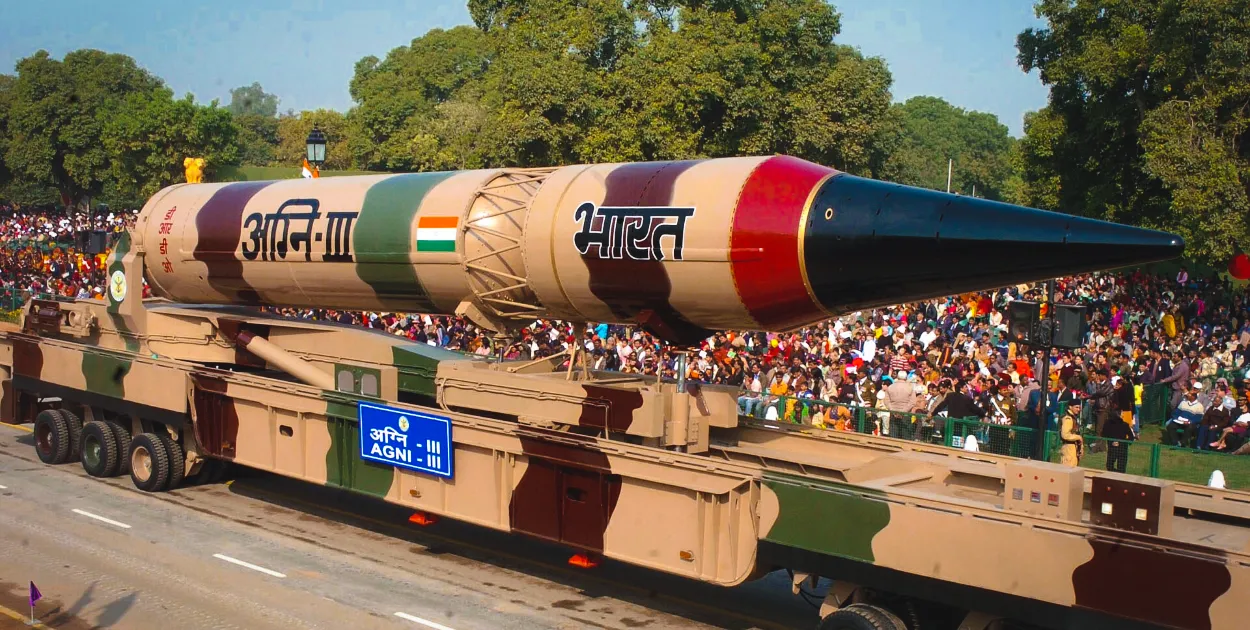
Agni and the K-series are excluded because of what they are, not who built them. Both are fully indigenous DRDO programmes — there is no foreign partner, no IP dispute, no contractual obstacle standing between DRDO and a private production line. If exclusion under this policy were purely about legal ownership, these two families would be the easiest candidates for transfer, not the hardest.
They are excluded instead because of custodianship. Agni anchors India’s land-based nuclear deterrent; the K-series gives India its submarine-launched second-strike leg. Both sit inside the architecture the Nuclear Command Authority relies on for assured retaliation — a doctrine that depends on centralised, unbroken control over warheads, delivery systems, and the custody chain connecting them. As officials told Bharat Shakti, strategic missiles “remain outside the scope of the decision and will continue to be handled separately.” This is a sovereignty decision, not a confidentiality one.
The Contract Wall: BrahMos and MRSAM
BrahMos and MRSAM are excluded for a completely unrelated reason, and officials have been explicit about it: foreign partnership. BrahMos is a joint venture between DRDO and Russia’s NPO Mashinostroyenia; MRSAM is co-developed with Israel. In both cases, India does not hold unilateral rights to the underlying technology — it holds rights shared with, and constrained by, a foreign government partner.
As The Week quoted officials directly, Agni and the K-series sit outside this transfer because they are handled separately, while “BrahMos and MRSAM involve foreign partners and are governed by separate arrangements.”
This is a contract-law wall, not a doctrine wall — and unlike the Agni/K-series wall, it is a wall that can, in principle, move, if joint-venture terms change or a fully indigenised successor emerges.
Why the Distinction Matters
Conflating these two exclusions obscures the more interesting question: which is permanent, and which is contingent?
The Agni/K-series wall is not going anywhere. No plausible reform of India’s defence-industrial policy moves nuclear-capable delivery systems into private hands, because the constraint is not about industrial capacity — it is about the fundamental design of the deterrent.
The BrahMos/MRSAM wall is different in kind. It is a function of current IP ownership, not what the missile does. India’s continuing push to indigenise more of the BrahMos production chain — including work toward BrahMos-II — points toward a future where an indigenised successor could plausibly enter the same transfer pipeline that Pralay and Rudram just entered. That is not declared policy, but it is a structurally different possibility than anything involving Agni.
The US Comparison Cuts Against the “India Is Cautious” Reading
It is tempting to read the Agni/K-series exclusion as evidence of an unusually conservative Indian defence-industrial posture. The comparative picture does not support that as cleanly as it seems.
The United States — the world’s most privatised defence-industrial base — has private contractors holding prime integration responsibility for its actual strategic deterrent. Northrop Grumman is the prime contractor building the LGM-35A Sentinel ICBM that will replace Minuteman III, and is also the prime contractor sustaining Minuteman III today. Private industry doesn’t just supply components for America’s land-based nuclear force — it holds the prime contracts for it.
France sits in between: strategic-deterrent components such as the ASMPA air-launched missile and the M51 submarine-launched ballistic missile run through ArianeGroup, a private joint venture of Airbus and Safran — private-sector-adjacent, but under intense state oversight and security-clearance regimes built over six decades.
Against that backdrop, India’s model — DRDO develops, a state integrator handles final assembly of strategic systems, and private industry is confined to conventional and tactical missiles — looks less like doctrinal caution about nuclear weapons specifically, and more like a private defence-industrial base that has not yet built the security-clearance depth or systems-integration track record that the US and France took decades to establish before extending strategic-system access.
BDL: The Non-Story Hiding in Plain Sight
The other angle nearly every outlet missed: what does this actually do to Bharat Dynamics Limited (BDL), the state-run integrator that has been India’s default missile production agency for over fifty years?
Less than the market initially priced in. When reports of the broader private-entry push first surfaced in mid-July 2026, BDL stock dropped roughly 2.5–3% in a single session, falling toward ₹1,303–1,315, with the Nifty India Defence index dipping alongside it. That was the market’s first, reflexive read: more competitors, less BDL.
That read did not hold up, and the 25 August announcement itself barely moved the stock further. Three reasons explain why:
- BDL’s highest-value franchise was untouched. BDL’s own reported business lines split into Missiles, Weapon Systems and Strategic Systems — and the segment carrying the deepest state trust and highest barriers to entry is exactly the segment this decision walled off. Private competition is arriving in conventional and tactical missiles, a real category, but not BDL’s most defensible one.
- The order book provides multi-year cover. BDL’s total orders stood at ₹26,176 crore as of 31 March 2026, up from ₹22,814 crore a year earlier, with roughly ₹15,000 crore in additional orders anticipated for the current financial year. A policy shift affecting future competitive bidding doesn’t retroactively touch an order book of that size.
- BDL remains the principal integrator, not just a competing manufacturer. It sits atop a distributed industrial network that private firms already feed into as component suppliers. The decision changes who can bid to become a development-cum-production partner on new conventional programmes; it doesn’t touch BDL’s existing integration role on the systems it already owns — including the ones now permanently off-limits to competitors.
By late August, BDL shares had recovered to the ₹1,340–1,368 range, up roughly 5.9% over the preceding six months — suggesting the market had already absorbed and largely discounted the competitive threat by the time the formal announcement landed. The stock’s July reaction was the real event; 25 August was confirmation, not news, as far as BDL’s valuation was concerned.
The Open Question
Officials have floated conventional technology transfer as a possible first step toward building industrial capacity that “could one day support more sensitive production,” while simultaneously insisting this is inference, not policy, according to reporting from SSBCrack. That tension is worth sitting with rather than resolving prematurely.
If the Development-cum-Production Partner model succeeds on Pralay, Rudram and Nag — if private firms build the track record, scale and security-clearance depth over the coming years — the pressure will not be to hand Agni to a private consortium. It will be more incremental: private firms supplying deeper subsystems into strategic programmes, mirroring how the model itself has evolved from component supply toward production rights. The Agni/K-series wall is built to hold. The BrahMos/MRSAM wall is built to move, if the underlying joint-venture arrangements ever do. Conflating the two, as most coverage has, obscures which one is actually worth watching.

2 thoughts on “Missile Technology Transfer: Why Agni, K-Series and BrahMos Stay Out”