
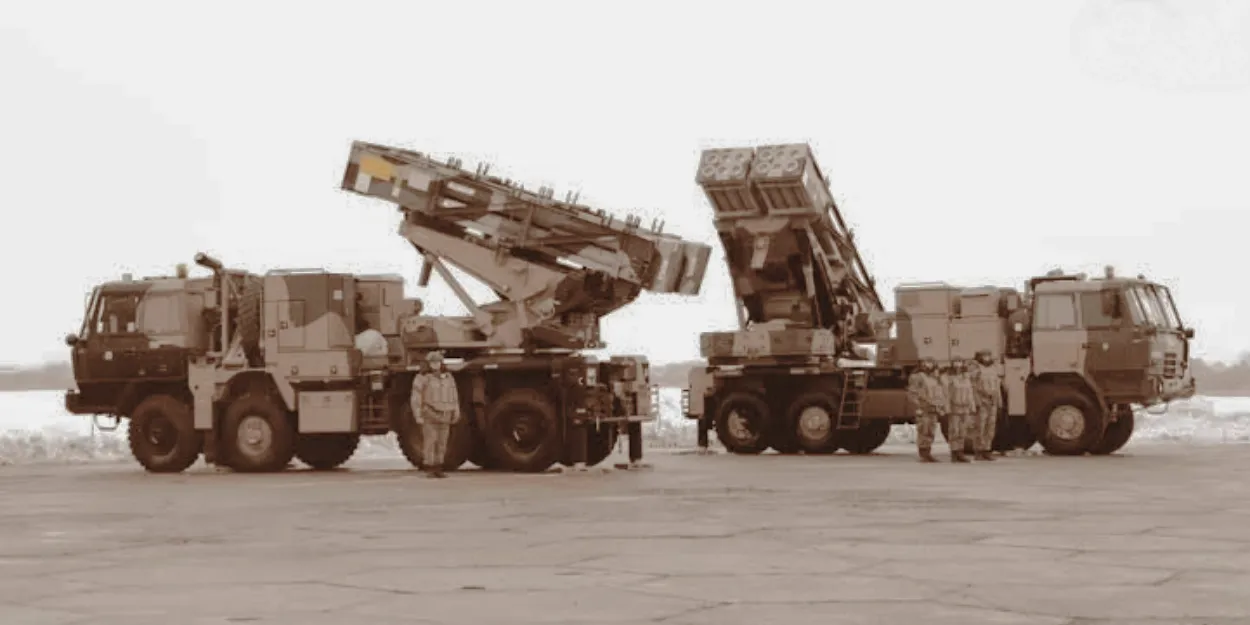
In November 2022, an Indian artillery system that had never been bought by India’s own army rolled off a production line in Pune, bound for a country India shares no border, no historical alliance, and barely any trade with. Four years later, that same country — Armenia, population three million — has become the single most instructive customer India’s defence industry has ever had.
Not the largest. Not the richest. But the most instructive, because Armenia has done for Indian arms exports what small, urgent buyers have always done for fledgling defence industries: taken the risk that larger, more cautious militaries would not.
When West Germany’s Bundeswehr adopted the Israeli-made Uzi submachine gun as its standard-issue MP2 in 1959, the deal was neither large nor especially profitable. But it told every subsequent buyer that a NATO army had tested and trusted a weapon from a state barely a decade old. Armenia has played a similar role for New Delhi — as the first export customer for the Akash-1S air defence system, and the debut customer for Bharat Forge’s MArG 155mm self-propelled howitzer. Defence Secretary Rajesh Kumar Singh’s two-day visit to Yerevan on 17–18 August 2026, which produced a new Memorandum of Understanding on defence research, innovation and shared production, marks the point where that relationship stops being a series of one-off export wins and starts looking like an industrial partnership.
Why Armenia Matters More Than Its Size Suggests
The Core Answer: Armenia is the first or debut foreign customer for at least three major Indian-origin systems — Akash-1S, the MArG 155mm self-propelled howitzer, and India’s Zen Anti-Drone System export line — making it a live operational testbed that de-risks these platforms for larger, more conservative buyers evaluating them today.
Export-driven industries rarely get their first validation from their biggest eventual customer. Big militaries wait; small, threatened ones cannot afford to. Armenia’s near-continuous confrontation with Azerbaijan since the 2020 Nagorno-Karabakh war, and the retreat of Russian security guarantees as Moscow’s Collective Security Treaty Organisation stepped back from the region, left Yerevan needing combat-relevant hardware faster than traditional suppliers — Russia, tied down in Ukraine, and Western manufacturers, wary of the politics — could deliver.
India filled that gap. And because Armenia used what it bought, in a live threat environment, the equipment generated something no brochure or trade-show demonstration can: an operational record.
India-Armenia defence Order Book: Five Platforms in Four Years
The Core Answer: Since 2020, Armenia has placed cumulative Indian defence orders reportedly approaching $2 billion, spanning Swathi weapon-locating radars, Pinaka rocket artillery, Akash-1S air defence, ATAGS/MArG howitzers, and Zen Technologies’ counter-drone systems — the broadest single-country export basket in India’s modern defence-export history.
The sequence is worth setting out plainly, because procurement history is where capability claims get tested against what a buyer actually paid for and received:
- March 2020: Four Swathi weapon-locating radars, supplied by Bharat Electronics Limited, in a contract reported at roughly $40 million — the opening transaction.
- September 2022: A $245 million contract for Pinaka multi-barrel rocket launchers, anti-tank rockets and ammunition — India’s first-ever Pinaka export.
- November 2022: Bharat Forge’s Kalyani Strategic Systems confirmed an export order, later reported at $155 million, for MArG 155mm/39-calibre wheeled self-propelled howitzers and ATAGS towed guns — Armenia’s role as the debut MArG customer, ahead of the Indian Army’s own induction decision.
- 2022: A $720 million order for 15 Akash-1S surface-to-air missile systems from Bharat Dynamics Limited — the first export customer for the platform anywhere in the world.
- November 2023: A roughly $41.5 million contract with Hyderabad-based Zen Technologies for its Anti-Drone System (ZADS), covering both hardware and training.
Indian government estimates and independent Armenian reporting have put the cumulative total at close to $2 billion — an estimate, not an audited figure, but one that multiple sources on both sides converge around. What is not in dispute is the trajectory: Armenia moved from radar customer to air-defence, artillery and counter-drone customer inside three years, and the pace has not slowed.
What Armenia Actually Operates — and Why
The Core Answer: Each Indian system Armenia has bought answers a specific gap exposed by Azerbaijan’s Turkish-supplied drone arsenal — long-range fires to offset numerical disadvantage, layered air defence against low-altitude threats, and dedicated counter-drone capability against the Bayraktar TB2 and Akinci systems that shaped the outcome of the 2020 war.
Mission logic matters more than brand names here.
Pinaka gives Armenia mobile, shoot-and-scoot long-range rocket artillery — a system built to be hard to locate and destroy before it fires, which matters against an opponent with persistent drone surveillance.
Akash-1S is a medium-range surface-to-air system with an indigenous active seeker, designed to engage fighters, cruise missiles and drones out to roughly 30 kilometres. Its relevance to Armenia is direct: the 2020 war was decided as much by Azerbaijani air dominance as by ground manoeuvre, and Akash-1S is a partial answer to that specific failure.
MArG and ATAGS put 155mm firepower on a wheeled, high-mobility chassis capable of negotiating 30-degree gradients — a specification that reads like it was written for the Caucasus’s mountainous terrain, because in practice, it largely was.
Zen’s ZADS is narrower and more pointed still: a multi-layer detection, jamming and hard-kill system built specifically against the kamikaze and surveillance drones that inflicted disproportionate Armenian losses in 2020. Armenian units have reportedly displayed Pinaka, ATAGS and Akash-1S publicly at Yerevan’s 2026 military parades — a signal, as much as a capability.
Taken together, these are not scattered purchases. They form a coherent counter-drone, counter-air, long-range-fires package aimed squarely at the specific way Armenia lost the last war.
From Vendor to Co-Developer: What the August 2026 Visit Actually Changed
The Core Answer: The MoU signed on 17 August 2026 shifts the relationship from arms sales toward joint research, innovation and shared production — a structural change that, if implemented, would embed Indian defence-industrial processes inside Armenia rather than simply shipping finished hardware to it.
Singh’s engagements in Yerevan were narrower and more concrete than a corridor narrative alone would suggest. He met Armenian Defence Minister Suren Papikyan and Minister of High-Tech Industry Davit Tadevosyan, where the two sides signed an MoU on cooperation in research, development, innovation and shared production in the defence industry — India’s Ministry of Defence described it as reaffirming a commitment to “deepening and elevating” the bilateral partnership. Singh also called on Chief of the General Staff Lieutenant General Edvard Asryan and visited Armenia’s Military Academy, where he reviewed an IT laboratory established with Indian support.
None of this has yet been formalised into a standing bilateral staff-talks mechanism of the kind India runs with Japan, France or Israel. Whether that follows is a reasonable question to ask, not a fact to assert; TES will treat any such institutionalisation as a story in its own right once it is confirmed rather than assumed.
What is confirmed is more modest but still significant: this is the language of technology co-development, not procurement. If shared production materialises, Armenia would move from operator to minor manufacturing partner — a status very few of India’s defence-export customers currently hold.
Regional Military Balance: Countering a Turkish-Azerbaijani Drone Advantage
The Core Answer: India’s exports have narrowed, though not closed, the air and drone-warfare gap that Turkish-supplied Bayraktar TB2 and Akinci systems opened for Azerbaijan in 2020, while indirectly countering the wider Turkey-Azerbaijan-Pakistan alignment that has consistently sided against both Armenia and India diplomatically.
The geopolitical logic runs through South Asia as much as the South Caucasus. Azerbaijan has repeatedly backed Pakistan’s position on Kashmir at multilateral forums; Turkey has supplied Baku with combat training and its signature armed drones. India’s counter is not symmetrical — it cannot match Turkish drone volumes — but it is targeted: air defence and counter-drone systems built to blunt the specific instrument that gave Azerbaijan its edge.
The obvious rejoinder is that Baku and Ankara can adapt — saturating Armenian air defences with larger drone swarms, or diversifying loitering-munition tactics to stress Akash-1S engagement rates. That is a reasonable expectation, not a prediction; it is the kind of countermeasure any capable adversary would explore, and it is the reason systems like ZADS were bought as a layer, not a substitute, alongside Akash-1S.
The Industrial Ecosystem at Home
The Core Answer: Sustained Armenian orders have functioned as revenue and validation streams for Bharat Dynamics, Bharat Electronics, Bharat Forge’s Kalyani Strategic Systems, Solar Industries (via Pinaka), and Zen Technologies — turning a single small overseas client into a recurring order book across five separate listed and unlisted Indian defence manufacturers.
For BDL and BEL, Akash-1S’s first export sale created an international operational reference that Indian officials have since used to court other prospective buyers, including reported interest from Brazil in co-production talks. For Bharat Forge, MArG’s Armenian order arrived before the Indian Army had placed its own — an unusual sequence that gave Kalyani Strategic Systems a foreign combat-relevant validation case ahead of domestic induction. For Zen Technologies, the Armenian contract preceded larger Indian Army counter-drone orders and helped justify the company’s decision to open a branch office in Yerevan in October 2023.
The Armenian order book sits inside a much larger export story. India’s overall defence exports hit a record ₹38,424 crore in FY26, up 62.66 percent over FY25’s ₹23,622 crore — a jump driven disproportionately by state-run Defence Public Sector Undertakings, whose exports surged 151 percent as BDL, BEL and their peers scaled up overseas order execution; private-sector exports grew a comparatively modest 14 percent over the same period. Institutional investors have taken notice. Jefferies has repeatedly cited rising exports as a structural driver behind its constructive stance on Bharat Electronics and Hindustan Aeronautics, and revised price targets upward across its defence and power-equipment basket as recently as 18 August 2026. Motilal Oswal has stayed “Buy” on BEL, HAL, Bharat Dynamics, Astra Microwave and Zen Technologies through 2026, pointing to record Defence Acquisition Council approvals — roughly ₹3.3 trillion sanctioned in FY26 alone — as evidence the order pipeline is not a one-off. Nomura and CLSA have taken broadly similar positions on select names in the sector.
Armenia is a small line in that ledger by value. But it is one of the few lines with a multi-year, repeat-purchase, combat-tested track record behind it — precisely the kind of evidence that turns an export spike into an export thesis for analysts deciding whether to stay overweight the sector.
What This Means for India’s Broader Export Strategy
Armenia is now being used, explicitly, as a reference case to court other buyers. Reported briefings to prospective clients on the more advanced Akash-NG have followed Armenian operators’ own requests for an upgrade path, and Yerevan is reportedly in discussions with India on Pralay tactical ballistic missiles and Su-30 fighter upgrades — a level of engagement that treats Armenia as a graduating client rather than a one-time buyer. New Delhi has set a defence-export target of ₹50,000 crore (roughly $5–6 billion) by FY 2029-30; for that goal, a small, combat-tested, publicly satisfied customer is worth more in credibility terms than its contract value alone suggests.
What to Watch
Will the R&D MoU produce an actual shared-production line, or remain a framework document? MoUs of this kind can sit unimplemented for years; the test will be whether a specific co-production project is announced within the next 12–18 months.
Does the Pralay discussion advance to a contract? A tactical ballistic missile sale would represent a significant escalation in system sophistication compared to everything Armenia has bought to date, and would likely draw sharper Azerbaijani and Turkish objections than the artillery and air-defence deals have.
Does Akash-1S’s Armenian combat record translate into fresh export contracts? Reported interest from multiple countries in Akash-NG is the clearest signal yet that Yerevan’s experience is functioning as intended — as a reference sale.
The strategic value of the India-Armenia defence relationship was never only about weapons transfers. It also underwrites India’s access to the Iran-Armenia-Georgia leg of the International North-South Transport Corridor, a connection explored in TES’s earlier analysis of the Turkey-Pakistan-Azerbaijan alignment. But that corridor logic is a downstream benefit of a defence-industrial relationship, not its cause. The relationship exists because Armenia needed weapons that worked, and India needed a customer willing to prove that its weapons did.
Investment disclaimer: This article discusses publicly listed companies, brokerage price targets and sector ratings for editorial and informational purposes only. It does not constitute investment advice, a recommendation to buy or sell any security, or a solicitation of any kind. The Eastern Strategist is not a registered investment adviser. Brokerage views cited (Jefferies, Motilal Oswal, Nomura, CLSA) reflect those firms’ published research as reported at the time of writing and are subject to change without notice. Readers should conduct independent research and consult a licensed financial adviser before making investment decisions.
Source transparency: Visit dates, the MoU signing, and officials met are drawn from India’s Ministry of Defence statements (via PIB and ANI) and corroborated by multiple independent wire reports. Contract values for Swathi, Pinaka, Akash-1S, MArG/ATAGS and Zen Technologies are drawn from Indian and Armenian trade and defence press (Business Standard, Armenpress, Army Recognition, EurAsian Times) and should be read as reported estimates rather than officially confirmed figures, as neither government has published an audited consolidated total. FY26 export figures and the FY 2029-30 export target are drawn from Ministry of Defence statements reported via Business Standard and other outlets. Analyst positions from Jefferies, Motilal Oswal, Nomura and CLSA are drawn from contemporaneous market reporting current through August 2026 and are subject to revision as brokerages update coverage. Assessments of drone-warfare countermeasures, export-strategy implications, and the significance of the R&D MoU are TES editorial analysis, not confirmed government positions.