
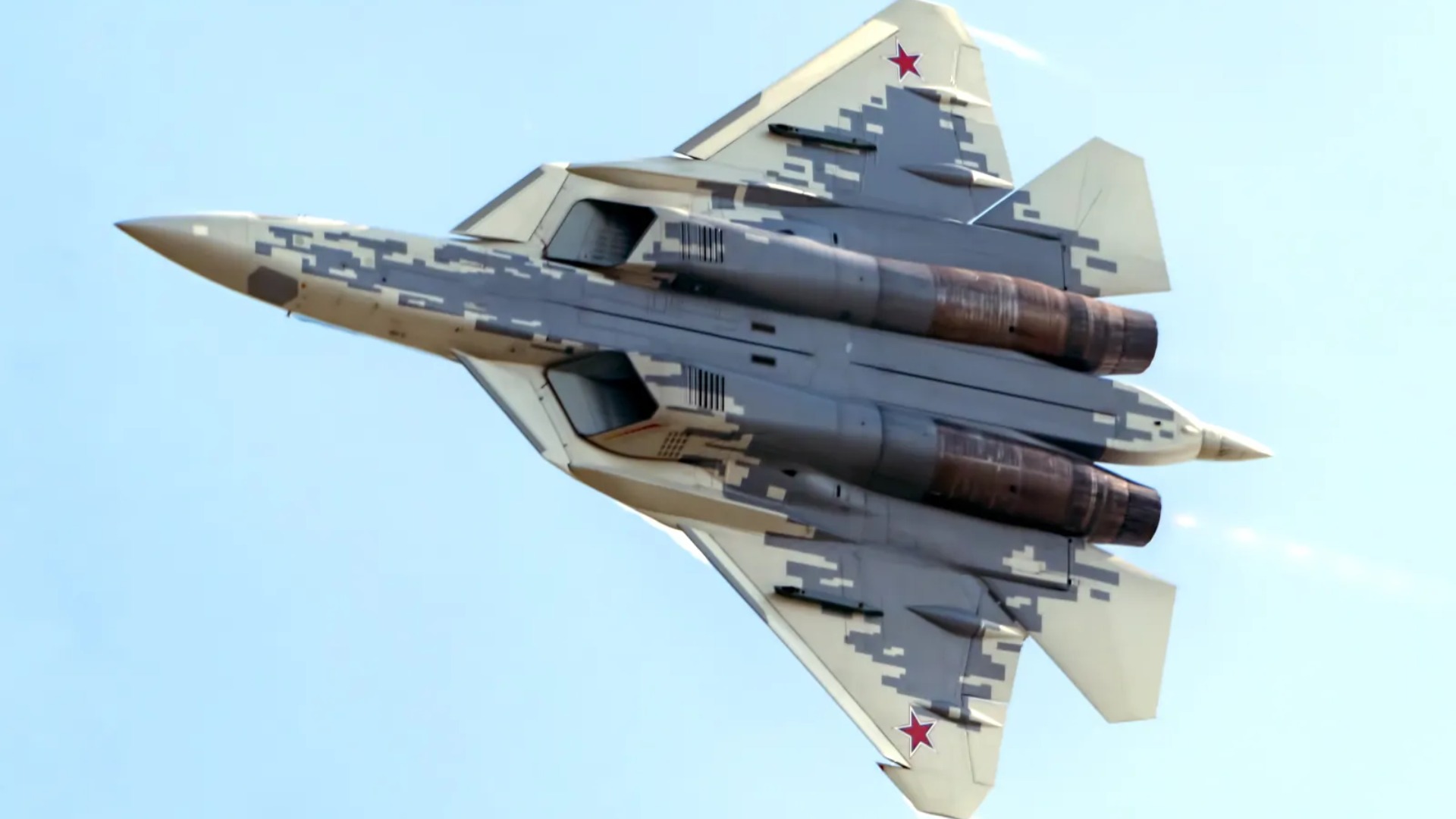
The renewed Su-57 India pitch orchestrated by the Kremlin ahead of the 2026 BRICS Summit in New Delhi is neither routine diplomatic choreography nor a conventional fighter sales drive. It represents an opportunistic strike at the most vulnerable intersection of Indian national security: a widening ten-year capability void in fifth-generation air power, exacerbated by the rapid expansion of China’s stealth fleet and mounting delays in domestic jet engine manufacturing.
For more than six years following New Delhi’s formal withdrawal from the contentious Fifth Generation Fighter Aircraft (FGFA) co-development initiative in 2018, Moscow’s premier stealth programme remained persona non grata in Vayu Bhavan. Today, that calculus is undergoing intense tactical reconsideration. With the Indian Air Force (IAF) operating at an alarming historic low of roughly 30 to 31 operational fighter squadrons against an authorised ceiling of 42, the strategic arithmetic has shifted decisively.
Moscow understands that India’s defence establishment is caught in a rigid timeline trap. The indigenous Advanced Medium Combat Aircraft (AMCA) is legally and financially backed by the Cabinet Committee on Security (CCS), yet operational squadron induction remains unrealistic before 2035. By coupling licensed domestic assembly with technology transfers, the latest Su-57 India pitch attempts to weaponise India’s immediate airspace anxiety to secure long-term industrial leverage over New Delhi.
The Moscow Playbook: What Powers the Su-57 India Pitch in New Delhi?
Speaking in a virtual briefing to Indian journalists from Moscow on 8 September 2026 to outline the Su-57 India pitch, Kremlin spokesperson Dmitry Peskov laid bare Russia’s strategic ambition. Addressing the high-level bilateral agenda, Peskov confirmed that selling fifth-generation Su-57 stealth fighters to India is high on Putin’s agenda during his visit to the Indian capital for the BRICS Summit.
Crucially, Peskov tackled the very grievance that collapsed the earlier FGFA venture: deep access to manufacturing technology. “Indian scientists want production technologies, and this is a question for additional discussions which are underway,” Peskov noted, acknowledging that while nations vigorously guard sovereign stealth data, Moscow’s strategic intimacy with New Delhi justifies negotiating full technical transfers. Behind closed doors, the strategic framework of the Su-57 India pitch extends far beyond an off-the-shelf platform procurement.
The broader bilateral defence slate supporting the Su-57 India pitch reflects high-stakes transactional interdependence:
- Air Defence Resupply: Resolving final delivery schedules for the remaining two squadrons of the S-400 Triumf surface-to-air missile system, disrupted by Russian domestic attrition in Ukraine, while floating introductory technical briefs for the hypersonic S-500 Prometheus.
- Precision Strike Enhancements: Expanding the joint venture parameters of BrahMos Aerospace to incorporate advanced active radar seekers, extended ranges exceeding 800 kilometres, and hypersonic ramjet integration.
- Sanctions-Insulated Clearing: Finalising bilateral payment channels to bypass Western financial choke points, as Russia seeks to deploy sovereign assets free from third-country interference.
- Personnel Repatriation: Completing the identification and formal discharge of Indian nationals recruited into combat support roles within the Russian military.
This coordinated push illustrates how Moscow is utilising the summit stage to present the Su-57 India pitch as the centerpiece of a unified, sanctions-resilient defence relationship.
Technical Reality Check: Su-57 Capabilities vs Structural Flaws
The Sukhoi Su-57, codenamed “Felon” by NATO, represents an unorthodox design philosophy that prioritises extreme kinematic performance and long-range engagement over pure passive all-aspect stealth. Developed by the Sukhoi Design Bureau under the PAK FA programme, the platform integrates several combat-tested technologies that differentiate it from Western competitors.
Its Sh121 multifunctional radar suite incorporates the N036 Byelka active electronically scanned array (AESA), supplemented by unique cheek-mounted X-band radar arrays and L-band transceiver arrays embedded in the wing leading edges. This radar architecture is specifically tailored for counter-stealth detection, designed to acquire low-observable aerial targets at medium-to-long ranges. Coupled with the 101KS Atoll electro-optical targeting system and internal carriage of the Vympel R-37M hypersonic air-to-air missile—boasting an operational range exceeding 300 kilometres—the Su-57 serves as a lethal air-dominance platform in contested airspace.
In operational deployment over Ukraine, the Russian Aerospace Forces (VKS) have utilised the Su-57 primarily in stand-off strike and long-range suppression roles, firing Kh-69 low-observable cruise missiles while remaining well behind hostile air defence envelopes. This operational conservatism highlights the central vulnerability underlying the Su-57 India pitch: its radar cross-section (RCS).
| Parameter | Sukhoi Su-57 “Felon” | Chengdu J-20A “Mighty Dragon” | Lockheed Martin F-35A |
|---|---|---|---|
| Estimated Radar Cross Section (RCS) | 0.1 to 1.0 m² (Frontal reduced, non-all-aspect) | ~0.01 to 0.05 m² (Frontal stealth optimised) | ~0.0001 m² (Broadband, all-aspect stealth) |
| Propulsion & Supercruise | Interim AL-41F1 (147 kN); Delayed AL-51F1 / Izdeliye 30 | WS-10C / WS-15 (Serial supercruise capable) | Pratt & Whitney F135 (191 kN, non-supercruise) |
| Sensor Suite | N036 Byelka AESA + Cheek arrays + 101KS IRST | Type 1475 AESA + EOTS-86 + EORD-31 distributed | AN/APG-81 AESA + AN/AAQ-37 DAS + EOTS |
| Operational Fleet Size | ~32 to 36 serial airframes in VKS service | 250+ active airframes across 12+ PLAAF brigades | 1,000+ airframes deployed globally |
Unlike the smooth serpentine intake ducts of the F-35 or F-22 that completely obscure engine fan blades from incident radar beams, the Su-57 features direct-path engine intakes equipped with coaxial radar blockers. Combined with conventional mechanical panel fasteners and exposed engine nozzles, Western and Indian aerospace analysts evaluate the Su-57’s frontal RCS at between 0.1 and 1.0 square metres. This performance profile aligns more closely with a “clean” fourth-generation-plus platform like the Dassault Rafale or Boeing F/A-18E Super Hornet than with true fifth-generation low-observable fighters.
Compounding the credibility of the Su-57 India pitch is the prolonged development cycle of the Saturn AL-51F1 (formerly Izdeliye 30) engine. While current production batches are beginning to transition from the interim AL-41F1, full-rate serial production remains constrained. Furthermore, strict international export controls have disrupted the import of specialised multi-axis CNC machine tools and mil-spec semiconductors, limiting the annual assembly throughput of the Komsomolsk-on-Amur Aircraft Plant (KnAAZ).
The 2030 Stealth Asymmetry: IAF’s Squadron Floor and the Two-Front Pincer
To understand why New Delhi cannot simply dismiss the Su-57 India pitch out of hand, one must examine the stark trajectory of India’s combat aviation force structure. The IAF is currently mandated to maintain 42 squadrons to ensure credible conventional deterrence against a coordinated two-front contingency involving China and Pakistan. Instead, operational strength has fallen to barely 31 squadrons.
The impending retirement cycle will accelerate this attrition. With the remaining MiG-21 Bison squadrons completing phased decommissioning, the IAF’s legacy fleets—including approximately 110 SEPECAT Jaguars, 50 Mirage 2000s, and 60 MiG-29s—will reach structural airframe fatigue limits between 2029 and 2035. As explored across our Strategic Analysis section, the rate of aircraft phase-outs is outstripping the induction rate of new capital assets.
Across the Line of Actual Control (LAC), China’s People’s Liberation Army Air Force (PLAAF) has permanently altered the regional air order. China has inducted more than 250 Chengdu J-20 stealth fighters into active service, deploying continuous rotations through high-altitude forward bases in Tibet and Xinjiang, including Hotan, Shigatse, and Kashgar. In an aerial clash over Ladakh, Chinese fifth-generation jets operating in forward air sweeps would leverage long-range PL-15 and PL-17 missiles to target Indian airborne early warning (AEW&C) platforms and air-to-air refuellers while remaining invisible to standard radar cross-sections.
Simultaneously, the Pakistan Air Force (PAF) has signaled intent to acquire the Shenyang J-31 / FC-31 “Gyrfalcon” stealth fighter from China. PAF Chief of Air Staff Zaheer Ahmed Baber Sidhu publicly confirmed structural procurement talks, outlining a trajectory that could operationalise stealth assets along India’s western frontier before 2030.
Against this emerging two-front stealth pincer, India’s domestic aerospace pipeline is struggling with delivery timelines. Deliveries of the 83 Tejas Light Combat Aircraft (LCA) Mk1A fighters are grappling with acute supply chain delays for GE Aerospace F404-IN20 turbofans. The ambitious 114 Multi-Role Fighter Aircraft (MRFA) acquisition project remains trapped in administrative evaluation. Meanwhile, the indigenous Advanced Medium Combat Aircraft (AMCA), greenlit by the CCS with an allocation of ₹15,000 crore in March 2024, targets its initial prototype flight around 2028–2029. Realistic serial production and operational squadron readiness cannot occur before 2034 to 2036.
This operational reality has intensified strategic deliberations around the Su-57 India pitch, as India’s fifth-generation fighter gap gives fresh life to Russia’s Su-57 pitch. Without an interim acquisition, the strategic dilemma amplified by the Su-57 India pitch will only intensify as the IAF faces a decade-long gap during which both regional adversaries deploy low-observable fifth-generation combat aircraft while India relies on upgraded fourth-generation platforms.
The Defence & Markets Crossover: HAL, Vostro Balances, and CAATSA Traps
Beyond military strategy, the strategic logic behind the Su-57 India pitch is deeply entwined with industrial capacity and sovereign currency mechanics. At the centre of the domestic industrial response to the Su-57 India pitch stands state-owned aerospace giant Hindustan Aeronautics Limited (HAL).
HAL’s dedicated manufacturing division at Ozar, Nashik, spent over two decades assembling the multirole Su-30MKI under Russian license. With the primary production run completed and current assembly lines transitioning toward minor attrition replacements, Nashik faces a looming structural gap before the full industrial rollout of the indigenous Tejas Mk2 and AMCA. Re-tooling the Nashik facility to execute the Su-57 India pitch through completely knocked-down (CKD) and semi-knocked-down (SKD) assembly would immediately inject long-term workload, stabilising revenues across HAL’s aerospace division.
However, this industrial salvation carries significant risk for domestic programmes:
- Engineering Cannibalisation: Committing HAL’s specialised tooling facilities, structural design engineers, and precision composites manufacturing floor to licensed Russian assembly risks starving the nascent AMCA industrial consortium of experienced aerospace personnel.
- Sub-Tier Industrial Disruption: Unlike indigenous platforms that funnel subcontracts to domestic avionics leaders like Bharat Electronics Limited (BEL) and private precision fabricators such as Dynamatic Technologies and Astra Microwave, a Russian licensed line would remain heavily dependent on Russian-sourced major assemblies.
- Sanctions Exposure: Under the Countering America’s Adversaries Through Sanctions Act (CAATSA), secondary US sanctions could target Indian financial entities handling defence disbursements for Russian arms, threatening critical Western commercial aerospace joint ventures operated by HAL and Tata Advanced Systems.
Simultaneously, the financial architecture driving Moscow’s overtures is anchored in the international oil trade. Following Western sanctions and price caps, India emerged as the largest seaborne buyer of discounted Russian Urals crude oil. Because bilateral trade heavily favours Moscow—with Russian exports running far ahead of Indian non-defence exports—Russia has accumulated an estimated ₹2.5 lakh crore to ₹3 lakh crore ($30 billion to $35 billion) in Indian rupees parked inside RBI-authorised Special Rupee Vostro Accounts (SRVA).
For the Kremlin, the Su-57 India pitch offers a direct macroeconomic solution; Russian financial planners cannot readily convert these rupee reserves into hard currency or repatriate them without triggering Western banking scrutiny or accepting steep currency depreciation. Direct defence capital expenditures—specifically high-value aerospace hardware, domestic joint venture equity, and long-term service contracts—represent one of the few avenues through which Moscow can liquidate its trapped rupee holdings into strategic sovereign assets.
Strategic Autonomy vs The AMCA Trap: What Happens Next?
Despite the diplomatic intensity surrounding the Su-57 India pitch, New Delhi’s strategic posture remains anchored in calculated deterrence and multi-alignment. Indian defence planners recognise that submitting to the Su-57 India pitch by purchasing an off-the-shelf foreign stealth platform would strike a devastating blow to the political and fiscal viability of the indigenous AMCA programme.
Rather than signing an agreement for the Su-57, India is pursuing a measured three-track strategy:
First, the Ministry of Defence will maintain technical dialogue regarding the Su-57 India pitch as an effective diplomatic bargaining chip. Visible engagement with Moscow applies continuous pressure on Western partners—specifically France, which is actively pitching additional Rafale tranches, and the United States, which continues to pace the critical transfer of jet engine manufacturing technologies under the bilateral Initiative on Critical and Emerging Technology (iCET).
Second, India’s immediate capital commitment will centre on the long-awaited Super Sukhoi modernisation programme. This ₹65,000-crore initiative will upgrade roughly 84 frontline Su-30MKIs with indigenous technology, including the indigenous Uttam active electronically scanned array radar, the Virupaksha electronic warfare suite, advanced indigenous mission computers, and long-range Astra Mk2 and Mk3 beyond-visual-range missiles. Upgrading existing airframes extends fourth-generation combat relevance into the late 2030s without diverting the massive capital outlays required to establish a new fifth-generation logistics pipeline.
Finally, Air Headquarters will focus its organisational energy on holding the Aeronautical Development Agency (ADA) and its industrial partners to the AMCA development schedule. As detailed in our Latest intelligence feeds and Strategic Intelligence reports, genuine strategic autonomy in aerospace cannot be purchased off foreign assembly lines. By keeping the Su-57 India pitch under formal technical review while accelerating domestic engine and stealth metallurgy, India is leveraging the Kremlin’s desperation without walking into its timeline trap.