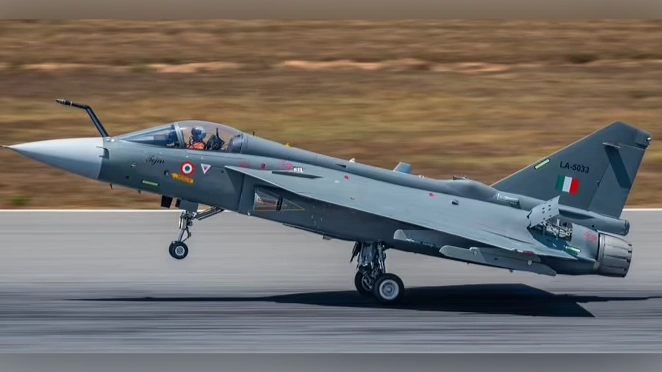
- On 18 September 2026, Hindustan Aeronautics Limited (HAL) will hand over the final two Tejas Mk-1 twin-seater trainer aircraft to the Indian Air Force (IAF), closing an order first placed in 2006.
- The same ceremony in Bengaluru delivers the first three production HTT-40 basic trainer aircraft and hands Dhruv Next Generation (NG) helicopters to Pawan Hans Limited (PHL) for civil use.
- The event falls in the same window as continued delays on HAL’s much larger, 180-aircraft Tejas Mk-1A programme, still bottlenecked by GE Aerospace’s F404-IN20 engine supply.
- HAL’s order book stood at ₹2,54,538 crore as of 31 March 2026, and Q1 FY27 profit rose nearly 15% year-on-year — brokerages have named delivery execution as the key driver for the stock.
Defence Minister Rajnath Singh and Civil Aviation Minister K. Rammohan Naidu will preside over a handover ceremony in Bengaluru on 18 September that, on paper, looks routine: a state-run manufacturer delivering aircraft it was contracted to build years ago. What makes the HAL Tejas trainer handover worth examining is less the ceremony itself than what it quietly closes, what it opens up, and what it conspicuously does not include — the delayed Tejas Mk-1A fighters that have drawn far more public attention than the trainers actually being delivered this week.
What the HAL Tejas Trainer Handover Actually Involves
According to a Ministry of Defence statement issued on 17 September 2026, Hindustan Aeronautics Limited will deliver Light Combat Aircraft (LCA) Tejas Final Operational Clearance (FOC) twin-seater trainers and HTT-40 basic trainer aircraft to the Indian Air Force, alongside Dhruv NG helicopters to Pawan Hans Limited, at a ceremony in Bengaluru, Karnataka. The ministry described the handover as a milestone in India’s self-reliance journey, or Atmanirbharta, and said it would highlight the role played by HAL and its industry partners in strengthening the domestic aerospace ecosystem.
Attendees are expected to include Chief of the Air Staff Air Chief Marshal A.P. Singh, Defence Production Secretary Sanjeev Kumar, Civil Aviation Secretary Samir Kumar Sinha and HAL Chairman and Managing Director Ravi K. Government statements of this kind are typically strong on ceremony and strategic framing, and considerably thinner on operational detail — how many aircraft, from which contract, and what happens to the larger programme sitting just behind these trainers. That detail, gathered from independent reporting rather than the official release, is where the actual story sits.
Closing a Two-Decade Chapter: The Tejas Mk-1 Order Behind the Ceremony
The two Tejas trainers being handed over are reported to be the final aircraft under HAL’s original 40-unit LCA Mk-1 order — split between 20 aircraft in Initial Operational Clearance configuration ordered in 2006 and 20 in Final Operational Clearance configuration ordered later — according to defence-aviation outlet SSBCrack. Their delivery formally closes a programme two decades in the making.
That closure matters mainly because of what replaces it. HAL’s production focus now shifts almost entirely to the Tejas Mk-1A, a 180-aircraft programme combining an 83-jet order placed in February 2021, worth roughly ₹48,000 crore, and a follow-on 97-jet order placed in September 2025. Unlike the Mk-1, which HAL built essentially in-house, Mk-1A deliveries hinge on a single foreign supplier: GE Aerospace’s F404-IN20 engine. According to The Week’s 4 September 2026 report, HAL had received only around ten of the 99 contracted engines by that point, more than two years behind the original schedule, and was targeting 22 by the end of the calendar year. ThePrint has reported that GE’s production line for the F404 had sat dormant for roughly five years before the 2021 order forced a restart, and that supply-chain disruption tied to the US-Israel-Iran conflict added further delay through 2025.
The contrast is really the story here: India is closing out a fighter-trainer order it built almost entirely on its own terms in the very week its higher-profile successor programme remains stalled on an American engine supply chain — a structural tension TES has previously examined in assessing the reality behind India’s ₹1.78 lakh crore defence production milestone. Self-reliance and import dependency are, at HAL, running on parallel tracks rather than converging.
HTT-40’s First Deliveries End a Decade-Long Wait
The ceremony’s first three HTT-40 basic trainers — two built in Bengaluru and one in Nashik — mark the opening delivery under a ₹6,800 crore contract for 70 aircraft that the IAF and HAL concluded in October 2022, following Cabinet Committee on Security clearance. The HTT-40 was designed to replace the HPT-32 Deepak, which was grounded in 2009 after a series of fatal accidents, as Mobility Outlook has detailed.
Development ran long even by the standards of Indian defence procurement: the HTT-40 first flew in 2016, and it has taken a further decade for full production deliveries to reach the IAF. The aircraft is powered by a Honeywell Garrett TPE331-12B turboprop engine — a reminder that even India’s most “indigenous” trainer designs still lean on an imported powerplant, albeit from a supplier with a considerably better delivery record than GE’s F404 line. HAL’s own FY27 guidance names accelerating HTT-40 output as a specific near-term priority, alongside ramping Tejas Mk-1A production toward more than 24 aircraft a year once engine supply stabilises.
Dhruv NG Moves Into Civil Aviation Through Pawan Hans
The Dhruv NG helicopter being handed to Pawan Hans Limited is the civil variant of HAL’s Advanced Light Helicopter Mk-III, a 5.5-tonne twin-engine platform powered by indigenous Shakti engines that received a restricted type certificate from the European Aviation Safety Agency in June 2023. The Ministry of Defence’s own statement does not name a specific contract behind this delivery, but it lines up closely with a ₹2,141 crore, ten-year agreement Pawan Hans signed with Oil and Natural Gas Corporation (ONGC) in December 2024 to supply four Dhruv NG helicopters for offshore crew transfer, reported at the time by Deccan Herald.
TES Analytical Assessment: this connection is plausible given the timeline and aircraft type, but it is not officially confirmed in the 17 September release, and readers should treat it as informed inference rather than verified fact until Pawan Hans or ONGC name the specific airframes involved. If the link holds, it would mark the Dhruv NG’s first deployment into commercial offshore oil-and-gas service — a genuinely new market for a platform built primarily for the armed forces, and the kind of civil-military crossover HAL has said it wants more of.
The base Dhruv airframe already has a substantial operational record to draw on: more than 335 military Advanced Light Helicopters are in service across the armed forces and paramilitary organisations, having logged upward of 375,000 cumulative flight hours since the type entered service in 2002. Pawan Hans itself is not new to this market either — it already operates a fleet of 46 helicopters serving oil-and-gas exploration, police and paramilitary requirements, and connectivity to remote and hilly regions, which is precisely why ONGC’s global tender process settled on an HAL-built option for offshore crew transfer rather than an established foreign manufacturer.
What This Means for HAL as a Company
For HAL as a listed company, this handover matters less for what it delivers than for what it demonstrates. The stock’s investment case rests almost entirely on converting a ₹2,54,538 crore order book — recorded as of 31 March 2026, and offering roughly seven to eight years of revenue visibility — into delivered, revenue-recognised aircraft. Commenting after an earlier quarter’s results, brokerage Motilal Oswal named Tejas deliveries and order-book execution explicitly as the key driver for the stock going forward, according to Business Standard. HAL’s Q1 FY27 results, released in August 2026, showed consolidated net profit up nearly 15% year-on-year to ₹1,589.68 crore and revenue up a similar margin to ₹5,515.22 crore, beating analyst estimates, per Sahi.com’s results coverage.
Closing the Tejas Mk-1 order cleanly, while market attention sits on the delayed Mk-1A, gives HAL a visible, low-risk delivery to point to. The first HTT-40 deliveries do something similar for a second production line, and the probable Pawan Hans-ONGC connection extends the HAL Tejas trainer handover story into the civil aviation and export ambitions that HAL’s own FY27 guidance has flagged as growth priorities — alongside a July 2026 order to Astra Microwave Products worth ₹2,205 crore for the indigenous Uttam AESA radar programme, a move Kotak Securities reported the market read as reducing single-supplier execution risk. HAL shares rose nearly 6% in early August 2026 on the back of that order-book and outlook update. None of this changes the underlying dependency on GE’s engine supply for the much larger Mk-1A order, which remains the single biggest swing factor for HAL’s near-term production numbers and, by extension, its stock. Readers tracking the broader listed defence space more generally can find further context in TES’s Indian Defence Stocks 2026 guide, and in TES’s coverage of India’s wider push to turn domestic manufacturing into an export narrative following Operation Sindoor.
The Bengaluru ceremony also sits inside a longer pipeline HAL has flagged for FY27 and beyond, including the Indian Multi-Role Helicopter, the Tejas Mk2, the Combat Air Teaming System of unmanned wingmen, a hypersonic-capable flight test platform, and further unmanned aerial vehicle development. None of these are directly connected to what is being handed over on 18 September, but they are the projects investors are really pricing in when they buy HAL shares on the strength of a seven-to-eight-year order book — which makes each near-term delivery milestone, however modest on its own, a small proof point for a much larger and more speculative set of bets.
This section discusses HAL’s share price, order book and brokerage estimates for informational purposes only. It is not investment advice, and The Eastern Strategist is not a registered investment adviser. Readers should consult a qualified financial professional before making investment decisions.
What to Watch Next
Will Pawan Hans or ONGC confirm the Dhruv NG units are tied to the offshore contract?
Neither company has commented specifically on tomorrow’s delivery as of this writing. A confirmation from either side would settle whether this is the first operational Dhruv NG deployment into commercial offshore service.
When will the first Tejas Mk-1A actually reach the IAF?
HAL’s own Q4 FY26 earnings call guidance pointed to deliveries beginning between August and September 2026, contingent on GE Aerospace’s engine supply reaching a steady state of roughly 20 to 26 engines a year from 2026 onward. That timeline has already slipped more than once.
Does HAL hit its FY27 production targets?
Watch subsequent quarterly results for confirmation of the ramp toward 24-plus Tejas Mk-1A aircraft annually and accelerated HTT-40 output — the two production-line metrics HAL’s own management has tied directly to its FY27 growth guidance, and the ones this week’s handover was designed, at least in part, to reassure the market about.
Source transparency note on this HAL Tejas trainer handover article: the core facts of the 18 September 2026 ceremony — attendees, platforms and the government’s self-reliance framing — are drawn from a Ministry of Defence statement issued via the Press Information Bureau on 17 September 2026, corroborated by ETV Bharat, Odisha Diary and SSBCrack reporting the same release. Background on the Tejas Mk-1 and Mk-1A order history and GE F404-IN20 engine delays is sourced to SSBCrack, ThePrint and The Week. HTT-40 programme history is sourced to Mobility Outlook. The Dhruv NG-Pawan Hans-ONGC contract detail is sourced to Deccan Herald’s December 2024 reporting; its connection to this specific delivery is TES’s own inference and has not been officially confirmed. HAL’s financial figures and brokerage commentary are sourced to Sahi.com, Kotak Securities and Business Standard. This article discusses listed-company financials for informational purposes only and is not investment advice.