A private Lucknow foundry is casting titanium for Airbus and Safran today — and the same vacuum furnaces are what India needs to absorb the technology behind its next fighter engine.
Every account of India’s stalled Kaveri engine programme eventually blames the same things: underfunded research, shifting requirements, a design that never quite closed the gap with foreign powerplants. Almost none of them mention a furnace.
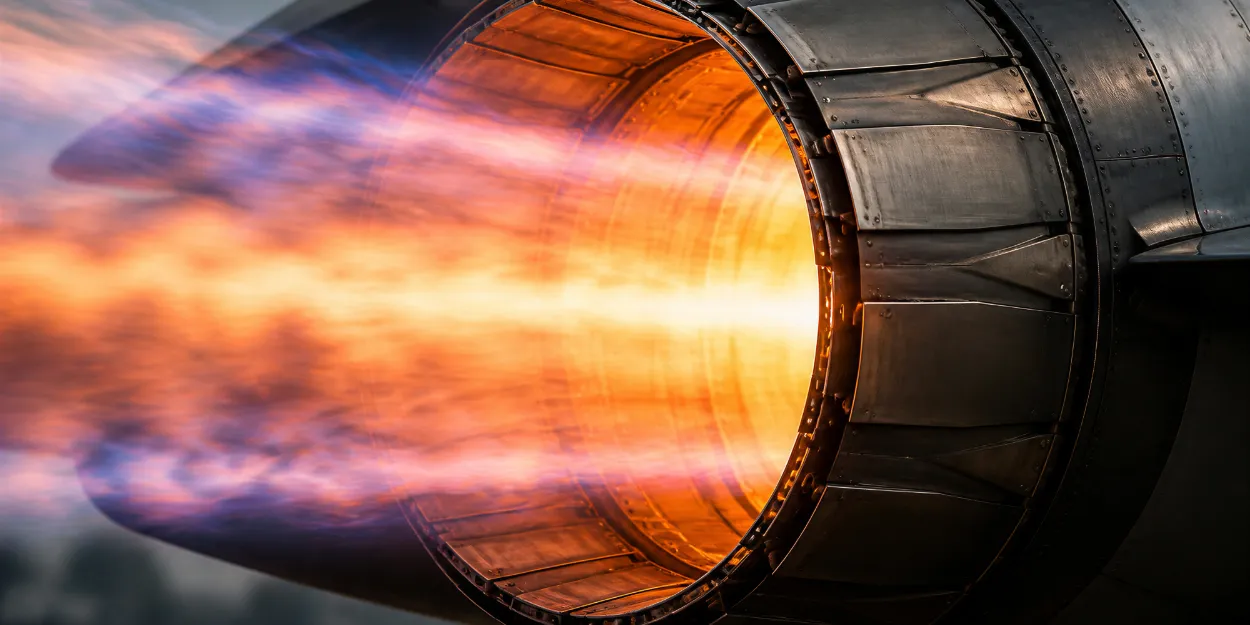
That omission matters, because the reason India has never built a fighter engine end to end has less to do with aerodynamics than with metallurgy. A jet turbine’s hottest section runs above 1,500°C — hotter than steel or standard titanium can survive without deforming under load.
Building that section requires vacuum remelting, single-crystal casting and Hot Isostatic Pressing capacity that, until recently, India’s private sector simply did not have. A Lucknow-based foundry has spent the past three years building exactly that capacity. Now the same furnaces that cast parts for Airbus and Safran’s commercial engines have quietly become relevant to a very different, and far more strategic, conversation.
Executive Brief
PTC Industries Limited (NSE: PTCIL | BSE: 539006), through its wholly owned subsidiary Aerolloy Technologies Limited, has built one of the few private, vertically integrated titanium and superalloy casting operations outside the traditional aerospace foundry cartel led by Russia’s VSMPO-AVISMA.
Aerolloy holds disclosed supply agreements with Airbus, Safran Aircraft Engines and Dassault Aviation, and has separately confirmed a memorandum of understanding with Safran specifically covering military engine components — work that sits adjacent to, though is not formally part of, India’s Safran-GTRE co-development programme for the AMCA Mk2 fighter engine. That distinction matters, and this piece is careful to keep it.
Why a Fighter Engine Is Really a Foundry Problem
For six decades, aerospace-grade titanium and superalloy casting sat with a handful of producers, and Western commercial aviation leaned heavily on Russia’s state-backed VSMPO-AVISMA for structural titanium forgings. That changed after 2022, when Airbus, Boeing, Safran and Rolls-Royce all faced the same problem at once: qualifying new, non-Russian foundries with certified vacuum melting and Hot Isostatic Pressing lines, on a timeline measured in years rather than months.
India’s own Kaveri programme ran into a version of this problem decades earlier. GTRE could design a turbine. It could not, at the time, cast the single-crystal blades that turbine needed to survive, and foreign foundry slots for a country with no bargaining leverage were unreliable at best.
Aerolloy’s Lucknow Build-Out
Aerolloy Technologies — PTC Industries’ wholly owned subsidiary — has built an integrated titanium and superalloy manufacturing base in Lucknow, inside the Uttar Pradesh Defence Industrial Corridor. The company says the site covers the full chain from raw titanium processing through investment casting, machining and inspection under what it calls its “PTC ONE” model.
It has commissioned Vacuum Arc Remelting and Electron Beam Cold Hearth Remelting capacity, along with the single-crystal and directionally-solidified casting processes used for turbine blades — capabilities the company says place it among a very small number of foundries globally with this combination, and the only one in India. Trade press covering the Airbus agreement has described the vertically integrated, single-site model as a specific point of differentiation for global primes now qualifying suppliers outside Russia and China.
| Aerospace Partner | Platform / Programme | Scope, as disclosed |
|---|---|---|
| Airbus Commercial | A320neo, A330neo, A350 | Development, qualification and future supply of fully machined titanium structural castings, subject to Airbus qualification milestones. |
| Safran Aircraft Engines | CFM LEAP-1A / 1B (civil) | Long-term supply agreement (March 2025) for cast titanium engine components. |
| Safran Aircraft Engines | Military engines (unspecified) | Separate MoU, distinct from the LEAP agreement — confirmed by PTC’s chairman as relating specifically to military propulsion work, without a named platform. |
| Dassault Aviation | Rafale-linked programmes | Multi-year agreement for titanium casting parts manufactured in India. |
Where This Intersects the AMCA Engine — and Where It Doesn’t
Here is where the story needs care, because it is easy to overstate.
India’s most consequential aero-engine decision in a generation is unfolding in parallel. Safran and DRDO’s Gas Turbine Research Establishment have proposed a joint venture to co-develop a new turbofan, generally described in the 110–130 kN thrust class with an initial target near 120 kN and a stated growth path to 140 kN, built around an entirely new core rather than an adaptation of Safran’s M88.
The proposal reached India’s Cabinet Committee on Security in early August 2026, with clearance widely reported as expected around Independence Day. As of this writing, the commercial contract that would follow CCS approval had not been publicly confirmed as signed. Reporting on the programme’s execution model has named Hindustan Aeronautics Limited, not a private foundry, as the manufacturing partner for engine assembly and testing.
Aerolloy has no publicly disclosed role in that specific programme. What it does have — and what is verifiable — is a separate, standalone MoU with Safran covering military engine components, plus a growing track record of qualifying to aerospace-grade casting standards that any future GTRE-Safran supply chain would eventually need to draw on domestically.
TES has covered the technology-transfer questions around the AMCA engine deal in detail separately. The honest reading of Aerolloy’s position is proximity and capability, not a confirmed contract. Readers should treat any claim that PTC Industries is “supplying the AMCA engine” as premature until GTRE, Safran or PTC itself discloses component-level sourcing.
The Titanium Sponge Problem Underneath All of This
Whatever role private foundries eventually play, they inherit a supply constraint that predates PTC Industries by fifteen years. Kerala Minerals and Metals Limited, in Kollam, remains India’s only titanium sponge producer, running on technology developed by the Defence Metallurgical Research Laboratory. Its capacity has been capped at 500 tonnes a year since 2011.
Everything downstream — Mishra Dhatu Nigam’s alloy processing, Aerolloy’s castings, HAL’s Tejas Mk1A line running at 24 aircraft a year against a 180-aircraft order book — draws from that single, unmoved ceiling. India imports the rest of its aerospace-grade sponge from Russia, Japan and China.
A private foundry can qualify to any standard it likes. It cannot manufacture titanium sponge that does not exist. That is the ceiling on this entire story, and no amount of contract-signing changes it until the sponge bottleneck itself is addressed.
The Market’s Read: Valuation and What It Is Pricing In
PTC Industries reported consolidated Q1 FY27 revenue from operations of ₹191.8 crore and net profit of ₹29.2 crore, up 466% year on year, with the board approving results on 14 August 2026. Aerolloy alone accounted for the bulk of that profit growth.
The stock has responded accordingly. Alongside a broader run in defence-linked equities this year, PTC’s market capitalisation stood at roughly ₹31,110 crore as of 24 August 2026, with a trailing P/E near 246x on one major broker’s platform. Different data providers show meaningfully different multiples depending on the trailing-EPS window used, so the figure should be read as directional rather than precise on any given day.
TES Analytical Assessment
- A P/E multiple in the hundreds is not a valuation an established industrial-casting business would command. It reflects the market pricing PTC as an early-stage, near-monopoly proxy for India’s private aerospace-materials capability — a bet on multi-year order-book conversion, not current earnings.
- The titanium sponge ceiling described above is the clearest structural risk to that bet: revenue growth at Aerolloy cannot outrun the raw-material supply it depends on without either a domestic capacity expansion or continued reliance on imports from Russia, Japan and China.
- The unconfirmed status of any AMCA-engine-specific contract is a second variable the current share price may already be partly pricing in, given how closely PTC’s public narrative has become associated with India’s engine self-reliance story.
A French Precedent
France solved a version of this problem sixty years ago. Facing American reluctance to underwrite fully independent French military engine production, Paris directed sustained state investment into Snecma’s metallurgy — vacuum melting, single-crystal casting, the unglamorous foundry work behind any engine programme. That investment eventually produced the M53 and M88 engines that power the Mirage and Rafale respectively, and it built the industrial base that later let Snecma become a co-equal partner in the multinational CFM joint venture rather than a licensee of someone else’s engine.
The lesson was never that France built better turbines than everyone else on the first attempt. It is that sovereign engine capability was assembled decades before anyone needed it, in foundries doing unglamorous commercial work, so that the capability existed when the military requirement arrived. HAL’s own aero-engine programme has spent decades learning that same lesson the hard way, mostly through the Kaveri programme’s long detours.
Which brings the story back to that furnace nobody mentions when they talk about Kaveri. Whether Aerolloy’s foundry ends up inside the AMCA engine’s specific supply chain is still an open question, and TES will treat it as open until GTRE, Safran or PTC says otherwise on the record.
But the capability question it represents — whether India’s private sector can cast to aerospace standard, at scale, without asking anyone’s permission — has already been answered. That answer came on a factory floor in Lucknow, in contracts with Airbus and Safran that have nothing to do with the Indian Air Force.
Sovereignty in aero-engines was never going to arrive as a single announcement. It arrives as a furnace that was already running when the requirement showed up.
This article discusses listed companies, share prices, market capitalisation and valuation multiples for informational and analytical purposes only. It does not constitute investment advice, a recommendation to buy or sell any security, or a solicitation of any kind. Share prices and financial ratios cited are accurate as of the dates stated and are subject to change. The Eastern Strategist is not a registered investment advisor. Readers should conduct independent research and consult a qualified financial advisor before making investment decisions.
Frequently Asked Questions
Is PTC Industries confirmed to be supplying components for India’s AMCA fighter engine?
No formal role has been publicly disclosed. Aerolloy Technologies, PTC’s subsidiary, has a separate MoU with Safran covering unspecified military engine components, and reporting has named Hindustan Aeronautics Limited as the manufacturing partner for the Safran-GTRE AMCA Mk2 engine programme specifically.
What does Aerolloy Technologies actually manufacture for Airbus and Safran today?
Titanium castings — for Airbus’ A320neo, A330neo and A350 commercial aircraft, and for Safran’s CFM LEAP-1A/1B civil turbofan engines under a March 2025 agreement.
Why does India’s titanium sponge capacity matter to this story?
India’s only titanium sponge producer, KMML in Kerala, has been capped at 500 tonnes a year for fifteen years. Every downstream aerospace and defence programme that needs titanium — from Tejas to any future AMCA engine — draws against that single ceiling, regardless of how much private casting capacity exists.
The Eastern Strategist is an independent digital publication dedicated to geopolitical, defence-industrial, and macroeconomic intelligence. The market metrics, equity valuations, and corporate analyses presented in this article are for informational, analytical, and educational purposes only.
Nothing contained herein constitutes financial advice, an investment recommendation, a price target endorsement, or a solicitation to buy, hold, or sell any security, equity, or commodity. Stock markets and strategic equities carry inherent risks. Readers and investors are strongly advised to conduct their own independent due diligence and consult a qualified, SEBI-registered financial advisor before making any investment decisions.