
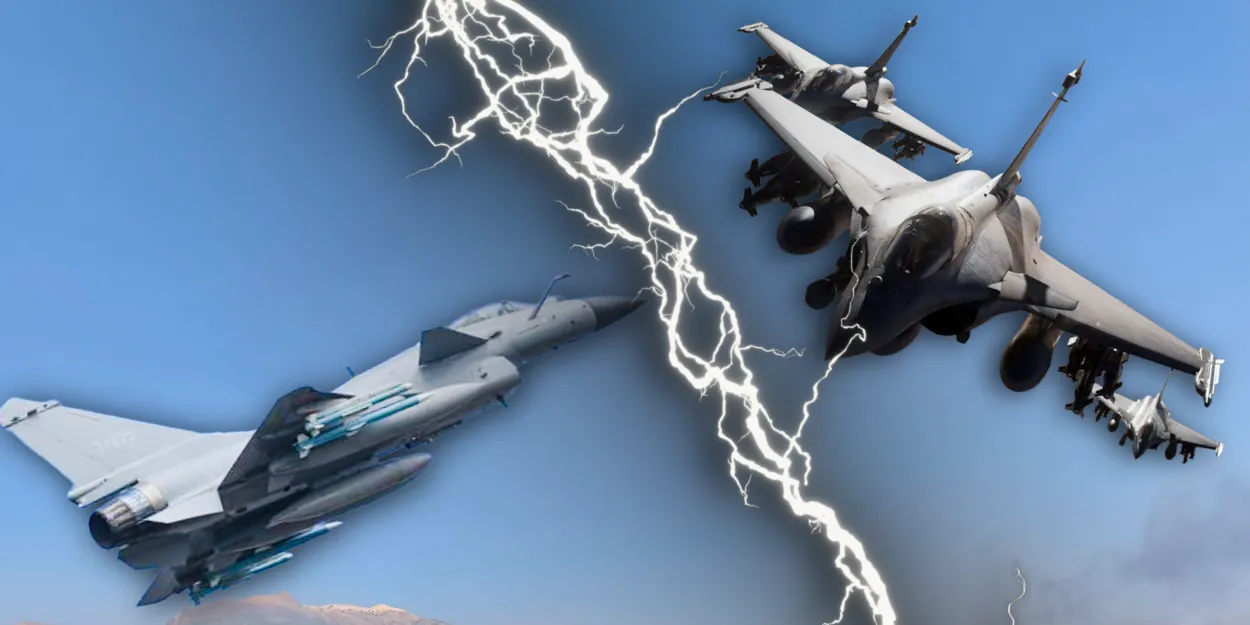
Six months after taking office promising to reset ties with New Delhi, Prime Minister Tarique Rahman has not made a single visit to India. What his government has produced instead, on 25 August 2026, is Bangladesh’s Rafale claim — a spokesperson reviving a contested aircraft-loss claim from a war between two other countries, offered as the justification for a $2.3 billion Chinese fighter deal.
In August 1940, as the Battle of Britain raged, RAF and Luftwaffe pilots both wildly over-claimed enemy losses — post-war audits found each side’s kill counts inflated by roughly double. Fighter combat has always been a poor witness to its own outcome; the fog does not lift for eight decades. Bangladesh’s government has now built a procurement argument on exactly that kind of fog, drawn from a conflict fought last year between India and Pakistan, in which Dhaka was not a participant.
What Zahed Ur Rahman Actually Said
Zahed Ur Rahman, the Bangladesh Prime Minister’s Adviser for Information and Broadcasting, told reporters at a regular Secretariat briefing on 25 August 2026 that Dhaka’s interest in the Chinese J-10CE fighter rested partly on the aircraft’s reported performance during the May 2025 India-Pakistan conflict. Verified FactAccording to Bangladesh’s official Press Information Department, Rahman said an inter-ministerial committee had prepared a draft agreement, submitted to the Ministry of Finance and the Armed Forces Division, covering the purchase of J-10CE jets alongside attack helicopters, VIP transport helicopters and unmanned aerial systems.
He did not confirm exact numbers, but Bangladeshi media have consistently reported a package of 20 aircraft, with Dhaka-based The Business Standard putting the total programme cost at roughly Tk 28,314 crore — approximately $2.3 billion at prevailing exchange rates. The proposal remains at draft stage. Whether it proceeds this financial year depends on budget allocation; if funds are not found, Rahman said, it moves to the next cycle.
The line that travelled furthest was narrower and more pointed: Rahman said it was now “established” that an Indian Rafale had been shot down by a Chinese-built J-10 during last year’s conflict, and that the J-10CE had “performed very well” against a jet he called one of the world’s most capable 4.5-generation fighters.
Fact-Checking Bangladesh’s Rafale Claim
It is not established. It is contested, and has been since the week the claim first surfaced.
| Claimant | Position |
|---|---|
| Pakistan | Deputy PM and Foreign Minister Ishaq Dar told Pakistan’s National Assembly in May 2025 that J-10C jets took part in Pakistan’s response and that five Indian jets were downed, describing “instructions to only target Indian jets that released payloads.” |
| India | Indian Air Force Chief Air Chief Marshal A.P. Singh has said Indian forces downed at least five Pakistani aircraft and one large military asset during Operation Sindoor. India has acknowledged losses in the exchange but has never officially confirmed the type, number, or cause of its own downed aircraft. |
| Dassault Aviation | Chief executive Eric Trappier called Pakistan’s claim of three downed Rafales inaccurate. |
| Reuters reporting | Cited assessments attributing Indian losses to miscalculation of the PL-15 missile’s engagement range, rather than to any inherent superiority of the J-10 platform over the Rafale. |
TES Analytical AssessmentThe claim Bangladesh has adopted did not originate in Dhaka. It is Islamabad’s account of a war it fought, repeated by a government that fought no part of it, and used to justify a defence purchase from the one supplier — China — that benefits most from the claim being believed. Beijing’s own state media have leaned into the same narrative to market the J-10CE across the Global South. That does not make the claim false. It makes it a marketing line masquerading as combat data, and Dhaka has now amplified it without independent verification of its own.
Six Months of Silence, Not a Reset Interrupted
The timing looks like a contradiction only if you assume Bangladesh-India relations were actually warming. They were not.
Tarique Rahman was sworn in as Prime Minister on 17 February 2026, after the Bangladesh Nationalist Party’s landslide election victory ended eighteen months of interim government. Prime Minister Narendra Modi wrote to him the same week, inviting him to visit India “along with his family” and describing a “deep-rooted friendship” between the two nations. That invitation has sat unanswered for six months. Rahman has instead travelled to China, meeting President Xi Jinping in Beijing on 26 June 2026, and to Malaysia. He has not been to Delhi once — a reversal of the early optimism TES covered around Bangladesh’s February 2026 election and the reset it appeared to promise.
This is the real backdrop against which Rahman’s spokesperson invoked the Rafale claim: not a diplomatic thaw undercut by a stray remark, but six stalled months in which the loudest signal Dhaka has sent toward India is a disputed account of someone else’s war.
The pressure has a name and a date. Nahid Islam, the National Citizen Party’s founding convenor and one of the student leaders who coordinated the 2024 uprising against Hasina, declared last week that “no initiative to establish normal diplomatic relations” with India should be taken until her extradition is resolved. He went further, rejecting the idea of a “shared dream” with India altogether — a direct swipe at the language Delhi has used to describe the relationship for decades. Jamaat-e-Islami, the country’s largest Islamist party, took a milder public line but still called Hasina’s 5 August appearance from Delhi “a gross violation of diplomatic norms,” through its Secretary General Miya Ghulam Parwar, even as party chief and Leader of the Opposition Shafiqur Rahman later signalled the Prime Minister could still travel. The opposition is not unified on tactics. It is unified on the demand: Hasina first.
Bangladesh’s own Foreign Ministry hardened its language to match. Its 16 August statement said a “propitious environment” was needed before Rahman could visit India, explicitly tying the trip to her extradition and that of other fugitives. Rahman’s foreign affairs adviser, Humayun Kabir, put it more bluntly to Bangladeshi media: there is “no rush” in Dhaka to facilitate the visit.
TES Analytical AssessmentThis is what ties Rahman’s hands. Visible warmth toward India, while Hasina remains free and vocal from Indian soil, hands the NCP and Jamaat a ready-made charge — that the BNP government is soft on the very figure the July uprising was fought to remove. New Delhi’s own diplomatic establishment has reportedly read the Bangladeshi brinkmanship this way too, seeing it as part of the BNP’s effort to hold ground against NCP and Jamaat on home turf rather than a genuine cooling toward India itself. If the diplomatic track stays closed under that pressure, the rhetorical one stays open by default. A defence-procurement talking point that revives an old, contested claim against India costs Rahman’s government nothing with that domestic audience — it requires no concession on Hasina, commits Dhaka to no policy, and can be walked back or ignored the moment it stops being useful. The visit cannot be improvised the same way. It has to survive Nahid Islam’s objection, Jamaat’s ambivalence, and a Foreign Ministry that has now put its conditions in writing.
Does the Purchase Itself Change the Regional Balance?
Even taken at face value, the numbers involved do not describe a shift in South Asia’s air balance so much as routine fleet recapitalisation.
| Metric | India | Bangladesh |
|---|---|---|
| Active fighter inventory | 600+ (Rafale, Su-30MKI, Mirage 2000, Tejas) | ~44 (ageing Chengdu F-7s and MiG-29s); proposed 20 J-10CE |
| Airborne Early Warning | Netra AEW&C, Phalcon | None; ground-based radar only |
| Integrated air defence | S-400, MRSAM, Akash-NG under IACCS | Short-range point defence only |
The Bangladesh Air Force’s F-7s are 1960s-derived MiG-21 variants; replacing them is closer to fleet survival than force projection. Even if the draft agreement clears budget allocation this year, delivery, pilot conversion and integration typically run three to four years from signature — this is not a near-term development to watch on any operational timeline. For context on India’s own post-Sindoor modernisation pace, see TES’s earlier analysis of India’s defence modernisation from Kargil to Operation Sindoor.
What This Means for Indian Defence Markets
Investors reading geopolitical headlines into stock moves this week should be cautious about drawing a line that is not there. Hindustan Aeronautics and Bharat Electronics both eased through the 24–25 August trading sessions — HAL down between roughly 1 and 2 percent across those days — but that dip tracks a separate and well-documented story: delayed GE Aerospace F404 engine deliveries holding up Tejas Mk1A handovers to the Indian Air Force, not any reaction to Dhaka’s procurement announcement.
The more relevant signal for the sector sits elsewhere. HAL’s stock has returned close to 28 percent year-to-date on the back of order-book execution and the August delivery of India’s first Tejas Mk1A, while BEL and Mazagon Dock continue to be priced on multi-year revenue visibility from indigenisation contracts rather than on neighbouring headlines — a dynamic TES examined in its recent look at the boom and risk profile of India’s listed defence sector. TES Analytical AssessmentBangladesh’s rhetoric is noise against that signal — which is itself the more useful lesson: Indian defence equities move on delivery schedules and domestic order books, not on a spokesperson’s press briefing in Dhaka.
What to Watch
- Will the Tarique Rahman-Modi bilateral visit happen before the September BRICS summit in Delhi?
- Unconfirmed as of this writing. Dhaka has linked progress to reassurances on Sheikh Hasina’s conduct from Indian soil; New Delhi has given no public commitment on her extradition. Bangladeshi officials, including State Minister for Foreign Affairs Shama Obaed, have said no visit has been finalised.
- Will the J-10CE deal receive budget allocation this fiscal year?
- Not yet decided. Zahed Ur Rahman has said the procurement proceeds this year only if funds are allocated; otherwise it moves to the next budget cycle, with no fixed date given.
- Has India’s government formally responded to the Rafale claim?
- No official Ministry of External Affairs statement directly addressing Rahman’s remarks had been issued as of this writing. India’s established position — disputing Pakistan’s account of Rafale losses — predates this specific claim and has not changed.
The Takeaway
The Battle of Britain’s kill claims were finally reconciled decades later, once both air forces opened their wartime books to historians with no stake in either outcome. Nobody has offered that kind of access here, and nobody is likely to soon. What Bangladesh’s government has done is borrow an unresolved number from someone else’s war and use it to explain a decision — fleet recapitalisation on a tight budget — that needed no such justification to begin with. The more telling number is the other one: six months, zero visits to Delhi. That is the balance sheet Dhaka’s own foreign policy will eventually be read against, not the disputed tally over a stretch of sky neither country’s air force controls.
Source Transparency Note
Verified fact: Zahed Ur Rahman’s 25 August 2026 statement and the draft J-10CE agreement, per Bangladesh’s Press Information Department and reporting by Prothom Alo, The Wire and the South China Morning Post. Tarique Rahman’s swearing-in, Modi’s invitation letter, the Beijing and Malaysia visits, and the stalled India visit are drawn from Al Jazeera, The Daily Star, The Diplomat and India’s News on Air service.
Official statements: ACM A.P. Singh’s and Ishaq Dar’s respective accounts of Operation Sindoor losses; Dassault CEO Eric Trappier’s denial; Nahid Islam’s (NCP) and Miya Ghulam Parwar’s (Jamaat-e-Islami) public remarks; Bangladesh’s Foreign Ministry statement of 16 August 2026; foreign affairs adviser Humayun Kabir’s comments to Bangladeshi media — per reporting by The Diplomat and ThePrint.
Company/market data: HAL and BEL trading movements and HAL’s year-to-date return, as reported in contemporaneous market coverage; these are cited for informational context only.
TES Analytical Assessment: All interpretive judgments on domestic political calculus, motive, and market significance — including the reading of New Delhi’s own diplomatic perception, sourced to ThePrint — are clearly labelled inline above and represent The Eastern Strategist’s independent analysis, not confirmed fact.