The government has known for months that this deal is coming. So has the market. Neither has acted on it yet.
One Signature Away, After Twenty-Five Years
Project 75I is not a new idea. India first sketched a 30-year plan to build 24 conventional submarines back in 1999, in the aftermath of Kargil; twenty-seven years later, only six have actually entered service, all under the earlier Project 75 with France’s Naval Group. The “I” batch — six more boats, this time built with a German partner and a much larger indigenous-content requirement — has been stuck in some stage of approval since 2010.
What is different this time is how far the paperwork has actually progressed. The Union Finance Ministry signed off on the roughly ₹70,000 crore programme in May 2026. Contract Negotiation Committee talks between the Ministry of Defence, Mazagon Dock and Germany’s ThyssenKrupp Marine Systems concluded earlier this year. The only step left is Cabinet Committee on Security clearance — the final, highest-level approval required before India signs a major defence contract — and multiple reports through July and August have described that clearance as imminent, with contract conclusion “targeted by September 2026”. As of this week, it still hadn’t happened.
The delay is not really about Mazagon Dock or TKMS. The programme has been re-approved at least three times — 2010, 2014, 2019 — and lost two of its original foreign contenders along the way. France’s Naval Group and Russia’s Rubin Design Bureau both withdrew in 2022 after India insisted on an air-independent propulsion system that had already been proven at sea, a requirement neither could meet on the tender’s terms. That left a straight fight between MDL-TKMS and an L&T-Navantia pairing, and by early 2026 L&T was reportedly out of the race entirely. MDL-TKMS is now the sole compliant bidder for a contract that has taken longer to award than most of the submarines it will eventually replace have been in service.
What ₹70,000 Crore Actually Buys
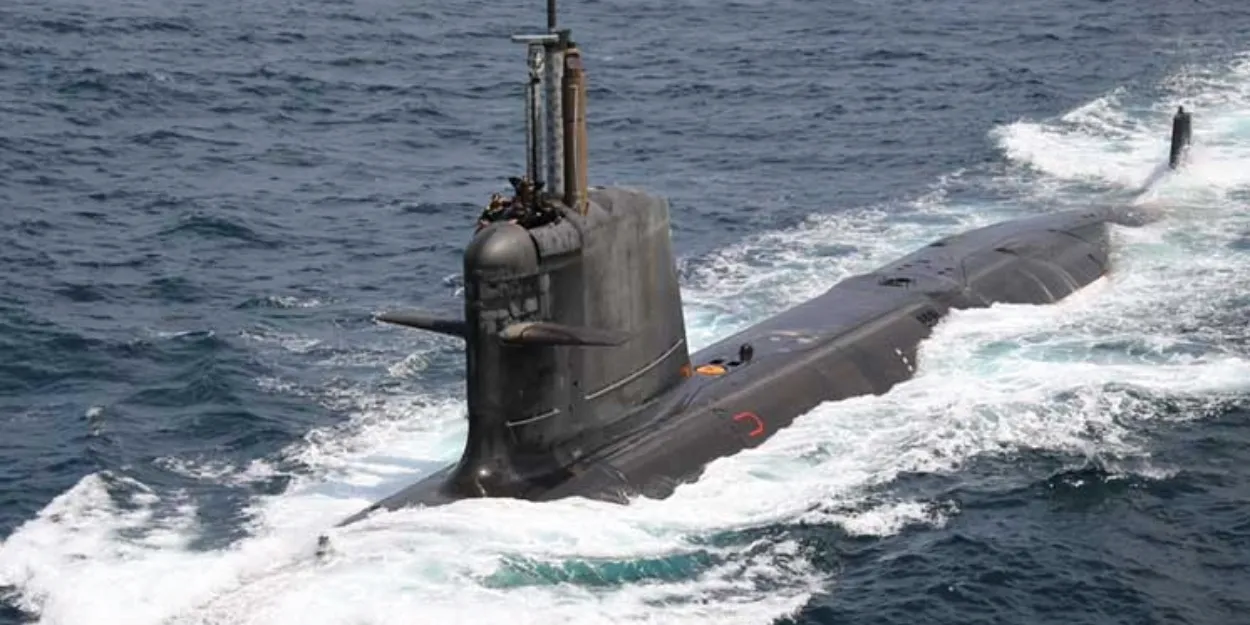
The programme covers six diesel-electric attack submarines built around a variant of Germany’s Type 214, fitted with hydrogen fuel-cell air-independent propulsion that lets a boat stay submerged for roughly two weeks without surfacing — a meaningful jump in stealth endurance over India’s ageing Sindhughosh and Shishumar-class fleets, some of which are already past 30 years old.
₹70,000 crore is the Finance Ministry-cleared benchmark cost for the core procurement, and it’s the figure worth anchoring on. It is not, however, the full lifetime price tag. Broader estimates that fold in complete technology transfer, indigenous weapons integration and lifecycle maintenance packages put the total programmatic outlay closer to ₹90,000-99,000 crore — a reminder that the headline number understates what India is actually committing to once support and sustainment are included.
The indigenous-content structure is the part worth watching closely. The first submarine is contracted for around 45 per cent local content; by the sixth, that rises to roughly 60 per cent. TKMS transfers submarine design and manufacturing know-how to MDL over the course of the programme rather than handing over six finished hulls — the explicit goal being that India comes out the other side able to design its own submarines, not just assemble someone else’s. First delivery is expected roughly seven years after signing, putting the lead boat in the water around 2032-33, with the remaining five following at roughly annual intervals after that.
Why India’s Navy Can’t Wait Much Longer
The urgency behind this deal is not abstract. India’s conventional submarine fleet has been shrinking, not growing. When INS Sindhughosh was decommissioned on 19 December 2025 after nearly forty years in service, the Navy’s operational diesel-electric fleet fell to around 16 boats — Sindhughosh-class and Shishumar-class veterans dating to the 1980s, alongside six newer Kalvari-class boats delivered under the original Project 75. That is roughly the same fleet strength that triggered India’s 30-year, 24-submarine building plan back in 1999. Twenty-seven years later, the plan has delivered a third of its target, and the boats it was meant to replace are now old enough to retire on their own.
Pakistan is not standing still on the other side of that gap. Reporting puts eight Chinese-origin Yuan-class (Hangor) submarines — fitted with air-independent propulsion, four built in China and four to be assembled in Karachi — entering service between 2026 and 2028. That is a modern, AIP-equipped fleet arriving years before India’s first Project 75I boat is even expected in the water around 2032-33. None of Pakistan’s current submarines carry AIP; all eight of its incoming ones will. For a period likely running into the early 2030s, the underwater balance in the Arabian Sea tilts toward Islamabad on modernity even if not on numbers — which is precisely the gap this deal, and the AIP technology it brings, is designed to close.
Reading the Stock Against the Programme
None of this has been secret. Finance Ministry approval was public in May. CNC completion was public in March. Ambassador-level statements about an imminent signing go back to late July. A rational market, in theory, prices in a well-telegraphed catalyst well before it lands — and to an extent, that has happened: MDL is up roughly 9 per cent over the past six months even as it sits well below its highs, suggesting some accumulation rather than pure indifference.
But the gap to the all-time high has not closed, and there is a reasonably ordinary explanation for that. CCS clearance has been “imminent” in press reporting since at least May, and has slipped past several informally floated windows already. A market that has watched this specific approval get pushed more than once in twenty-five years has some reason to wait for the signature rather than the signal. There is also a simpler, more mechanical factor: Mazagon Dock’s ₹2,942 crore in Q1 FY27 revenue and roughly ₹1.04 lakh crore market capitalisation already price in a large, established order book — its existing frigate and submarine work, plus its fresh Colombo Dockyard stake — and this single programme, however large, is one more addition to a company the market has already re-rated once.
What would actually move the stock from here is less ambiguous than the underlying politics. A CCS clearance, followed by a signed contract, is the kind of binary, dated catalyst that Indian defence-PSU stocks have historically reacted to sharply — as MDL itself has shown around past dividend record dates and order announcements. Whether that reaction lands before or after the news is, at this point, largely a question of how much of the wait investors are willing to sit through.
What This Actually Does to the Order Book
Strip away the speculation and the order-book numbers tell their own story. Mazagon Dock’s backlog stood at ₹27,415 crore in mid-2025, slipped to ₹20,535 crore by the end of FY26 in March, and had fallen further to ₹18,218 crore as of 30 June 2026 — a company visibly eating through its existing work faster than it has been replacing it. Management has been explicit about the fix: Director (Finance) Ruchir Agrawal has said the company is targeting an order book of “more than a lakh crore” once the deal is signed, and brokerages have started running the same arithmetic. Project 75I alone, at roughly ₹70,000 crore, would nearly quadruple the current backlog on its own. Add the separately reported three-boat Kalvari follow-on order — pegged at around ₹36,000 crore — and the combined addition approaches ₹1.06 lakh crore, pushing MDL’s total order book past ₹1.2 lakh crore for the first time in its history.
That is not a marginal top-up. It is close to a full order-book replacement in a single stroke, and it is the specific number analysts mean when they say Project 75I could “reverse the declining trend” in MDL’s backlog rather than simply extend it. None of it is confirmed at contract stage, and a number this large deserves the same scepticism as any pre-signature figure in Indian defence procurement — this programme itself has already drifted from an original ₹43,000 crore estimate to nearly double that, largely on the cost of full technology transfer and indigenised mission-critical systems like sonar and combat management.
Is MDL Actually Cheap, Next to Its Peers?
One thing the fourteen-month consolidation has done is leave Mazagon Dock trading at a noticeably lower multiple than the rest of the listed defence-electronics cohort it gets lumped in with. At current levels, MDL trades around 36-41 times trailing earnings. Data Patterns, the radar-electronics maker that hit its own all-time high in August on a single Bharat Electronics order, trades closer to 70-90 times earnings. Azad Engineering, the Hyderabad-based aerospace forgings specialist, trades north of 90-120 times. Solar Industries, the explosives and propellant maker that has become a default “defence basket” holding, sits around 90-97 times.
None of these are like-for-like businesses — Data Patterns, Azad and Solar are asset-light, high-margin electronics and materials plays, while MDL is a capital-intensive shipyard with lower margins and a much larger, lumpier balance sheet. That difference partly explains the gap. But it also means MDL is the one name in that group whose next major re-rating catalyst is fully identified, dated, and sitting one signature away — while the others are already priced as if their growth stories are running. Whether that makes MDL cheap or simply un-re-rated yet is, in effect, the same question this entire piece has been asking about the stock price.
Would Signing Project 75I Actually Re-Rate the Stock?
This is the question analysts covering the stock are already trying to answer, and their models offer a partial preview. Antique Stock Broking has maintained a ‘Buy’ rating through the delay, even as it has repeatedly trimmed its target price on the back of exactly the procedural slippage this piece has described — cutting it from ₹3,858 to ₹3,407 in January 2026, and again to ₹3,275 after August’s Q1 FY27 results, still implying roughly 37 per cent upside from where the stock trades today. The pattern is telling: the rating hasn’t moved, but the price target keeps quietly resetting lower each time the CCS clearance slips past another quarter. Consensus 12-month targets from a wider analyst pool cluster around ₹2,800, above current levels but still well short of the ₹3,778 all-time high.
Read carefully, that is not a market betting on a dramatic re-rating so much as one waiting to see the multiple it is already prepared to pay confirmed by an actual signature. A re-rating, if it comes, is more likely to look like the stock closing the gap to its own record than leaping past the multiples Data Patterns or Solar Industries currently command — MDL is a shipyard, not a fabless electronics company, and the market has shown no sign of wanting to price it like one. This is context for how analysts are modelling the stock, not a forecast of how it will trade; nothing here should be read as investment advice.
What to Watch Next
Two dates matter more than anything else here. The first is Cabinet Committee on Security clearance itself — the actual approval, not another round of “expected soon” reporting. The second is the contract signature that follows it, which multiple reports have pointed to landing by September 2026. Between those two events sits the closest thing this stock has to a confirmed near-term catalyst, and the market’s current levels suggest that catalyst has not yet been fully priced.
What to Watch — Frequently Asked Questions
The stock hit an all-time high of ₹3,778 in May 2025 and has traded in a roughly ₹2,000–3,100 range since, even as its main upcoming catalyst — Cabinet Committee on Security clearance for the ₹70,000 crore Project 75I submarine deal — has been repeatedly described as imminent without actually landing.
It is a programme to build six German-designed, air-independent-propulsion submarines with Mazagon Dock and ThyssenKrupp Marine Systems. First conceived in the late 1990s, it has been re-approved multiple times and lost two rival bidders — France’s Naval Group and Russia’s Rubin Design Bureau — after India required a submarine AIP system already proven at sea.
Multiple 2026 reports have pointed to Cabinet Committee on Security clearance and contract signature landing by September 2026, though similar timelines have slipped before in this programme’s history.
MDL’s order book stood at around ₹18,218 crore as of June 2026. The submarine deal alone, at roughly ₹70,000 crore, would nearly quadruple that; combined with a separately reported ~₹36,000 crore follow-on order for three more Kalvari-class submarines, the total addition could push MDL’s order book past ₹1.2 lakh crore.
On a price-to-earnings basis, yes relative to peers: MDL trades around 36-41 times earnings versus 70-120 times for names like Data Patterns, Azad Engineering and Solar Industries. The businesses are not directly comparable, but MDL is the one name in that group whose next major catalyst is dated and still pending.
India’s operational conventional submarine fleet has fallen to around 16 boats following the December 2025 retirement of INS Sindhughosh — roughly the same fleet size that triggered India’s original 24-submarine building plan in 1999. Pakistan, meanwhile, is inducting eight Chinese-built, AIP-equipped Hangor-class submarines between 2026 and 2028, years before India’s first Project 75I boat is expected in the water.
Related on TES: Mazagon Dock’s Naval Procurement Pipeline · India’s Navy Fleet, Pakistan and German Submarines · India’s Shipbuilding Industry

2 thoughts on “Mazagon Dock Project 75I: Why a Stock Sitting 32% Below Its Record Hasn’t Moved Yet”