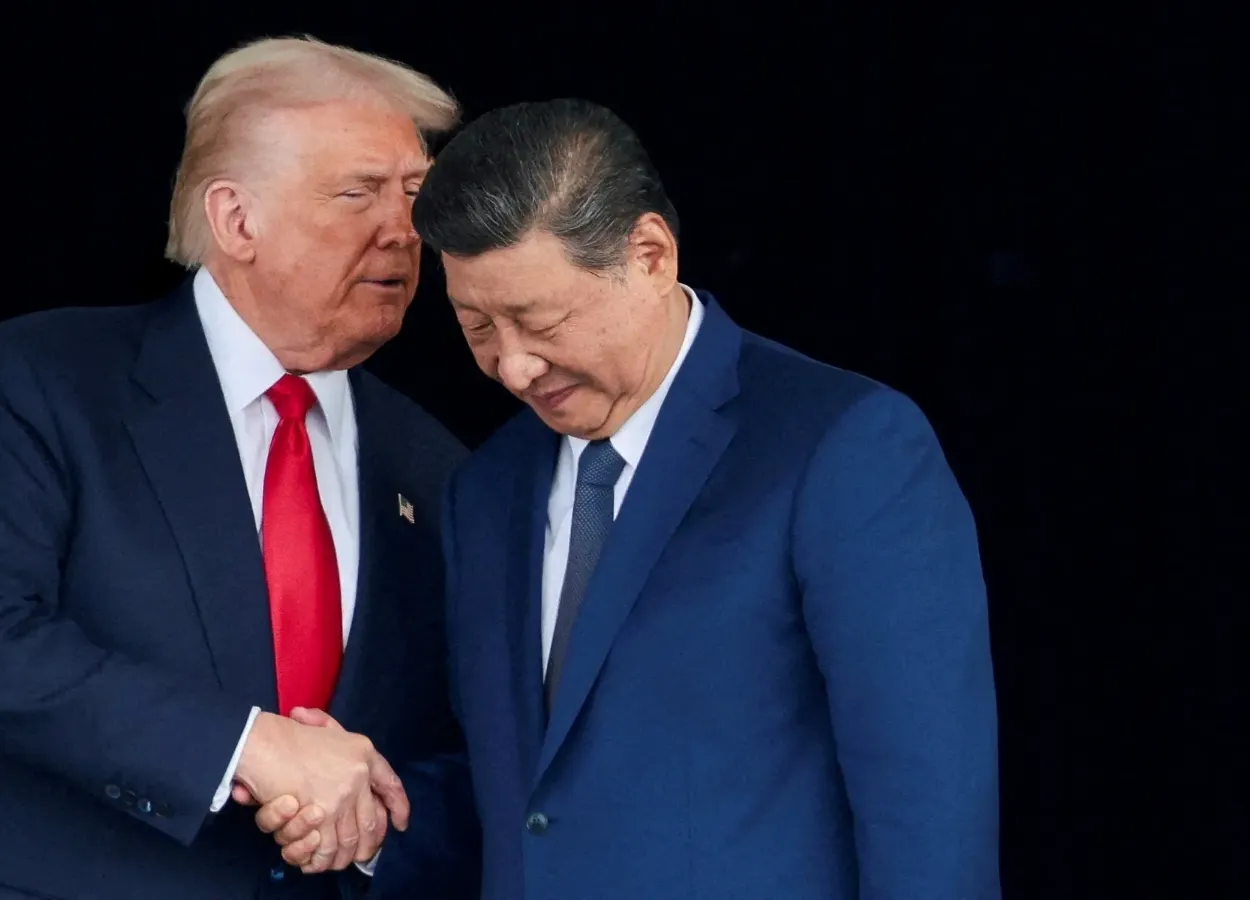
When United States President Donald Trump welcomes Chinese President Xi Jinping in Washington on 24 September, the staging will suggest harmony: a personal greeting at Joint Base Andrews — only the second time in his second term that he has gone to an airport himself to receive a foreign leader — a state dinner for the Trump-Xi summit, and a delegation of Chinese company executives arriving alongside the leadership.
The substance on the table at the Trump-Xi summit is harder than the pageantry suggests. The summit follows a full-day preparatory meeting in New York on 20 September between US Treasury Secretary Scott Bessent, US Trade Representative Jamieson Greer and Chinese Vice-Premier He Lifeng at JPMorgan Chase’s Manhattan headquarters, convened to work through tariffs, artificial intelligence and critical minerals, according to Reuters. At stake is the survival of a trade truce that expires on 10 November — the same date on which China’s suspension of its expanded rare-earth export controls lapses.
The truce was forged at Busan in October 2025, on the sidelines of the Asia-Pacific Economic Cooperation summit. It capped the tariffs each side had imposed during President Trump’s second term at roughly 20 per cent, after tit-for-tat escalation had pushed duties above 100 per cent on both sides. Under its terms, China agreed to purchase 25 million metric tonnes of US soybeans annually through 2028, according to the White House, while Washington granted exemptions from its steepest duties and permitted some AI chip exports.
The May 2026 Beijing meeting added further commitments: a reported $17 billion in additional agricultural purchases and more than 200 Boeing aircraft — pledges that Beijing has never publicly acknowledged and whose details, according to Reuters, have yet to emerge.
Since then, the legal foundations of the US tariff wall have shifted. In February 2026, the US Supreme Court struck down the tariffs Trump had invoked under the International Emergency Economic Powers Act, including duties tied to fentanyl-trafficking allegations — a ruling TES examined in detail at the time. The administration has been rebuilding the regime under different authorities. In July, the US Trade Representative imposed forced-labour tariffs of 10 to 12.5 per cent on 60 economies, including China. A separate investigation into excess industrial capacity is being finalised; Bloomberg has reported that the initial rate on Chinese goods under this heading was set at 7.5 per cent, and that the announcement has been delayed until after the summit — a deliberate clearing of the runway for Xi’s visit.
Congress has now added a new instrument. On 18 September, Trump signed the Lindsey O. Graham Sanctioning Russia and Iran Act of 2026, which gives him statutory authority to impose tariffs of up to 100 per cent on the five largest buyers of Russian oil — a list that by current import volumes includes both China and India, the latter having secured an 18 per cent preferential rate in its February tariff reset — and up to 500 per cent on Russian-origin goods. The leverage cuts across the Global South more broadly, a dynamic TES tracked in its coverage of the 140-article BRICS New Delhi Declaration and its critical-mineral corridors. The Act does not trigger any tariff automatically; the rate and the targets remain at the President’s discretion. But a signed statute with a five-year life is a different proposition from a threat on social media, and it hands Washington durable leverage that neither the courts nor the calendar can take away.
What is on the table at the Trump-Xi summit
The central question at the Trump-Xi summit is not whether the truce will be extended, but for how long. Washington is seeking an extension of roughly six months — a short leash that keeps pressure on Beijing — while China wants the détente locked in for the remainder of Trump’s term. Xi’s delegation arrives with bargaining chips. A Chinese official involved in planning the meeting told Singapore’s Straits Times that Beijing would offer additional rare-earth export permits, without specifying what it expects in return.
Beijing’s own priority list is different. The same official identified Taiwan — specifically a planned US weapons sale — as China’s top issue, with tariffs and agricultural trade rated as easier conversations. For Washington, the Trump-Xi summit agenda includes China’s performance on critical-mineral flows, which a senior US official described to reporters as “not been up to par”, and potential guard rails for artificial intelligence, an area of acute sensitivity after reports of security breaches involving AI models.
The Iran war hovers over everything. Trump has publicly downplayed reporting that China provided Tehran with targeting data used against US service members in the Middle East, but US officials continue to press Beijing on Iran sanctions at the working level. An extension of the rare-earth truce, in the current climate, is being treated by many market participants as probable but not assured.
The rare-earth chokepoint
For the defence and industrial base on both sides of the Pacific, 10 November matters more than any handshake at the Trump-Xi summit. China imposed export controls on rare-earth permanent magnets in April 2025; within two months, magnet exports fell by 75 per cent, according to trade data cited by supply-chain analysts. The October 2025 truce suspended the expanded controls until 10 November 2026, but the underlying April 2025 licensing regime has remained in force throughout, and China’s monthly magnet exports have continued to run below pre-control levels.
If the suspension lapses, the extraterritorial architecture of China’s Ministry of Commerce Notice 61 comes back into force: any product anywhere in the world containing Chinese-origin rare-earth material above a 0.1 per cent value threshold — assembled in Vietnam, Mexico, Japan or Germany — would require a Chinese export licence before shipment to the United States.
The scope captures AI hardware, automotive traction motors, wind-turbine components, medical imaging equipment, industrial servo motors and defence electronics. Analysts at the Center for Strategic and International Studies have described the suspension as a reprieve rather than a resolution.
Beijing has also demonstrated that the pressure can be applied with precision even during the truce. In June 2026, after the Pentagon added about 80 Chinese companies to its Section 1260H list of firms identified as Chinese military companies, China’s Ministry of Commerce added ten US firms to its export-control list — including MP Materials and USA Rare Earth, the two companies at the centre of Washington’s effort to build a mine-to-magnet supply chain at home. The Ministry of Finance separately barred Chinese government procurement from 46 US companies, a roster that includes Lockheed Martin, Raytheon, Boeing Defense, General Atomics and General Dynamics.
Washington’s countermeasures are real but slow. The Department of Defense took a $500 million equity position in MP Materials in July 2025, alongside a $150 million loan for heavy rare-earth separation; the government became the company’s largest shareholder. USA Rare Earth announced $1.6 billion in funding in January 2026 for its Round Top deposit and an Oklahoma magnet plant. In February 2026 the White House unveiled Project Vault, a $12 billion strategic critical-minerals reserve. On 31 August, the Pentagon announced a $174 million equity investment in a gallium facility at Alcoa’s Wagerup refinery in Australia — 100 tonnes a year of a metal used in radar and missile-defence systems, after gallium prices outside China reached roughly $2,100 per kilogram against about $247 inside it. The Department of Defense has also moved to restrict exports of rare-earth “black mass” to keep recyclable material onshore. None of this closes the gap on a two-to-five-year timeline; most assessments put a genuinely resilient non-China magnet chain at five to ten years away.
From Busan to the Trump-Xi summit
-
Busan truce
Tariffs capped at roughly 20 per cent; soybean and critical-mineral commitments locked in.
-
Supreme Court strikes down IEEPA tariffs
The legal foundation of the second-term tariff wall collapses; rebuilding begins under new authorities.
-
Trump in Beijing
$17 billion in agricultural pledges and 200-plus Boeing aircraft agreed; the “Board of Trade” mechanism launched.
-
China blacklists MP Materials and USA Rare Earth
Ten US firms cut off from Chinese dual-use items after the Pentagon’s Section 1260H listings.
-
Forced-labour tariffs imposed
Section 301 duties of 10 to 12.5 per cent on 60 economies, including China.
-
Graham Act signed
Statutory authority for up to 100 per cent tariffs on the largest buyers of Russian oil.
-
Bessent–He talks in New York
Sherpa-level negotiations on tariffs, rare earths and AI ahead of the summit.
-
Trump-Xi summit, Washington
Truce extension, rare-earth permits and Taiwan top the leaders’ agenda.
-
US midterm elections
Inflation and gas prices are persistent voter concerns; Trump seeks trade wins to announce.
-
The twin deadline
Trade truce and the rare-earth suspension expire on the same day.
The political clock
Both leaders have reasons to avoid a rupture at the Trump-Xi summit. Trump heads into the 3 November midterms with inflation as a persistent voter concern, a costly and unpopular war in the Gulf, and gas prices elevated — pressures TES has documented through the Chokepoint Collapse of the Saudi East-West Pipeline and the wider Hormuz disruption. A trade flare-up with China that raised consumer prices further would be self-defeating. For Xi, whose economy still depends on export manufacturing, an extension through the remainder of Trump’s term would remove a major source of uncertainty.
Expectations for new deals from the Trump-Xi summit are modest. Wendy Cutler of the Asia Society Policy Institute, a veteran of US trade negotiations, has noted that the short preparation time makes major new agreements unlikely; Greer has said the countries will make “some announcements on agriculture and non-tariff barriers”. The most probable outcome, in the assessment of several observers, is a summit that extends the truce — perhaps with a show of friendship — and defers the harder questions of tariff architecture, technology controls and Taiwan to another day.
The signal to track this week is not the joint statement but the rare-earth permit flow in the weeks after it.
The Eastern StrategistThe risk case is straightforward. If the Trump-Xi summit fails to extend the truce, or extends it on a short fuse that either side considers coercive, the 10 November deadline brings a simultaneous return of triple-digit tariff threats and the extraterritorial rare-earth licensing regime — a combination that would hit automotive, aerospace, defence and electronics supply chains at once, in the middle of the US election aftermath. US officials say they have continued to press China on compliance with the 2025 agreement; Beijing has pressed for further tariff relief. Both positions are known. What neither side has revealed is how much pressure it is prepared to absorb.
For a publication watching the intersection of strategy and markets, the signal to track this week is not the joint statement but the rare-earth permit flow in the weeks after it. Beijing has used the pause to remind Washington and its allies — Japan most acutely, whose China-sourced rare-earth imports fell 51 per cent year-on-year in the first half of 2026 — how exposed they remain. The Trump-Xi summit will determine whether that pause becomes a settlement, or merely the interval before the next squeeze.