
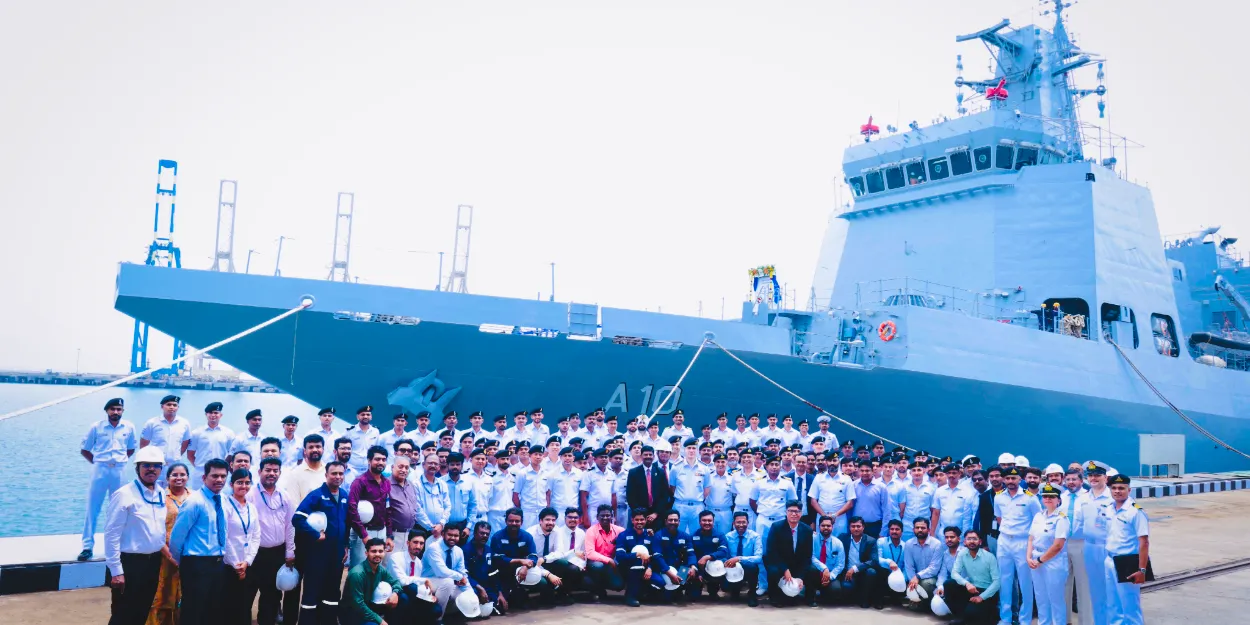
Samarthak: Inside India’s Fast-Moving Warship Boom

The ship the Indian Navy formally accepted on 27 August 2026 was never meant to fire a shot in anger. Samarthak’s entire purpose is to test the weapons other ships will eventually carry — which is precisely why almost nobody outside the Ministry of Defence noticed its delivery. That is a mistake. Look past the modest specifications, and Samarthak turns out to be one of the more revealing data points in a shipbuilding programme currently moving faster than at any point in the Navy’s history.

What Samarthak is

Built by Larsen & Toubro at its Kattupalli Shipyard near Chennai, Samarthak is the first of two Multi-Purpose Vessels (MPVs) ordered by the Ministry of Defence, closing a project that traces back to a contract signed with L&T in March 2022. According to the Press Information Bureau, the ship comprises over 75 percent indigenous content — well within range of the indigenisation benchmarks the government has been tracking across its positive indigenisation lists — and is intended chiefly as a versatile trial and evaluation platform, tasked with maritime surveillance and reconnaissance, offshore patrolling, and support for humanitarian assistance and disaster relief operations when required.

L&T’s own account of the vessel, issued when it was launched in October 2024, is more specific about the underlying purpose: the vessel is meant to serve as a trial platform for the development of next-generation weapons and sensors for the Navy, alongside duties such as launching and recovering surface and aerial targets, maritime surveillance, patrolling, and combating sea pollution. At 107 metres long, with an 18.6-metre beam and a displacement above 3,750 tonnes, it is not a small ship — closer in size to a corvette than a patrol boat. But its role has nothing to do with combat.

That distinction matters.

The gap Samarthak fills

Every indigenous weapon or sensor that DRDO or a private developer builds for the Navy eventually needs to be fired, dropped, launched or tracked from something before it can be certified for fleet-wide use. A dedicated trial ship removes the friction of improvising that testing on operational warships doing double duty. As India’s pipeline of indigenous naval weapons and sensors grows, the case for exactly this kind of unglamorous, purpose-built platform grows with it.

This paragraph is TES Analysis. Neither the Navy nor L&T has publicly framed the project in these terms; the reasoning above is our own reading of why a platform like this fits the current moment.

What the launch record shows

At the launch ceremony in October 2024, AT Ramchandani, L&T’s senior vice president heading Precision Engineering & Systems, said the vessel had gone into the water on schedule “notwithstanding geopolitical disruptions in supply chains” — a modest claim, but a real one for a shipyard managing a global supply chain through a period of sanctions, tariffs and rerouted trade. The ship was designed in-house by L&T rather than assembled from an imported blueprint, which is worth noting: Kattupalli is demonstrating design capability, not just fabrication capacity.

The delivery timeline is worth a moment too. The ship went from launch to delivery in roughly 22 months — a reasonably tight window for a first-of-class platform, and well inside the multi-year spans that comparable naval programmes at other Indian yards have typically needed. Read against a private yard’s broader order book, it starts to look less like a one-off achievement and more like a routine one.

Why production is “in full swing”

Samarthak did not arrive in isolation. According to the Ministry of Defence’s own Navy Day release in December 2025, 51 large ships are currently under construction in Indian shipyards, worth approximately ₹90,000 crore. Since 2014, Indian yards have delivered more than 40 indigenous warships and submarines to the Navy, and over the past year a new vessel has entered service on average every 40 days. Roughly 67 percent of the Navy’s capital acquisition spending over the last decade has gone to Indian industry, and the Navy’s own budget has nearly doubled — from ₹49,623 crore in 2020–21 to ₹1,03,548 crore in 2025–26 — lifting its share of total defence spending from 15 to 21 percent. The broader Indian shipbuilding industry has expanded alongside this defence push.

The numbers hold up at the level of a single yard, too. At Kattupalli, L&T is simultaneously building the two Samarthak-class MPVs, three Cadet Training Ships and six other defence vessels under a public-private-partnership model — on top of repairing the US Navy support ship USNS Charles Drew under a Master Ship Repair Agreement, and constructing two of the five Fleet Support Ships that the government contracted Hindustan Shipyard Limited to deliver under a ₹19,000-crore deal signed in August 2023. That order book is a more concrete illustration of “full swing” than any national aggregate: one private shipyard, roughly a dozen concurrent defence projects, several different customers.

The MSME backbone behind India’s shipbuilding scale

None of this runs on prime contractors alone. Speaking at the Samudra Utkarsh seminar in New Delhi in November 2025, Defence Minister Rajnath Singh described India’s shipbuilding ecosystem as one now powered by public sector yards, private companies and thousands of small and medium enterprises functioning as an integrated framework, not a supply chain bolted on as an afterthought. INS Vikrant, India’s first indigenous aircraft carrier, is the clearest illustration of what that looks like in practice: beyond the familiar names — BEL, BHEL, GRSE, Keltron, Kirloskar, L&T — the carrier’s construction drew on more than 100 MSMEs for components ranging from cabling to fittings to specialised machining.

The government has tried to formalise that dependence rather than leave it informal. The private sector’s share of overall defence production reached 22 percent in FY24, the highest in eight years, supported by dedicated budget lines and schemes such as iDEX and the Technology Development Fund aimed at drawing India’s defence MSME sector into design and manufacturing roles that used to sit almost exclusively with PSUs. It is a slower, less photogenic story than a warship launch. It is also the one that will determine whether the current pace holds for a decade or fades in three years.

The markets angle

For investors, the read-through is straightforward on paper, even if it doesn’t always show up cleanly in the share price. L&T’s shipbuilding activity sits inside a much larger conglomerate, so Samarthak’s delivery alone won’t move markets — but it adds another data point to an order book that already spans MPVs, cadet training ships, Fleet Support Ship components and a US Navy repair contract. Garden Reach Shipbuilders, Cochin Shipyard and Mazagon Dock Shipbuilders — pure-play or majority-defence PSU yards — carry more direct exposure to the broader ₹90,000-crore, 51-ship pipeline described above, and their order books have expanded in step with the Navy’s accelerated induction schedule.

Investment Disclaimer This article discusses listed companies and sector-wide procurement data for informational purposes only. It is not investment advice or a recommendation to buy, sell or hold any security. Readers should conduct independent research or consult a licensed financial advisor before making investment decisions. Stock prices and order-book figures are subject to change and should be verified against current company disclosures.

What’s next for the MPV class and the wider fleet

Samarthak’s sister ship, Utkarsh, launched in January 2025 and remains in the fitting-out and trials process; its delivery date has not been officially confirmed. On the fleet-wide horizon, the numbers get less tidy. Navy Chief Admiral Dinesh K. Tripathi said in February 2026 that the service added 12 warships and one submarine in 2025 and could add around 15 more in 2026 — the highest single-year total in its history — on the way to a fleet of more than 200 ships by 2035, with 50 ships currently on order, all built domestically. An earlier statement from the Vice Chief of Naval Staff in October 2025 had cited somewhat different figures: 10 ships and one submarine for 2025, and a 2035 target of roughly 175 ships. TES has not been able to reconcile the two accounts and is attributing each figure to the officer who stated it rather than treating either as a single settled number.

Takeaway

The Navy marks its most celebrated victory, Operation Trident, from a war fought in December 1971 with missile boats bought almost entirely from the Soviet Union. Samarthak’s real significance lies in how far that picture has reversed: a Navy that once imported its firepower now needs a dedicated ship just to test the firepower it builds itself. That is not a headline. It is infrastructure. And infrastructure, more than any single frigate or destroyer, is what will decide whether “full swing” shipbuilding lasts a decade or fades in three years.

Source Transparency Note

Verified fact (PIB / official government sources): Samarthak’s delivery date, indigenous content percentage, stated role; Navy Day shipbuilding statistics (51 ships, ₹90,000 crore, 40-day induction average, 67% capital acquisition, Navy budget figures); Fleet Support Ship contract value and Kattupalli’s role in it.

Official company disclosure: Samarthak’s dimensions, launch date, design provenance, and the Ramchandani quote (L&T press release); Kattupalli’s concurrent order book.

Official statement, attributed: Rajnath Singh’s Samudra Utkarsh remarks on the MSME-integrated shipbuilding ecosystem; Admiral Dinesh K. Tripathi’s and the Vice Chief of Naval Staff’s fleet-growth figures, presented as two distinct, unreconciled statements.

TES Analysis (marked in text): The reasoning on why a dedicated trial ship fills a structural gap in India’s weapons-development pipeline.

The ship the Indian Navy formally accepted on 27 August 2026 was never meant to fire a shot in anger. Samarthak’s entire purpose is to test the weapons other ships will eventually carry — which is precisely why almost nobody outside the Ministry of Defence noticed its delivery. That is a mistake. Look past the modest specifications, and Samarthak turns out to be one of the more revealing data points in a shipbuilding programme currently moving faster than at any point in the Navy’s history.

What Samarthak is

Built by Larsen & Toubro at its Kattupalli Shipyard near Chennai, Samarthak is the first of two Multi-Purpose Vessels (MPVs) ordered by the Ministry of Defence, closing a project that traces back to a contract signed with L&T in March 2022. According to the Press Information Bureau, the ship comprises over 75 percent indigenous content — well within range of the indigenisation benchmarks the government has been tracking across its positive indigenisation lists — and is intended chiefly as a versatile trial and evaluation platform, tasked with maritime surveillance and reconnaissance, offshore patrolling, and support for humanitarian assistance and disaster relief operations when required.

L&T’s own account of the vessel, issued when it was launched in October 2024, is more specific about the underlying purpose: the vessel is meant to serve as a trial platform for the development of next-generation weapons and sensors for the Navy, alongside duties such as launching and recovering surface and aerial targets, maritime surveillance, patrolling, and combating sea pollution. At 107 metres long, with an 18.6-metre beam and a displacement above 3,750 tonnes, it is not a small ship — closer in size to a corvette than a patrol boat. But its role has nothing to do with combat.

That distinction matters.

The gap Samarthak fills

Every indigenous weapon or sensor that DRDO or a private developer builds for the Navy eventually needs to be fired, dropped, launched or tracked from something before it can be certified for fleet-wide use. A dedicated trial ship removes the friction of improvising that testing on operational warships doing double duty. As India’s pipeline of indigenous naval weapons and sensors grows, the case for exactly this kind of unglamorous, purpose-built platform grows with it.

This paragraph is TES Analysis. Neither the Navy nor L&T has publicly framed the project in these terms; the reasoning above is our own reading of why a platform like this fits the current moment.

What the launch record shows

At the launch ceremony in October 2024, AT Ramchandani, L&T’s senior vice president heading Precision Engineering & Systems, said the vessel had gone into the water on schedule “notwithstanding geopolitical disruptions in supply chains” — a modest claim, but a real one for a shipyard managing a global supply chain through a period of sanctions, tariffs and rerouted trade. The ship was designed in-house by L&T rather than assembled from an imported blueprint, which is worth noting: Kattupalli is demonstrating design capability, not just fabrication capacity.

The delivery timeline is worth a moment too. The ship went from launch to delivery in roughly 22 months — a reasonably tight window for a first-of-class platform, and well inside the multi-year spans that comparable naval programmes at other Indian yards have typically needed. Read against a private yard’s broader order book, it starts to look less like a one-off achievement and more like a routine one.

Why production is “in full swing”

Samarthak did not arrive in isolation. According to the Ministry of Defence’s own Navy Day release in December 2025, 51 large ships are currently under construction in Indian shipyards, worth approximately ₹90,000 crore. Since 2014, Indian yards have delivered more than 40 indigenous warships and submarines to the Navy, and over the past year a new vessel has entered service on average every 40 days. Roughly 67 percent of the Navy’s capital acquisition spending over the last decade has gone to Indian industry, and the Navy’s own budget has nearly doubled — from ₹49,623 crore in 2020–21 to ₹1,03,548 crore in 2025–26 — lifting its share of total defence spending from 15 to 21 percent. The broader Indian shipbuilding industry has expanded alongside this defence push.

The numbers hold up at the level of a single yard, too. At Kattupalli, L&T is simultaneously building the two Samarthak-class MPVs, three Cadet Training Ships and six other defence vessels under a public-private-partnership model — on top of repairing the US Navy support ship USNS Charles Drew under a Master Ship Repair Agreement, and constructing two of the five Fleet Support Ships that the government contracted Hindustan Shipyard Limited to deliver under a ₹19,000-crore deal signed in August 2023. That order book is a more concrete illustration of “full swing” than any national aggregate: one private shipyard, roughly a dozen concurrent defence projects, several different customers.

The MSME backbone behind India’s shipbuilding scale

None of this runs on prime contractors alone. Speaking at the Samudra Utkarsh seminar in New Delhi in November 2025, Defence Minister Rajnath Singh described India’s shipbuilding ecosystem as one now powered by public sector yards, private companies and thousands of small and medium enterprises functioning as an integrated framework, not a supply chain bolted on as an afterthought. INS Vikrant, India’s first indigenous aircraft carrier, is the clearest illustration of what that looks like in practice: beyond the familiar names — BEL, BHEL, GRSE, Keltron, Kirloskar, L&T — the carrier’s construction drew on more than 100 MSMEs for components ranging from cabling to fittings to specialised machining.

The government has tried to formalise that dependence rather than leave it informal. The private sector’s share of overall defence production reached 22 percent in FY24, the highest in eight years, supported by dedicated budget lines and schemes such as iDEX and the Technology Development Fund aimed at drawing India’s defence MSME sector into design and manufacturing roles that used to sit almost exclusively with PSUs. It is a slower, less photogenic story than a warship launch. It is also the one that will determine whether the current pace holds for a decade or fades in three years.

The markets angle

For investors, the read-through is straightforward on paper, even if it doesn’t always show up cleanly in the share price. L&T’s shipbuilding activity sits inside a much larger conglomerate, so Samarthak’s delivery alone won’t move markets — but it adds another data point to an order book that already spans MPVs, cadet training ships, Fleet Support Ship components and a US Navy repair contract. Garden Reach Shipbuilders, Cochin Shipyard and Mazagon Dock Shipbuilders — pure-play or majority-defence PSU yards — carry more direct exposure to the broader ₹90,000-crore, 51-ship pipeline described above, and their order books have expanded in step with the Navy’s accelerated induction schedule.

Investment Disclaimer This article discusses listed companies and sector-wide procurement data for informational purposes only. It is not investment advice or a recommendation to buy, sell or hold any security. Readers should conduct independent research or consult a licensed financial advisor before making investment decisions. Stock prices and order-book figures are subject to change and should be verified against current company disclosures.

What’s next for the MPV class and the wider fleet

Samarthak’s sister ship, Utkarsh, launched in January 2025 and remains in the fitting-out and trials process; its delivery date has not been officially confirmed. On the fleet-wide horizon, the numbers get less tidy. Navy Chief Admiral Dinesh K. Tripathi said in February 2026 that the service added 12 warships and one submarine in 2025 and could add around 15 more in 2026 — the highest single-year total in its history — on the way to a fleet of more than 200 ships by 2035, with 50 ships currently on order, all built domestically. An earlier statement from the Vice Chief of Naval Staff in October 2025 had cited somewhat different figures: 10 ships and one submarine for 2025, and a 2035 target of roughly 175 ships. TES has not been able to reconcile the two accounts and is attributing each figure to the officer who stated it rather than treating either as a single settled number.

Takeaway

The Navy marks its most celebrated victory, Operation Trident, from a war fought in December 1971 with missile boats bought almost entirely from the Soviet Union. Samarthak’s real significance lies in how far that picture has reversed: a Navy that once imported its firepower now needs a dedicated ship just to test the firepower it builds itself. That is not a headline. It is infrastructure. And infrastructure, more than any single frigate or destroyer, is what will decide whether “full swing” shipbuilding lasts a decade or fades in three years.

Source Transparency Note

Verified fact (PIB / official government sources): Samarthak’s delivery date, indigenous content percentage, stated role; Navy Day shipbuilding statistics (51 ships, ₹90,000 crore, 40-day induction average, 67% capital acquisition, Navy budget figures); Fleet Support Ship contract value and Kattupalli’s role in it.

Official company disclosure: Samarthak’s dimensions, launch date, design provenance, and the Ramchandani quote (L&T press release); Kattupalli’s concurrent order book.

Official statement, attributed: Rajnath Singh’s Samudra Utkarsh remarks on the MSME-integrated shipbuilding ecosystem; Admiral Dinesh K. Tripathi’s and the Vice Chief of Naval Staff’s fleet-growth figures, presented as two distinct, unreconciled statements.

TES Analysis (marked in text): The reasoning on why a dedicated trial ship fills a structural gap in India’s weapons-development pipeline.

The ship the Indian Navy formally accepted on 27 August 2026 was never meant to fire a shot in anger. Samarthak’s entire purpose is to test the weapons other ships will eventually carry — which is precisely why almost nobody outside the Ministry of Defence noticed its delivery. That is a mistake. Look past the modest specifications, and Samarthak turns out to be one of the more revealing data points in a shipbuilding programme currently moving faster than at any point in the Navy’s history.

What Samarthak is

Built by Larsen & Toubro at its Kattupalli Shipyard near Chennai, Samarthak is the first of two Multi-Purpose Vessels (MPVs) ordered by the Ministry of Defence, closing a project that traces back to a contract signed with L&T in March 2022. According to the Press Information Bureau, the ship comprises over 75 percent indigenous content — well within range of the indigenisation benchmarks the government has been tracking across its positive indigenisation lists — and is intended chiefly as a versatile trial and evaluation platform, tasked with maritime surveillance and reconnaissance, offshore patrolling, and support for humanitarian assistance and disaster relief operations when required.

L&T’s own account of the vessel, issued when it was launched in October 2024, is more specific about the underlying purpose: the vessel is meant to serve as a trial platform for the development of next-generation weapons and sensors for the Navy, alongside duties such as launching and recovering surface and aerial targets, maritime surveillance, patrolling, and combating sea pollution. At 107 metres long, with an 18.6-metre beam and a displacement above 3,750 tonnes, it is not a small ship — closer in size to a corvette than a patrol boat. But its role has nothing to do with combat.

That distinction matters.

The gap Samarthak fills

Every indigenous weapon or sensor that DRDO or a private developer builds for the Navy eventually needs to be fired, dropped, launched or tracked from something before it can be certified for fleet-wide use. A dedicated trial ship removes the friction of improvising that testing on operational warships doing double duty. As India’s pipeline of indigenous naval weapons and sensors grows, the case for exactly this kind of unglamorous, purpose-built platform grows with it.

This paragraph is TES Analysis. Neither the Navy nor L&T has publicly framed the project in these terms; the reasoning above is our own reading of why a platform like this fits the current moment.

What the launch record shows

At the launch ceremony in October 2024, AT Ramchandani, L&T’s senior vice president heading Precision Engineering & Systems, said the vessel had gone into the water on schedule “notwithstanding geopolitical disruptions in supply chains” — a modest claim, but a real one for a shipyard managing a global supply chain through a period of sanctions, tariffs and rerouted trade. The ship was designed in-house by L&T rather than assembled from an imported blueprint, which is worth noting: Kattupalli is demonstrating design capability, not just fabrication capacity.

The delivery timeline is worth a moment too. The ship went from launch to delivery in roughly 22 months — a reasonably tight window for a first-of-class platform, and well inside the multi-year spans that comparable naval programmes at other Indian yards have typically needed. Read against a private yard’s broader order book, it starts to look less like a one-off achievement and more like a routine one.

Why production is “in full swing”

Samarthak did not arrive in isolation. According to the Ministry of Defence’s own Navy Day release in December 2025, 51 large ships are currently under construction in Indian shipyards, worth approximately ₹90,000 crore. Since 2014, Indian yards have delivered more than 40 indigenous warships and submarines to the Navy, and over the past year a new vessel has entered service on average every 40 days. Roughly 67 percent of the Navy’s capital acquisition spending over the last decade has gone to Indian industry, and the Navy’s own budget has nearly doubled — from ₹49,623 crore in 2020–21 to ₹1,03,548 crore in 2025–26 — lifting its share of total defence spending from 15 to 21 percent. The broader Indian shipbuilding industry has expanded alongside this defence push.

The numbers hold up at the level of a single yard, too. At Kattupalli, L&T is simultaneously building the two Samarthak-class MPVs, three Cadet Training Ships and six other defence vessels under a public-private-partnership model — on top of repairing the US Navy support ship USNS Charles Drew under a Master Ship Repair Agreement, and constructing two of the five Fleet Support Ships that the government contracted Hindustan Shipyard Limited to deliver under a ₹19,000-crore deal signed in August 2023. That order book is a more concrete illustration of “full swing” than any national aggregate: one private shipyard, roughly a dozen concurrent defence projects, several different customers.

The MSME backbone behind India’s shipbuilding scale

None of this runs on prime contractors alone. Speaking at the Samudra Utkarsh seminar in New Delhi in November 2025, Defence Minister Rajnath Singh described India’s shipbuilding ecosystem as one now powered by public sector yards, private companies and thousands of small and medium enterprises functioning as an integrated framework, not a supply chain bolted on as an afterthought. INS Vikrant, India’s first indigenous aircraft carrier, is the clearest illustration of what that looks like in practice: beyond the familiar names — BEL, BHEL, GRSE, Keltron, Kirloskar, L&T — the carrier’s construction drew on more than 100 MSMEs for components ranging from cabling to fittings to specialised machining.

The government has tried to formalise that dependence rather than leave it informal. The private sector’s share of overall defence production reached 22 percent in FY24, the highest in eight years, supported by dedicated budget lines and schemes such as iDEX and the Technology Development Fund aimed at drawing India’s defence MSME sector into design and manufacturing roles that used to sit almost exclusively with PSUs. It is a slower, less photogenic story than a warship launch. It is also the one that will determine whether the current pace holds for a decade or fades in three years.

The markets angle

For investors, the read-through is straightforward on paper, even if it doesn’t always show up cleanly in the share price. L&T’s shipbuilding activity sits inside a much larger conglomerate, so Samarthak’s delivery alone won’t move markets — but it adds another data point to an order book that already spans MPVs, cadet training ships, Fleet Support Ship components and a US Navy repair contract. Garden Reach Shipbuilders, Cochin Shipyard and Mazagon Dock Shipbuilders — pure-play or majority-defence PSU yards — carry more direct exposure to the broader ₹90,000-crore, 51-ship pipeline described above, and their order books have expanded in step with the Navy’s accelerated induction schedule.

Investment Disclaimer This article discusses listed companies and sector-wide procurement data for informational purposes only. It is not investment advice or a recommendation to buy, sell or hold any security. Readers should conduct independent research or consult a licensed financial advisor before making investment decisions. Stock prices and order-book figures are subject to change and should be verified against current company disclosures.

What’s next for the MPV class and the wider fleet

Samarthak’s sister ship, Utkarsh, launched in January 2025 and remains in the fitting-out and trials process; its delivery date has not been officially confirmed. On the fleet-wide horizon, the numbers get less tidy. Navy Chief Admiral Dinesh K. Tripathi said in February 2026 that the service added 12 warships and one submarine in 2025 and could add around 15 more in 2026 — the highest single-year total in its history — on the way to a fleet of more than 200 ships by 2035, with 50 ships currently on order, all built domestically. An earlier statement from the Vice Chief of Naval Staff in October 2025 had cited somewhat different figures: 10 ships and one submarine for 2025, and a 2035 target of roughly 175 ships. TES has not been able to reconcile the two accounts and is attributing each figure to the officer who stated it rather than treating either as a single settled number.

Takeaway

The Navy marks its most celebrated victory, Operation Trident, from a war fought in December 1971 with missile boats bought almost entirely from the Soviet Union. Samarthak’s real significance lies in how far that picture has reversed: a Navy that once imported its firepower now needs a dedicated ship just to test the firepower it builds itself. That is not a headline. It is infrastructure. And infrastructure, more than any single frigate or destroyer, is what will decide whether “full swing” shipbuilding lasts a decade or fades in three years.

Source Transparency Note

Verified fact (PIB / official government sources): Samarthak’s delivery date, indigenous content percentage, stated role; Navy Day shipbuilding statistics (51 ships, ₹90,000 crore, 40-day induction average, 67% capital acquisition, Navy budget figures); Fleet Support Ship contract value and Kattupalli’s role in it.

Official company disclosure: Samarthak’s dimensions, launch date, design provenance, and the Ramchandani quote (L&T press release); Kattupalli’s concurrent order book.

Official statement, attributed: Rajnath Singh’s Samudra Utkarsh remarks on the MSME-integrated shipbuilding ecosystem; Admiral Dinesh K. Tripathi’s and the Vice Chief of Naval Staff’s fleet-growth figures, presented as two distinct, unreconciled statements.

TES Analysis (marked in text): The reasoning on why a dedicated trial ship fills a structural gap in India’s weapons-development pipeline.

Abhishek Kumar

Abhishek Kumar

Founder & Lead Analyst

Abhishek Kumar is the Founder and Lead Analyst of The Eastern Strategist. He has over 25 years of journalism experience across Zee News, Sahara TV, Network18 and India TV. He holds a Bachelor's degree in Economics (Honours), bringing an economics perspective to reporting on geopolitics, defense, trade, markets and macroeconomic developments.

1 thought on “Samarthak: Inside India’s Fast-Moving Warship Boom”

Leave a Comment