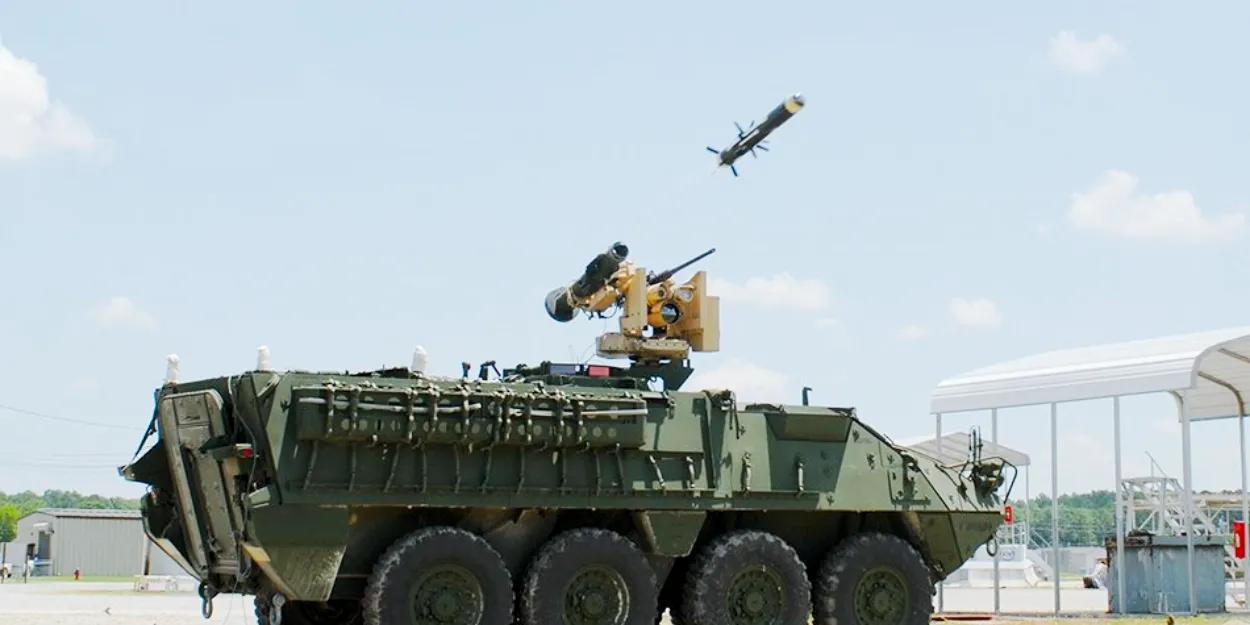
A Rs 292-crore Javelin missile deal signed on 28 August closes a procurement saga that began in 2010. It arrived through routine financial powers, not a fresh Ladakh crisis — and years before DRDO’s indigenous alternative is ready for mass production.
In 2010, the Indian Army began looking for a shoulder-fired missile that could kill a tank from above, without exposing the soldier who fired it. On 28 August 2026, it finally signed for one. The stranger part is how the deal closed: not through a fresh crisis on the Ladakh plateau, but through a routine financial delegation that exists because of an entirely different conflict. The Javelin missile has arrived in the Indian Army’s inventory. The missile meant to replace it has not.
A Sixteen-Year Wait, Quietly Ended
On 28 August 2026, India and the United States signed a government-to-government Letter of Offer and Acceptance for the FGM-148 Javelin anti-tank guided missile, executed through the US Foreign Military Sales process. The US Embassy in India confirmed the signing the same day, with US Ambassador Sergio Gor calling it proof that the defence partnership “has never been stronger.” The deal itself has a far longer backstory than the announcement suggests.
India first approached Washington about the Javelin missile in 2010, after the missile was showcased to Indian troops during a joint exercise at Babina Cantonment near Jhansi. Then-Defence Minister A K Antony told Parliament that year that the ministry would issue a Letter of Request through the FMS route. Sixteen years, several stalled negotiations, and one abandoned co-production attempt later, the Army has an actual contract.
Procurement sagas rarely end quietly. This one did.
The Javelin Missile Deal, Line by Line
India has contracted for roughly 60 Javelin missiles at a cost of approximately Rs 292–294 crore, according to defence sources cited by ANI and ThePrint. That is a smaller package than the ceiling the US State Department’s Defense Security Cooperation Agency cleared for possible sale in November 2025 — up to 100 missile rounds and 25 command launch units, worth as much as $93 million.
The two figures describe different things. TES Analysis: the gap between an FMS ceiling approval and the actual signed contract is routine — Washington clears the maximum package a buyer could purchase, and the government-to-government LOA is often signed for a smaller, more immediate tranche. The contracted package reportedly includes training equipment, missile simulation rounds, a battery coolant unit, technical manuals, spares and lifecycle support, per ThePrint’s reporting.
Emergency Powers, Not an Emergency
The deal was executed under India’s Emergency Procurement (EP-6) powers — a financial delegation capping purchases at Rs 300 crore per case, which lets the armed forces sanction a buy without the longer standard acquisition process. Defence sources told ANI the powers were expanded specifically after Operation Sindoor last year, to help the forces close capability gaps quickly. The Javelin missile buy fits under that cap almost exactly.
Read plainly, “emergency” here describes a financial mechanism, not a fresh trigger on the border. The same EP-6 route has also been used to buy Excalibur precision-guided artillery ammunition, per ANI’s reporting. Deliveries under these EP-6 contracts are generally expected to begin by the end of FY 2026–27, though several suppliers have sought timeline extensions citing disruptions from the West Asia conflict.
The label survived. The circumstances that named it didn’t.
Fig. 1 — The Javelin missile’s procurement path and DRDO’s MPATGM development path have run for years on separate tracks, converging only now.
The Gap on the Ladakh Plateau
The Javelin purchase is meant to address a capability gap that has persisted since the 2020 Galwan clash: high-altitude terrain along the Line of Actual Control where Indian infantry battalions have lacked a reliable, modern, top-attack anti-tank missile. An earlier emergency purchase of Israeli Spike ATGMs in 2019–2020 was meant to fill the same gap, but the system reportedly struggled with target detection in the extreme heat and dust of desert trial conditions, according to defence-industry reporting.
Indian and international defence analysts have documented the People’s Liberation Army’s deployment of lighter, high-altitude-optimised armour — including the Type 15 light tank — alongside heavier Type 99A main battle tanks in the Western Theatre Command sector opposite Ladakh. TES Analysis: a fire-and-forget, top-attack missile is specifically suited to defeating the explosive reactive armour such platforms carry, which is why the capability gap, not any single vendor, has been the persistent story here.
The Missile That Was Supposed to Replace It
DRDO’s indigenous Man-Portable Anti-Tank Guided Missile (MPATGM), developed to eventually replace both the Javelin missile and older imports, has not yet entered mass production. Bharat Dynamics Limited and private partner VEM Technologies are set to begin full-scale manufacturing once final user evaluation trials — currently under way across Ladakh’s high-altitude terrain and in desert conditions — are complete. Serial production is targeted for late 2026, with first deliveries projected only for 2027.
That timing gap matters for how this story gets read. The Javelin missile isn’t arriving because Atmanirbhar Bharat failed, and MPATGM isn’t behind because indigenous development doesn’t work. It’s arriving because trial timelines and border requirements don’t move in sync. Separately, Defence Minister Rajnath Singh approved a broader policy in August 2026 opening DRDO-developed conventional missile technology to private-sector manufacturing at large, under a Development-cum-Production Partner model — a structural shift that extends well beyond MPATGM alone, as The Eastern Strategist has covered separately.
Bharat Dynamics and the Co-Production Question
The immediate Javelin purchase is financially modest, but a parallel track matters more for India’s defence-industrial base. Bharat Dynamics Limited signed a memorandum of understanding with the Javelin Joint Venture — the Lockheed Martin-RTX partnership that manufactures the missile — in February 2025 to evaluate local co-production. Friday’s US Embassy statement reiterated that the LOA “opens the door” to that possibility, though no co-production contract has been finalised.
BDL is a listed, majority government-owned defence PSU whose share price has historically moved on confirmed order announcements far smaller than its existing order book: an 8 percent jump followed a Rs 2,960-crore MRSAM contract in January 2025, and a 10 percent rally followed a Rs 3,132-crore Konkurs-M contract, according to Business Standard’s market reporting. At roughly Rs 292 crore, this week’s Javelin LOA is small next to BDL’s order book, which stood at Rs 26,176 crore as of 31 March 2026 — up 14.7 percent over the year, per the company’s FY26 investor presentation. TES Analysis: BDL’s stock has also shown it doesn’t move on order-book size alone; shares fell nearly 9 percent after a weak Q4 FY26 earnings print despite the large backlog, a reminder that execution and delivery timing matter as much as headline order value. The number worth tracking from this week’s news isn’t the Javelin contract itself — it’s whether the JJV-BDL MoU converts into a firm co-production deal, which would be a materially different order of magnitude.
The Ten-Year Umbrella
Friday’s LOA sits inside a broader structure: the 2025 Framework for the US-India Major Defense Partnership, signed by Defence Minister Rajnath Singh and then-US Secretary of War Pete Hegseth on 31 October 2025 in Kuala Lumpur. The ten-year framework, renewed roughly once a decade, replaced the 2015 arrangement and both governments describe it as the umbrella document guiding deeper co-production and industrial cooperation — the same language now attached to the Javelin missile deal. The Eastern Strategist has traced how Operation Sindoor reshaped India’s broader modernisation posture, of which this financial delegation is one downstream effect.
What to Watch
Will the BDL–Javelin Joint Venture MoU convert into a firm co-production contract?
Not yet finalised; talks remain at the evaluation stage as of August 2026. A firm contract would be the clearer signal for BDL’s order book than this LOA, and worth more than the missile purchase itself.
When will DRDO’s MPATGM be ready for induction?
Serial production is targeted for late 2026, contingent on final user evaluation trials in Ladakh and desert terrain concluding on schedule; first deliveries are projected for 2027.
Could India expand the Javelin missile purchase beyond the initial ~60 missiles?
Possible. The November 2025 DSCA clearance covers a larger package — up to 100 rounds and 25 launch units — than what has been contracted so far, leaving room for a follow-on order without a fresh US approval process.
In October 1973, as Egyptian and Syrian forces pushed into the Sinai and the Golan, the United States airlifted TOW anti-tank missiles to Israel under Operation Nickel Grass — a resupply effort born of battlefield urgency, executed in days. India’s Javelin missile deal took the opposite path: sixteen years of negotiation, a war it wasn’t fighting, and financial powers built for a different crisis, before a soldier on the Ladakh plateau gets a missile that was already on the table when the conversation began. Speed, it turns out, isn’t always the scarce resource in a procurement decision. Patience is.
Related reading: India’s private missile manufacturing shift | Defence stocks and the sixth positive indigenisation list | From Kargil to Operation Sindoor