
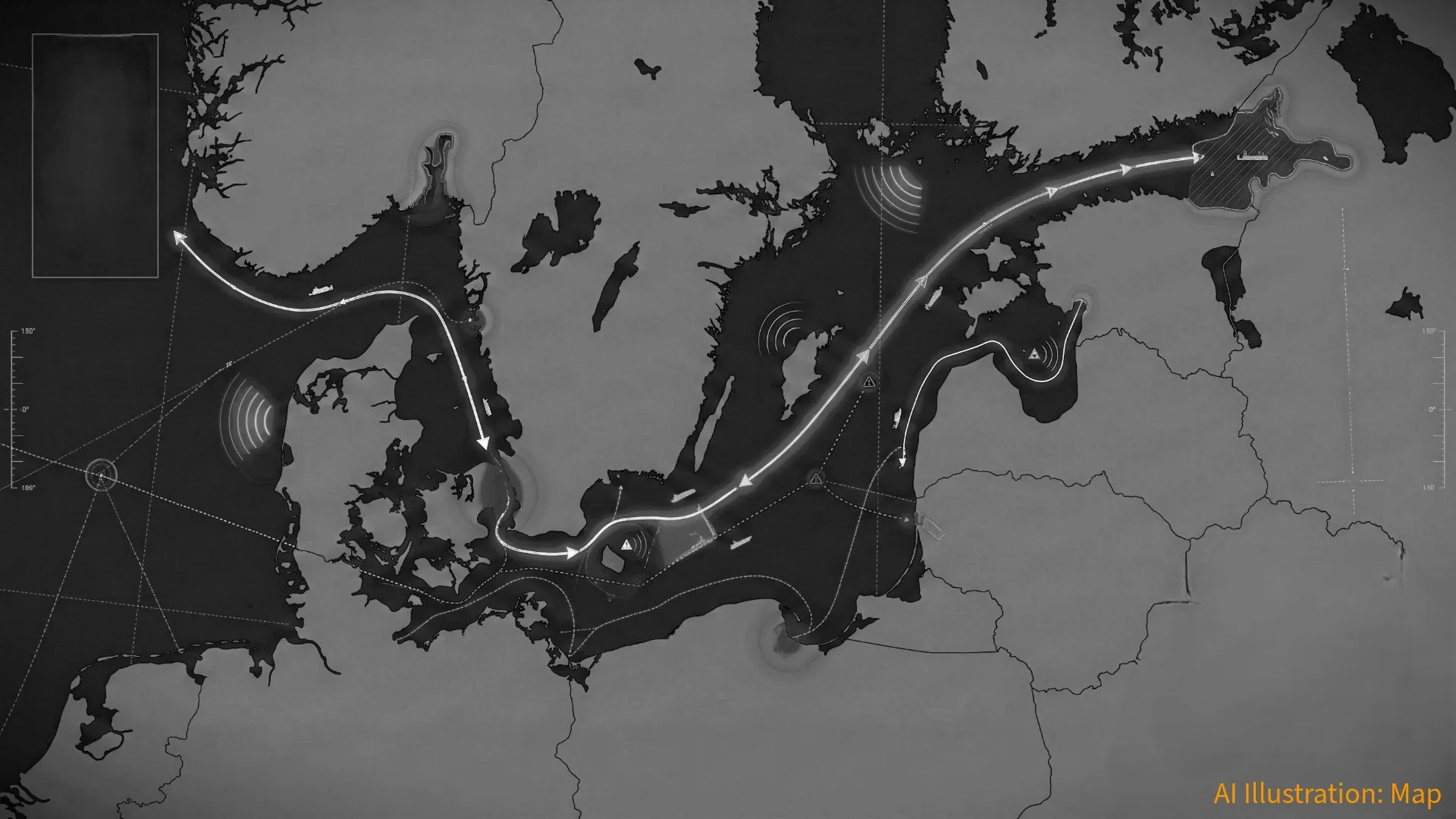
Baltic tensions affect Indian crude imports through the price of Russian oil before they touch volumes, and India sits closer to the Baltic than most buyers realise: it takes around 90 per cent of the loadings at Primorsk and Ust-Luga, Russia’s two main Baltic oil ports, according to Kpler data reported on 31 October. Vladimir Putin’s warning that restricted Baltic shipping could produce a Hormuz-like situation has not changed that arithmetic. The first freight bill falls on the Russian seller.
Putin made the remark in Moscow on 29 October, after being asked about the 27 October call with Finland’s President Alexander Stubb and Norway’s Prime Minister Jonas Gahr Støre. Russia wants no impediments to navigation in the Baltic Sea, he said, and restrictions could produce a situation like the one in the Strait of Hormuz, where traffic has been disrupted since the US-Iran war began in February, Reuters reported.
For Indian refiners the exposure runs through a different channel from the one the headline suggests. It sits in the Urals discount and in the number of cargoes on offer, and the data from October show both already moving.
Why Putin’s Hormuz Comparison Is a Warning, Not a Blockade
Putin announced no blockade and no military measure. The remark is a conditional warning aimed at any European move to restrict Russian shipping, and its logic cuts against Moscow itself: Russia loads crude at Primorsk and Ust-Luga, so a closed Baltic would hit Russian export revenue first. It signals deterrence and does not describe an operational plan.
The law also differs from the Gulf. Under the Copenhagen Convention of 1857, merchant ships enjoy free passage through the Danish straits, so any restriction would have to arrive through inspections and insurance checks, not a closure. The North Atlantic Treaty Organization’s Baltic Sentry mission, launched in January 2025 to protect undersea cables and pipelines, already monitors the area. In the Strait of Hormuz, by contrast, Iran asserted control over a chokepoint it borders.
The Nordic call itself was narrower than the headlines suggested. According to the Norwegian government’s statement, Stubb and Støre initiated the call, spoke for their own countries and not for Europe as a whole, and stressed a shared interest in stability and predictability in the Baltic region. The Kremlin’s readout said the leaders reaffirmed international maritime law and freedom of navigation.
The call asked for predictability. The Hormuz parallel Putin drew two days later is a separate signal about the cost of disruption. Neither is a supply event. Baltic tensions affect Indian crude imports only when a cargo is delayed or repriced, and neither signal has yet done that.
Why Baltic Tensions Affect Indian Crude Imports Through the Urals Discount, Not Freight Bills
Spot Urals sold to India is quoted on a delivered ex-ship (DES) basis, according to trader assessments reported by Reuters, so the seller pays for shipping and insurance until the cargo is discharged. A Baltic freight spike therefore cuts Russian netbacks first. Indian refiners feel it only when sellers pass the cost into the DES differential, or when fewer cargoes are on offer.
That pass-through has happened before. In late 2025, trader assessments reported by Reuters put DES discounts to Indian ports at USD 7 a barrel or more (about ₹665 at current rates), up from USD 1-2 in August, with sanctions and high freight both cited. Term contracts may price differently, and no public data show what share of Baltic volumes moves that way.
The mechanism is already running. Kpler’s lead analyst for oil markets and refineries, Nikhil Dubey, expects Russian suppliers to face further pressure in November and December as higher freight costs erode their price advantage, while Middle Eastern producers offer more competitive delivered prices and concessions to defend market share.
What a USD 1.50 Freight Rise Would Cost: ₹17-25 Crore a Day Across the Flow
A USD 1.50-a-barrel (₹142) freight increase on Baltic-loaded crude would cost roughly ₹17-25 crore a day across the whole flow, or ₹6,100-9,250 crore a year, at ₹94.95 to the dollar. That is a gross figure for all parties. Indian refiners would bear only the share that sellers pass through.
| Input | Value |
|---|---|
| Russian crude arrivals in India, October | about 1.97 million barrels a day |
| Black Sea arrivals, October | about 0.19 million barrels a day |
| Baltic share assumed (historical) | 60-70%, or 1.18-1.38 million |
| Ceiling case (all non-Black Sea) | 1.78 million barrels a day |
| Freight scenario | +USD 1.50 a barrel (₹142) |
| Gross cost, historical share | ₹16.8-19.7 crore a day |
| Gross cost, ceiling case | ₹25.4 crore a day |
| Share passed to Indian buyers | Daily cost to India, historical share | Daily cost, ceiling case |
|---|---|---|
| 0% | ₹0 | ₹0 |
| 25% | ₹4.2-4.9 crore | ₹6.3 crore |
| 50% | ₹8.4-9.8 crore | ₹12.7 crore |
| 100% | ₹16.8-19.7 crore | ₹25.4 crore |
The inputs are illustrative. Arrivals are not loadings, and northern ports including Murmansk are gaining share, which blurs a Baltic-only estimate. The ceiling case counts every non-Black Sea cargo as Baltic.
Indian Refiners Were Diversifying Before Putin Spoke, and the Gulf Is Not the Fallback
Russian crude has already slipped from 55 per cent of India’s imports in July to about 35 per cent in October, according to Kpler data reported on 31 October. India’s total crude arrivals are still set for a record 5.4-5.6 million barrels a day, as Angola, Venezuela and other suppliers fill the gap. The pivot predates any Baltic escalation, so Baltic tensions affect Indian crude imports at the margin of a mix that was already changing.
The Gulf has not absorbed the shift. Kpler data show Middle Eastern arrivals at around 2.3 million barrels a day in October, against 2.7 million in September, with supplies from the UAE, Kuwait and Iraq lower as attacks and sinkings raise risk around the Strait of Hormuz. Saudi arrivals from Ras Tanura rose to 625,000 barrels a day, though Oilprice.com analyst Natalia Katona cautioned that many of those cargoes loaded in September and may have sat in floating storage. TES has tracked the recovery in Hormuz oil flows and what it means for Indian buyers.
Procurement has moved to the Atlantic basin. Angolan arrivals rose nearly tenfold to 334,000 barrels a day, and Venezuelan volumes to nearly 340,000 from 196,000, all of it headed for Reliance Industries’ Jamnagar complex, which has the equipment to process heavy, high-sulphur crude. Katona expects Brazilian crude to reach record levels in November. Her summary of refiner logic runs to one line: the best crude “isn’t necessarily the cheapest,” but the one that arrives.
Concentration at the Baltic ports cuts both ways. A closed Baltic would hit Moscow’s largest buyer for those terminals, and the October data suggest India’s weight there is rising: Katona said Black Sea arrivals in India fell to about 190,000 barrels a day from 800,000 in the summer, so more of the Russian crude reaching Indian ports now loads in the north. TES has examined the earlier attack on the St Petersburg oil terminal and India’s stake in those flows, and Russia’s Kaliningrad nuclear warning in September showed how quickly the regional temperature can change.
Four Signals Will Show Whether Baltic Risk Reaches Indian Refiners
Four indicators will show whether Baltic tensions affect Indian crude imports in volume and not only on paper: delivered ex-ship differentials, Baltic loading and transit, November arrivals, and the diplomacy around Washington’s sanctions posture and the Abu Dhabi talks.
- DES differentials. Whether the Urals discount to dated Brent at Indian ports widens, as Reuters trader surveys report.
- Baltic loading and transit. Delays at Primorsk and Ust-Luga, or new inspections tied to Baltic Sentry.
- November arrivals. Kpler recorded 1.97 million barrels a day in October. Katona says a recovery in Russian refinery runs could temporarily pull supplies to India down to 1.5-1.6 million barrels a day, and Russian cargoes may also return toward India as Arctic ice closes the Northern Sea Route.
- Diplomacy and sanctions. The Finnish and Norwegian leaders welcomed the resumption of Russia-Ukraine-US talks in Abu Dhabi. In Washington, the Russian diesel licence and a US law signed on 18 September that allows tariffs of up to 100 per cent on buyers of Russian oil sit side by side. Katona does not expect the tariff law to be used against India soon.
The nearest precedent is the Tanker War of 1984-1988, when attacks on merchant ships lifted Gulf insurance costs before they cut supply. Baltic shipping has seen nothing comparable. The lesson still applies: risk reaches a market through insurance and freight first, and in India’s case it would reach refiners through the Urals discount. With the Strait of Hormuz crisis still limiting Gulf cargoes, Indian refiners have spent the months since July widening their supplier list. Without movement in those four signals, Baltic tensions affect Indian crude imports mainly on paper, and refiners head into the winter fuel-demand peak with a broader sourcing base than they had in summer.
Source note: Kpler cargo-tracking data as reported in the Indian press, statements from the Norwegian government and the Kremlin, trader assessments, and TES analysis. Rupee conversions are TES calculations at ₹94.95 to the dollar.