
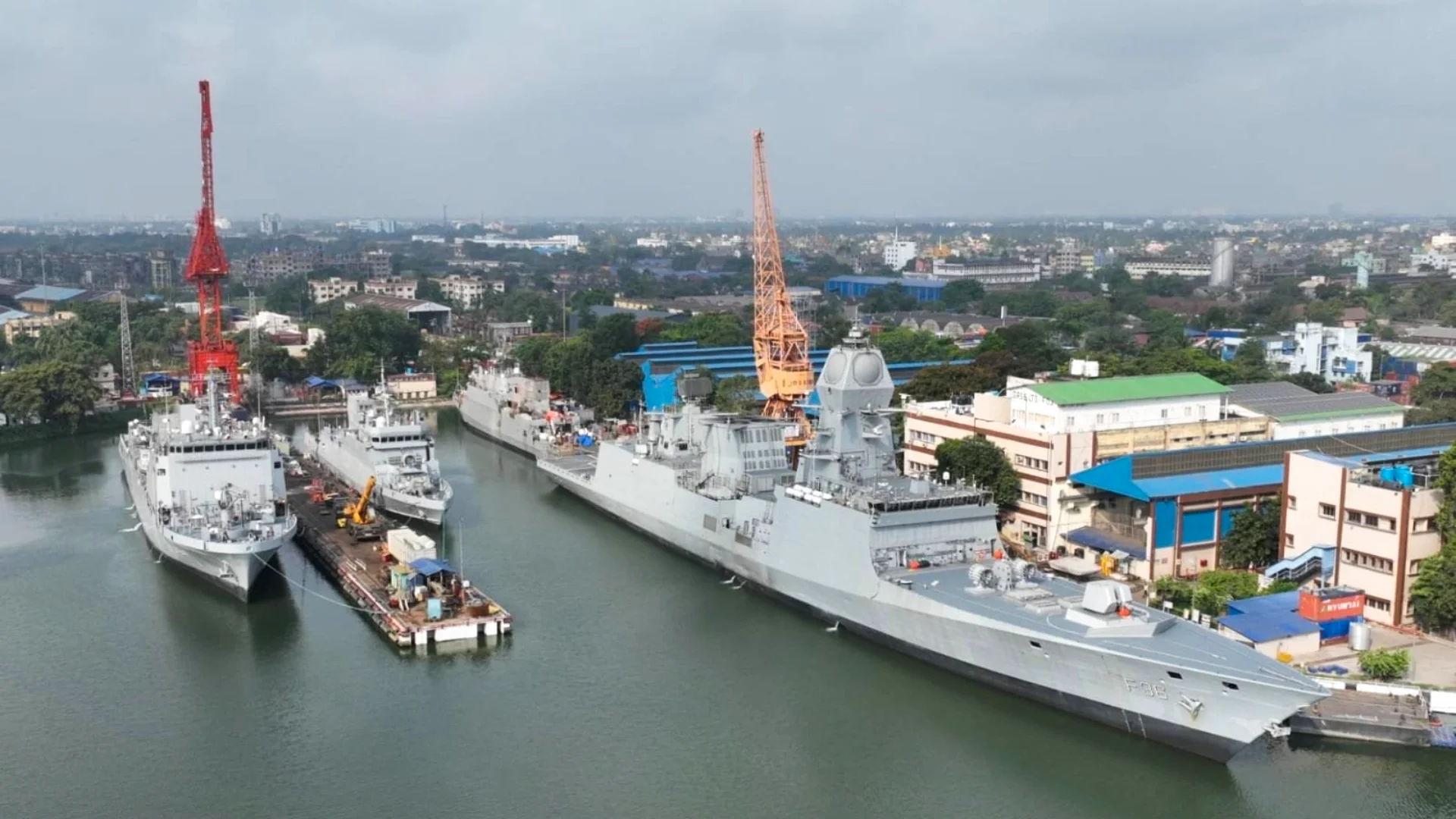
KOLKATA, June 21 — GRSE Navratna status marks a new chapter for Garden Reach Shipbuilders & Engineers, which saw three warships slide into active service together on the Hooghly on Sunday, a rare tri-commissioning that the Navy called a milestone for self-reliance. Prime Minister Narendra Modi handed over INS Dunagiri, INS Sanshodhak and INS Agray in a single ceremony, all three designed by the Navy’s Warship Design Bureau and built side by side at Garden Reach Shipbuilders & Engineers. The ships span the Navy’s core needs: Dunagiri is a Project 17A stealth-guided missile frigate, Sanshodhak is a large survey vessel, Agray is an anti-submarine warfare shallow water craft. The yard delivered them with nearly 75 percent indigenous content in Dunagiri and more than 80 percent in the other two, a figure the Prime Minister repeatedly cited as proof of a maturing supply chain.
The ceremony was theater. The balance sheet is the story.
GRSE Navratna Status and the Balance Sheet Story
GRSE is not a newcomer. The Kolkata yard has built 118 warships over 65 years, more than any other Indian shipbuilder, and in FY26 alone it delivered eight warships, including those three hulls on a single day, March 30. Two days before the commissioning, on June 19, the government formally granted it Navratna status, giving the board greater financial autonomy to invest without Delhi clearances for every large outlay. The Department of Public Enterprises approved the elevation through an office memorandum dated June 19, a recognition the company said reflected consistent performance and contribution to national security.
That consistency shows up in numbers that look odd for heavy manufacturing. As of June 19, GRSE’s market capitalization stood at ₹32,043.63 crore, trading at a trailing PE of 42.84. For the year ended March 2026, revenue rose 38 percent and PAT surged 42 percent to a record high. The fourth quarter captured the momentum: revenue up 29 percent year-on-year to ₹2,119 crore, net profit up 24 percent to ₹303 crore.
Those topline gains are not driven by margin expansion. GRSE’s TTM net income margin was 10.68 percent, EBITDA margin 15.28 percent, gross margin 19.42 percent — solid for shipbuilding, but far from the high-20s operating margins you see at HAL. Where GRSE separates itself is capital efficiency. Return on equity for the period was 28.48 percent, return on capital employed was even higher at 38.21 percent. In plain terms, the yard generates more profit per rupee of capital actually tied up than most asset-heavy peers. With the newly granted GRSE Navratna status, the shipyard now has the enhanced agility to scale these capital-efficient operations into new segments, such as green and autonomous maritime platforms.
The mechanism is old-fashioned customer financing, scaled to warship economics. The Navy pays stage-wise advances against build milestones. GRSE uses that money to pay vendors, buy steel, and fund outfitting, which means its own working capital stays low and often negative. It can run a multi-thousand-crore order book on a relatively small fixed-asset base in Kolkata. Generate even a modest 10 to 11 percent net margin on that minimized capital, and ROE naturally prints in the high 20s.
This is why the defense rally has shifted from order-book cheerleading to execution metrics. Three years ago, investors bought any PSU with a big backlog. Now they ask: who converts advances into delivered hulls without cost overruns? GRSE’s answer in FY26 was eight deliveries, a debt-free balance sheet, and a 24 percent Q4 profit rise even as input costs remained volatile. The yard also points to diversification beyond warships: twelve multi-purpose vessels for a German client, work on green and autonomous platforms, and a stated ambition to use Navratna autonomy for brownfield and greenfield capacity.
Risks and Opportunities Following GRSE Navratna Status
There are limits to the model, and they matter for valuation. Shipbuilding cash flows are lumpy by design. A single frigate can tie up advances for three years, then release a large chunk of revenue on delivery. If the Navy slows milestone payments, or if a design change slips a delivery by six months, the negative cash conversion cycle that flatters ROCE can reverse quickly. GRSE is also exposed to concentration risk: more than 90 percent of its order book remains Navy and Coast Guard. The premium PE of 42.8x prices in flawless execution through the next defense plan cycle.
The strategic backdrop helps. India’s maritime doctrine now demands layered capability in the Indo-Pacific, from blue-water frigates to shallow-water ASW craft and survey ships that map the seabed for submarines. GRSE’s portfolio maps neatly onto that demand, and the indigenous content figures Modi cited — 75 percent plus — mean over 200 MSMEs are now tooled for naval grades of steel, combat management systems integration, and stealth shaping. That ecosystem is hard to replicate quickly, which gives incumbent yards a moat even as private players enter.The GRSE Navratna status serves as a signal of intent, ensuring that the yard remains at the forefront of the government’s maritime doctrine by providing the financial flexibility needed to meet rising indigenous manufacturing demands.
For investors, the question is not whether GRSE can build ships. It has built 118 of them. The question is whether it can keep turning customer advances into 28 percent-plus ROE while scaling capacity without borrowing. The Navratna tag, granted on June 19, gives it the formal freedom to make larger bets on its own. The tri-commissioning on June 21 gave it the political visibility to justify those bets.
If the next two years look like FY26 — revenue up high-30s, PAT up low-40s, deliveries on time — the market’s current premium will look conservative. If milestone flows hiccup, the same capital-light model that drives outsized returns will magnify the downside. Beneath the surface of those three grey hulls in Kolkata, that is the real battle GRSE is fighting.Ultimately, the GRSE Navratna status is more than an administrative upgrade; it is a validation of the yard’s capacity to transform sovereign naval requirements into sustainable, high-growth financial performance.
Investment Disclaimer: This article is for informational and editorial purposes only and does not constitute investment advice, a recommendation, or an offer to buy or sell any securities. The analysis is based on publicly available information as of June 2026, including company filings and news reports, and may contain forward-looking statements subject to risks. Past performance, including GRSE’s reported ROE, ROCE, and profit growth, is not indicative of future results. Defense stocks are subject to policy changes, order delays, and project execution risks. Readers should conduct their own due diligence and consult a licensed financial advisor before making any investment decisions. The author does not hold a position in GRSE at the time of writing.

1 thought on “Beyond the Hull: How GRSE Navratna Status Rewrites the Defense Shipbuilding Playbook”