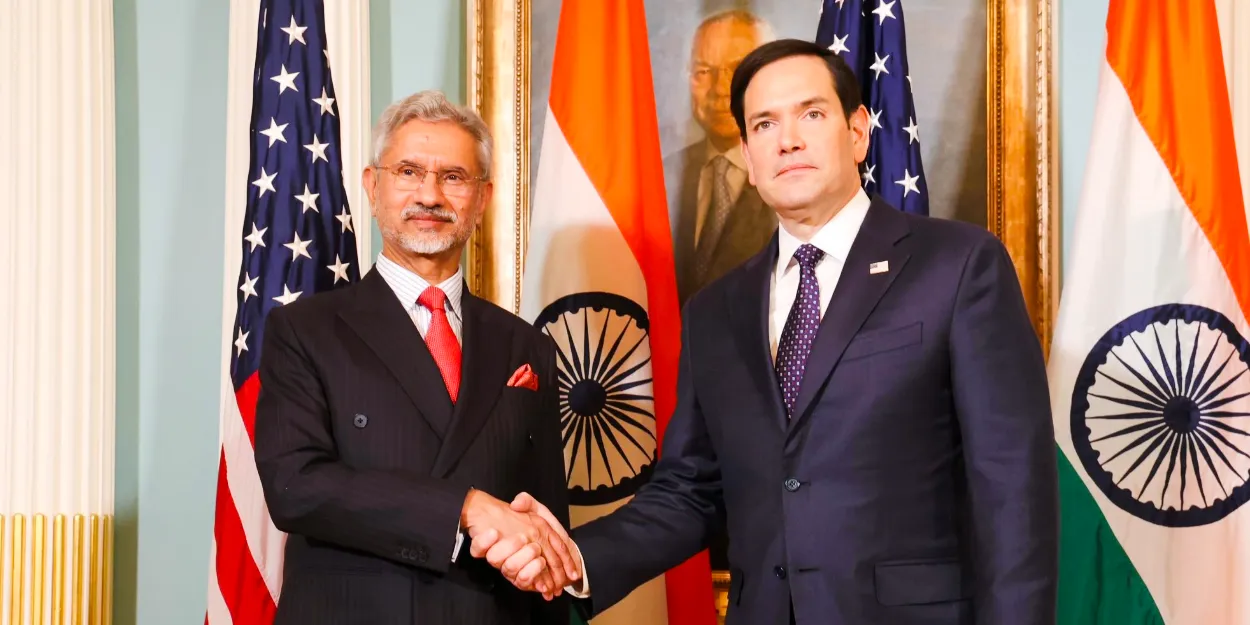
On 23 September, US Secretary of State Marco Rubio and India’s External Affairs Minister S. Jaishankar sat down in New York and talked, by both governments’ own account, about sanctions. Not hypothetical ones. The India Russian oil tariff question — how far Washington will go under a law it signed five days earlier — was, according to a US State Department readout, discussed directly, alongside possible sanctions on states that trade economically with Russia and Iran. Jaishankar’s own summary was blunter: he had “reiterated India’s interests and concerns” regarding the new statute.
Three days later, in the same city and the same week, he met Russia’s Sergey Lavrov. A day after that, Iran’s Abbas Araghchi. Three foreign ministers, three sanctions regimes, one calendar week — and a US law that gives Washington until roughly mid-October to decide how hard it will actually squeeze the five countries that buy the most Russian crude and gas. India is on that list.
What the Rubio-Jaishankar meeting actually signals
A single diplomatic meeting rarely moves markets on its own, and this one did not come with an announcement attached. The State Department’s readout was carefully unspecific — it did not name which countries might face sanctions, nor describe India’s response in detail. What it confirms is something more useful than a headline: the India Russian oil tariff question is now a live, bilateral negotiating item, not a piece of legislative trivia sitting in Washington. Rubio reportedly offered US help on partners’ energy security in the same conversation, which suggests an American side aware that pressure alone risks pushing India toward exactly the Russian and Iranian counterparts it met later that week.
TES covered the legal mechanics of the underlying law — Section 113 of the Lindsey O. Graham Sanctioning Russia and Iran Act of 2026, and the 30-day clock running from its 18 September signing — in our earlier analysis of the Trump-Xi summit. What has changed since then is not the law. It is that India is now visibly negotiating against it, in public, at the ministerial level, instead of appearing only as a name on a buyer list. The law itself, as CBS News reported when Trump signed it, lets the administration impose tariffs of up to 100 percent on the top five purchasers of Russian energy — a category India cannot easily argue its way out of.
The India Russian oil tariff timeline: how we got here
This is not the first round. In August 2025, Washington added a 25 percent “penalty” tariff on Indian goods over Russian crude purchases, taking the cumulative rate to 50 percent. By February 2026, that additional duty was gone, replaced by an 18 percent reciprocal rate under an interim trade framework — one TES examined in detail at the time. The White House said India had committed to scaling back Russian purchases and buying more American energy; New Delhi’s own public statements never confirmed that reading.
Seven months later, the threat is back — now written into binding statute instead of an executive order, with a tariff ceiling of 100 percent against the earlier 25. The pattern — a threat, a partial climbdown, the same threat returning in sharper form — is itself the story. It shows that Washington’s leverage over India’s energy choices is renewable, and largely independent of what India has already conceded.
India’s reliance on discounted Russian barrels runs deeper than this one dispute. As TES detailed during the March 2026 Strait of Hormuz disruption, Russian crude has repeatedly functioned as New Delhi’s genuine energy-security backstop, not merely an opportunistic discount play — which is exactly why an India Russian oil tariff decision carries weight far beyond a single trade dispute.
The September dip isn’t what it looks like
India’s imports of Russian crude did fall sharply into September — from roughly 2.1 million barrels a day in August to about 1.42 million barrels a day in the first half of the month, according to ship-tracking data from Kpler. Analyst Note Nikhil Dubey, Kpler’s lead oil markets analyst, told ThePrint that the full month is likely to recover toward 1.7 to 1.9 million barrels a day as delayed cargoes arrive.
It would be tidy to read that dip as Indian refiners flinching ahead of the Graham Act. The data does not support that story cleanly. Dubey’s own explanation points elsewhere: tighter availability of Russian barrels, following strikes on Russian export infrastructure, combined with rising Chinese demand for the same discounted crude. Iraq has been the immediate beneficiary — Indian imports of Iraqi crude in the first half of September rose more than 200 percent year-on-year by one measure. The tariff threat may be shaping decisions at the margin. Reading the September numbers purely as an India Russian oil tariff story overstates Washington’s current influence over refiners’ near-term sourcing — supply and competition, not policy, are doing most of the work so far.
The precedent refiners already lived through
If anyone wants to know what a genuinely disruptive sanctions shock does to an Indian refiner’s Russian-crude intake, they do not need to speculate. It already happened, once, less than a year ago.
In October 2025, the US Treasury sanctioned Rosneft and Lukoil directly — Russia’s two largest oil producers. Reliance Industries, India’s biggest single buyer of Russian crude, cut its Russian intake by 24 percent within a month, to about 534,000 barrels a day, with Russian oil’s share of its total crude slate falling from 56 percent to 43 percent, according to Kpler data reported by The Economic Times. Bharat Petroleum Corporation Limited (BPCL) responded by turning to Abu Dhabi National Oil Company’s Upper Zakum grade to replace some Russian volumes.
That is the closer analogy for what a real tariff decision — as opposed to a threat — would trigger. Refiners have already shown they can and will reroute supply within weeks when a specific counterparty is sanctioned. What they have not yet been tested against is a blanket tariff applied to the country as a whole, which is a materially different instrument than sanctioning two named companies.
Refiner exposure at a glance
| Refiner | Type | Russian crude exposure | Response so far |
|---|---|---|---|
| Reliance Industries | Private, export-oriented | 43% of crude slate in October 2025, down from 56% a month earlier | Cut volumes 24%, to ~534,000 bpd, within weeks of Rosneft/Lukoil sanctions |
| Bharat Petroleum (BPCL) | State-owned | Roughly half of ~2 million tonnes/month spot purchases historically Russian | Shifted spot buying toward ADNOC’s Upper Zakum crude |
| Hindustan Petroleum (HPCL) | State-owned | 13.2% of crude processed in April-June 2025 quarter | Says a full stoppage would have no “significant” impact on operations |
| Indian Oil Corporation (IOC) | State-owned | Not independently quantified for the current period | TES has not verified a current figure; flagged as a research gap |
Figures compiled from Kpler-sourced reporting (The Economic Times, Outlook Business) and company investor statements; see linked sources. IOC figure not independently confirmed as of publication.
Reliance vs the PSU refiners: different exposure profiles
The India Russian oil tariff conversation tends to get treated as a single national number, which flattens a real difference in who actually carries the risk. Reliance’s Jamnagar complex is substantially export-oriented — a large share of what it refines from discounted Russian crude leaves the country again as finished product, sold into markets where the discount, not the country of origin, is what customers see. A tariff on Indian goods entering the United States is a different exposure for Reliance than it is for the state-owned refiners, whose output mostly serves the domestic market and whose margin sensitivity runs through crude cost, not export duty.
HPCL’s own chairman put this plainly at an investor call in August 2025, when Russian crude made up only 13.2 percent of what the company processed that quarter: a complete stoppage, he said, would have no “significant” impact. That is not a claim Reliance, or BPCL at its historical purchase levels, could make with the same confidence.
The waiver card Washington still holds
The Graham Act is not a blunt, all-or-nothing instrument. As a legal analysis from Akin Gump lays out, Section 113’s tariffs stack on top of existing duties but include a 15 percent gas-import exemption designed to shield buyers who visibly cut Russian volumes, and the President retains discretion to grant a national-security waiver rather than impose the full tariff. Reasoned Assessment Given that India has already demonstrated, twice now, that it will adjust crude sourcing under pressure — once after the February 2026 framework, once after the Rosneft/Lukoil sanctions — a graduated or delayed application of the tariff is a plausible outcome, though it is not the only one, and TES is not treating it as decided.
What tips that decision one way or another over the next three weeks has less to do with oil markets than with how Washington weighs India against China on the same list. China holds rare-earth and critical-mineral leverage that India does not. That asymmetry, flagged in TES’s earlier coverage of the law, means an identical statute could land very differently on the two economies even though China buys more Russian oil in absolute volume — and it is likely to matter more to the final India Russian oil tariff rate than anything said inside Rubio’s meeting room.
What to watch before mid-October
Will the US actually impose a 100 percent tariff tied to Russian oil purchases?
Unresolved. Trump has until roughly mid-October 2026 — 30 days from the 18 September signing — to set the specific rate. No decision has been announced as of the Rubio-Jaishankar meeting.
How much has India’s Russian oil intake actually fallen?
Kpler data shows a drop from about 2.1 million barrels a day in August to roughly 1.42 million in the first half of September, with the full month expected to recover toward 1.7-1.9 million barrels a day. Analysts attribute this mainly to tighter Russian barrel availability and Chinese competition, not primarily to the tariff threat.
Which refiners carry the most exposure if a tariff is applied?
Reliance Industries has historically run the highest share of Russian crude among major Indian refiners and has already shown, after the October 2025 Rosneft/Lukoil sanctions, that it can cut volumes by roughly a quarter within weeks. State refiners such as HPCL carry comparatively low exposure; BPCL sits in between and has actively diversified toward Gulf grades.