
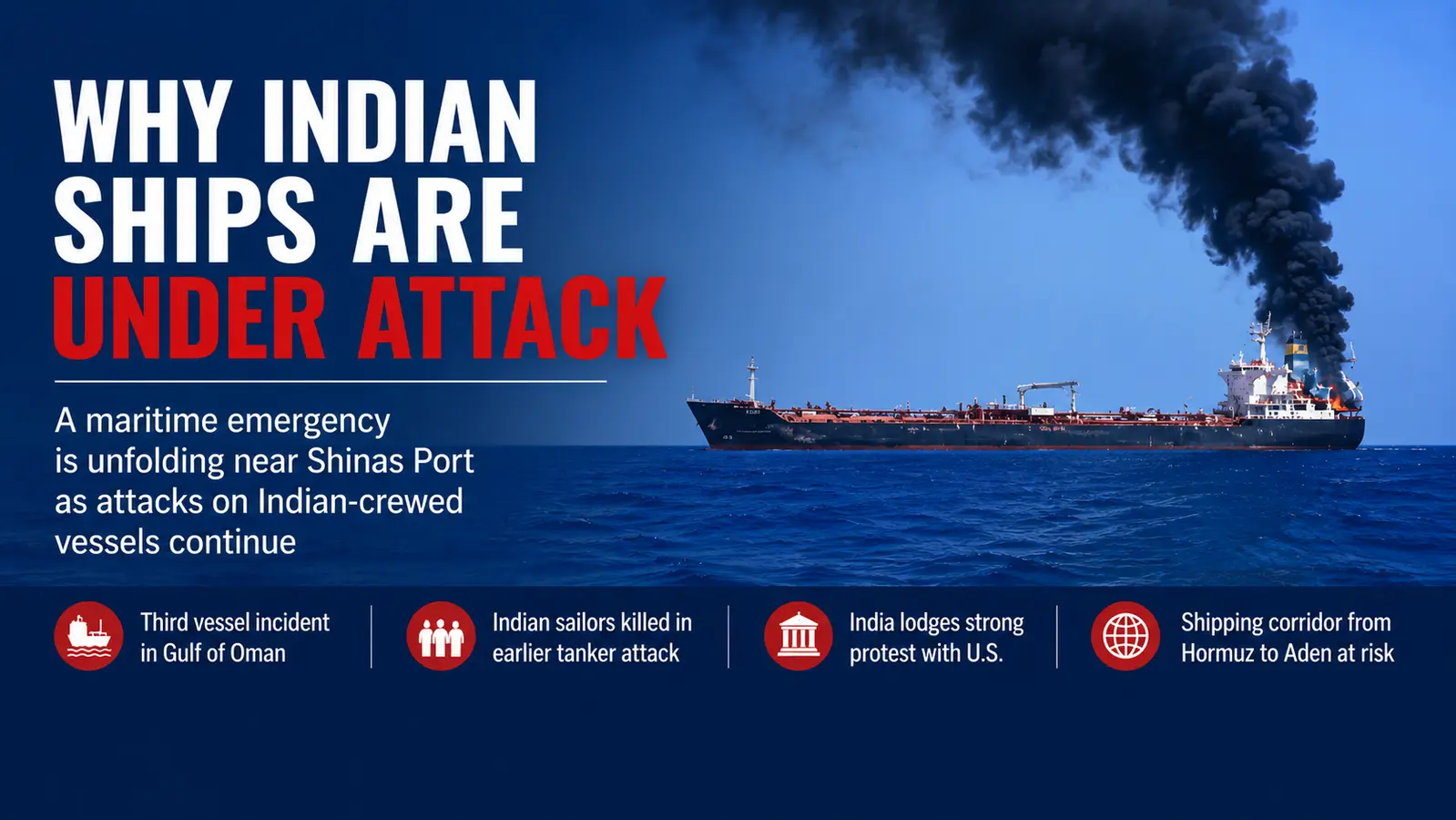
Indian sailors killed, tankers attacked and diplomats summoned as a conflict once centered on Iran spills into one of the world’s most important shipping corridors.
June 11, 2026: The tanker MT Jalveer reported an incident and engine-room fire near Shinas Port in northern Oman, becoming the latest vessel caught in a widening maritime security crisis stretching from the Strait of Hormuz to the Gulf of Aden.
The development came days after the attack on the tanker Settebello, which triggered a diplomatic protest from New Delhi after Indian crew members were killed. The Embassy of India in Muscat confirmed it was monitoring the latest incident and coordinating with Omani authorities.
“We have learnt of an incident involving a vessel off Shinas port of Oman, earlier today. We are closely monitoring the situation and coordinating with the local authorities for further details.”
Taken individually, the incidents may appear isolated.
Viewed together with recent tanker attacks, Houthi threats in the Red Sea, escalating U.S.-Iran tensions and growing naval deployments, they point to a broader reality: the maritime corridor linking the Persian Gulf, Gulf of Oman, Arabian Sea and Gulf of Aden is becoming one of the world’s most contested strategic waterways.
For India, the implications are immediate.
Indian sailors have become casualties of the conflict. Commercial vessels carrying Indian crews are operating in increasingly dangerous waters. And New Delhi has moved from calls for restraint to direct diplomatic intervention.
What began as a regional confrontation is increasingly becoming a crisis of maritime security.
The Maritime Corridor Under Pressure
| Waterway | Why It Matters |
|---|---|
| Strait of Hormuz | Main outlet for Gulf oil and LNG exports |
| Gulf of Oman | Connects Hormuz to the Arabian Sea |
| Arabian Sea | Critical route for Indian trade and energy imports |
| Gulf of Aden | Gateway to Bab al-Mandab and the Red Sea |
| Bab al-Mandab Strait | Connects the Indian Ocean with the Red Sea |
| Suez Canal | Fastest maritime route between Asia and Europe |
Together, these waterways carry a substantial share of global energy supplies, container traffic and commercial shipping.
Disruption at one point can affect the entire network.
Strait of Hormuz Back at the Center of Global Attention
The Strait of Hormuz remains the immediate flashpoint.
A significant share of globally traded oil and liquefied natural gas passes through the narrow waterway linking the Persian Gulf with the Gulf of Oman. Every military development in the region is now scrutinized by energy traders, insurers and shipping companies.
Washington’s rhetoric has hardened considerably.
Before the latest round of military operations, U.S. Secretary of War Pete Hegseth signaled that further strikes were likely.
“We will hit them hard on our terms, on the targets that improve the environment for us to operate in and undermine the capabilities that Iran wants to have.”
Hegseth also framed military pressure as part of a broader effort to force Tehran back to negotiations.
“Iran has an opportunity to make a deal. President Trump is a dealmaker. Iran would be wise to take it.”
Yet the most consequential remarks were not about air strikes.
They were about shipping.
According to Hegseth, a little-publicized operation known as Project Freedom has continued protecting commercial traffic moving through the Strait of Hormuz.
“Project Freedom — the idea of running ships through the Strait of Hormuz — it never stopped, it just went underground.”
The Pentagon has also claimed that approximately 100 million barrels of oil have safely transited Hormuz under U.S. protection during the current crisis.
Most notably, Hegseth declared:
“The United States of America controls the Strait of Hormuz.”
Whether that assessment reflects reality or strategic messaging remains open to debate. Iran retains missiles, drones, fast-attack craft and proxy networks capable of threatening shipping across a much wider area than Hormuz itself.
The challenge is no longer simply keeping Hormuz open. It is maintaining security across an interconnected maritime corridor stretching from the Persian Gulf to the Red Sea.
The Crisis Does Not End at Hormuz
Military planners increasingly view the Strait of Hormuz, Gulf of Oman, Arabian Sea, Gulf of Aden and Red Sea as a single operating theater.
A disruption in one section affects decisions across the entire network.
That reality has brought renewed attention to the Gulf of Aden.
Located between Yemen and Somalia, the waterway forms the western gateway to the Bab al-Mandab Strait and ultimately the Suez Canal. Nearly every vessel sailing between Asia and Europe passes through this route.
If Hormuz is the world’s most important energy chokepoint, the Gulf of Aden is one of its most important commercial gateways.
Houthi Threats Continue to Reshape Global Shipping
The resumption of Houthi missile activity has kept commercial shipping companies on alert and reinforced concerns about the security of the Red Sea corridor.
European naval authorities have warned that attacks on merchant vessels could resume with little warning.
The consequences are already visible.
Many shipping companies continue diverting vessels around the Cape of Good Hope rather than risk transit through the Red Sea.
That diversion carries a price:
- Approximately 3,500 additional nautical miles
- Up to one extra week at sea
- Higher fuel costs
- Increased insurance premiums
- More expensive freight rates
For businesses and consumers, those costs eventually feed into supply chains and inflation.
What begins as a security crisis quickly becomes an economic one.
A Pattern Emerging Off Oman
The incidents are no longer isolated.
Within days, multiple commercial vessels operating near Oman reported attacks, explosions, fires or security incidents, drawing attention to growing risks in the Gulf of Oman.
The latest case involved MT Jalveer near Shinas Port. Earlier incidents involving Settebello and other commercial vessels occurred along the same maritime corridor connecting the Strait of Hormuz with the Arabian Sea.
For maritime insurers, naval planners and shipping companies, the challenge increasingly spans the entire corridor rather than a single chokepoint.
The significance lies not only in individual attacks but in the emerging pattern. Multiple security incidents occurring along the same maritime route are reinforcing fears that one of the world’s busiest shipping corridors is entering a prolonged period of instability.
India’s Response Turns Sharper
For much of the crisis, New Delhi emphasized restraint, diplomacy and freedom of navigation.
The attacks on commercial vessels near Oman have changed the tone.
After the strike on the tanker Settebello, India summoned U.S. Chargé d’Affaires Jason Meeks and lodged what officials described as a “strong protest.” The Ministry of External Affairs called the incident “deeply worrisome” and warned that the escalating conflict was placing civilian seafarers at increasing risk.
The diplomatic démarche marked one of India’s strongest public responses since the current phase of the crisis began.
At the United Nations Security Council, India’s Permanent Representative Ambassador Parvathaneni Harish delivered a broader warning.
“The world can ill afford a wider conflict in the region.”
Harish stressed the importance of protecting maritime routes across the Arabian Sea, Bab al-Mandab Strait, Gulf of Aden and the wider Indian Ocean.
For New Delhi, the issue is no longer abstract.
Indian sailors have become casualties of the conflict. Commercial vessels carrying Indian crews are operating in increasingly dangerous waters. The maritime corridor linking Hormuz to Aden has become a direct national security concern.
A Subtle Shift in War Aims
Another development is attracting attention among diplomats and strategic analysts.
While Washington and Jerusalem continue to share the objective of preventing Iran from acquiring a nuclear weapon, their immediate priorities appear increasingly different.
For the Trump administration, pressure on energy markets, shipping routes and global economic stability has elevated maritime security to the top of the agenda.
Israel’s leadership remains focused on degrading Iran’s military capabilities and limiting Tehran’s long-term strategic options.
One approach prioritizes stabilizing trade routes and avoiding broader economic disruption.
The other prioritizes altering Iran’s strategic calculus through sustained military pressure.
For countries such as India, whose interests are closely tied to uninterrupted energy imports and secure sea lanes, the outcome of that debate could prove almost as important as developments on the battlefield.
The Economic Shock Is Already Spreading
The consequences of the crisis are no longer confined to the Middle East.
Higher shipping costs, rising insurance premiums and uncertainty surrounding energy supplies are feeding into inflation expectations across major economies.
Central banks, commodity traders and financial markets are increasingly factoring Middle East maritime risks into their calculations.
The conflict’s effects now extend beyond security and diplomacy.
They are becoming part of the global economic outlook.
From Chokepoints to Casualties
For months, discussion of the Iran crisis centered on missiles, military deployments and diplomatic maneuvering.
The latest incidents off Oman reveal a different reality.
Behind every tanker transiting Hormuz or the Gulf of Oman are civilian crews drawn from countries around the world, including thousands of Indian seafarers who help sustain global trade.
Attacks on commercial vessels, the deaths of Indian sailors, diplomatic protests and expanding naval deployments show how quickly a regional conflict can spill into international shipping lanes.
What began as a contest over military pressure and strategic influence is increasingly becoming a challenge to the security of the maritime arteries that connect Asia, the Middle East and Europe.
From Hormuz to Aden, the crisis is no longer confined to governments and militaries.
It is being felt by the people who keep the global economy moving.