
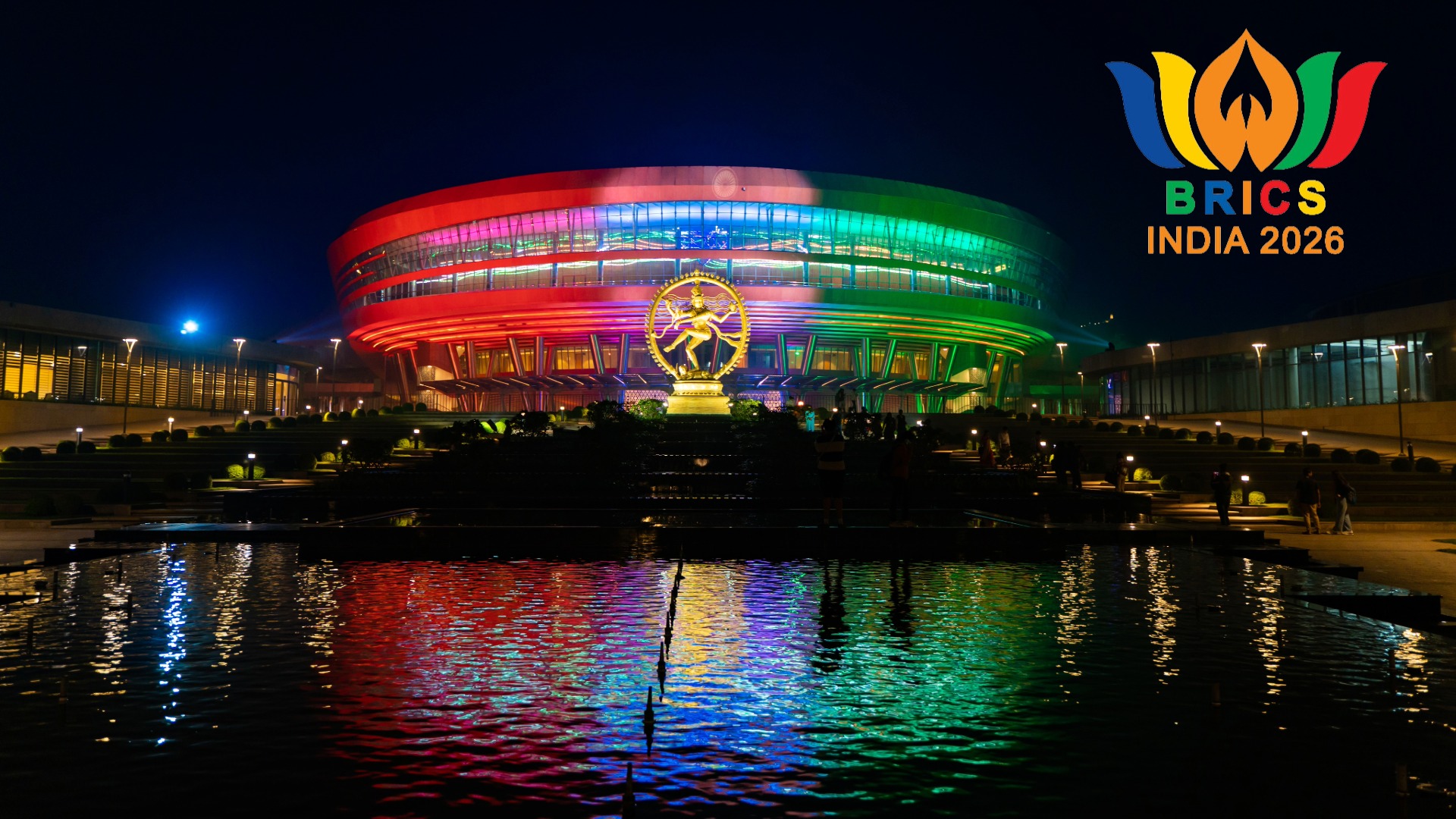
Negotiated under India’s fourth presidency ahead of the New Delhi Summit, the BRICS logistics framework represents a fundamental recalibration of Global South trade, shifting the 11-nation bloc from diplomatic rhetoric to concrete supply chain engineering. Forty-nine and a half percent of the global population. Forty percent of global gross domestic product. Twenty-six percent of world merchandise trade. When Prime Minister Narendra Modi convenes leaders on 12–13 September 2026 for the 18th BRICS Summit, Western commentary will inevitably interpret the gathering through the lens of revisionist confrontation and de-dollarisation. That reading misses the real institutional shift: behind closed doors, India has steered ministerial tracks toward operational connectivity.
Rather than chasing speculative currency alternatives, Indian negotiators spent eight months convening over 350 ministerial and technical working groups across 25 cities. The primary deliverable is an intricate web of supply chain agreements. By linking customs clearances, standardising regulatory filings, and unlocking multimodal freight corridors, the BRICS logistics framework represents a calibrated Indian bid to insulate strategic commerce against external chokepoints without rupturing crucial Western partnerships.
Inside the Ministerial Architecture: Beyond Diplomatic Rhetoric
Diplomatic communiqués frequently expire the moment summit banners are dismantled. Yet the institutional deliverables finalised during India’s 2026 tenure reflect granular, procedural coordination designed to survive political volatility. The operational cornerstone of the BRICS logistics framework is the Logistics Supply-Chain Cooperation Framework, a consensus-based mechanism engineered to address fragmented multimodal transit, volatile maritime freight pricing, and localized assembly bottlenecks.
To reinforce the BRICS logistics framework on the factory floor, member states drafted the Global Value Chains Action Plan 2026–2030. Coordinated through a dedicated Technical Council and backed by a comprehensive GVC Joint Study, the plan establishes actionable criteria for economic diversification. Rather than relying on distant single-source component hubs, the initiative incentivises co-located sub-tier assembly clusters across member nations.
Parallel to physical freight corridors, the BRICS logistics framework demands legal and regulatory synchronization. Members confirmed in-principle approval for the BRICS Agreement on Cooperation and Mutual Administrative Assistance in Customs Matters. By creating formal channels for real-time cargo verification and documentation exchange, the agreement significantly reduces dwelling times at ports of entry, lowers overall transaction expenses, and curbs trade-based money laundering. Complementing this is a landmark Memorandum of Understanding among BRICS National Standards Bodies, which establishes mutual technical benchmarks to dismantle non-tariff barriers that have historically stymied South-South commerce.
Connecting Corridors: How the BRICS Logistics Framework Bridges the INSTC and Maritime Chokepoints
For over two decades, India’s ambition to tap landlocked Central Asian and Russian markets ran into persistent operational headwinds. While the 7,200-kilometre INSTC offered a theoretical 30% reduction in transit duration and a 40% drop in freight expenses compared to the traditional maritime circuit via the Suez Canal and the Strait of Gibraltar, execution languished. Disjointed rail gauges, incompatible electronic documentation, arbitrary road tolls, and chronic insurance hurdles stalled shipments at Iranian and Caspian interfaces.
The structural expansion of BRICS completely rewrites this logistical equation. With Iran and the United Arab Emirates inducted as full members in 2024, Indonesia joining in 2025, and Central Asian transit anchors Kazakhstan and Uzbekistan formally incorporated into the new Partner Country framework, the BRICS logistics framework bridges physical infrastructure with institutional certainty.
Under the operational parameters of the BRICS logistics framework, cargo departing Jawaharlal Nehru Port Authority (JNPA) in Mumbai or Kandla in Gujarat now benefits from synchronized pre-arrival declarations when docking at Bandar Abbas or Chabahar. Under the new customs assistance parameters, transhipment manifests can be cleared digitally before physical containers arrive, eliminating weeks of bureaucratic paralysis. In an era marked by recurring maritime attacks across the dual chokepoints of the Bab el-Mandeb and the Strait of Hormuz and soaring war-risk insurance premiums, securing an operational overland fallback across Eurasia is an imperative of national economic security.
Defence and Markets Impact: The BRICS Logistics Framework Across Equities and Shipping
From an equity valuation perspective, the roll-out of the BRICS logistics framework yields direct commercial outcomes for listed Indian enterprises. Container rail operators and coastal shipping networks stand as the immediate commercial beneficiaries, addressing long-standing bottlenecks in India’s maritime infrastructure and coastal shipping competitiveness. As bilateral cargo flows under the BRICS logistics framework transition toward standardized digital documentation, freight volume velocity increases, expanding operational margins across long-haul freight corridors.
Consider the industrial footprint of major market entities:
- Container Corporation of India (CONCOR): Holds exclusive intermodal advantages along Western Dedicated Freight Corridor (WDFC) linkages, directly feeding outbound ex-im container traffic destined for INSTC gateways.
- Adani Ports and Special Economic Zone (APSEZ): Operates premier deep-water facilities at Mundra and Hazira that manage substantial West Asia–bound containerized trade, benefiting from accelerated turn-around times under mutual customs pacts.
- Capital Goods & Heavy Engineering: Entities like Larsen & Toubro (L&T) and Bharat Heavy Electricals Limited (BHEL), which frequently bid on industrial, power transmission, and rail modernization contracts across Central Asia and the Gulf, gain from harmonized technical standards and reduced import duty bottlenecks on modular components.
Furthermore, the establishment of the BRICS MSME Cooperation Portal and an institutionalized Dialogue on MSME Finance aligns with national initiatives focused on upgrading Indian MSMEs into tier-1 precision suppliers while addressing systemic working capital constraints. By creating standardized trade financing frameworks, Indian precision engineering suppliers can integrate directly into localized assembly lines across Brazil, Egypt, and Indonesia without absorbing excessive foreign exchange settlement risks.
Strategic Autonomy Under Pressure: Navigating Western Secondary Sanctions
The foremost strategic risk facing the BRICS logistics framework is the threat of secondary sanctions administered by the United States Department of the Treasury and European regulatory authorities. Western capitals monitor trade corridors transiting Iran and Russia with heightened vigilance, frequently penalising third-party maritime shippers and financial institutions accused of sanctions evasion.
India’s diplomatic maneuver throughout its 2026 presidency has been to insulate cooperation from ideological confrontation. Indian diplomats successfully resisted pressure from Moscow and Beijing to codify mandatory de-dollarisation mechanisms or frame BRICS as an anti-Western security bloc. Instead, the language of the ministerial outcomes emphasizes transparent, voluntary facilitation, consumer protection, and the mitigation of illicit trade.
By anchoring the BRICS logistics framework in trade settlement flexibility—using national currencies on a bilateral basis rather than introducing an experimental, contested BRICS collective currency—New Delhi protects Indian commercial banks from extraterritorial sanctions. Simultaneously, India continues to deepen high-technology co-production under the Quad and the US–India initiative on Critical and Emerging Technology (iCET). Strategic autonomy, in this operational reality, is demonstrated not by choosing geopolitical blocs, but by creating redundant logistical channels that ensure Indian industry never becomes hostage to any single power’s economic leverage.
The Road Ahead: Institutionalising the Global Value Chain Technical Council
The true test of the BRICS logistics framework begins after the summit communiqués are filed. Translating ministerial roadmaps into operational trade velocity requires persistent bureaucratic follow-through across multiple disparate legal systems. Setting up the Global Value Chain Technical Council before the close of 2026 will serve as the initial litmus test for whether member states can move from conceptual alignment to industrial implementation.
Significant internal contradictions remain unresolved. China and India maintain unresolved friction along the Line of Actual Control (LAC), while competitive manufacturing overlaps persist between Indian industrial clusters and Chinese state-backed industrial giants. Furthermore, integrating new members such as Ethiopia, Iran, and Egypt—each grappling with macroeconomic volatility and distinct foreign policy imperatives—demands continuous diplomatic mediation.
Yet the directional trajectory is unmistakable. Under India’s leadership, BRICS has evolved beyond its Goldman Sachs origins as an investment banking acronym into a pragmatic infrastructure framework. By engineering concrete technical solutions for global value chains, port interfaces, and customs documentation, New Delhi has demonstrated that multilateral leadership in the 21st century is built not on geopolitical slogans, but on the unglamorous mechanics of trade resilience.
Source Attribution & Primary Documentation
- Official Gazette / Ministerial Release: Press Information Bureau (PIB) Delhi, “BRICS: Evolution, Cooperation and India’s Leadership”, Release ID 2308611 (Issued 10 September 2026).
- Diplomatic Records: Ministry of External Affairs (MEA), Fourth BRICS Summit Delhi Declaration and 13th BRICS Summit New Delhi Declaration.
- Multilateral Portals: Official BRICS 2026 Presidency Portal, Government of India.
- Analytical Assessment: Supply chain, equity cross-references, and corridor impact assessments conducted by The Eastern Strategist Editorial Research Unit.