Sirens sounded over Islam’s holiest city, Riyadh reportedly reached out to Israel for help, and the Mecca Pact’s first real test drew statements from Pakistan instead of support.
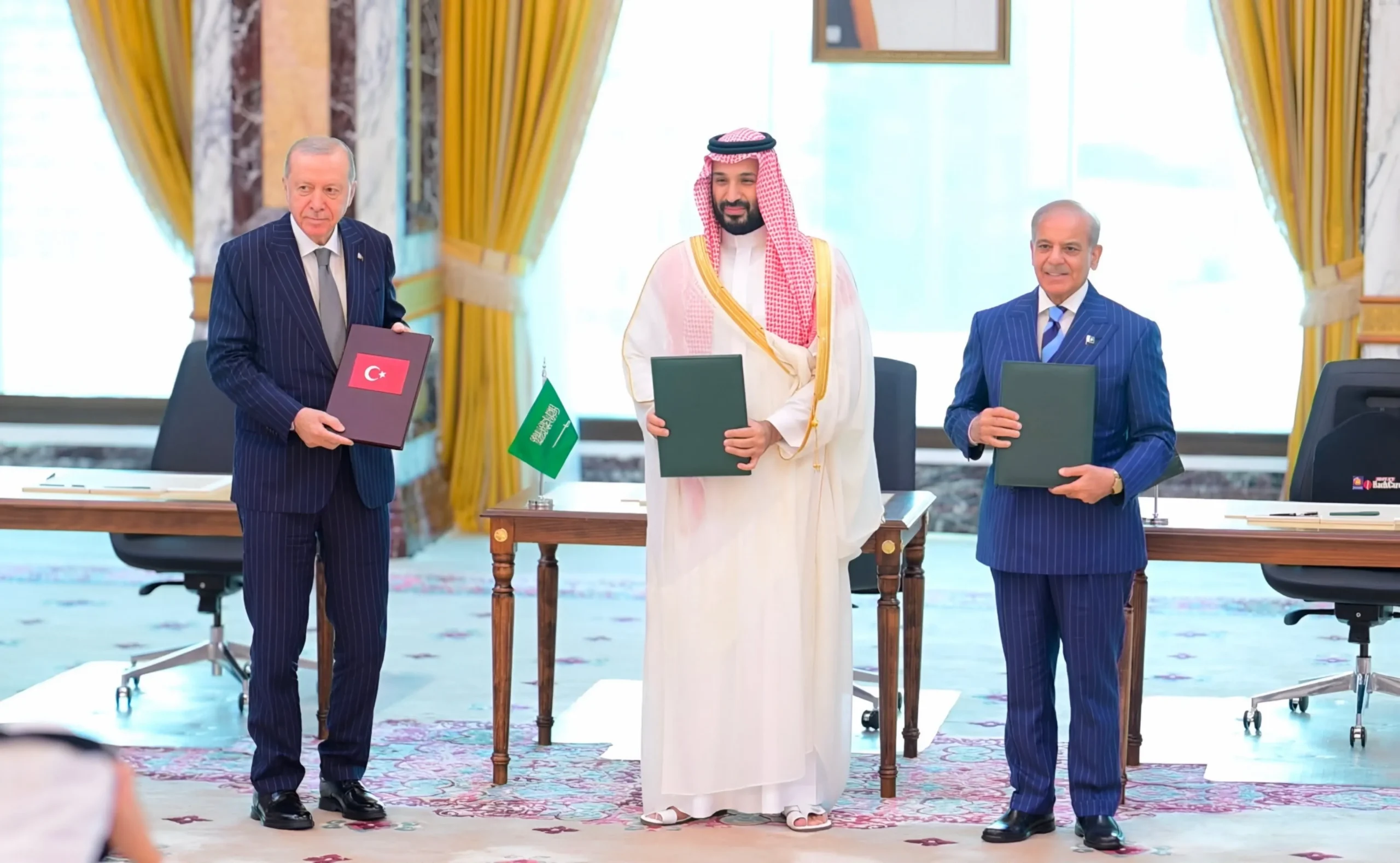
On 7 August 2026, Crown Prince Mohammed bin Salman signed a defence agreement in Mecca that Saudi and Pakistani officials, according to reporting by Middle East Eye, described in terms inviting comparison with NATO’s Article 5 — an attack on one signatory to be treated as an attack on all. Five weeks later, missile warnings sounded in that same city for the first time since the region’s war began. The partners bound by that pact did not send aircraft. They issued statements.
TES has already tracked the oil-price and India-facing side of this crisis in detail — the fall of Mocha, the Bab al-Mandeb threat, and the rupee-and-refiner arithmetic — in Houthi Red Sea Escalation: Oil Prices, the Mecca Pact, and India’s Vulnerability. This piece picks up where that one left off, and stays with the question it flagged but didn’t yet have the evidence to answer: what happens when the Mecca Pact is actually tested.
A Test the Mecca Pact Failed to Meet
The barrage that triggered this test landed on 8 September, when Houthi forces launched a large-scale drone and missile attack on Saudi military and energy infrastructure. Asif’s statement followed within days, according to Al Jazeera. But a pact modelled on state-to-state deterrence was never built for this scenario. Houthi missiles are not a state actor’s aggression in the sense Riyadh, Islamabad and Ankara had in mind when they signed — they are a non-state force embedded in an active civil war, and neither Pakistan nor Turkiye has shown any appetite to be drawn into fighting it directly.
One Pakistani official familiar with Gulf affairs told Middle East Eye that the current caution echoes 2015, when Pakistan’s Parliament voted to stay neutral rather than send troops into the Saudi-led Yemen coalition — a decision that badly strained relations with Riyadh at the time. A think-tank analyst quoted in the same report argued the pact still functions as a deterrent and a marker of strategic depth for Saudi Arabia. Deterrence value and operational value are not the same thing, and September has made the gap between them visible to everyone watching.
Full Control of Bab al-Mandeb
The capture followed the fall of the port of Mocha a day earlier — a collapse TES covered as it happened, including how it exposed Saudi Arabia’s Yanbu export route. What’s changed since is scale: Perim sits at the mouth of the strait and splits it into two shipping channels, and Houthi control of the island means Ansar Allah can now observe and threaten traffic through both. The US Energy Information Administration had recorded oil flows through Bab al-Mandeb reaching 8.1 million barrels per day in the second quarter of 2026, close to 8 percent of global supply — a figure that now sits under substantially tighter Houthi leverage.
The Coalition That Didn’t Show Up
The Saudi-led coalition said it carried out more than 50 strikes on Houthi positions in Marib, al-Jawf and Taiz following the 14 September attacks on Khamis Mushait, Abha and Taif, which wounded 13 civilians according to coalition spokesperson Col. Turki al-Maliki. That response is conventional and expected. What is less expected is the gap it sits alongside: according to Axios, cited by Al-Monitor, MBS personally asked Trump on 11 September to order US airstrikes in Yemen. He was turned down both times.
Washington’s Calculated Distance
US Central Command’s regional chief travelled to Saudi Arabia as the Bab al-Mandeb situation developed, according to Al-Monitor. That visit, paired with Washington’s refusal to authorise strikes, suggests a deliberate choice to stay close to the crisis without joining it — watching, advising, but not fighting on Riyadh’s behalf.
The Unthinkable Phone Call
If accurate, this would matter regardless of how limited the assistance turns out to be. Saudi Arabia has long conditioned any normalisation with Israel on progress toward Palestinian statehood. A reported request for help — even indirect, even confined to intelligence-sharing — would mark a shift from that public position, made under the pressure of an immediate security emergency rather than a negotiated diplomatic process. TES will treat this as a claim requiring further confirmation until a primary source becomes available, not as an established fact.
The Chokepoint Squeeze, in Brief
The market mechanics of this crisis — why Brent crude broke above $100 a barrel, what it means for India’s import bill, and how Indian oil marketing companies and refiners are exposed — are covered in full in TES’s earlier analysis, and the pipeline shutdown specifically is covered in The Chokepoint Collapse. The short version: when two of Saudi Arabia’s three export routes are constrained at once, markets price in scarcity before a single barrel of actual export volume has to fall.
What Happens Next
Three thresholds are worth watching in the coming weeks. First, whether the Mecca Pact is invoked in language stronger than “may be activated” — the current wording lets Islamabad and Ankara avoid commitment indefinitely. Second, whether Houthi forces move radar systems or missile launchers into their newly captured positions overlooking Bab al-Mandeb, which US officials have indicated would be the trigger for reconsidering direct American action. Third, the East-West pipeline’s stated three-to-five-week repair window — a deadline that, if missed, leaves Saudi Arabia without a single fully open export corridor of its own.
Source Transparency Note: Facts on the pipeline attack, the Mecca-area alerts, and the Bab al-Mandeb advances are drawn from Saudi and Iraqi government statements and on-the-record coalition spokespersons, corroborated across AP, CNN, Al Jazeera, Al-Monitor and Reuters-sourced reporting. The account of Trump declining direct strikes twice is sourced to Axios reporting as relayed by Al-Monitor and separately by CNN, and is treated as well-corroborated but not government-confirmed. The reported Saudi approach to Israel rests solely on Israeli media citing unnamed officials and has no independent or primary-source confirmation. The analytical framing throughout — including the argument that the Mecca Pact’s deterrence value has outpaced its operational value — is TES Analytical Assessment, not attributed to any cited source.