
News Analysis · Maritime Security · Bay of Bengal
The first BIMSTEC maritime security exercise closed at Sri Vijaya Puram on 3 November with ships from three of the grouping’s seven members at sea. BIMSTEC, the Bay of Bengal Initiative for Multi-Sectoral Technical and Economic Cooperation, took its first step from declarations to drills under the Andaman and Nicobar Command (ANC).
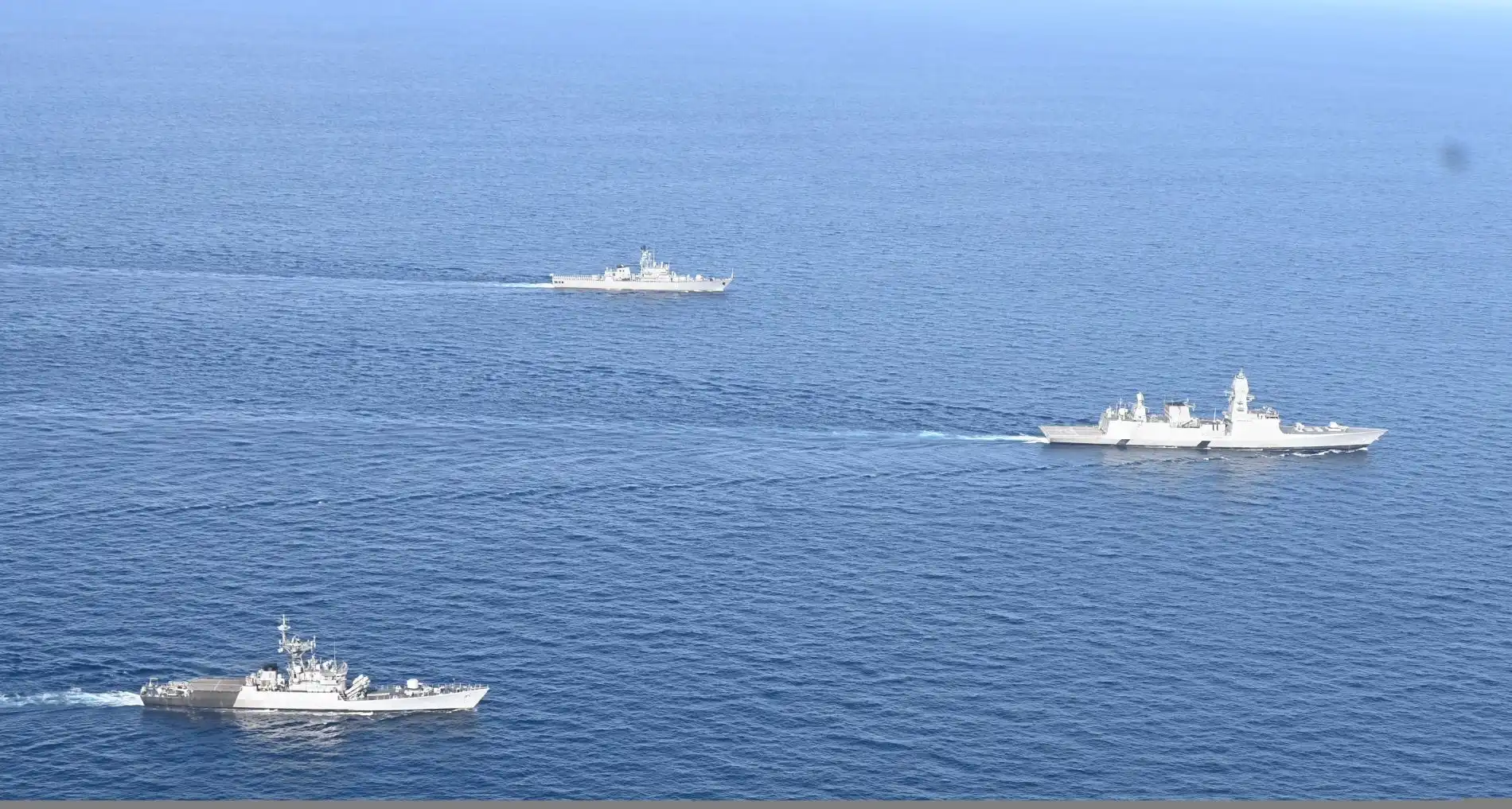
According to the Ministry of Defence, INS Taragiri, INS Karmuk and INS Saryu sailed with Myanmar’s UMS King Aung Zeya and Sri Lanka’s SLNS Gajabahu. The ship count is modest. The sequence behind it is the story: a declaration in New Delhi on 13 October, a drill from 30 October.
How the Delhi Declaration Became a Drill at Sea in 17 Days
The BIMSTEC maritime exercise follows the Delhi Declaration, adopted on 13 October 2026 at the first BIMSTEC Home Ministers’ Meeting in New Delhi, chaired by Union Home Minister Amit Shah. Home ministers of all seven members adopted it, according to the Press Information Bureau (PIB). The Defence Ministry says the exercise was conducted in the spirit of that declaration and in furtherance of the 4th BIMSTEC Experts Group Meeting on Maritime Security Cooperation, held in November 2025.
The maritime track is older than the declaration. The Ministry of External Affairs (MEA) spokesperson said Prime Minister Narendra Modi announced the exercise at the 6th BIMSTEC Summit in Thailand, as All India Radio reported. BIMSTEC Secretary General Indra Mani Pandey said in April 2026 that the first joint exercise would take place in November 2026. The 17 days between declaration and drill therefore reflect sequencing, not improvisation.
Home ministers set the political frame; the navies filled it in.
The MEA spokesperson described the programme as three days of tabletop exercises followed by a two-day harbour phase, with ships participating, according to ANI’s report. The Defence Ministry’s closing release records a harbour phase at Sri Vijaya Puram, then a sea phase off the port on 2 and 3 November involving, in its words, coordinated maritime deployments and collaborative operational activities. It gives no serial-by-serial detail of what was practised at sea.
Why Only Three of Seven BIMSTEC Members Appear in the Ship List
BIMSTEC has seven members: Bangladesh, Bhutan, India, Myanmar, Nepal, Sri Lanka and Thailand. The Defence Ministry’s release on the BIMSTEC exercise names ships from three. It also lists senior attendees: Pandey; Vice Admiral Biswajit Dasgupta (Retd), the National Maritime Security Coordinator; Rear Admiral Kyaw Kyaw Htoo of the Myanmar Navy; Air Vice Marshal MDR Prasad (Retd) from Sri Lanka’s Ministry of Ports and Civil Aviation; and Captain Mohammad Monzurul Islam, commanding officer of BNS Prottoy, Bangladesh.
Before the BIMSTEC maritime security exercise began, the ANC had said assets from Bangladesh, Myanmar, Sri Lanka and Thailand would take part, and that Bhutan and Nepal would send representatives. The closing release does not say whether BNS Prottoy sailed in the sea phase, whether a Thai unit took part, or how many personnel each side contributed. Those gaps are in the official record, and TES has not filled them.
The ANC’s reasoning for including the two landlocked members is on record: it said both depend heavily on the Bay of Bengal for export-import trade. The Defence Ministry calls the exercise a step towards institutionalising maritime engagement and a foundation for future collaborative initiatives under the BIMSTEC framework. It does not announce a date or venue for a second edition.
What the Andaman and Nicobar Command Adds That a Bilateral Drill Cannot
The Defence Ministry describes the ANC as India’s only Operational Quad Service Command, headed by Vice Admiral Vineet McCarty. Hosting a seven-nation grouping from Sri Vijaya Puram puts a joint command, not a single service, at the centre of regional maritime diplomacy. TES has looked at the command’s role on the Malacca approaches in its analysis of the Indian Navy and the Malacca Strait.
India already runs layers beneath this one. The Defence Ministry’s Annual Report 2025-26 records the fifth edition of the bilateral Bongosagar exercise with the Bangladesh Navy, 10 to 12 March 2025 in the northern Bay of Bengal. It also records the Information Fusion Centre – Indian Ocean Region, which expanded in 2025 to accommodate 26 international liaison officers, and whose November 2025 workshop included BIMSTEC representatives. The BIMSTEC maritime security exercise is the first multilateral layer on top.
Humanitarian response is the likeliest common ground, and the record supports that reading. After the Myanmar earthquake of 28 March 2025, five Indian ships, INS Karmuk among them, delivered about 512 tonnes of relief material under Operation Brahma, according to the Annual Report. Karmuk now exercises alongside a Myanmar Navy ship.
This is a TES assessment, not an official claim: disaster relief is the least contentious task for navies that do not yet train together. The ANC listed it among the aims of the maritime security exercise, alongside maritime domain awareness, cross-border maritime crime and oil-spill response.
Which Agreements Decide Whether the BIMSTEC Exercise Becomes a Habit
According to the ANC, the BIMSTEC Expert Group on Maritime Security Cooperation has finalised guidelines for maritime law enforcement agencies on coordination at sea, guidelines on the maritime component of humanitarian assistance and disaster relief (HADR), and guidelines for a coordinated regional oil-spill response. The ANC added that India will soon present a draft BIMSTEC White Shipping Agreement for the members’ consideration, and that India has proposed a BIMSTEC Disaster Management Centre. White shipping agreements typically govern the exchange of merchant-vessel data.
These are proposals and finalised guidelines, not binding commitments. The ANC’s account also notes the BIMSTEC Agreement on Maritime Transport Cooperation, signed in Bangkok in April 2025, which sits alongside the security work.
The ANC placed the exercise against the crisis around the Strait of Hormuz, saying the right of transit passage under the UN Convention on the Law of the Sea is being violated there. That is the command’s framing; TES’s own reporting on the strait is collected in the India maritime security hub.
The comparison BIMSTEC invites is with the South Asian Association for Regional Cooperation (SAARC), which has not held a summit since Kathmandu in 2014. BIMSTEC’s case rests on doing small, concrete things on schedule.
What to Watch After the First BIMSTEC Maritime Security Exercise
Three signals will show whether this was a one-off.
Will India table the BIMSTEC White Shipping draft?
According to the Andaman and Nicobar Command, India will soon present a draft BIMSTEC White Shipping Agreement for the members’ consideration. Whether members engage with it is the first test of whether the exercise leads to a standing arrangement for sharing merchant-vessel data.
The Defence Ministry gives no date or venue for a second edition. Ships from three members sailed in the first. Before it began, the ANC had named Bangladesh and Thailand as sending assets, so a second edition with their ships in the water would show whether participation is widening.
Will the expert group’s guidelines be exercised and not merely adopted?
The ANC says the BIMSTEC Expert Group on Maritime Security Cooperation has finalised guidelines on law enforcement coordination at sea, the maritime side of humanitarian assistance and disaster relief, and oil-spill response. They become operational only if future drills practise them.
If those move, the Bay of Bengal acquires a working maritime habit that India hosts and shapes. If they stall, the BIMSTEC maritime security exercise remains a well-run first edition.
Source note: Ministry of Defence releases and Annual Report 2025-26, MEA spokesperson statements, and Andaman and Nicobar Command statements as carried by news agencies.