
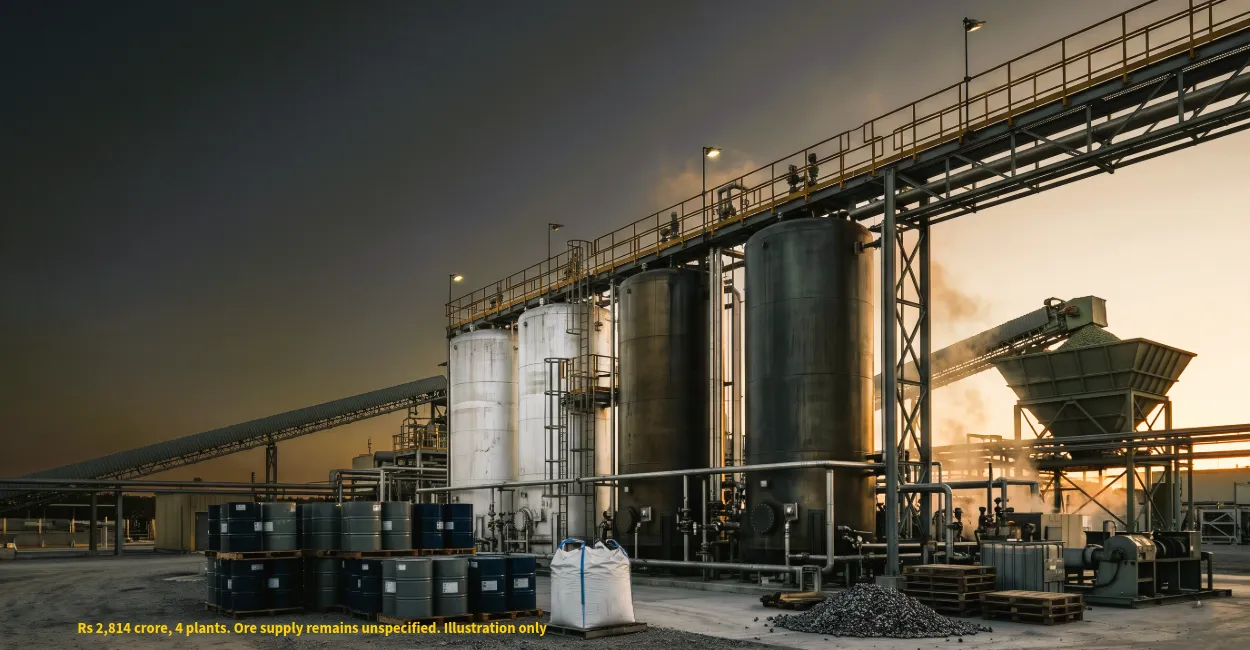
The Union Cabinet’s critical mineral processing scheme, cleared on 4 November 2026, puts Rs 2,814 crore (about $300 million) behind four plants, yet the caps on those four plants add up to Rs 2,800 crore. The Rs 14 crore gap is the smaller puzzle. The scheme’s own text names the larger one: processing needs raw material, and the Cabinet’s release lists access to it among the constraints.
The scheme sits in the middle of the chain, at refining and not at the mine. The government will pay 30% of eligible investment for two lithium plants and two nickel plants between FY2026-27 and FY2030-31. The Prime Minister put the intent on X by asking whether India should depend on other countries for processing, then answering, “I certainly don’t.”
What does the critical mineral processing scheme pay for, and who can claim it?
The scheme pays a 30% capital subsidy on eligible investment for four plants. Two will turn lithium ores or intermediates into high-purity compounds, each at a minimum of 30 kilotonnes (kt). Two will do the same for nickel at 50 kt or more. Support is capped at Rs 500 crore per lithium beneficiary and Rs 900 crore per nickel beneficiary. Cobalt is expected as a by-product of nickel.
Selection runs in two stages. Applicants first clear a technical qualification, and only the qualified move to financial bidding. For each mineral, the two winners are those seeking the lowest capex support under a least-cost rule. The subsidy is paid in three tranches linked to milestones. End-uses named are electric mobility, battery energy storage, electronics, defence and speciality steel.
| Item | Lithium | Nickel |
|---|---|---|
| Plants to be supported | 2 | 2 |
| Minimum capacity, each | 30 kt | 50 kt |
| Maximum support per beneficiary | Rs 500 crore | Rs 900 crore |
| Maximum support, both plants | Rs 1,000 crore | Rs 1,800 crore |
| Eligible investment at which the cap binds (TES arithmetic at 30%) | about Rs 1,667 crore | Rs 3,000 crore |
Source: Union Cabinet release, 4 November 2026. The last row is TES arithmetic, not an official figure.
Why do the four caps total Rs 2,800 crore against an outlay of Rs 2,814 crore?
Two lithium caps of Rs 500 crore and two nickel caps of Rs 900 crore make Rs 2,800 crore. The approved outlay is Rs 2,814 crore, which is Rs 14 crore higher. The release does not say what the difference covers. In practice the outlay works as a ceiling, because the least-cost rule invites bidders to ask for less than the cap.
The release also leaves the bid format open. It does not say whether a bidder offers a rate below 30% or a rupee amount below the cap. If all four plants claimed the full caps, Rs 2,800 crore of support would sit against about Rs 9,333 crore of eligible investment, which is TES arithmetic and not a figure from the scheme. Actual bids will set the real number.
The 30% rate is ten points above the 20% capex subsidy in the Rs 1,500 crore recycling scheme the Cabinet approved on 3 September 2025.
Where will the four plants get their ore when India relies on imports for all of it?
The Ministry of Mines told the Lok Sabha that import reliance for lithium, nickel and cobalt was 100% in 2022-23, and the Cabinet’s release describes the same dependence for refined intermediates and high-purity materials. It lists constrained access to raw materials among the barriers to commercial-scale projects. A subsidised plant still needs ore or intermediates to run.
The Mines Secretary, Keshav Chandra, said last month that the government is working on processing parks in four states. Gujarat and Andhra Pradesh would focus on rare earths, Maharashtra on lithium and Odisha on nickel. The Cabinet release does not tie the four subsidised plants to those parks.
The global chain these plants will draw on is concentrated. According to the International Energy Agency’s 2026 outlook, summarised by the Bank of Finland, China refines about 74% of lithium and 76% of cobalt. China holds 31% of nickel refining, Indonesia leads it, and Chinese-owned firms control about 75% of Indonesia’s nickel refining capacity.
TES reads that as follows. A plant that imports its intermediates replaces dependence on refined output with dependence on feedstock suppliers, some inside the same concentrated chain. Value addition at home is real, but it is not full import substitution. Inputs beyond ore also count: hydrometallurgical routes commonly consume sulphuric acid, and TES has reported how India’s sulphur shortage disrupted the fertiliser chain.
Japan offers a precedent. After a trawler collision near the Senkaku Islands in September 2010, Japanese firms reported rare-earth shipment stoppages, and Beijing announced no formal ban. In 2011 Japan’s state minerals agency JOGMEC and the trader Sojitz put $250 million into the Australian producer Lynas, which refines in Malaysia. Japanese data show reliance on China falling from about 90% to 60-70%. Tokyo paired capital with feed and a buyer.
Are 30 kt and 50 kt plants sized for today’s imports or for demand still to come?
Ministry of Mines figures for 2022-23 record about 2,145 tonnes of lithium oxide, hydroxide and carbonate imports and 32,298 tonnes of unwrought nickel. One minimum-size lithium plant would be roughly fourteen times that lithium figure. Two nickel plants at 50 kt would be about three times the nickel figure. The release does not say whether kt means feed or finished product, so the comparison is indicative.
Two cautions apply. Those trade codes cover compounds and unwrought metal, not lithium inside imported cells or nickel in other forms such as sulphate. Press reports of 2024-25 trade data put lithium imports near 3,000 tonnes, the same order of magnitude. TES reads the gap as capacity sized for demand ahead, such as the 30 GWh of battery storage the Cabinet backed the same day, and not for the present import bill.
Where does the processing scheme sit beside the mission, recycling and storage?
The critical mineral processing scheme adds a processing layer to a programme built since January 2025. The National Critical Mineral Mission carries Rs 16,300 crore of expenditure and an expected Rs 18,000 crore from public sector undertakings. The Rs 1,500 crore recycling incentive followed in September 2025. On 4 November the Cabinet also cleared Rs 14,500 crore of viability gap funding for 92 GWh of grid-scale storage, of which 30 GWh is battery storage.
Industry welcomed the scheme. Attero called processing capacity a key gap in the value chain, and LOHUM said the scheme could help India move from importing refined materials towards domestic supply. TES reads the same-day approvals as demand and midstream being built together. India’s search for supply abroad continues in parallel, as in Myanmar’s rare earths, the mineral corridors of the BRICS New Delhi Declaration and the US funding for minerals recycling in the Quad Atlanta text.
The release names defence among the end-uses but names no programme, platform or buyer. Whether plant output will meet the grades defence users need is not addressed. TES tracks that question within its wider coverage of defence supply chains and industrial strategy.
What does the scheme settle, and what stays open until the guidelines arrive?
What has the Cabinet settled?
The Cabinet has fixed the outlay at Rs 2,814 crore for FY2026-27 to 2030-31, the 30% subsidy rate, the four-plant structure, the minimum capacities of 30 kt for lithium and 50 kt for nickel, the Rs 500 crore and Rs 900 crore caps, the two-stage selection and the three-tranche payout. Cobalt is expected as a nickel by-product.
What does the critical mineral processing scheme leave open?
The release does not say what the extra Rs 14 crore covers, whether kt means feed or finished product, whether least-cost bids are a lower percentage or a lower rupee amount, or what the technical stage tests. It also does not say how bidders must secure ore or intermediates, or who will buy the output.
What is the next step to watch?
The next documents are the scheme guidelines and bid terms, which the release does not date. Watch whether the technical stage asks for proof of feedstock supply and offtake, and whether the bids come in below the caps. Those answers will show how much of the Rs 2,814 crore is ever drawn.
The first test of the critical mineral processing scheme is not the subsidy but the feed. The 2011 Lynas deal worked because capital, supply and a buyer arrived together. If India’s four plants secure ore or intermediates and offtake in the bidding round, FY2030-31 could close with domestic lithium and nickel compounds in the supply chain. If they do not, the plants will be built and wait for feed.
Sources: Union Cabinet release of 4 November 2026 (PIB); Ministry of Mines reply, Lok Sabha, 2 August 2023; International Energy Agency 2026 outlook as summarised by the Bank of Finland; Cabinet announcements on the mission, recycling and storage schemes; industry and press reports. TES arithmetic is marked as such.