
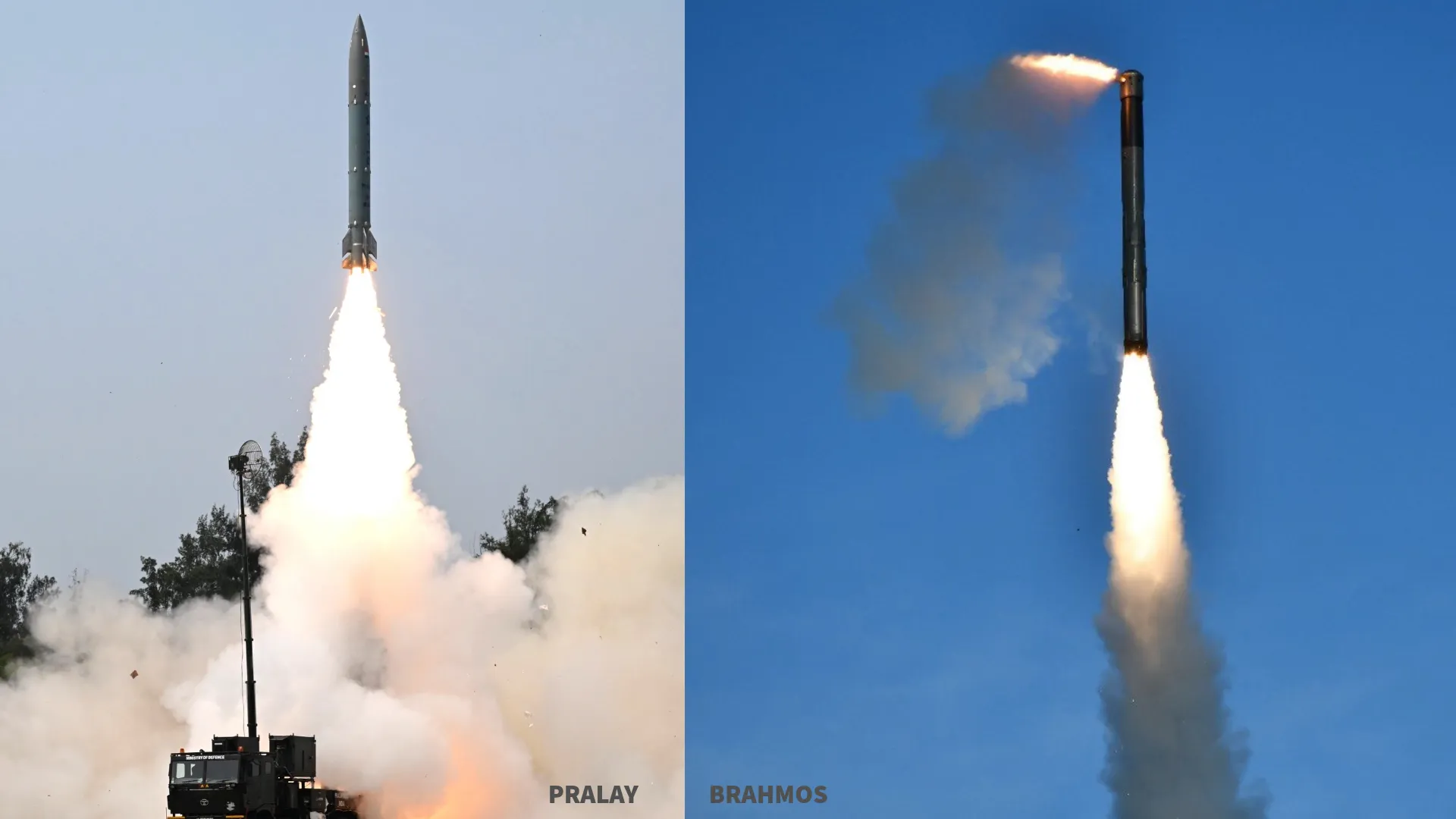
In the Pralay vs BrahMos cost debate, India’s newest conventional missile costs about what its most famous one costs. Measured by what each round delivers, Pralay is 1.3 times as efficient on the least favourable pairing of published figures and 6.8 times on the most favourable. The argument sits in that gap. The price tag is a footnote.
The Pralay vs BrahMos cost gap begins with unit price. Pralay costs an estimated ₹25 crore to ₹30 crore a round. An extended-range BrahMos costs about ₹34 crore. On the headline numbers India’s newest conventional missile is a modest saving on its most famous one, a gap of 12 to 26 per cent. That is not the transformation the coverage of the 5 November flight test suggested, and anyone repeating “Pralay is far cheaper than BrahMos” is repeating a claim that does not survive the arithmetic. Pralay and BrahMos are not substitutes, so a saving of that size understates the comparison.
Then look at what each round carries. BrahMos delivers roughly 200 kg to 300 kg of warhead. Pralay delivers up to 1,000 kg at 350 km, or around 350 kg when pushed to its full 500 km reach. Normalise for payload and the ranking inverts. On the least favourable pairing available, ₹30 crore for a 350 kg warhead, Pralay works out at about ₹8.6 lakh per kilogram of warhead delivered. BrahMos, on its most favourable pairing, is ₹11.3 lakh. Within the estimated price range, no pairing puts the cruise missile ahead on this measure.
The November trial matters for a related reason. India has never lacked targets within 500 km of its borders. It has lacked affordable ways to service them, and it has lacked the industrial capacity to build enough rounds in a year to matter in a war that lasts more than a week. Pralay addresses the second problem substantially and the first partly. The magazine is the story; the price list is secondary. That is the Pralay vs BrahMos question that matters for a war plan.
The short version
- The official record is narrower than the headlines. The Ministry of Defence confirmed a successful flight test on 5 November 2026 and said induction “has become imminent.” That is a statement of readiness, not of deployment. The ministry also confirmed a two-missile salvo from one launcher on 31 December 2025.
- In the Pralay vs BrahMos cost comparison, Pralay is not dramatically cheaper per missile. At ₹25–30 crore against roughly ₹34 crore for an extended-range BrahMos, the saving is 12–26 per cent. The advantage appears when cost is normalised against warhead weight, where Pralay leads by a factor of 1.3 to 6.8.
- Cost per kilogram is a screening measure, not cost per effect. On BrahMos’s ₹34 crore, Pralay keeps its edge until its unit price passes about ₹40 crore at a 350 kg warhead. The Pralay price is an unconfirmed media estimate. In the Pralay vs BrahMos cost comparison, price uncertainty sits on the Pralay side.
- The binding constraint is production, not price. BrahMos output from four plants runs at roughly 130–200 rounds a year and is already committed to three services and a growing export order book. A second, fully indigenous production line matters more than a cheaper round. Pralay and BrahMos draw on the same finite industrial base.
- The capability gap Pralay closes was opened by Pakistan. Islamabad put land-attack ballistic missiles into the India-Pakistan exchange for the first time in May 2025. India had nothing comparable in service. Pralay and BrahMos answer different questions for the same commander.
- The caveat. According to Indian accounts, a Fatah-II fired toward Delhi was intercepted over Sirsa during Operation Sindoor. Quasi-ballistic flight complicates interception. It does not prevent it. The Pralay vs BrahMos choice also depends on how interceptable each trajectory is.
What the ministry actually confirmed on 5 November
The Defence Research and Development Organisation flight-tested Pralay at around 1110 hrs on 5 November 2026 from Dr APJ Abdul Kalam Island off the Odisha coast. The Ministry of Defence stated that all test objectives were fully met, as confirmed by data from range instruments deployed by the Integrated Test Range at Chandipur, and that “with this successful test, the induction of the system has become imminent.”
The trial was run as a user evaluation, not a developer trial, and the distinction carries weight. It was witnessed by senior DRDO scientists, representatives of the user services from the Indian Army and the Indian Air Force, and industry partners, according to Business Standard’s reporting from Bhubaneswar. Defence sources quoted in that report said the missile followed its designated trajectory, performed mid-air manoeuvres and demonstrated hit-to-kill accuracy. The ministry’s statement and Defence Minister Rajnath Singh’s post describe a single flight test; the salvo was demonstrated separately in December 2025.
Published specifications put Pralay at around five tonnes. It is canisterised and solid-fuelled, and is built to strike radar installations, communication networks, command and control centres, ammunition depots and advanced airfields. Research Centre Imarat in Hyderabad led development with other DRDO laboratories; Bharat Dynamics Limited, described by the ministry as “one of the Development-cum-Production Partners,” has undertaken production.
The ministry has already cleared procurement orders for both the Army and the Air Force. What it has not published is a number, a contract value or a delivery schedule. Media reporting since 2022 has put the combined order at around 370 rounds — 120 for the Air Force cleared in December 2022 and roughly 250 for the Army the following year — but those figures remain reported, not official. The same applies to the unit cost. India does not publish missile prices, and the ₹25–30 crore estimate circulating in Indian media has no ministry confirmation behind it.
What a salvo test proves that a single shot cannot
A salvo launch fires two missiles from the same launcher in quick succession. Its purpose is to prove the launcher survives its own first shot: the second round must still leave accurately from a platform that blast, smoke, heat and vibration have just disturbed.
The engineering problem is physical. A single-shot trial cannot show whether a launcher is ready to fire again, and a launcher that must be reloaded or repositioned between shots is slower and more exposed in the field. Media reports describe a 12×12 vehicle carrying two canisterised Pralay rounds; the ministry has not published launcher configurations.
The Ministry of Defence confirmed on 31 December 2025 that DRDO had conducted a salvo launch of two Pralay missiles in quick succession from the same launcher at the Integrated Test Range, Chandipur, at about 1030 hrs, as part of user evaluation trials. DRDO said both missiles followed the intended trajectory and met all flight objectives, as confirmed by range tracking sensors. Defence Minister Rajnath Singh said the salvo had established the reliability of the missile. Media reports add that each round in a two-canister launcher can be assigned a different target, or the same target on two trajectories to raise the probability of a kill; the ministry has not published that.
The 5 November test did not repeat the salvo, so the ministry record on firing twice from one launcher rests on the December 2025 trial. Pralay’s combat launch cycle, reload time and per-launcher ammunition load remain unpublished.
Pralay vs BrahMos Cost: The Comparison That Survives Scrutiny
Per missile, Pralay saves little. Per kilogram of warhead delivered, it saves a great deal. BrahMos carries 200–300 kg for about ₹34 crore, or ₹11.3–17.0 lakh per kilogram. Pralay carries 350–1,000 kg for an estimated ₹25–30 crore, or ₹2.5–8.6 lakh per kilogram. Every pairing within that estimated range favours Pralay. The Pralay vs BrahMos ranking therefore holds across the whole estimated range.
| Input | BrahMos (extended range) | Pralay |
|---|---|---|
| Reported unit cost | ₹34 crore (about $4.85 million) | ₹25–30 crore, media estimate |
| Warhead weight | 200–300 kg | 350–1,000 kg, by payload configuration |
| Range | 450 km for the extended-range variant | 350 km at 1,000 kg; about 500 km at reduced payload |
| Cost per kg of warhead | ₹11.3–17.0 lakh | ₹2.5–8.6 lakh |
| Flight profile | Air-breathing cruise, about Mach 2.8, low altitude | Quasi-ballistic, manoeuvring terminal phase |
| Production partner | BrahMos Aerospace, an India-Russia joint venture | Bharat Dynamics Limited, with Research Centre Imarat as design authority |
The BrahMos figure is the better-sourced of the two, but it involves a step. A 2022 Ministry of Defence announcement covered 35 combat and 3 practice missiles for two Project-15B destroyers inside a ₹1,700 crore envelope, which is roughly ₹45–49 crore a round gross. Removing launchers, radar and command elements brings the round to near ₹34 crore; that split is TES’s estimate, not a published one. BrahMos Aerospace’s chief executive has since put the standard round at ₹34–35 crore, with newer variants intended to cut about 20 per cent.
Read the table as a statement about target allocation, not about procurement. A BrahMos round is the right instrument for a hardened command bunker, a naval combatant or a target that has to be hit inside a narrow window. It is the wrong instrument for a forward airfield, a radar site or a logistics dump, the categories Pralay was designed for and the ones the ministry named in its own briefings. What Pralay changes is how often a commander has to spend a BrahMos.
What the Pralay vs BrahMos cost comparison leaves out
Cost per kilogram is a screening measure, not a measure of cost per effect. It does not capture time on target, penetration of hardened structures or survival against air defences, and it sets a 450 km BrahMos against a Pralay that reaches 350 km only in its heaviest configuration. At comparable range, BrahMos at 450 km against Pralay at about 500 km with a roughly 350 kg warhead, Pralay’s advantage narrows to between 1.3 and 2.4 times.
The result also depends on a Pralay price that the ministry has not confirmed. Holding BrahMos at ₹34 crore and 300 kg, Pralay at 350 kg loses its cost-per-kilogram edge at about ₹40 crore a round. If BrahMos were costed at its gross ₹45 crore, that break-even rises to about ₹52 crore. The advantage holds unless Pralay’s true price sits well above the circulating estimate.
Why production capacity limits India’s conventional strike
BrahMos production runs from four plants, in Hyderabad, Nagpur, Pilani and Lucknow. The three older lines were reported to have produced 50–100 rounds a year; Lucknow, inaugurated in May 2025, adds 80–100 annually and can reach 150 at full capacity. That output is shared across the Army, Navy and Air Force and a growing export order book. Pralay adds a second production stream instead of competing with the first.
Defence Minister Rajnath Singh, flagging off the first Lucknow batch in October 2025, said around 100 missile systems a year would come from the new unit, rising to 150. BrahMos Aerospace’s chief executive said in October 2026 that all four facilities were running at full capacity to meet domestic orders and that the company was building surge capacity. The company works with more than 200 public and private suppliers, a chain whose pressure points TES has examined before.
Set that against demand. Three services are re-equipping. The Philippines, the first export customer, is seeking to expand its inventory, with Defence Secretary Gilberto Teodoro telling the Delhi Defence Dialogue in November 2026 that Manila hopes to increase its BrahMos units and has submitted a modification wish list. Every round shipped abroad is a round not in an Indian magazine.
Pralay is a DRDO design built by a defence public sector undertaking with no joint-venture partner, unlike BrahMos Aerospace, an India-Russia joint venture. That gives India a second production stream for long-range conventional strike. Pakistan’s approach, as analysts read its Army Rocket Force Command (established after Operation Sindoor), rests on volume: massed salvos of Fatah-family rockets, with a doctrine that draws on the People’s Liberation Army Rocket Force model of holding bases and air defences at risk through saturation. Against that, a BrahMos output of 130–200 rounds a year, shared across three services and an export customer, is the narrow point in India’s inventory.
Pralay and the gap Pakistan opened in May 2025
In May 2025 Pakistan introduced land-attack ballistic missiles into the India-Pakistan exchange for the first time, firing Fatah-I and Fatah-II rounds at Indian targets on 10 May. India had no comparable system in service. Pralay, which carries a heavier warhead at 350 km and a longer reach at reduced payload, is the first Indian answer to that specific gap.
The Fatah-II is a serious weapon and should be described as one. Pakistani releases and independent analysts describe a 365 kg warhead carried to about 400 km with a circular error probable under 10 metres, guided by inertial and satellite navigation, on a reportedly Chinese-origin eight-wheel chassis. It is built by NESCOM and GIDS. Pakistan tested an extended-range variant on 13 October 2026 and described it as its first hypersonic missile. Most ballistic missiles reach hypersonic speeds in terminal flight, so the label says little about the missile’s particular capability.
Its cost structure is the reason it exists. Analysts describe the Fatah family as cheap enough to build in numbers, short enough in sensor-to-shooter time to matter, and easy enough to maintain that it can sit alongside a multiple-launch rocket fleet. That is the same logic driving Pralay, executed from the opposite direction: Pakistan bought volume first and precision second, while India has bought precision first and is now addressing volume.
One caveat from the 2025 record applies. At dawn on 10 May 2025, Pakistan fired a barrage of Fatah-I and Fatah-II rounds at Indian targets. According to Indian accounts, a Fatah-II assessed as aimed toward the national capital was intercepted over Sirsa in Haryana, with debris recovered across Sirsa and Jalandhar. Indian analysis of the wider exchange found the multi-layered air defence network, with the S-400 and Akash systems prominent, performing effectively against the combined missile and drone attack. By the Indian account, Pakistan’s saturation attempt did not achieve its aim.
Pralay’s margins over the Fatah-II depend on configuration. At 350 km it carries up to roughly 1,000 kg against 365 kg, about 2.7 times the warhead. At its 500 km reach the warhead falls to around 350 kg, close to the Fatah-II’s, and the gain is the extra 100 km. Reports also credit Pralay with a manoeuvring terminal phase. Those are meaningful margins but not a category difference, and the 2025 record does not support treating a quasi-ballistic trajectory as a guarantee of penetration. Manoeuvring shortens a defender’s decision time and complicates an intercept solution. It does not remove the interceptor.
The number nobody has published
India has not disclosed an annual production rate for Pralay. Bharat Dynamics Limited is the named production partner and no other line has been announced. Until a rate is published or a contract value disclosed, the cost-per-kilogram argument describes a potential, not a capability.
Bharat Dynamics’ own disclosures show why this matters. The company closed FY2025-26 with an order book of ₹26,176 crore against revenue from operations of ₹2,442 crore, down 27 per cent from ₹3,345 crore the previous year. Earnings per share fell to ₹11.47 from ₹14.99. New orders received during the year were ₹5,909 crore, export orders stood at about ₹417 crore, and the company listed roughly ₹15,000 crore of orders in the pipeline. In the first quarter of FY2026-27 it converted about 2.2 per cent of that book into revenue.
A ₹26,000 crore order book against ₹2,400 crore of annual revenue is a measure of delivery capacity: at FY26 revenue, the book represents more than ten years of turnover. Pralay sits inside that constraint. A round that costs ₹25 crore is not cheap if the line that builds it can deliver only a few dozen a year. The economics of conventional strike are set at the factory gate, not at the contract signature, and BDL’s FY26 numbers show that the industrial side of the programme is where the work remains.
There is a route to more volume. Bharat Dynamics is one partner, not the only possible one, and the ministry has been opening tactical missile production to private industry under the 2026 procurement framework, building on the development-cum-production model that already governs Pralay, Rudram and Nag. If Pralay follows the Astra Mk2 route into licensed private manufacture, the rate question resolves quickly. That is a live policy direction, not a completed decision, and the evidence that would settle it, a production contract with a quantity and a schedule, has not been published.
What to watch
- A production contract with a number. The single most informative disclosure would be a Bharat Dynamics or Ministry of Defence announcement giving Pralay quantities and a delivery schedule. Everything in the cost argument above becomes concrete the day that lands.
- The first regiment’s raising. The ministry has said induction is imminent. Watch for the Army’s first Pralay unit and where it is stationed, which will indicate the intended target set more reliably than any briefing.
- Private manufacture. Any request for proposal opening Pralay production beyond Bharat Dynamics would confirm that volume, not capability, is the acknowledged bottleneck.
- The Fatah-II extended-range response. Pakistan tested an extended-range variant in October 2026. Watch whether India answers with a longer-reach Pralay variant.
- The Philippines decision. A second BrahMos export contract would tighten the shared production capacity that makes a separate Pralay line strategically necessary.
The temptation with a test like 5 November is to file it as a capability milestone and move on. The more useful reading is industrial. The ministry’s record now shows a quasi-ballistic missile that has cleared user evaluation and, from the December 2025 salvo, can fire twice from one launcher. On published and estimated figures it delivers more warhead per rupee than BrahMos, by a factor of 1.3 to 6.8 depending on configuration. What it has not shown is a production rate that would matter in a fortnight-long exchange. Pralay is the cheaper tool per kilogram, and BrahMos remains the scarcer one.
The conclusion is narrower than the coverage and easier to defend. Pralay can relieve BrahMos in the 150–500 km land-attack band for target types such as airfields, radars and depots, where a cheaper round can do the work. It does not replace BrahMos in the maritime role, in the air-launched role, or in the longer stand-off tier. The dependency it relieves is narrower than the coverage implies and more consequential than the price tag suggests. Pralay and BrahMos serve different rungs of the same ladder.
Source note: Ministry of Defence releases of 31 December 2025 and 5 November 2026, Bharat Dynamics Limited’s FY2025-26 investor disclosure, and Business Standard. Cost arithmetic is a TES calculation on published and media-estimated figures; the Ministry has published no Pralay unit price or order quantity.
Investment note: This article discusses Bharat Dynamics Limited and BrahMos Aerospace in the context of defence procurement. It is not investment advice, not a recommendation to buy or sell any security, and not a valuation of any company. Order book, revenue and margin figures are drawn from company disclosure and are historical. Readers should consult a registered investment adviser before acting on anything here.