
GUEST ANALYSIS
Quad maritime security should move from dialogue to capability, the authors argue, built on seabed surveillance, chokepoint contingency planning and critical minerals, and stopping short of an alliance that New Delhi is unlikely to accept.
The Quadrilateral Security Dialogue (Quad), comprising Australia, India, Japan and the United States, stands at a strategic crossroads. Nearly a decade after its revival in 2017, the grouping has become an important mechanism for Indo-Pacific cooperation. Yet competing national priorities, India’s strategic autonomy and the absence of a permanent secretariat constrain its effectiveness.
China’s expanding maritime presence, competition over critical minerals and vulnerabilities in international shipping routes strengthen the case for deeper cooperation. The challenge is translating shared concerns into a coherent regional security architecture.
Rather than becoming an Asian NATO, Quad 3.0 should evolve into a functional maritime security compact, combining maritime domain awareness, chokepoint security and economic resilience while preserving India’s strategic autonomy. Australia and India are particularly well positioned to advance this transformation through their complementary geography, naval capabilities and strategic cooperation.
From Quad 2.0 to Quad 3.0
When the Quad was revived in 2017, China’s expanding naval capabilities and assertiveness in the South China Sea created common security concerns among four major Indo-Pacific democracies. In 2018, one of the authors, Dr Balaji Chandramohan, argued in a Future Directions International paper that the Quad could develop into an informal maritime alliance capable of challenging China’s ambitions for regional sea control.
Subsequent developments reinforced this assessment. India concluded foundational defence agreements with the United States, Australia rejoined the Malabar naval exercises in 2020, and maritime cooperation expanded. However, the anticipated alliance never emerged.
Instead, the Quad broadened its agenda to include maritime security, critical technologies, infrastructure and supply chains. This reflected India’s willingness to deepen defence cooperation without surrendering strategic autonomy through formal alliance commitments.
Although the last leaders’ summit occurred in September 2024, foreign ministers met three times during 2026 despite bilateral tensions between Washington and New Delhi. These meetings advanced maritime surveillance, critical-minerals recycling, fuel security and undersea cable resilience.
The Quad therefore possesses functioning diplomatic and operational mechanisms. The challenge is translating these initiatives into enduring capabilities independent of political disagreements and leadership changes.
The Indian Ocean: A Strategic Advantage
Indo-Pacific security debates frequently concentrate on Taiwan and the South China Sea. Yet the Indian Ocean is increasingly central to strategic competition.
China’s expanding naval reach is accompanied by oceanographic research and seabed mapping. A March 2026 Reuters investigation documented extensive Chinese ocean-mapping activities with potential military applications, including submarine navigation and underwater surveillance.
For Beijing, Indian Ocean access connects its economy to Persian Gulf energy supplies and commercial routes towards Africa and Europe. However, naval movements between the Pacific and Indian oceans face geographical constraints through passages including Malacca, Sunda, Lombok and Ombai–Wetar.
India occupies an advantageous position. Its Andaman and Nicobar Islands overlook the western approaches to the Malacca Strait, while its navy operates across the wider Indian Ocean. Australia contributes complementary geography through the Cocos (Keeling) Islands and Christmas Island. Japan brings maritime technology and economic resources, while the United States contributes naval reach, intelligence capabilities and regional alliances.
Together, these capabilities could underpin a more effective maritime security architecture. The objective should not be to blockade China or deny legitimate commercial access, but to prevent any single power from dominating maritime routes, threatening undersea infrastructure or exploiting economic dependencies to coerce regional states.
Three Pillars for Quad Maritime Security
A more effective Quad requires a focused strategic purpose built around three priorities.
Maritime Domain Awareness and Undersea Security
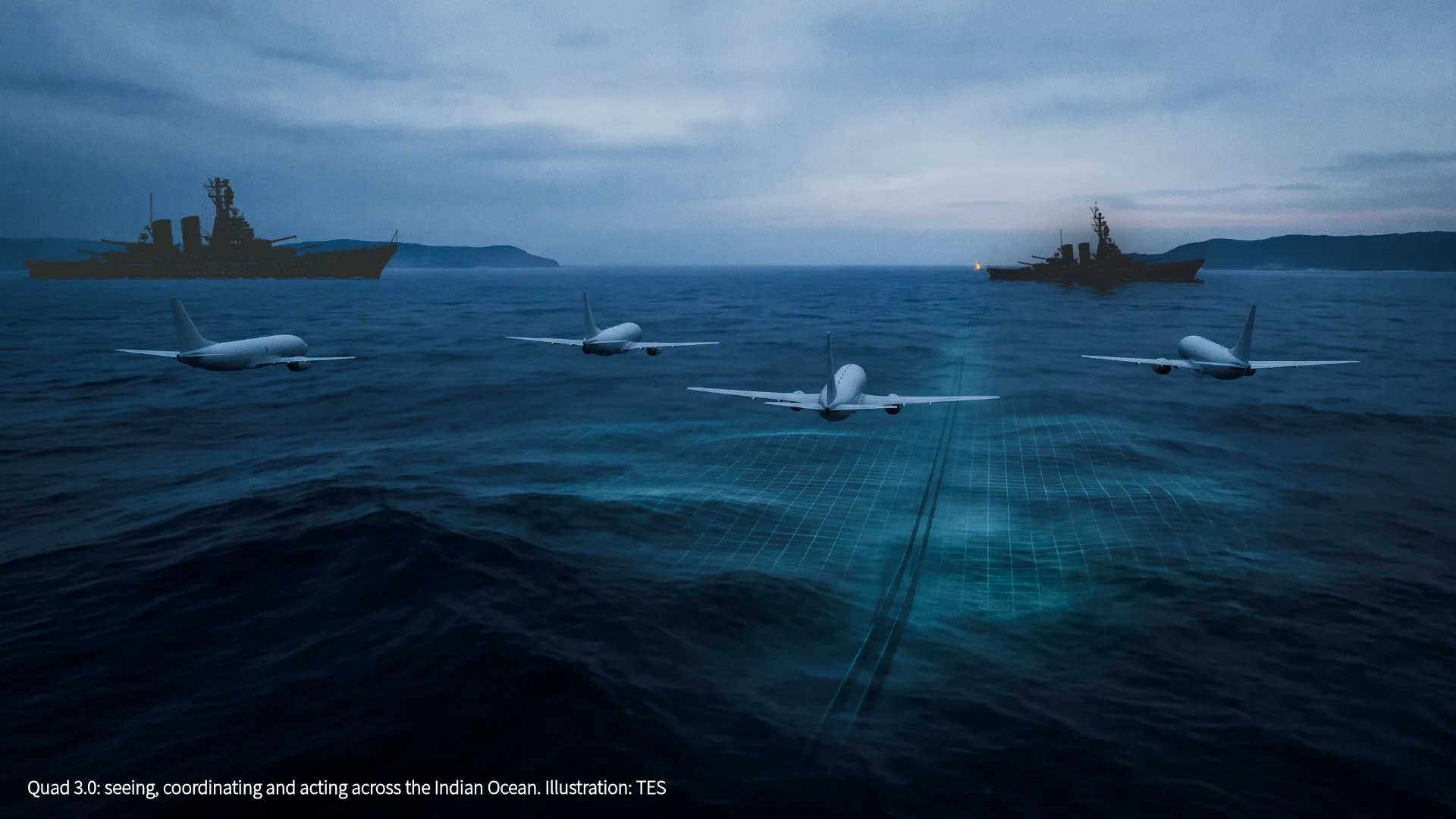
The first priority should be comprehensive maritime surveillance across the Indian Ocean. Existing initiatives have strengthened commercial shipping awareness, but submarine operations and seabed infrastructure require greater attention. Quad members should expand cooperation on oceanographic information, underwater monitoring and maritime patrol coordination.
Australia, India and the United States operate P-8 maritime patrol aircraft, while Japan operates its P-1 aircraft. Their participation in Sea Dragon 2026 demonstrates an existing foundation for anti-submarine warfare cooperation.
Exercises such as Malabar and Sea Dragon could support regular surveillance across the eastern Indian Ocean. India’s Andaman and Nicobar Command and Australia’s maritime surveillance capabilities could become complementary elements of a wider operational network.
Protecting submarine cables should also become a priority, given their importance to communications, financial transactions and regional stability. TES has examined how India, China and the West compete over these data routes.
Chokepoint and Energy Security
The second priority should be maritime chokepoint resilience. The 2026 Strait of Hormuz crisis demonstrated how shipping disruptions threaten energy-importing economies, particularly India and Japan.
Although the Quad has developed maritime security and logistics initiatives, publicly announced arrangements do not constitute a comprehensive collective framework for managing major chokepoint disruptions. A dedicated contingency framework could coordinate shipping information, alternative routes, strategic petroleum reserves and mine countermeasure capabilities.
Mine warfare deserves attention. Inexpensive naval mines and uncrewed systems can disrupt commercial shipping and impose substantial economic costs. Joint mine countermeasure exercises would strengthen security without requiring integrated military command or formal alliance obligations.
Critical Minerals and Economic Resilience
The third priority should address critical minerals and supply-chain resilience. China’s dominant position in several mineral-processing supply chains creates vulnerabilities for countries seeking independent defence-industrial capabilities.
Australia possesses substantial critical mineral resources, India offers industrial capacity, Japan contributes processing technology and investment, and the United States brings capital and defence-industrial demand. The Quad’s Critical Minerals Initiative Framework and recycling investments provide a foundation, but cooperation must extend beyond pilot projects.
Joint processing investments, long-term offtake agreements, recycling technologies and coordinated stockpiling could reduce strategic dependencies. Maritime security ultimately depends upon industrial supply chains capable of sustaining defence capabilities during prolonged crises.
India and the Limits of Alliance Building
Any credible Quad strategy must accommodate India’s strategic autonomy. New Delhi’s approach to China combines border tensions, economic interests, maritime competition and diplomatic engagement. Cooperation with Western partners does not imply an intention to join a containment alliance.
Transforming the Quad into a treaty-based collective defence organisation would risk weakening the partnership. A functional security compact offers a more realistic alternative, allowing India to contribute maritime capabilities, regional knowledge and strategic geography without accepting automatic military obligations.
For Australia, Japan and the United States, this strengthens cooperation with India without demanding commitments New Delhi is unlikely to accept. The Quad’s effectiveness should be measured by the capabilities it produces, not whether members adopt identical strategic positions.
Expanding the Architecture Beyond Four Members
The Quad’s maritime architecture would benefit from cooperation with other regional powers. Indonesia, France and Vietnam offer complementary capabilities. Project-based participation is more practical in the near term than formal membership expansion.
Indonesia occupies strategically important maritime passages connecting the Indian and Pacific oceans. Australia and India could support maritime surveillance, hydrographic collaboration and capacity building. France, with military facilities and territories across the Indian Ocean, could contribute to chokepoint security, naval exercises and mine countermeasures. Vietnam offers opportunities for cooperation in maritime surveillance, coast guard capacity building and critical mineral supply chains.
The guiding principle should be functional participation rather than institutional expansion.
A Quad-plus framework organised around specific projects would enable regional participation without exclusive geopolitical commitments or undermining ASEAN centrality.
Australia and India’s Opportunity to Shape Quad 3.0
Australia and India are well positioned to shape the Quad’s next phase. India’s strategic location, naval capabilities and defence-industrial base complement Australia’s maritime geography, defence partnerships and critical mineral resources. Together, they could anchor a framework connecting the eastern Indian Ocean, Southeast Asian maritime passages and the Pacific.
Canberra should prioritise maritime surveillance in the eastern Indian Ocean, particularly through cooperation with Indonesia, while New Delhi could strengthen coordination around the Andaman and Nicobar Islands.
Both countries should advocate a small standing Quad coordination mechanism to maintain continuity between rotating chairmanships and monitor implementation. Regular foreign ministers’ meetings should provide institutional continuity, while leaders’ summits offer strategic direction.
Success should be measured through surveillance coverage, operational exercises, contingency arrangements and supply-chain investments, not by diplomatic communiqués.
From Dialogue to Strategic Architecture
The Quad’s greatest strength may lie in what it is not. It is neither a treaty alliance nor a substitute for existing US security commitments or AUKUS, the trilateral security partnership of Australia, the United Kingdom and the United States. American alliances provide formal deterrence commitments, including extended nuclear deterrence, while AUKUS strengthens conventional military capabilities and advanced defence technology cooperation.
The Quad can complement both by improving maritime transparency, strengthening resilience and connecting India’s naval capabilities with those of the United States and its allies. TES has set out how India’s Project-77 submarines, AUKUS and the Quad fit together as complementary pillars. Such cooperation could strengthen deterrence indirectly by reducing opportunities for coercion and improving collective responses to maritime disruption.
No single country can independently secure the Indo-Pacific’s maritime routes, critical infrastructure and supply chains. Equally, a NATO-style alliance remains politically unrealistic. A distributed security architecture combining treaty alliances with flexible operational partnerships offers a more achievable alternative.
Quad 3.0 should be judged not by whether it becomes an alliance, but by whether it can help prevent any single power from dominating the Indo-Pacific’s maritime system.
The original Quad established the dialogue. Quad 2.0 expanded the agenda. Quad 3.0 must now deliver the architecture. The Indo-Pacific does not need another forum producing declarations. It needs a Quad capable of seeing, coordinating and acting across the maritime spaces upon which regional security and prosperity depend.
Source note: This is the authors’ analysis; views are their own. Factual references draw on the Quad joint press release of October 2026, US Navy and Royal Australian Air Force exercise releases, a Reuters investigation of 24 March 2026 and a 2018 Future Directions International paper.