The Turkey Mecca pact vote of 5 November ended 279 to 119, and the government’s own side then confirmed that no soldier moves without a second vote. India’s terms are already declared. The pact’s procedure is slower than they are.
Key takeaways
- Turkey’s Grand National Assembly ratified the 16-article Mecca Joint Defence Agreement by 279 votes to 119 on 5 November 2026. Fuat Oktay, who chairs its foreign affairs committee, said any deployment of troops needs a separate mandate under Article 92 of the constitution.
- The pact was activated on 5 October. Activation has produced support roles so far: Turkey’s defence minister ruled out combat against the Houthis, and Pakistan, which already has a large presence in Saudi Arabia, describes the fighting as Saudi-led.
- India has said any future terror attack will be treated as an act of war. Operation Sindoor ran from 7 May to a ceasefire on 10 May 2025, a tempo that a pact needing parliamentary votes cannot match.
- Pakistan gains endurance from the pact in supplies, finance and diplomatic cover. It does not gain immunity, and five signals will show whether that changes.
Turkey Mecca pact vote: ratified 279–119, no troops authorised
The Turkey Mecca pact vote of 5 November 2026 passed 279 to 119 in the 600-seat Grand National Assembly. Ratification does not authorise Turkish troops anywhere. Any deployment needs a separate parliamentary mandate under Article 92 of the constitution, according to Fuat Oktay, a member of the ruling party who chairs the foreign affairs committee. India’s declared position, that a terror attack is an act of war, is unchanged by the vote.
The 16-article agreement was signed in Mecca on 7 August 2026 by Saudi Arabia, Turkey and Pakistan. It commits the three to regard an attack on one as an attack on all, and covers intelligence sharing, military cooperation and defence-industry ties, according to the Associated Press. The Associated Press reported that opposition parties objected on the ground that the agreement could embroil Turkey in regional wars and put soldiers in harm’s way.
Oktay’s reply was procedural. Turkey, he said, would not be drawn into an uncontrolled process against its will. Turkish reports of the debate add that the text states it does not prejudice the parties’ existing obligations, including those under NATO, and that the vote alone does not bring the treaty into force: gazette publication and deposit of the ratification instrument remain.
The pact was activated on 5 October, and activation produced support, not combat
Saudi Arabia, Turkey and Pakistan agreed on 5 October 2026 to activate collective deterrence measures against the Houthis, and a joint statement spoke of rapid deployment of “agreed military forces and capabilities”. A month later, Turkey’s defence minister says no combat role against the Houthis is planned, and Pakistan’s defence minister describes the fighting as Saudi-led, with Turkey and Pakistan in support.
The activation followed a first phase of statements. TES reported in September that Turkey and Pakistan answered the early Houthi barrage with solidarity and no aircraft. Al Jazeera’s account of the 5 October meeting at Riyadh records the shift: the three ministers agreed to trigger deterrence measures, and the statement published by Pakistan’s Foreign Ministry promised rapid deployment. India Today reported that details of the deployment were not disclosed.
Pakistan is the member with forces already forward. Middle East Eye reported that Pakistan has tens of thousands of troops in the kingdom, and that Reuters had reported four planeloads of weapons sent to Aden for the Saudi-backed government. One analysis cited a senior Pakistani military official as saying Pakistani jets had struck Houthi targets; Islamabad denied it and said only that its forces were in the kingdom in “multiple capabilities”.
Ankara has drawn a narrower line. Defence Minister Yaşar Güler said on 8 October that Turkey did not envisage its troops engaging in combat or offensive operations against the Houthis, and that the extent of support would be decided after ratification, according to Turkish press reports. Pakistan’s Khawaja Asif, as reported by Al Jazeera, said combat was practically being conducted by Saudi Arabia’s own forces.
That is the working template of the pact so far: a joint statement, deterrence measures, forward Pakistani presence, Turkish technical and defensive support, Saudi forces in the fight. The pattern is clear for a non-state adversary in Yemen.
Turkey’s opposition feared Yemen, India and a vote nobody took
Turkey’s opposition did not dispute the pact’s existence so much as its reach. The New Party, a CHP breakaway, and the pro-Kurdish DEM Party argued it could draw Turkish soldiers into Yemen or into an India–Pakistan conflict without a separate decision. The main opposition CHP backed ratification but asked for rules protecting Turkey’s other obligations. The government’s answer was a second mandate under Article 92.
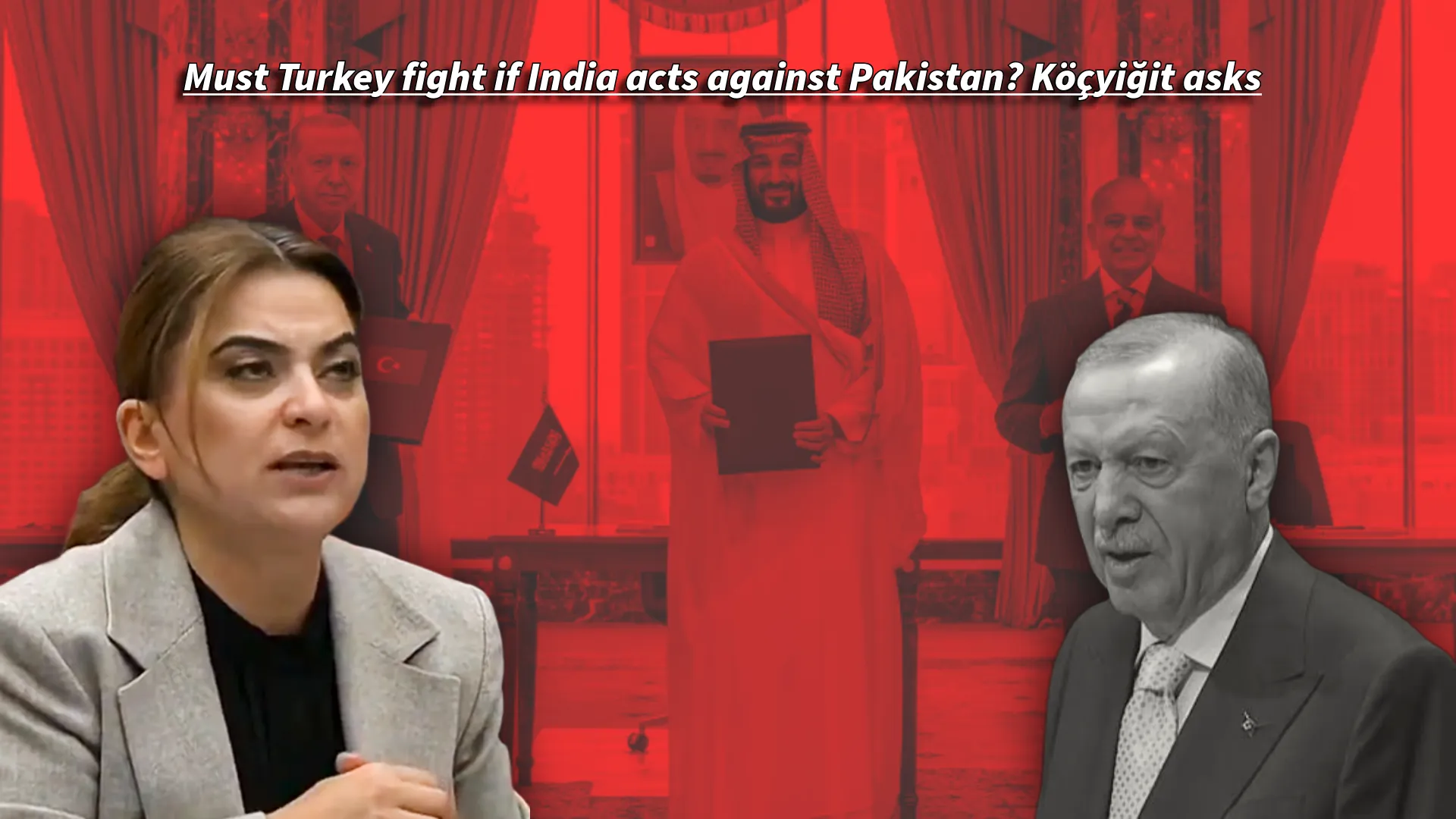
If India acts against Pakistan, must Turkey go to war? Gülistan Kılıç Köçyiğit, deputy parliamentary group leader of the Peoples’ Equality and Democracy Party (DEM), put that question to the chamber, citing the history of conflict between India and Pakistan and their nuclear arsenals, India Today reported. She asked who would decide Turkey’s response if Pakistan sought help, and said neither parliament nor the public had made that decision. “If we are going to enter, how do you decide on this?” she asked.
The other objections came from the memory of Yemen. Murat Emir, deputy leader of the New Party’s parliamentary group, said the government “brought this agreement to send Turkish soldiers to the deserts of Yemen”. The Associated Press noted that the loss of Ottoman soldiers in Yemen in the early twentieth century still weighs heavily in Turkish cultural memory. DEM said any deployment there should come before parliament as a separate motion, and that it would vote against.
The CHP took a middle position. Faik Öztrak said the party would vote in favour, according to Turkish reports, while Mehmet Güzelmansur asked for clear rules so the agreement did not collide with Turkey’s other international obligations. Hulusi Akar, a former defence minister, called the pact a complement to NATO. Several opposition members also asked whether the grouping was being positioned against Iran, which shares a border with Turkey; Turkish and Pakistani officials have said it targets no country.
Turkey’s parliament has refused a government before. On 1 March 2003 it rejected the motion that would have let American forces use Turkish territory for the invasion of Iraq, against the government’s own recommendation. The Mecca law leaves the next decision, if one comes, to the chamber.
TES assessment: the debate shows that Turkey’s own politics has not signed off on a South Asian commitment. The ruling coalition still carried 279 votes and would probably carry a mandate vote, so the point concerns speed, not a veto.
India’s terms are declared, and the pact’s procedure is slower
India has stated that any future terrorist attack on its soil will be treated as an act of war and answered accordingly, and External Affairs Minister S. Jaishankar told Parliament that terrorists will not be treated as proxies. Operation Sindoor began on 7 May 2025 and ended in a ceasefire on 10 May. A response on that timeline would be over before a Turkish mandate vote could be scheduled.
The statement came shortly before the ceasefire, after India struck terror sites in Pakistan and Pakistan-occupied Kashmir (PoK) on 7 May following the Pahalgam attack, as the Tribune and other Indian outlets reported at the time. Israel’s BESA Centre describes the declaration as a shift from deterrence to compellence. The doctrine addresses the Pakistani state as well as the attackers, which makes it a different case from Yemen, where the adversary is a militia.
TES assessment: any invocation would also be awkward for Ankara and Riyadh, since Pakistan itself calls the pact defensive and a campaign that follows a terror attack places them beside the side whose territory hosted the attackers.
The Ministry of External Affairs said on 11 August that it was examining the pact’s implications for national security and regional stability, according to spokesperson Randhir Jaiswal. That is a measured position from a government that has already set its own terms.
Two further constraints sit outside the treaty text. Saudi Arabia keeps close ties with both India and Pakistan, and the Lowy Institute’s analysis notes that India cannot disregard Saudi involvement as easily as Turkish support to Pakistan. That makes Riyadh more likely to mediate than to escalate, which is a TES assessment. And NATO would not cover Turkey in a South Asian war: Article 6 of the North Atlantic Treaty confines collective defence to defined territories and areas that do not include the subcontinent.
What Pakistan can count on is endurance, not immunity
The pact can give Pakistan faster resupply, financing, intelligence and diplomatic cover in a crisis with India. It cannot supply combat power on the timeline of a short Indian operation. This is a TES assessment, since the pact’s full text has not been published. Analysts cited by Zee News make a similar point: Turkish defence cooperation and Saudi financial capacity could indirectly strengthen Pakistan’s military resilience.
The economic balance supports that reading. The International Monetary Fund’s April 2026 estimate put India’s nominal GDP at about $4.15 trillion. Turkey stood at about $1.64 trillion and Pakistan at about $408 billion, which together come to roughly $2 trillion. India is therefore about twice the combined size of the two, and the October update projects India at about $6.74 trillion in 2031. The weaker rupee has trimmed India’s dollar figure, as the IMF’s own estimates show.
The gap is widening, but the near-term test is conversion. India’s task through the early 2030s is to turn that economic lead into capability in air defence, naval power and surveillance, where indigenous programmes are already under way. Partners such as Israel and Western governments add supply and technology, not troops, which is a TES assessment.
India’s crude sourcing has already moved away from the Strait of Hormuz
Petroleum Minister Hardeep Singh Puri said in March 2026 that non-Hormuz sourcing had risen to about 70 per cent of India’s crude imports, up from 55 per cent before the conflict. India now buys crude from about 40 countries, against 27 in 2006-07. The pact reaches India’s energy planning through risk premiums, not through any treaty clause.
The ministry also said daily consumption of roughly 55 lakh barrels remained secure. Brent, priced in dollars like every benchmark, topped $100 a barrel on 10 September for the first time since July as tanker attacks intensified, the Korea Times reported. TES traced the Red Sea chain to Indian tanker economics in September, and the Mecca pact sits alongside that chain without having been shown to move it.
No source reviewed for this article attributes a price move to the pact. TES assessment: if the three members begin to coordinate force posture, insurers will price Gulf energy infrastructure with a political component, and India’s wider sourcing and storage are the response already in place. India’s defence ties with Greece, which TES covered after INS Trishul called at Souda Bay, add a Mediterranean dimension to New Delhi’s options.
Five signals will show whether the pact is gaining operational weight
- Gazette publication and deposit. Entry into force depends on both. The date also starts any withdrawal clock the text contains, which the sources reviewed do not describe.
- The wording of any Turkish mandate. Advisory and training language is a different commitment from force protection or combat. Article 92 puts that choice before the chamber.
- Pakistani units moving between Saudi Arabia and its own fronts. With a large Pakistani presence already in the kingdom, any shift of squadrons or air-defence assets toward the eastern front would be the clearest physical sign.
- Invocation during an India–Pakistan crisis. Yemen has set the template for activation. A declared invocation against India would be a different act and would have to pass the Turkish and Saudi tests described above.
- A Gulf–Ankara statement naming India. Routine language on regional stability is cheap. A joint statement that adopts Islamabad’s framing of events would be a policy shift.
The Mecca pact is a three-member arrangement whose members do not share an adversary: Riyadh’s is a militia in Yemen and, at the outer edge, Iran; Ankara’s attention sits with the eastern Mediterranean; Islamabad’s is India. Such alliances usually settle on the lowest common denominator in a crisis, and so far that has meant deterrence measures, support roles and statements.
For New Delhi, the planning variable is a better-supplied Pakistan in a longer crisis, and India’s economic lead, its declared doctrine and its own tempo remain the fixed points. Turkey’s parliament showed in 2003 that it can say no, and the next vote is still to come.
Source note: Drawn from Turkish parliamentary proceedings as reported by wire agencies and Turkish outlets, the three governments’ joint statement of 5 October 2026, Government of India statements, Ministry of Petroleum and Natural Gas briefings and IMF projections.