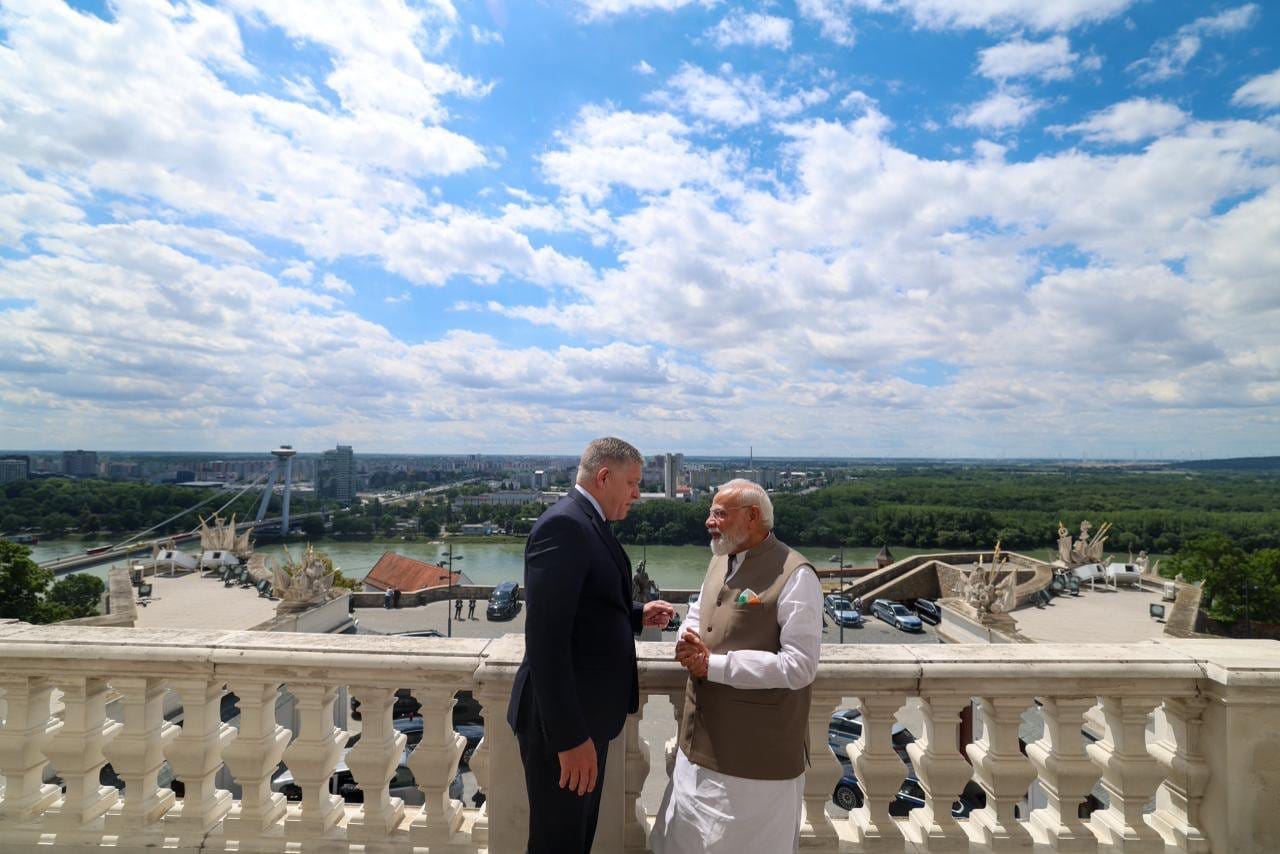
BRATISLAVA, June 15 — India and Slovakia formally elevated their bilateral relationship to a Comprehensive Partnership on Monday, establishing a new framework driven by advanced digital innovation, manufacturing infrastructure, and security cooperation. The strategic realignment followed delegation-level talks between Prime Minister Narendra Modi and Slovak Prime Minister Robert Fico at Bratislava Castle, concluding the core agenda of the modi slovakia visit, which marks the first time an Indian head of government has traveled to the country since its independence in 1993.
‘Held an excellent meeting with Prime Minister Fico. This is indeed a very special moment for the India-Slovakia friendship.
-Prime Minister Narendra Modi
Considering the strong potential of our ties, we have elevated our relations to a Comprehensive Partnership.
Our talks covered cooperation in sectors like automobiles, railways, advanced manufacturing and green technology.
The India-EU Free Trade Agreement will also add momentum to our partnership.
While traditional diplomatic agreements frequently focus on legacy trade commodities, this summit signaled a distinct pivot toward deep-tech sectors and security assets. According to statements released by India’s Ministry of External Affairs (MEA), the upgraded diplomatic status is structurally designed to accelerate India-Slovakia tech cooperation and broaden bilateral security mechanisms amid shifting global supply chains and evolving European geopolitical architectures.
The Strategic Value of the Central European Axis
Diplomatic analysts tracking New Delhi’s continental policy emphasize why slovakia is important for india within the wider European Union framework. While India maintains deep-seated trade and diplomatic channels with Western European hubs like Paris and Berlin, Central Europe’s heavy industrial weight offers critical alternatives for supply chain diversification, software integration, and heavy industrial assembly. Slovakia’s position as a highly industrialized EU member state—with a robust manufacturing ecosystem spanning the automotive and heavy machinery sectors—makes it a practical entry point for Indian enterprises looking to navigate continental trade routes and complex regulatory frameworks, such as the EU AI Act.
A major outcome of these shifting dynamics is the expansion of india slovakia defence ties. During the bilateral talks, the two leaders exchanged a formal Letter of Intent on promoting cooperation in Defence, aimed at integrating joint industrial capabilities. Officials from the Indian delegation—which included External Affairs Minister S. Jaishankar and National Security Advisor Ajit Doval—noted that the defence roadmap focuses on co-production in advanced manufacturing, vehicle engineering, and military software, allowing both nations to bypass traditional defense procurement bottlenecks.
Deploying the First AI Academic Chair in Central Europe
A central anchor of the technological pivot finalized during the summit is the establishment of an official India Chair on Artificial Intelligence (AI) at the Technical University of Kosice. Administered through the Indian Council for Cultural Relations (ICCR), this academic post represents a notable shift from traditional external chairs, which have historically focused on languages, humanities, or classical studies.
The placement of the chair at the Technical University of Kosice allows India to embed its digital governance expertise directly into one of Slovakia’s premier technical research institutions. Indian officials noted that the chair will co-develop frameworks for responsible AI governance and supercomputers. This academic baseline operates in tandem with a newly signed bilateral agreement on Quantum Communication and Critical Infrastructure Protection, intended to secure essential digital networks and lay the groundwork for joint cybersecurity research.
Institutional Academic and Labor Corridors
To sustain these joint initiatives, the two governments formalized direct pipelines between premier academic and scientific institutions. The Indian Institute of Technology (IIT) Delhi and the Slovak Technical University finalized a comprehensive agreement enabling reciprocal student exchange programs, joint engineering scholarships, and collaborative doctoral research pathways. Simultaneously, a new pact between the Indian National Science Academy (INSA) and the Slovak Academy of Sciences (SAS) was concluded to provide structured funding and personnel mobility for fundamental scientific research.
India-Slovakia tech cooperation and defence ties
The technological commitments are further supported by an inter-governmental Memorandum of Understanding (MoU) on Labor Migration. Slovakia’s industrial sectors have faced widening deficits in engineering and technical personnel. Conversely, India possesses a significant surplus of technical and software engineering talent.
Ministry officials stated that the labor migration framework introduces streamlined consular and visa protocols to facilitate the legal, structured movement of Indian digital specialists and skilled technicians into the Slovak economy. To manage the operational demands of increased personnel movement and strategic coordination, permanent institutional mechanisms for security and consular affairs were declared active alongside the core text of the agreement.
The summit concluded with Modi extending an official invitation to Fico for a reciprocal state visit to India to monitor the implementation of the 11 finalized pacts. Joint working groups are scheduled to convene later this year to draft the operational roadmap, transforming the diplomatic text into active technical and industrial projects.