
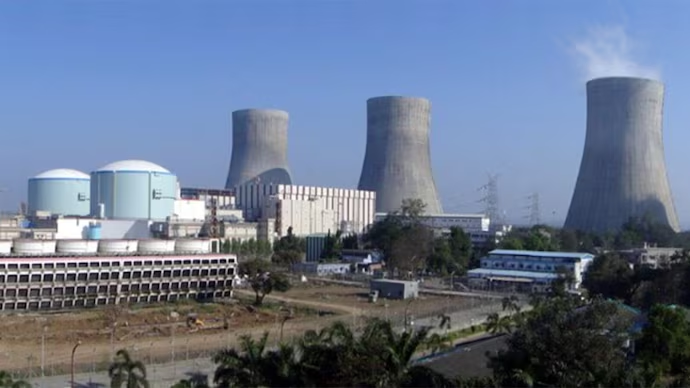
From Kalpakkam to Kudankulam: Expanding Nuclear Energy in India
New Delhi: India’s rapid growth is driving record power demand. Factories, transit systems, and data centers now require more supply. To reach its goal of being a developed nation by 2047, the government must find cheap and clean energy.
The country pledged to reach net-zero carbon emissions by 2070. Meeting economic goals while cutting pollution needs a mix of energy sources. Solar and wind power are growing fast. But they are not always available. They need steady plants to back them up.
India’s Prototype Fast Breeder Reactor at Kalpakkam recently reached its first chain reaction as the Kudankulam plant expands. The projects show nuclear power is central to India’s energy and climate plans.
India’s Growing Energy Challenge
India’s energy demand is projected to grow significantly over the next few decades. Rapid urbanization, industrial growth, expanding transportation networks, digital transformation, the application of artificial intelligence, data centres and growing household consumption are driving the rising electricity requirements.
India, the world’s most populous country, needs to keep its energy supply in step with economic growth. Manufacturing, healthcare, education, agriculture, transportation and digital services all depend on a reliable electricity supply. Any interruption in the power supply can directly affect productivity, economic competitiveness and quality of life.
Meeting this demand relying only on traditional fossil fuels will increase dependence on imports and hinder the achievement of climate objectives. Hence India demands a reliable, affordable and sustainable energy source combination.
Nuclear Power Integration Targeted to Enhance Long-Term Energy Security
India said on Dec. 17 that nuclear power offers a way to meet its long-term energy needs. The government told Parliament that nuclear plants provide a constant electricity supply. Nuclear reactors run regardless of weather. Solar and wind power do not. These plants operate 24 hours a day. They provide a clean power source for the national grid.
India said nuclear power emissions match those of wind and hydropower as it targets net-zero by 2070. The government expects the technology to lead its shift to cleaner power. Nuclear lifecycle output equals renewables. This supports the country’s plan to cut carbon.
Nuclear Energy Recognized for Low Carbon Emissions and High Reliability
- Continuous 24×7 electricity generation.
- Minimal greenhouse gas emissions during operation.
- High energy density compared to fossil fuels.
- Reduced dependence on imported fuels.
- Long operational life of power plants.
- Reliable base-load power that complements renewable energy.
Nuclear Power Offers Strategic Benefits for National Energy Infrastructure.
India’s Unique Three-Stage Nuclear Energy Programme
India is developing a three-stage nuclear power program to exploit its vast thorium reserves and overcome a lack of domestic uranium. Physicist Homi Jehangir Bhabha designed the strategy to fit the country’s resource profile. It uses a closed fuel cycle. This differs from most international nuclear models. India holds some of the world’s largest thorium deposits but few uranium mines. The Department of Atomic Energy runs the program.
India has established the first stage of its nuclear power program through a fleet of domestic pressurized heavy water reactors. These plants use natural uranium to generate electricity. They also produce plutonium. The indigenous units operate nationwide.
India’s 500-megawatt Prototype Fast Breeder Reactor reached its first criticality on April 6, 2026, at the Kalpakkam site in Tamil Nadu. The milestone marks the start of a controlled nuclear chain reaction. This event moves India into the second stage of its three-part nuclear power program.
The reactor uses Uranium-Plutonium Mixed Oxide fuel. It converts Uranium-238 into Plutonium-239 to produce more fuel than it burns. The Indira Gandhi Centre for Atomic Research designed the facility. Bharatiya Nabhikiya Vidyut Nigam Limited built it. Both agencies operate under the Department of Atomic Energy.
This stage allows India to eventually use its large thorium reserves. Engineers plan to use the reactor to turn thorium into Uranium-233. That fuel will power plants in the final stage of the energy strategy.
Work also continues at the Kudankulam Nuclear Power Project. Unit-5 should start by the end of 2026. Each reactor at the Tamil Nadu site generates 1,000 MW. These units provide steady power to the southern grid and help meet national energy goals.
Masterplan for Nuclear Energy in India
New Delhi wants 100 GW of nuclear capacity by 2047. The government told states to speed up approvals for more than 30 identified reactor sites. The target supports a plan to reach net-zero emissions by 2070.
Renewable energy sources like solar and wind face limits because they depend on the weather. Solar power stops after sunset. Wind levels change constantly. Nuclear plants provide a steady supply when renewables drop off. This helps keep the power grid stable.
Large nuclear projects require high investment and long lead times. The government says it is now looking at small modular reactors to lower costs and finish projects faster. Officials say safety and waste management stay at the center of planning to keep public trust. Success at Kalpakkam and expansion at Kudankulam show India is moving toward a power system based on self-reliance and thorium.