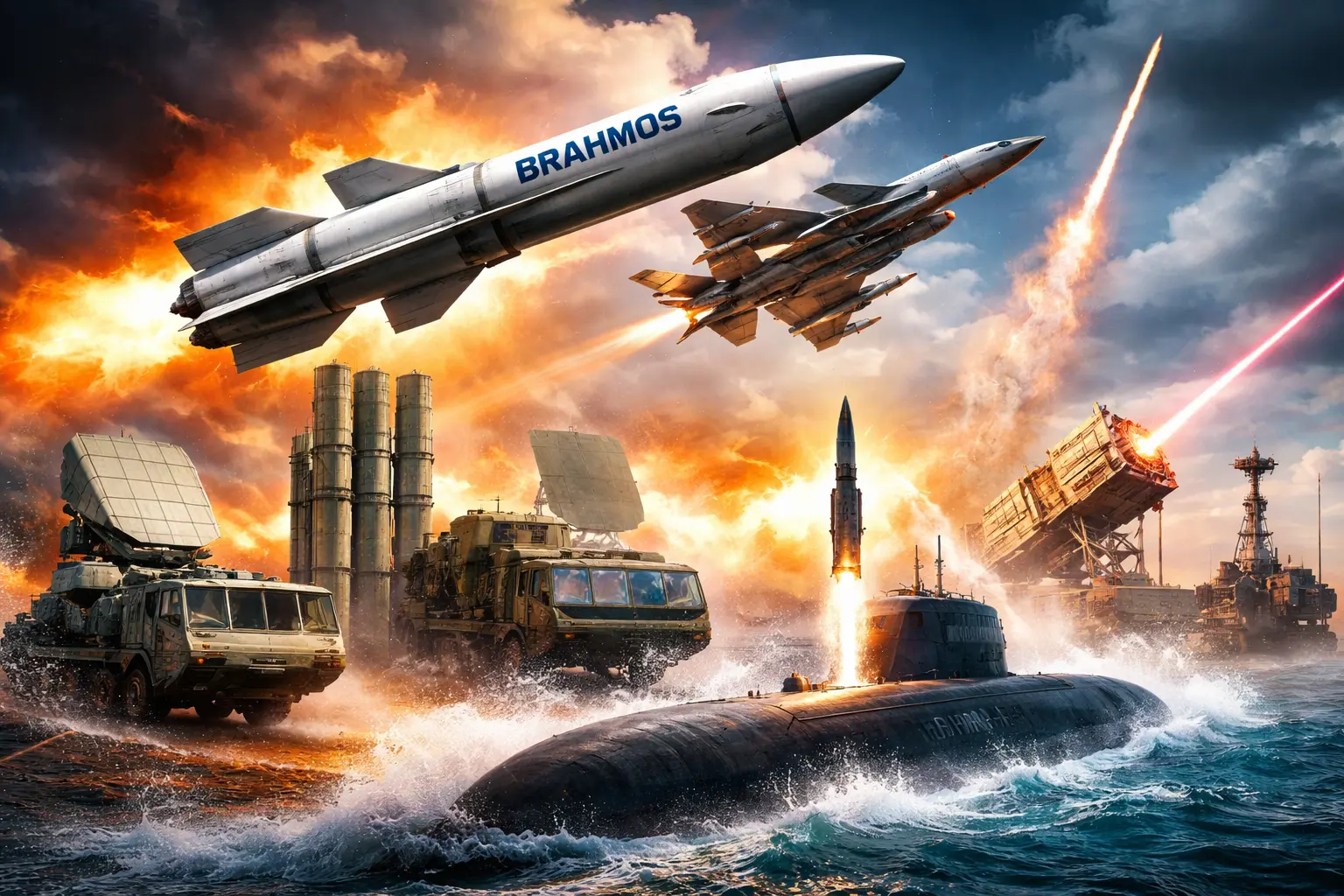
India military power 2026 is no longer about incremental upgrades — it reflects a structural transformation in how New Delhi approaches deterrence, defence depth, and strategic autonomy.
From long-range air defence systems guarding critical airspace to sea-based nuclear deterrence strengthening second-strike credibility, India is building a layered military architecture that carries both stabilizing and disruptive implications across Asia.
This transformation is deliberate. It is not noise — it is recalibration.
India Military Power 2026: S-400 and the Expanding Air Shield
The deployment of the S-400 long-range air defence system significantly strengthens India military power 2026 by creating a formidable anti-access umbrella.
- Engagement range up to 400 km
- Capability against aircraft, drones, and missile threats
- Multi-layered air defence integration
This system reduces adversarial air maneuvering flexibility while increasing strategic stability through deterrence. It also complements India’s evolving regional posture discussed in India’s Middle East Bombshell Shift in Power.
External reference: Reuters Asia-Pacific Defence Coverage
India Military Power 2026: BrahMos Extended Strike Capability
The continued expansion of the BrahMos supersonic cruise missile family represents a powerful offensive component within India military power 2026.
- Supersonic speed (Mach 2.8+)
- Land, sea, and air launch capability
- Extended-range variants increasing strike depth
The reduced reaction window created by high-speed strike systems complicates adversarial planning. These developments connect directly to broader strategic themes explored in Modi–Israel Strategic Deal and War Calculus.
External reference: Defense News Global Analysis
India Military Power 2026: INS Aridhaman and Nuclear Deterrence
The strengthening of the sea-based leg of the nuclear triad through INS Aridhaman enhances the credibility of India military power 2026.
- Improved second-strike survivability
- Greater underwater deterrence depth
- Strategic stability through credible response capability
Sea-based deterrence reduces vulnerability to first-strike scenarios and reinforces long-term balance. The geopolitical context of such strategic positioning is further analyzed in Middle East on Brink of War: Strategic Assessment.
External reference: Times of India Defence Section
India Military Power 2026: Astra Mk-2 and Indigenous Air Superiority
The Astra Mk-2 air-to-air missile represents India’s push toward indigenous beyond-visual-range combat capability. Within the broader framework of India military power 2026, this reduces long-term dependency on foreign suppliers.
- Enhanced aerial engagement range
- Indigenous development through DRDO
- Strengthened air combat autonomy
Indigenization is not merely economic policy — it is strategic resilience.
India Military Power 2026: India–Israel Defence Cooperation and Next-Gen Shields
A defining feature of India military power 2026 is the deepening India–Israel defence partnership, shifting from traditional procurement to co-development and technology transfer.
Discussions include advanced air defence and laser interception systems, potentially enhancing multi-layer missile defence architecture and counter-drone capability.
- Layered missile interception capability
- Exploration of laser-based air defence
- Joint research and manufacturing collaboration
This partnership strengthens deterrence while introducing diplomatic complexity in a sensitive regional environment.
External reference: NDTV Defence Coverage
India vs Pakistan: The Military Gap in 2026
When evaluating India military power 2026 in comparison with Pakistan, the gap is increasingly structural rather than numerical.
India operates:
- Advanced long-range air defence systems
- A functioning nuclear triad
- Indigenous missile programs
- Expanded naval deterrence
Pakistan relies heavily on external suppliers and tactical deterrence strategy. While both nations retain military capability, India’s diversified industrial base and technological depth provide broader long-term leverage.
India Future Weapons: The Next Phase
India military power 2026 represents a transition rather than a peak. Future systems under development include hypersonic research, integrated air defence grids, drone swarm technology, and expanded naval modernization.
The trajectory suggests steady capability accumulation rather than dramatic escalation.
Strategic Conclusion: What India Military Power 2026 Signals
India military power 2026 reflects layered modernization, expanded deterrence depth, and deeper strategic partnerships.
Positive Outcome: Greater stability through credible defence architecture and indigenous capability growth.
Negative Pressure: Rising recalibration pressure across regional rivals and increased strategic competition.
This is not sudden militarization. It is systematic positioning.
The balance in Asia is not collapsing — it is adjusting.