
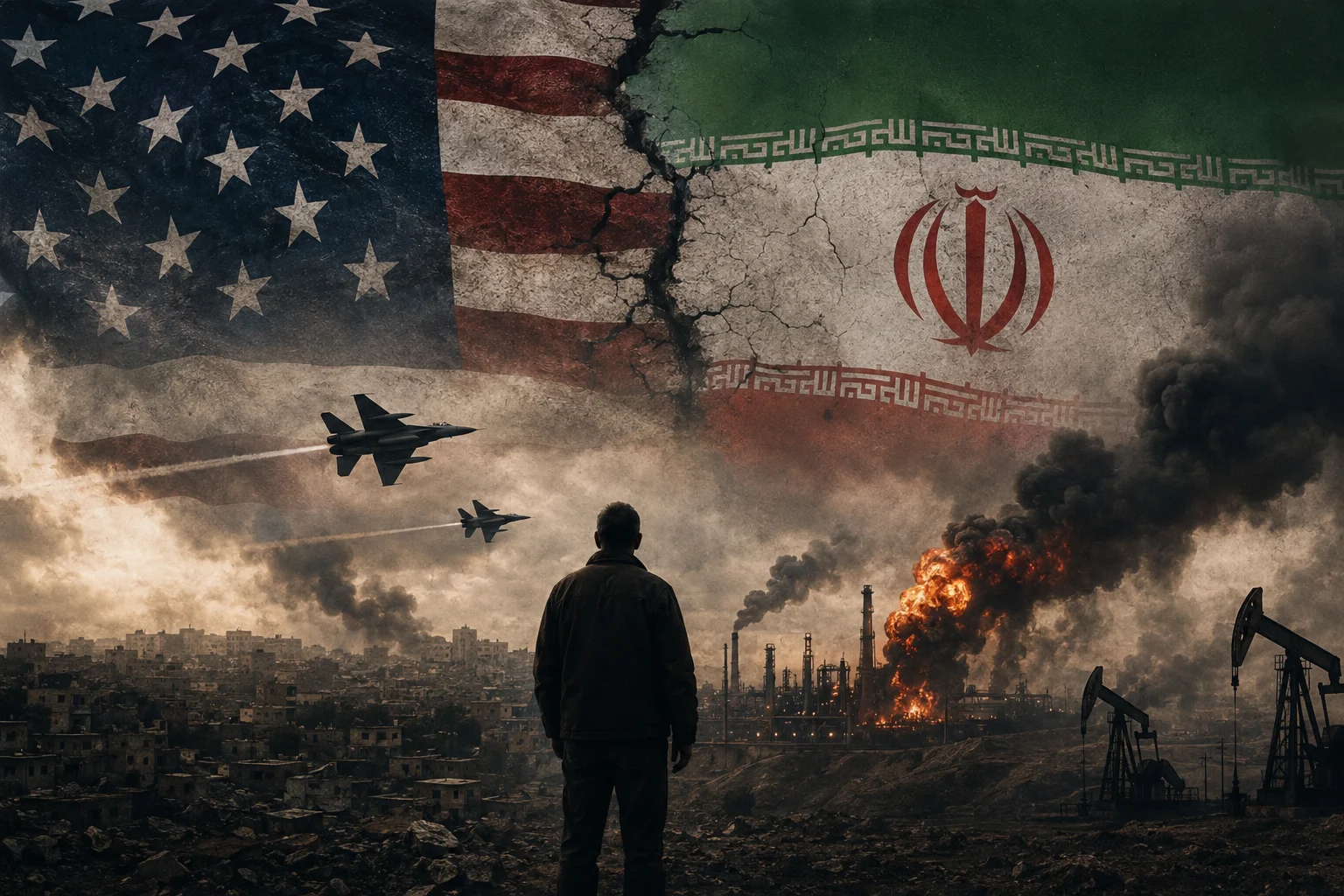
Why Is America at War With Iran? This question is being asked not only in Washington policy circles but across global markets, from the gas stations of Nairobi to the crowded markets of Cairo. While the debate in the West remains fixated on uranium enrichment and missile programs, the first signs of the conflict are already appearing in the monthly budgets of families in Mumbai. Thousands of miles from Tehran, people with no influence over military strategy are already feeling the economic shock of a conflict they did not start.
That reality helps explain why the question being asked across much of the world is often different from the one dominating Western policy circles.
In Washington, the debate centers on uranium enrichment, missile programs, and the possibility of a future nuclear-armed Iran.
At the heart of this tension lies the Iran nuclear threat debate, a polarized discourse that pits the drive for preemptive containment against the realities of global economic interdependence. While Washington advocates for a strategy of maximum pressure to curb Iran’s regional influence, critics argue that the policy itself is accelerating a broader economic decoupling, forcing non-aligned nations to bear the financial costs of a security strategy they did not draft.
Elsewhere, the question is far simpler:
Why is America at war with Iran?
The answer depends on how one defines security.
For American policymakers, the concern is largely about preventing a future threat.
For many countries across Africa, Asia, and Latin America, the immediate concern is managing the economic shock that is unfolding right now.
The gap between those perspectives has become one of the most important—and least discussed—consequences of the conflict.
A War About What Might Happen
The American case for confronting Iran rests on a straightforward argument.
Officials in Washington believe Iran’s nuclear activities, missile programs, and regional influence could eventually create a far more dangerous Middle East. Their fear is not necessarily rooted in what Iran has done recently, but in what Iran might be capable of doing in the future.
Supporters of this approach argue that waiting for certainty in international politics can be dangerous. Once a country acquires capabilities that fundamentally alter the balance of power, the opportunity to prevent a crisis may already have passed.
This logic is not unique to Iran. It reflects a broader belief that some threats must be addressed before they fully emerge.
Yet preventive strategies have always carried a difficult political question.
How much evidence is required before a future risk becomes justification for military action?
That question has followed nearly every major conflict launched in the name of preventing something worse.
The Cost Arrives Before the Outcome
While governments debate strategic risks, markets respond to uncertainty.
The economic consequences of the Iran conflict are already spreading through energy markets, shipping routes, and supply chains.
A weakening global economic outlook has become one of the conflict’s earliest and most measurable effects.
At the center of the concern sits the Strait of Hormuz energy corridor, a narrow waterway through which a significant share of the world’s oil and gas supplies travel.
When investors worry about Hormuz, they are not merely reacting to geography.
They are reacting to the possibility that fuel, transportation, and industrial costs could rise across the global economy.
That process is already underway.
The effects travel surprisingly fast. A rise in energy prices increases shipping costs, pushes up import bills, and eventually reaches supermarket shelves thousands of miles away from the Gulf.
For many households, the war arrives not through images of missile strikes but through a more expensive grocery basket.
The People Who Never Chose This Conflict
From Somalia to Afghanistan, concerns about growing hunger and food insecurity have intensified as higher transportation and fuel costs place additional strain on already vulnerable populations.
Inside Iran, meanwhile, inflation has become part of daily life. Reports describing a worsening cost-of-living crisis in Iran paint a picture of families struggling to afford goods that were once considered ordinary purchases.
This is one of the paradoxes of modern conflict.
Military operations are often measured in strategic objectives.
Their consequences are often measured in household budgets.
The battlefield may be regional.
The Iran War Economic impact is global.
The Global South and Iran War: Economic Realities
One of the most overlooked aspects of the Iran war has little to do with Iran itself.
A joint policy brief prepared by the African Development Bank, African Union, UNECA, and UNDP warns that the conflict threatens growth, food security, fiscal stability, and development prospects across Africa. The report argues that higher fuel costs, fertilizer shortages, shipping disruptions, and currency pressures could evolve into a broader economic shock for many African economies.
What makes this finding significant is not merely the economic risk.
It is the political reality behind it.
Assessing the Global Cost of Iran War
The countries facing some of the largest consequences had almost no influence over the decisions that produced them.
They are not participants in nuclear negotiations.
They are not military powers shaping events in the Gulf.
Yet they may spend years dealing with the consequences.
Researchers studying a potential cost-of-living crisis across North Africa and the Sahel argue that these pressures could become one of the defining secondary effects of the conflict.
Energy Vulnerability and the Strait of Hormuz Crisis
At the center of the conflict sits the Strait of Hormuz crisis, a narrow, high-stakes waterway through which a significant share of the world’s oil and gas supplies travel. When investors monitor this corridor, they are not merely reacting to geography; they are reacting to the immediate possibility that fuel, transportation, and industrial costs will rise globally. This vulnerability has become a core element in the current economic volatility affecting emerging markets.
The Debate Beyond Iran
The deeper debate surrounding the war is no longer simply about Iran.
It is about whether preventive military action remains an effective tool of international security in a deeply interconnected global economy.
Supporters argue that failing to act against emerging threats creates larger dangers later.
Critics counter that military action often generates economic and political consequences that extend far beyond the original target.
Neither argument can be dismissed easily.
What is increasingly clear, however, is that the costs of the conflict are not being distributed equally.
The Real Battlefield May Be Trust
History will eventually judge whether the war succeeded in preventing a future threat.
A different judgment is already taking shape.
Across much of the Global South, the debate is becoming less about Iran’s nuclear ambitions and more about trust in the international system itself.
Many countries see a world in which major powers retain the ability to shape outcomes far beyond their borders, while smaller and poorer states are left to absorb the economic fallout.
Whether that perception is fair or not, it is becoming more widespread.
And perceptions matter.
Military power can shape events.
Trust shapes legitimacy.
Iran War Economic Impact: A Global Reality
The debate over Iran’s nuclear program may continue for years.
The economic consequences, however, are already visible.
Across parts of Africa, Asia, and the Middle East, governments are grappling with higher energy costs, weaker currencies, and growing pressure on household incomes.
Whether the war ultimately succeeds in preventing a future security threat remains unknown.
What is already clear is that millions of people with no role in the conflict are living with its consequences.
That reality may shape how much of the world judges the war long after the last negotiations conclude.