
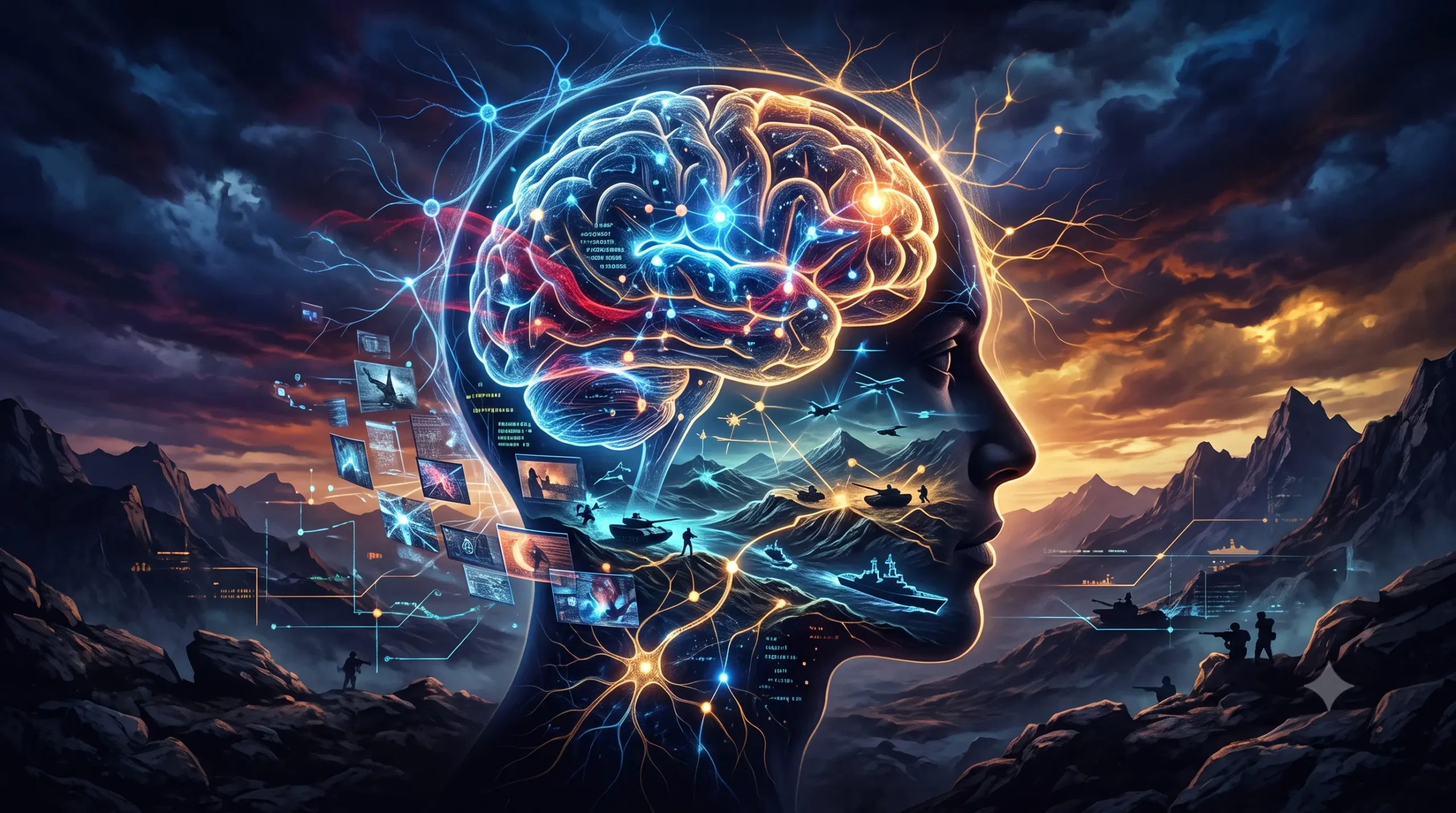

“The supreme art of war is to subdue the enemy without fighting.” — Sun Tzu
The Return of the Human Domain
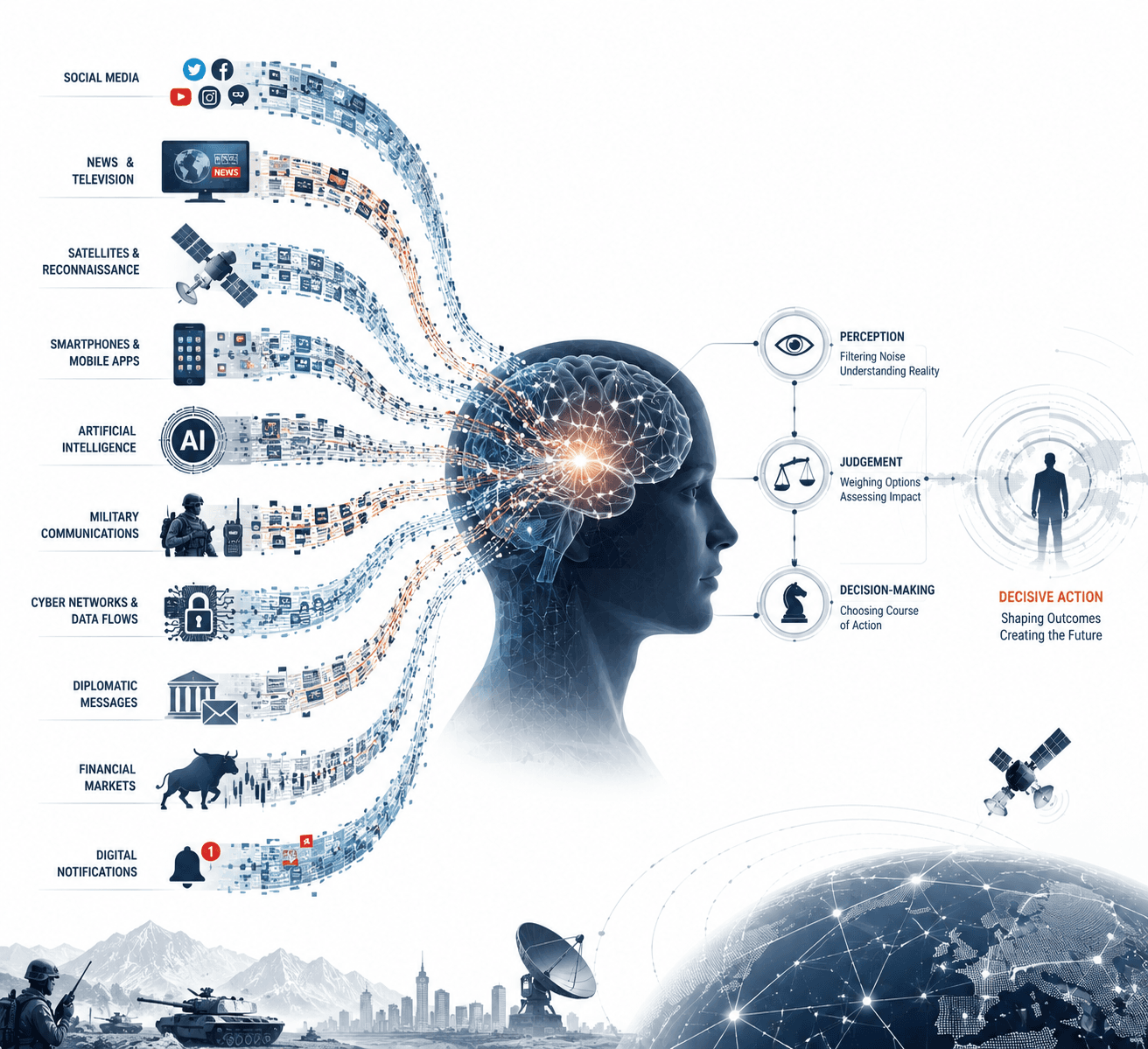
What if future wars are decided before most people realise a conflict has begun? Imagine a crisis unfolding in real time. Within minutes, social media is flooded with dramatic videos, satellite imagery, expert commentary and competing claims. Some are authentic, others manipulated, and many impossible to verify. Yet before governments issue official statements or militaries complete battle damage assessments, millions of people—including policymakers, journalists and global audiences—have already formed opinions. Diplomatic positions begin to harden, markets react and public sentiment shifts. The battle for perception is already underway.
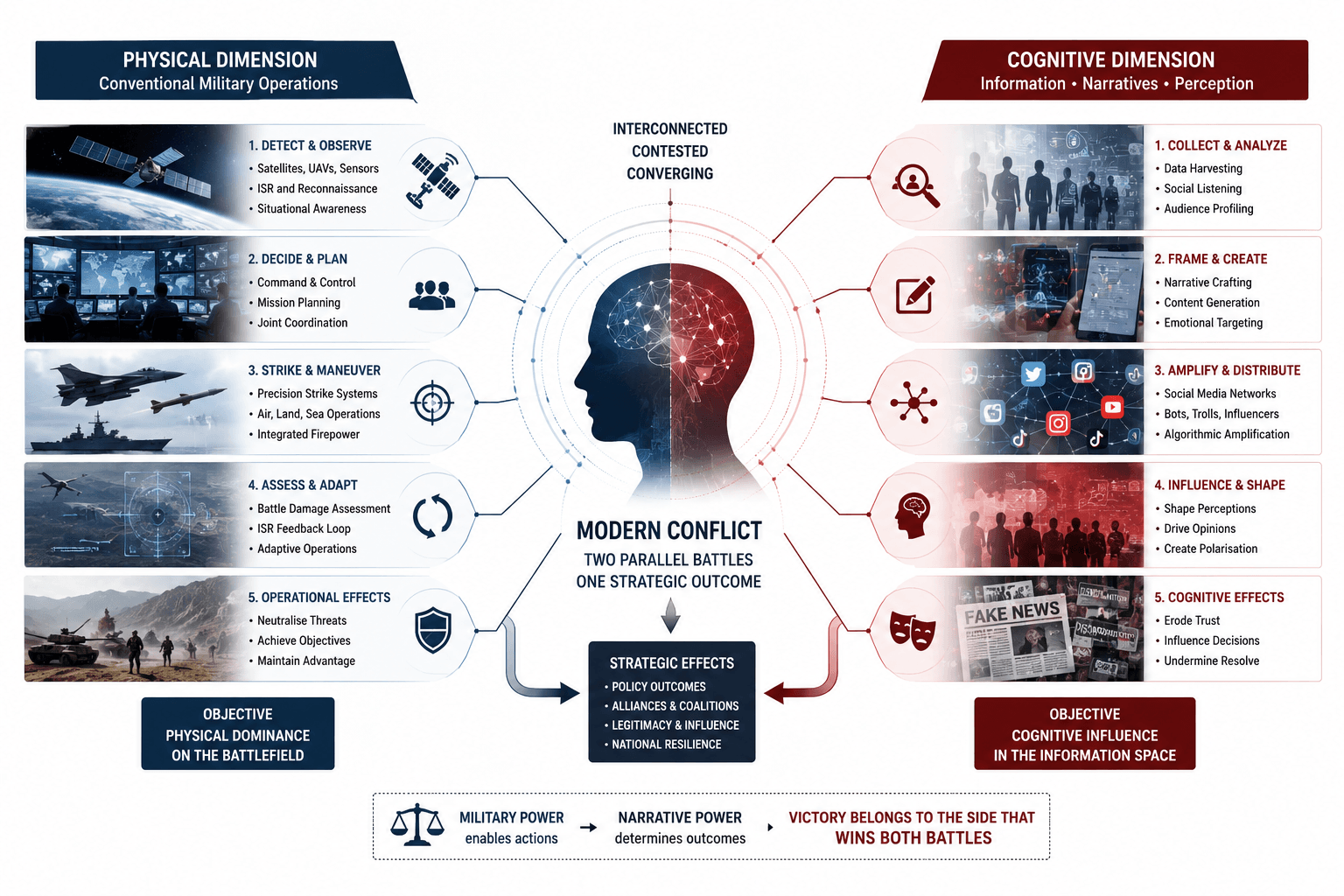
This is becoming a defining feature of modern conflict. Military operations now unfold simultaneously in two interconnected arenas. One is the physical battlefield where soldiers, aircraft, drones and missiles determine tactical outcomes. The other is the cognitive domain, where perceptions are shaped, narratives framed and contested; and political will either strengthened or weakened. Increasingly, success in one does not automatically guarantee success in the other.
For generations, military power was measured by firepower, industrial capacity and technological superiority. Victory meant destroying an adversary’s capability or compelling surrender through force. That logic remains valid, but it is no longer sufficient. In an age of ubiquitous connectivity and artificial intelligence, influencing how people understand events may prove almost as important as the events themselves.
Artificial intelligence is often described as the next Revolution in Military Affairs. It is undoubtedly transforming intelligence, surveillance, autonomous systems and military decision-making. Yet its greater impact may lie beyond the battlefield. By making it possible to generate, personalise and disseminate persuasive content at extraordinary speed and scale, AI is reshaping the information environment in which wars are conceived, legitimised, fought and remembered. The real revolution, therefore, may not be technological. It may be cognitive.
Wars have never been contests of firepower alone. They have always been contests of will. Military force seeks to compel an adversary to accept one’s political objectives. Today, that objective is increasingly pursued not only by destroying capabilities but by shaping choices. If leaders hesitate, soldiers lose confidence or societies become divided, strategic effects may be achieved without corresponding military success.
For India, this transformation has profound implications. Future conflicts are unlikely to remain confined to the Line of Control or the Line of Actual Control. They will unfold simultaneously across battlefields, digital platforms, diplomatic fora and international media. Military effectiveness will remain indispensable, but it may no longer be sufficient to secure strategic success. The decisive question is no longer simply who possesses superior military technology. It is who can shape the environment in which military, political and societal decisions are made.
From Information to Cognitive Warfare
Every era of warfare has possessed a defining source of strategic advantage. The Industrial Age rewarded mass. The Information Age rewarded precision, surveillance and networked operations. Today, the decisive competition is gradually shifting from information superiority to cognitive superiority. The distinction is important. Information superiority improves one’s own decisions; cognitive superiority seeks to influence the decisions of others. One enhances operational effectiveness. The other shapes strategic outcomes.
This is not an entirely new idea. More than two millennia ago, Kautilya recognised that influencing an adversary’s choices was often more effective than defeating him in battle. His sequence of sama (conciliation), dama (inducement), and danda (force) reflected a sophisticated understanding that persuasion and psychological advantage frequently precede coercion. Artificial intelligence has transformed the tools of influence, not its strategic logic.
The same insight appears in the Mahabharata. Dronacharya, one of the greatest warriors of that age, was not defeated through superior arms. His resolve collapsed after he was led to believe that his son Ashwatthama had been killed. The decisive blow was psychological before it became physical. Indian strategic thought has long recognised that perception can determine outcomes as decisively as force.
Western military thought echoes this conclusion. Napoleon famously observed that “the moral is to the physical as three is to one.” In modern language, he was referring to the intangible qualities of morale, confidence, leadership and national resolve that often outweigh material superiority. Technology changes; human psychology does not.
Artificial intelligence has dramatically expanded the scale, speed and precision with which perceptions can be influenced. It has lowered the cost of persuasion, accelerated the spread of narratives and enabled influence campaigns to operate continuously across societies. The competition increasingly centres on shaping how information is interpreted, trusted and acted upon. The battlespace has expanded from geography into cognition. That shift is only beginning to be understood.
AI and the New Economics of Influence
Artificial intelligence is often viewed through the prism of military hardware—autonomous systems, intelligent sensors, predictive analytics and faster decision-making. While these capabilities are important, AI’s most disruptive impact may lie elsewhere. It is fundamentally changing the economics of influence.
Until recently, large-scale influence campaigns demanded extensive resources. Governments relied on state-controlled media, intelligence agencies and carefully orchestrated information networks to shape public opinion. AI has dramatically lowered those barriers. Convincing videos, fabricated speeches and realistic imagery can now be created within minutes and disseminated globally at negligible cost.
More importantly, AI enables messages to be tailored to specific audiences and amplified through algorithms that reward emotion over evidence. The objective is not always to convince people that something false is true. Often, it is enough to make them doubt what is true. Confusion, hesitation and mistrust can themselves become strategic outcomes. In this environment, influence is no longer merely a supporting activity. It is an instrument of national power.
Lessons from Contemporary Conflicts
Recent conflicts demonstrate that military operations and information operations have become inseparable. The war in Ukraine has shown that every missile strike, destroyed vehicle and battlefield advance is accompanied by an equally intense struggle to define its meaning. Videos captured by soldiers appear online within minutes, satellite imagery is analysed by independent researchers and competing narratives race across digital platforms long before official briefings are issued. Military actions achieve strategic effect not merely because they occur, but because of how they are interpreted.
A similar pattern emerged during the exchanges between Israel and Iran. Precision strikes were immediately followed by competing claims, selective footage and smartly coordinated messaging designed to influence domestic and international audiences. The battle for perception unfolded almost as rapidly as the military engagement itself. These conflicts reveal a simple but profound truth: battlefield success must increasingly be accompanied by narrative success.
Operation SINDOOR: Winning the Battle, Contesting the Narrative
For India, Operation SINDOOR offers an equally important lesson. Operationally, the operation demonstrated India’s ability to execute precise military action while exercising measured political control over escalation. It reflected growing military professionalism, technological competence and strategic restraint.
The accompanying information contest, however, exposed a different challenge. Pakistan moved quickly to shape the international narrative. Official spokespersons, television channels, social media influencers, diaspora networks and sympathetic commentators converged around a coordinated messaging campaign. Authentic images mixed with recycled videos, manipulated visuals and unverified claims, creating an information environment in which speed often outweighed accuracy.
India’s official communication remained measured and fact-based, but it struggled to match the pace of digital narratives. By the time authoritative information emerged, global perceptions had already begun to crystallise. This was not a failure of public relations. It reflected a larger transformation in the character of warfare. Military success and narrative success are no longer synonymous. A nation may achieve its operational objectives yet still find itself responding to perceptions shaped by its adversary.
Operation SINDOOR therefore deserves to be studied not only for its military execution but also for what it reveals about the future of strategic competition. Information operations and strategic communication can no longer remain adjuncts to military planning. They must be integrated into campaign design from the outset. Winning the battle is no longer enough. Nations must also win the contest for credibility, legitimacy and public perception.
Trust: The New Centre of Gravity
Napoleon famously observed that “the moral is to the physical as three is to one.” In contemporary terms, he was referring to the intangible qualities of morale, confidence, leadership and national resolve that often outweigh material superiority. More than two centuries later, his insight has acquired renewed relevance.
Trust has become a strategic resource. Military capability, economic strength and technological innovation remain the foundations of national power. Yet their effectiveness increasingly depends upon public confidence in institutions, the credibility of official communication and the resilience of society against manipulation.
Artificial intelligence enables adversaries to identify social divisions, amplify polarising narratives and exploit cognitive biases at unprecedented scale. The objective, besides destroying infrastructure; is also to weaken confidence, create uncertainty and erode national cohesion. The first casualty of future wars may therefore not be truth, it may be trust.
This is also where AI reaches its limits. Technology can process information, generate persuasive content and accelerate decisions, but it cannot inspire courage, build legitimacy or create national purpose. Wars are ultimately fought by people for political objectives. Technology influences outcomes, but human judgement, leadership and collective resolve continue to determine victory.
Building Cognitive Resilience
If future conflicts increasingly target perception, resilience becomes as important as firepower. For democracies such as India, this presents a unique challenge. An open society is inherently more vulnerable to manipulation than a closed one, yet its openness is also its greatest strength. The answer, therefore, does not lie in tighter control over information but in building institutions that command public trust and a society capable of resisting manipulation.
Resilience begins long before a crisis. Citizens must be equipped to recognise misinformation without becoming cynical about all information. Government communication should be timely, coherent and credible. The armed forces, diplomatic community, intelligence agencies, technology companies, academia and the media must view the information environment as a shared strategic responsibility rather than as separate institutional domains.
Most importantly, strategic communication can no longer be treated as a post-operation activity. It must be integrated into campaign planning from the very outset. The first narrative often becomes the dominant narrative, regardless of whether it is accurate.
What Should India Do?
India has invested significantly in modernising its armed forces through advances in space, cyber, artificial intelligence and indigenous defence technologies. These efforts are essential, but they represent only one dimension of the challenge.
The next stage of reform should integrate military operations with strategic communication, information operations, diplomacy and technological innovation within a coherent national framework. Future campaigns will require commanders to think simultaneously about physical effects and cognitive effects. Every military action should be accompanied by a communication strategy designed to inform domestic audiences, reassure partners and deny adversaries the opportunity to shape perceptions first.
Operation SINDOOR underscored this requirement. India’s operational performance was credible and measured. The principal lesson lies elsewhere: strategic narratives evolve at digital speed. Future success will depend upon the ability to communicate with the same agility and credibility with which military operations are executed.
This is not merely a military responsibility. It demands a whole-of-government approach in which national security is understood to include information integrity, institutional credibility and societal resilience. These are strategic assets that cannot be improvised during a crisis; they must be cultivated in peacetime.
The Decisive Terrain
Artificial intelligence is undoubtedly transforming warfare. It will accelerate decision-making, improve intelligence, enhance precision and reshape military capability in ways that are only beginning to be understood. Yet its most enduring impact may lie beyond technology. By reshaping the information environment, AI is changing how conflicts are perceived, legitimised and politically contested.
This is not a departure from the enduring principles of strategy but an evolution of them. Kautilya recognised that influencing an adversary’s choices often produced greater results than relying on force alone. Modern technology has not altered that logic; it has multiplied its reach.
For India, the implications are profound. National security can no longer be measured solely by the strength of its armed forces or the sophistication of its weapon systems. It must also be measured by the resilience of its institutions, the credibility of its narratives and the confidence of its citizens. In the decades ahead, these intangible qualities may prove as decisive as military capability itself.
Every age has produced its own decisive terrain. The Industrial Age rewarded mass. The Information Age rewarded precision and connectivity. The age of artificial intelligence is likely to reward something less tangible but ultimately more consequential—the ability to shape perception, preserve trust and sustain national resolve. Future wars will still be fought by soldiers. Increasingly, however, they will be decided by societies.
References
- RAND Corporation, studies on Artificial Intelligence, Information Operations and Strategic Competition.
- International Institute for Strategic Studies, The Military Balance 2025.
Lt Gen Tarun Chawla PVSM, AVSM (Retd)
Lt Gen Tarun Chawla, PVSM, AVSM (Retd), is a distinguished former senior officer of the Indian Army with extensive experience in strategic leadership, national security, military operations and defence management. He holds multiple postgraduate qualifications, including MMS, M.Phil., MSc, MSc (Tech), AIPM and NDC.
Following his military career, he continues to contribute as a defence analyst, strategic advisor, consultant and trainer. His areas of expertise include defence strategy, military affairs, leadership development, financial planning and administration, and organisational transformation.
He is also a motivational speaker and regularly writes on emerging security challenges, strategic affairs and the evolving character of modern warfare.