
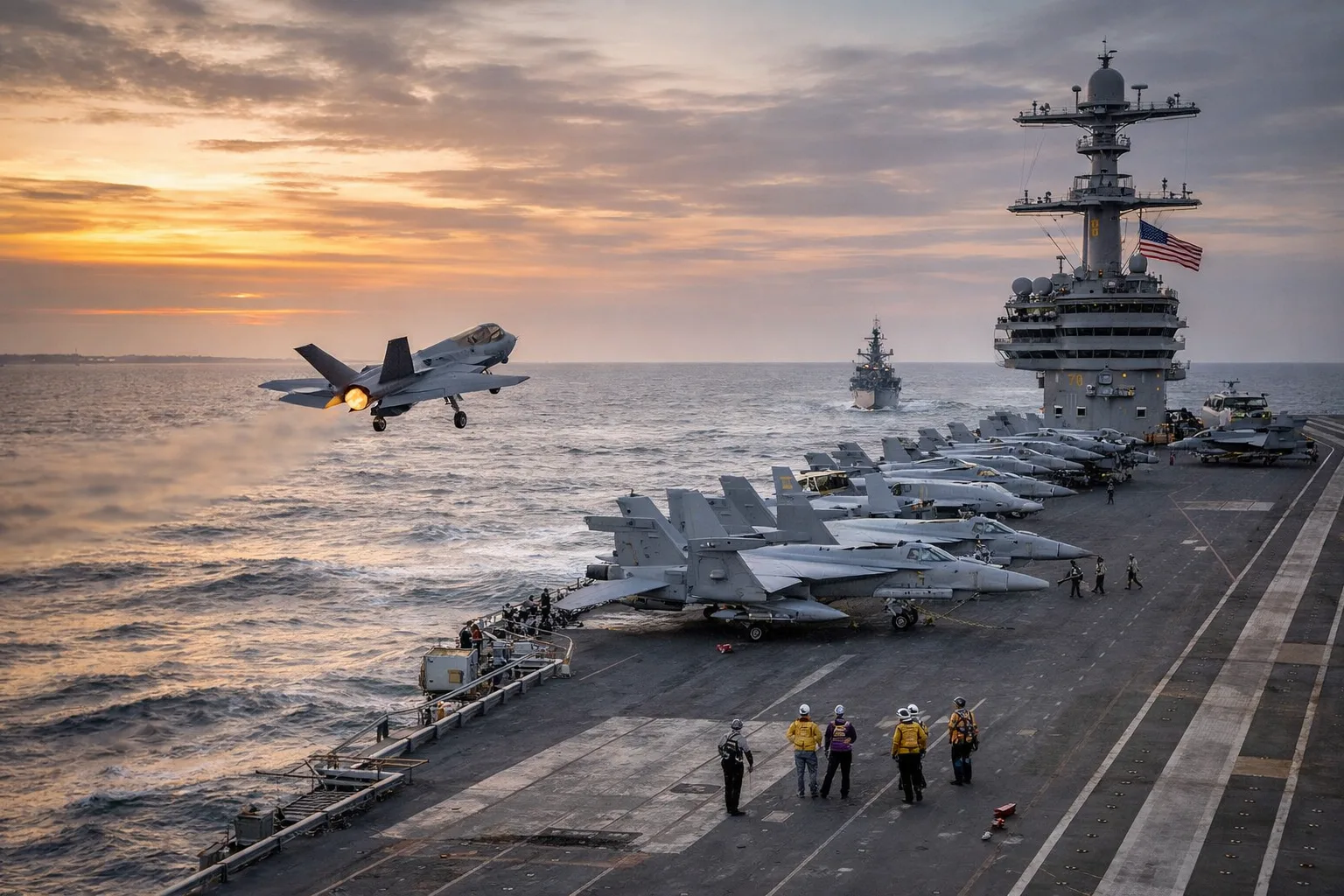
The US Iran war has entered another dangerous phase after a weekend of military exchanges that tested an already fragile ceasefire and renewed concerns over the security of the Strait of Hormuz, the world’s most important oil transit route.
The United States carried out another round of strikes against Iranian military targets, arguing the operation was necessary to protect commercial shipping after recent attacks in the Gulf. Iran responded with missile and drone attacks targeting American military facilities in Bahrain and Kuwait, accusing Washington of violating the ceasefire first.
Despite the exchange of fire, there has been no formal collapse of diplomatic efforts. Regional mediators remain engaged, although negotiations appear to have slowed considerably.
The immediate concern for governments and investors is not whether the conflict has become a full-scale regional war—it has not—but whether the latest escalation will affect oil supplies, shipping through the Strait of Hormuz and market sentiment when trading resumes on Monday.
For energy markets, confidence has become almost as important as supply itself.
Key Developments
- The United States conducted another round of military strikes on Iranian facilities over the weekend.
- Iran retaliated with missile and drone attacks targeting US military installations in Bahrain and Kuwait.
- Washington says the strikes were intended to protect international shipping and deter further attacks.
- Tehran insists the United States violated the ceasefire and has warned that continued military action could derail negotiations.
- The Strait of Hormuz remains open, although shipping companies continue operating under heightened security.
- Investors are now watching whether oil prices and global markets react sharply when trading resumes.
Timeline of Events
Friday: Ceasefire Comes Under Fresh Strain
Washington accused Iran of threatening commercial shipping operating near the Strait of Hormuz following a series of maritime security incidents.
Behind the scenes, diplomatic channels remained active through regional intermediaries, but officials on both sides acknowledged that the ceasefire had become increasingly fragile.
Energy markets ended the week relatively calm, with traders still hoping diplomacy would prevent another major escalation.
Saturday: US Launches Fresh Strikes
American forces carried out another round of strikes against Iranian military infrastructure, targeting surveillance assets, drone facilities and coastal defence positions.
According to Washington, the operation was designed to protect freedom of navigation and reduce Iran’s ability to threaten commercial shipping in the Gulf.
President Donald Trump later warned that any further attacks against American personnel or international shipping would invite a stronger military response.
Saturday Night: Iran Responds
Iran answered within hours.
Missiles and drones were launched towards US military facilities in Bahrain and Kuwait, marking another significant escalation in the US Iran war.
Regional air defence systems intercepted several incoming projectiles, limiting damage but highlighting the growing risk of miscalculation across the Gulf.
Iranian officials argued that Washington had violated the ceasefire first and described their response as a legitimate act of self-defence.
Sunday: Diplomacy Continues as Markets Wait
Neither Washington nor Tehran formally announced the end of negotiations.
Instead, both governments continued exchanging accusations while diplomatic channels reportedly remained open through regional mediators.
Commercial shipping continued moving through the Strait of Hormuz under heightened security, while shipping companies and insurers reassessed operational risks ahead of a new trading week.
Investor attention shifted quickly towards Monday’s market opening, where crude oil, shipping companies, airlines and defence stocks are expected to react first.
The White House maintains that the latest operation was defensive rather than offensive.
President Donald Trump warned that if Iran continued attacking American interests, the United States would be prepared to respond with greater force.
US officials argue that the strikes were intended to degrade Iran’s surveillance network, drone capabilities and coastal military infrastructure while ensuring that commercial shipping could continue using the Strait of Hormuz without further disruption.
American officials have also stressed that freedom of navigation remains a strategic priority, particularly as nearly one-fifth of the world’s seaborne oil trade passes through the narrow waterway.
Although Washington has left the door open for diplomacy, its latest military actions suggest deterrence now sits alongside negotiation as the administration’s preferred strategy.
Tehran’s Position
Iran presents a very different narrative.
Officials in Tehran accuse Washington of breaking the ceasefire through its latest military operation and insist that the missile and drone attacks against US facilities were a proportionate response.
Iran has warned that continued American military action could leave little room for negotiations, although it has stopped short of announcing a complete withdrawal from diplomatic efforts.
The Iranian leadership also argues that pressure from Washington will not alter its strategic calculations and that any future talks must begin with an immediate halt to American military operations.
From Tehran’s perspective, military retaliation and diplomacy are no longer separate tracks—they have become part of the same negotiation.
Strait of Hormuz: Current Status
Despite widespread speculation over the weekend, the Strait of Hormuz remains open to commercial shipping.
There has been no formal blockade, and tankers continue to transit the waterway linking the Persian Gulf with the Arabian Sea.
That does not mean conditions have returned to normal.
Shipping companies continue to operate cautiously. Some operators have delayed departures while insurers have raised war-risk premiums. Naval patrols across the Gulf have also increased, with commercial vessels receiving additional security guidance before entering high-risk waters.
For energy traders, the distinction is significant.
Oil continues to flow, but confidence has weakened.
Even without a physical disruption to exports, higher insurance costs, longer transit planning and geopolitical uncertainty can influence oil prices almost as quickly as an actual supply interruption.
Hormuz Status Snapshot
| Indicator | Current Assessment |
|---|---|
| Commercial Shipping | Continuing |
| Waterway Status | Open |
| Naval Activity | Increased |
| Insurance Premiums | Elevated |
| Immediate Supply Disruption | None Confirmed |
| Market Risk | Elevated |
The operational status of the Strait of Hormuz remains fluid and could change rapidly depending on military developments.
Why Oil Prices Could React When Markets Open
The weekend escalation in the US Iran war unfolded while most global financial markets were closed, leaving investors with nearly 48 hours of geopolitical developments to absorb before the first trading session of the new week.
That delay matters.
Unlike equity markets, geopolitical events rarely unfold according to market hours. Traders will now attempt to price not only the latest military exchanges but also the possibility of further escalation in one of the world’s most strategically important energy corridors.
Before the latest strikes, oil prices had eased as hopes grew that diplomatic efforts would reduce the immediate risk of supply disruptions. The renewed exchange of military action has changed that calculation.
For energy traders, the key issue is no longer the strikes themselves. It is whether they remain isolated military actions or begin affecting commercial shipping, energy infrastructure and confidence across the Gulf.
A sustained disruption to tanker traffic would almost certainly push oil prices higher. Even without a physical interruption to supply, higher insurance costs, elevated freight rates and increased operational risks can tighten markets by raising the cost of transporting crude.
At the time of publication, commercial exports from Gulf producers continue, suggesting the market is facing a confidence shock rather than an immediate supply shock.
Monday Market Outlook
When trading resumes, investors are expected to focus on three questions.
- First, has the risk of a broader Gulf crisis increased?
- Second, can the Strait of Hormuz continue operating without significant disruption?
- Third, is diplomacy still capable of preventing another cycle of military escalation?
Those answers will shape sentiment across multiple asset classes.
1.Energy companies could benefit from firmer crude prices if markets begin pricing a higher geopolitical risk premium

2.Defence stocks may also attract investor interest as governments across the region reassess security requirements.

3.Airlines and logistics companies, however, could face pressure if investors anticipate higher fuel costs and increased insurance expenses.

4.Shipping firms represent a more complicated picture. While freight rates may increase, higher operational risks and insurance premiums could offset part of those gains.

5.Gold is also expected to remain in focus. During periods of geopolitical uncertainty, investors often shift towards traditional safe-haven assets, particularly if confidence in equity markets weakens.
Currency markets will be equally important. A prolonged rise in oil prices typically places additional pressure on energy-importing economies, while the US dollar often strengthens as investors seek relatively safer assets.
What Professional Traders Will Be Watching
For institutional investors, headlines alone rarely drive decisions.Instead, attention is likely to centre on several measurable indicators over the next 24 to 48 hours.
These include:
- Brent crude’s opening price and whether a geopolitical risk premium emerges.
- The volume of commercial tanker traffic moving through the Strait of Hormuz.
- Marine insurance rates for vessels entering the Gulf.
- Any further military activity involving US or Iranian forces.
- Statements from Gulf governments regarding maritime security.
- OPEC producer commentary on regional supply conditions.
- Shipping advisories issued by international maritime authorities.
- Markets often react less to military announcements than to evidence that global energy supplies are becoming more difficult—or more expensive—to move.
Why India Is Watching the Gulf Closely
For India, developments in the US Iran war carry economic implications that extend well beyond foreign policy.
A significant share of India’s crude oil imports travels through the Strait of Hormuz, making the security of the waterway an issue of national economic importance.
At present, there is no indication that India’s energy supplies face immediate disruption. Commercial tankers continue operating, and refiners have not reported significant supply constraints.
However, a prolonged increase in oil prices would still affect India’s economy.
Higher crude prices increase the country’s import bill, place pressure on the rupee and make inflation management more challenging for policymakers. Rising shipping insurance costs could also increase the landed cost of imported crude even if export volumes remain unchanged.
India’s diversified sourcing strategy—including increased imports from Russia and other suppliers—offers some protection against regional disruptions. Nevertheless, the Gulf remains central to India’s long-term energy security, and any sustained instability in the region would be closely monitored in New Delhi.
Beyond oil, policymakers will also watch LNG shipments, fertiliser imports and broader shipping costs, all of which could be affected if maritime security deteriorates.
For Indian businesses, the immediate concern is unlikely to be supply shortages. Instead, the focus will be on whether higher transport costs and geopolitical uncertainty begin feeding into inflation and corporate margins over the coming weeks.
Beyond Energy: A Test for Global Confidence
The latest military exchanges illustrate how quickly geopolitical risk can return to financial markets.
The US Iran war is no longer being viewed solely through a military lens. Investors are increasingly assessing its potential impact on energy security, shipping routes, inflation and global trade.
As long as the Strait of Hormuz remains open, the global economy is unlikely to experience an immediate supply shock.
The greater risk lies in confidence.
Markets tend to adjust quickly when uncertainty persists, even if physical supplies continue to move. That is why the first few trading sessions of the week could prove more important than the military exchanges themselves.
By Monday morning, traders will not simply be pricing crude oil—they will be pricing the probability of what happens next.
Is Diplomacy Still Alive?
The military exchanges over the weekend have raised fresh doubts about the future of negotiations, but diplomacy has not collapsed.
Neither Washington nor Tehran has formally withdrawn from the ceasefire framework or announced an end to indirect talks. Regional actors, including Gulf states with an interest in preventing a wider conflict, are expected to continue diplomatic outreach in the coming days.
That said, the political environment has become far more complicated.
Every new missile strike reduces the room for compromise. Leaders on both sides now face domestic pressure to demonstrate resolve, making it increasingly difficult to step back without appearing to concede ground.
For the United States, maintaining freedom of navigation in the Gulf remains a strategic objective. For Iran, responding to military action without triggering a full-scale war has become an equally delicate balancing act.
The coming week will determine whether the latest exchange represents another chapter in a familiar cycle of deterrence or the beginning of a more sustained confrontation.
Three Scenarios to Watch
Scenario One: Controlled Escalation
Probability: High
This remains the most likely outcome.
Both countries continue limited military operations while avoiding direct attacks on critical energy infrastructure or civilian targets. Diplomatic contacts continue quietly through intermediaries, even as public rhetoric remains confrontational.
Under this scenario, the Strait of Hormuz remains open, oil prices stay volatile but manageable, and global markets gradually adjust to a higher geopolitical risk premium.
Scenario Two: Diplomatic Breakthrough
Probability: Medium
Military activity subsides over the coming days, allowing regional mediators to restart negotiations.
Confidence begins returning to energy markets, shipping insurance premiums ease and oil prices stabilise.
Although tensions remain, investors begin treating the latest Gulf crisis as another temporary flare-up rather than the start of a prolonged regional conflict.
Scenario Three: Regional Escalation
Probability: Low—but increasing if commercial shipping or energy infrastructure comes under sustained attack.
This is the scenario global markets fear most.
A direct strike on major oil export facilities, the closure of part of the Strait of Hormuz, or attacks causing significant civilian casualties could transform the US Iran war into a broader regional conflict involving additional actors.
Such a development would likely push oil prices sharply higher, increase freight and insurance costs, strengthen demand for safe-haven assets such as gold and the US dollar, and place renewed pressure on inflation across energy-importing economies.
What to Watch This Week
Several developments will determine whether tensions ease or intensify.
1. Military Activity
Will either side conduct additional strikes, or does the current exchange end with the weekend?
2. Strait of Hormuz
Commercial shipping remains the single most important indicator.
If tanker traffic continues normally, markets may conclude that energy supplies remain secure despite military tensions.
3. Oil Prices
Brent crude will be one of the first indicators of market sentiment.
A modest rise would suggest investors expect contained escalation. A sharp jump would indicate growing fears of supply disruption.
4. Diplomatic Signals
Investors will closely monitor statements from Washington, Tehran and regional mediators for any indication that negotiations are either resuming or breaking down.
5. Gulf Security
Any expansion of military activity into additional Gulf states would significantly increase geopolitical risk and alter market expectations.
Why This Matters Beyond the Gulf
Although the current confrontation is centred on the Middle East, its consequences extend well beyond the region.
The Strait of Hormuz handles roughly one-fifth of global seaborne crude oil trade. Any disruption—whether physical or psychological—can affect fuel prices, inflation, shipping costs and economic growth across multiple continents.
For Europe, higher energy prices would complicate efforts to contain inflation.
For Asia, particularly major importers such as India, Japan and South Korea, prolonged instability would increase energy costs and place additional pressure on trade balances.
For financial markets, the conflict serves as another reminder that geopolitical risk has once again become a central factor in investment decisions.
The Bottom Line
The latest escalation in the US Iran war has not closed the Strait of Hormuz, nor has it ended diplomatic engagement.
Instead, it has created a period of heightened uncertainty in which military operations, energy markets and diplomacy are moving in parallel.
Commercial shipping continues, oil exports remain largely uninterrupted and there is no evidence—at least for now—of an immediate global supply crisis.
Yet markets rarely wait for a crisis to become reality.
They react to probabilities.
That is why Monday’s trading session will be watched as closely as the military developments themselves. Investors will be looking beyond the headlines, searching for clues about whether this is another temporary flare-up or the early stages of a broader regional confrontation.
For governments, businesses and energy importers alike, the next few days could shape not only the trajectory of the US Iran war, but also the outlook for oil prices, the stability of the Strait of Hormuz, and confidence across the wider Gulf crisis.