Evian, France: The US-India strategic partnership is entering a decisive phase as President Donald Trump and Prime Minister Narendra Modi prepare to meet on the sidelines of the G7 Summit in France. As global leaders gather to discuss geopolitical conflicts, economic growth, artificial intelligence, energy security, and the future of international cooperation, a larger strategic question looms over Washington: what is the United States prepared to offer India that others cannot?
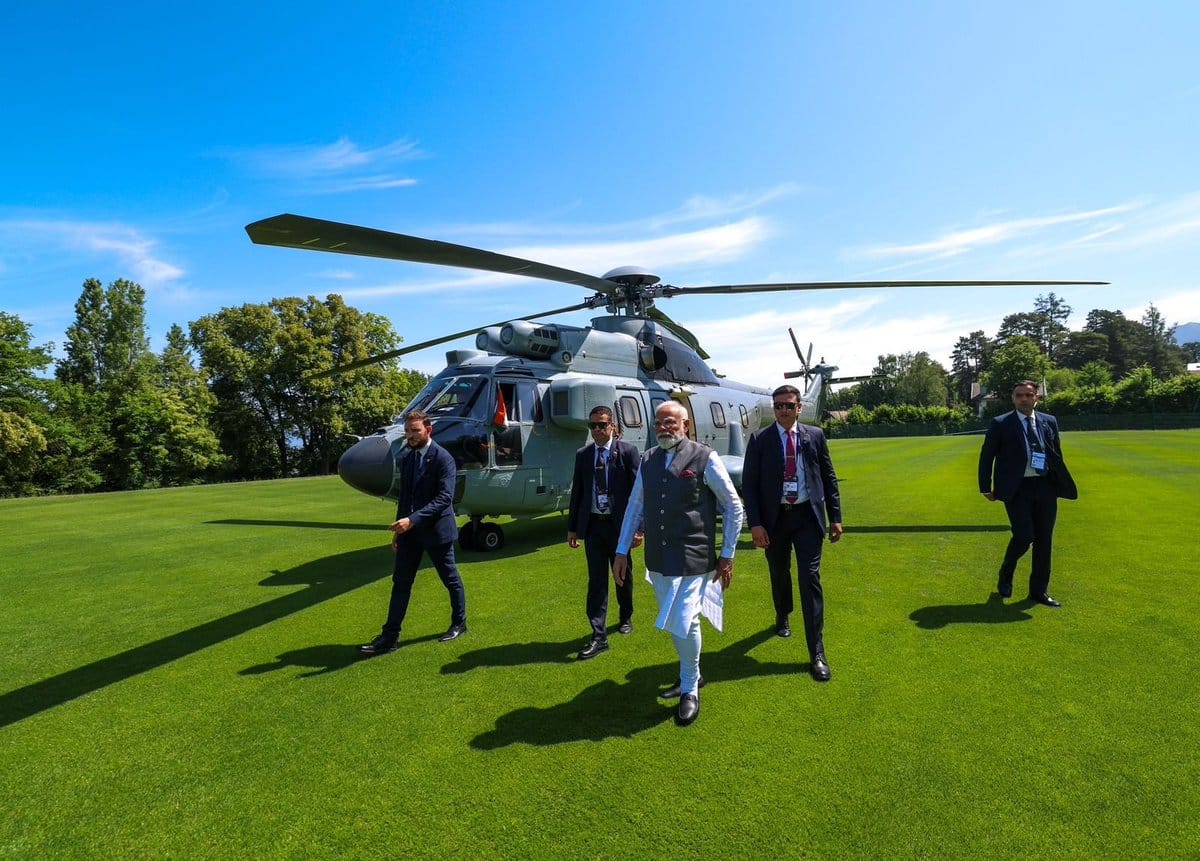
The timing of the Modi-Trump meeting is notable. Prime Minister Modi arrived in France as an invited leader at the G7 Summit, where discussions are expected to focus on global conflicts, economic uncertainty, supply chain resilience, emerging technologies, and the future of international cooperation. For India, the summit offers another opportunity to position itself as a leading voice of the Global South while deepening engagement with major powers.
For Trump, the summit comes at a moment when Washington’s strategic priorities are increasingly shifting beyond immediate crises toward long-term competition. That competition is unlikely to be defined solely by events in the Middle East. It is more likely to be shaped by China.
For all the attention given to regional conflicts and energy security, Washington’s long-term strategic challenge remains Beijing. China is competing with the United States across manufacturing, artificial intelligence, semiconductors, shipbuilding, critical minerals, infrastructure, and military modernization. Recent advances in Chinese technology and industrial capacity have only strengthened concerns in Washington that the race for technological leadership is accelerating.
This growing US-China-India triangle is reshaping strategic calculations across Asia. As American policymakers look toward the Indo-Pacific, one country increasingly sits at the center of their calculations: India.
Yet this is where many observers misunderstand the relationship. The common assumption is that India needs the United States. The reality is more complicated.
India’s priorities are already clear. It needs energy security, advanced technology, defense modernization, manufacturing growth, critical mineral access, and sustained economic development. Those requirements do not change based on who occupies the White House or who sits across the negotiating table. What has changed is India’s position in the world.
The Multipolar Courtship of New Delhi
Today, India is no longer looking for a seat at the table—it is becoming one of the tables around which major powers gather. New Delhi is actively being courted by almost every major power on the global stage:
- Russia: Remains a major defense and energy partner. President Vladimir Putin continues to promote deeper defense cooperation while Moscow supplies key military systems and discounted energy.
- France & Europe: France has expanded cooperation with India in defense, artificial intelligence, space, and advanced technologies. Simultaneously, European countries including Germany and the Netherlands are pursuing industrial, semiconductor, and clean-technology partnerships with New Delhi.
- The Gulf Nations: Continue investing billions of dollars into Indian infrastructure, logistics, energy, and digital projects.
This multipolar reality creates a dilemma not for New Delhi, but for Washington.
The Core of the US-India Strategic Partnership
American officials increasingly describe India as a cornerstone of their Indo-Pacific strategy. Cooperation has expanded across trade, defense, critical minerals, civil nuclear energy, semiconductors, telecommunications, and emerging technologies. Negotiations over a broader trade framework continue, while both countries have sought to deepen collaboration in advanced manufacturing and supply-chain resilience.
Together, these developments point toward a deeper commitment, but they also raise difficult questions that will test the resilience of the US-India strategic partnership:
- If the United States wants India to reduce dependence on Russian weapons, what alternatives is it prepared to provide?
- If Washington wants India to play a larger role in balancing China, will it support India’s ambitions in semiconductor manufacturing, artificial intelligence, critical minerals processing, defense production, and next-generation technologies?
The debate is not simply about fighter jets, trade agreements, or energy imports. It is about technology, industrial capacity, and long-term strategic alignment.
How Technology and AI Shape the US-India Strategic Partnership
Critical minerals offer a perfect example of this alignment. The United States and its allies are actively searching for alternatives to Chinese dominance in mineral supply chains. Those minerals power everything from electric vehicles and semiconductors to advanced weapons systems and AI infrastructure. India is increasingly viewed as a key partner in building resilient supply chains that reduce strategic dependence on China.
Artificial intelligence presents an identical challenge. AI has emerged as a central topic of discussion among major economies. Washington wants trusted technology partners capable of supporting secure innovation. India wants access to advanced technologies while simultaneously building domestic capabilities and technological sovereignty. As AI becomes a defining element of economic and military power, collaboration and competition will increasingly overlap.
Strategic Takeaway: While the headlines will focus on immediate trade numbers and bilateral handshakes, the underlying currents of the Modi-Trump meeting are anchored in a race for twenty-first-century industrial sovereignty.
The Path Forward
This is why the Modi-Trump meeting matters. The headlines will focus on trade, defense, energy security, critical minerals, artificial intelligence, and the Indo-Pacific. All of those issues are important. But beneath them lies a larger strategic question about the future balance of power in Asia.
India’s rise is no longer in doubt. The question is how the world’s major powers respond to it. Russia is offering energy and military cooperation. Europe is offering technology and industrial partnerships. The Gulf is offering capital and investment. China continues to reshape the global strategic environment.
As Trump and Modi meet in France amid discussions on geopolitical conflicts, economic growth, and emerging technologies, the challenge before Washington is becoming increasingly clear. The future of the US-India strategic partnership will depend not only on shared concerns about China or the Indo-Pacific but also on whether the United States can offer India something that others cannot.
That may be the real story behind the Modi-Trump meeting—and perhaps the broader story of twenty-first-century geopolitics.