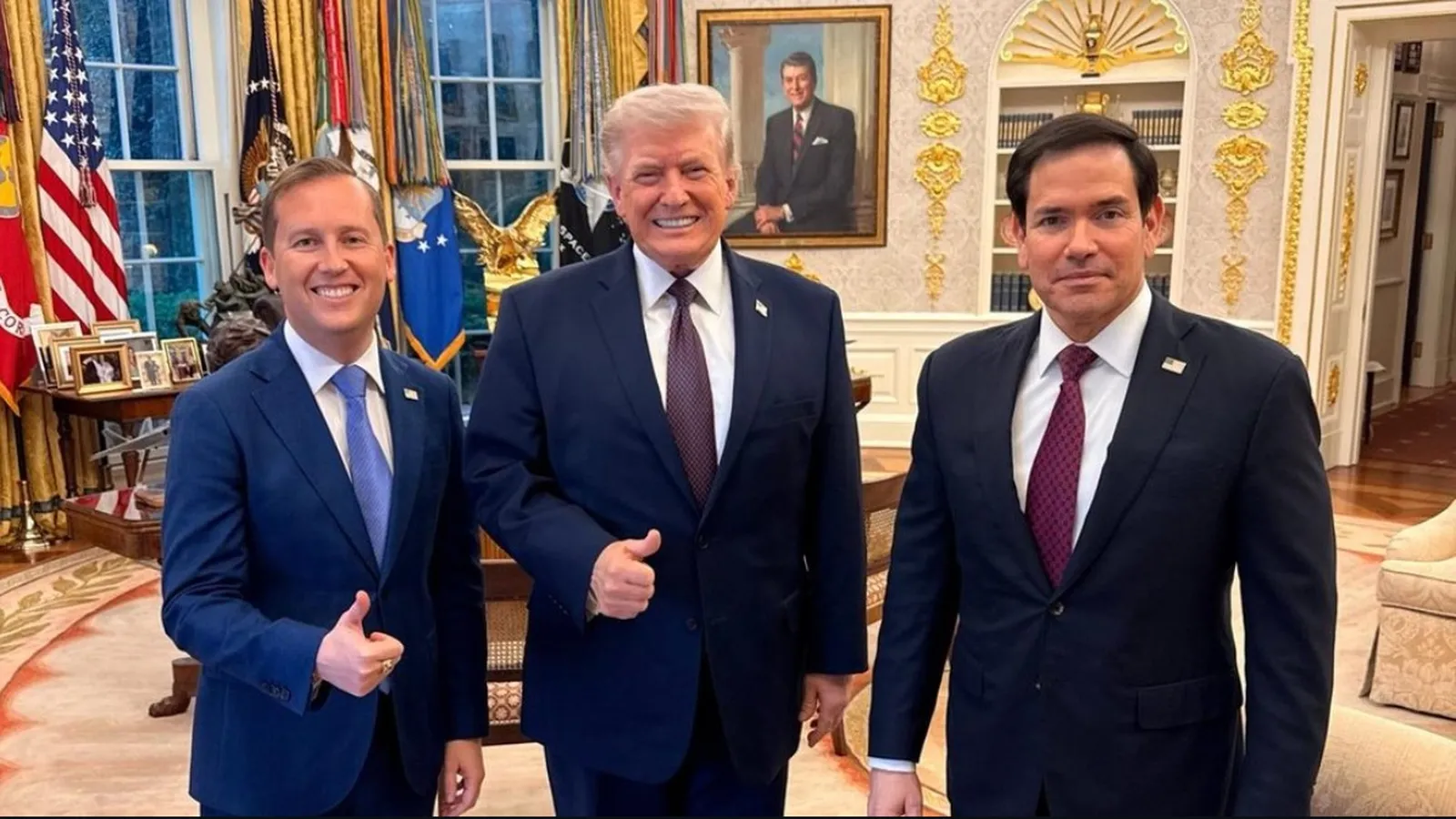
Marco Rubio India visit highlights Washington’s growing strategic focus on New Delhi as Indo-Pacific tensions continue to reshape global alliances.
Delhi, 22 May : When U.S. Secretary of State Marco Rubio arrives in India from 23–26 May, the visit will be publicly framed around the Quad, Indo‑Pacific stability, and trade talks. In reality, the trip carries a far deeper purpose: Rubio is being deployed as Washington’s stabilizer at a moment when the personal equation between Donald Trump and Narendra Modi has become increasingly transactional and strategically uncomfortable.
The message from Washington is clear: the U.S.–India partnership has become too important to depend solely on leadership chemistry. That marks a major shift in how Washington approaches India—from performative diplomacy toward a long‑term, institutionalized Indo‑Pacific strategy built around India as a central pillar.
From Trump–Modi ‘bromance’ to transactional friction
For years, the U.S.–India relationship was built around political spectacle and personal branding. The Trump–Modi era produced mass rallies, nationalist symbolism, and carefully staged displays of political closeness. The Houston “Howdy, Modi!” event in 2019 symbolized a period when both leaders projected the relationship as a partnership between ideological allies as much as strategic partners.
That era has given way to a more transactional dynamic. Trump’s second‑term economic posture—centered on tariffs, trade pressure, and reciprocity threats—has generated new friction with New Delhi. India’s continued engagement with Russia on energy and defence, combined with its refusal to fully align with U.S. strategic expectations, has created growing tension beneath the public messaging.
New Delhi, in turn, has become increasingly cautious about appearing overly dependent on Washington, even as it seeks deeper U.S. investment and defence cooperation. That is where Rubio enters the equation.
Rubio as Washington’s ‘institutional fixer
Unlike Trump, Marco Rubio is viewed as a structured Indo‑Pacific strategist rather than a purely personality‑driven negotiator. He has consistently advocated stronger coordination against China, deeper supply‑chain cooperation with India, and expanded strategic engagement across the Indo‑Pacific.
Marco Rubio india visit is therefore not about replacing Trump’s policy direction. It is about insulating U.S.–India relations from the volatility at the top. Washington is trying to separate strategic cooperation from leadership‑level friction—a recognition that the partnership must endure even when Trump and Modi’s rapport sours.
The timing is no coincidence. Across the Indo‑Pacific, the United States is accelerating efforts to build resilient economic and security networks capable of reducing dependence on China. Sectors—critical minerals, semiconductors, AI infrastructure, defence manufacturing, shipping corridors, and maritime logistics—have become central pillars of U.S. regional strategy.
India now sits at the center of that architecture. For American policymakers, India is no longer viewed simply as a regional partner. It is increasingly seen as the only large democratic power with the scale, geography, population, and industrial potential capable of balancing China over the long term without a formal alliance. That is the core logic behind the continued investment in the relationship, even as transactional disputes flare.
Rubio’s India visit and the Quad reset
Rubio’s tour reinforces the growing importance of the Quad. The grouping of India, the United States, Japan, and Australia has evolved beyond symbolic diplomacy into a working mechanism for regional coordination. Maritime security, supply‑chain diversification, critical minerals, emerging technologies, and infrastructure resilience now form the core of the Quad agenda.
The Quad has also become a political safety valve. While leadership‑level tensions between Trump and Modi have complicated summit diplomacy, institutional cooperation beneath the surface has continued expanding. Ministerial meetings, defence dialogues, technology partnerships, and industrial coordination have kept moving forward even in the absence of the theatrics that once defined the relationship.
Rubio’s participation in the Quad foreign‑ministers’ meeting in Delhi on 26 May reflects that transition. The emphasis now is less about optics and more about deliverables. This includes:
- Defence manufacturing cooperation and offsets,
- Energy security and supply‑chain coordination,
- Critical‑minerals partnerships and logistics‑network projects,
- Semiconductor‑linked supply‑chain resilience, and
- Indo‑Pacific maritime security arrangements.
Washington wants these networks deeply institutionalized so they can survive political fluctuations in both Washington and New Delhi.
China’s view of a Quad‑centric Indo‑Pacific
Beijing will watch this closely. Chinese strategists increasingly view the Quad as an emerging strategic coordination mechanism designed to constrain Chinese influence across Asia without formally replicating NATO. Rubio’s India visit reinforces that perception, particularly as U.S. messaging around the Indo‑Pacific becomes more direct and India‑centric.
At the same time, India continues walking a narrow strategic line. New Delhi wants deeper U.S. investment, advanced defence cooperation, and expanded technology access but it also wants to preserve strategic autonomy, maintain flexibility with Russia, and avoid appearing like a formal American ally. That balancing act remains the core tension inside the relationship and helps explain why India resists being framed as a ”de‑facto” bloc member.
Enduring friction, irreversible integration
Rubio cannot eliminate the structural disagreements. Trade disputes, tariff tensions, sanctions politics, and differing views on sovereignty will continue creating friction. India’s independent foreign‑policy tradition is unlikely to disappear simply because Washington now sees Delhi as central to its Indo‑Pacific strategy.
Yet, the broader trajectory is increasingly difficult to ignore. The U.S.–India relationship is moving away from personality‑driven diplomacy toward long‑term strategic integration. Supply chains, defence ecosystems, and Indo‑Pacific infrastructure projects are being hard‑wired into the fabric of the relationship in ways that outlast individual leaders.
That is the real significance of Marco Rubio India visit. Washington understands that leadership chemistry can fluctuate, but institutions, supply chains, and geopolitical realities endure far longer. The personalities may change.
The strategic logic no longer does.