
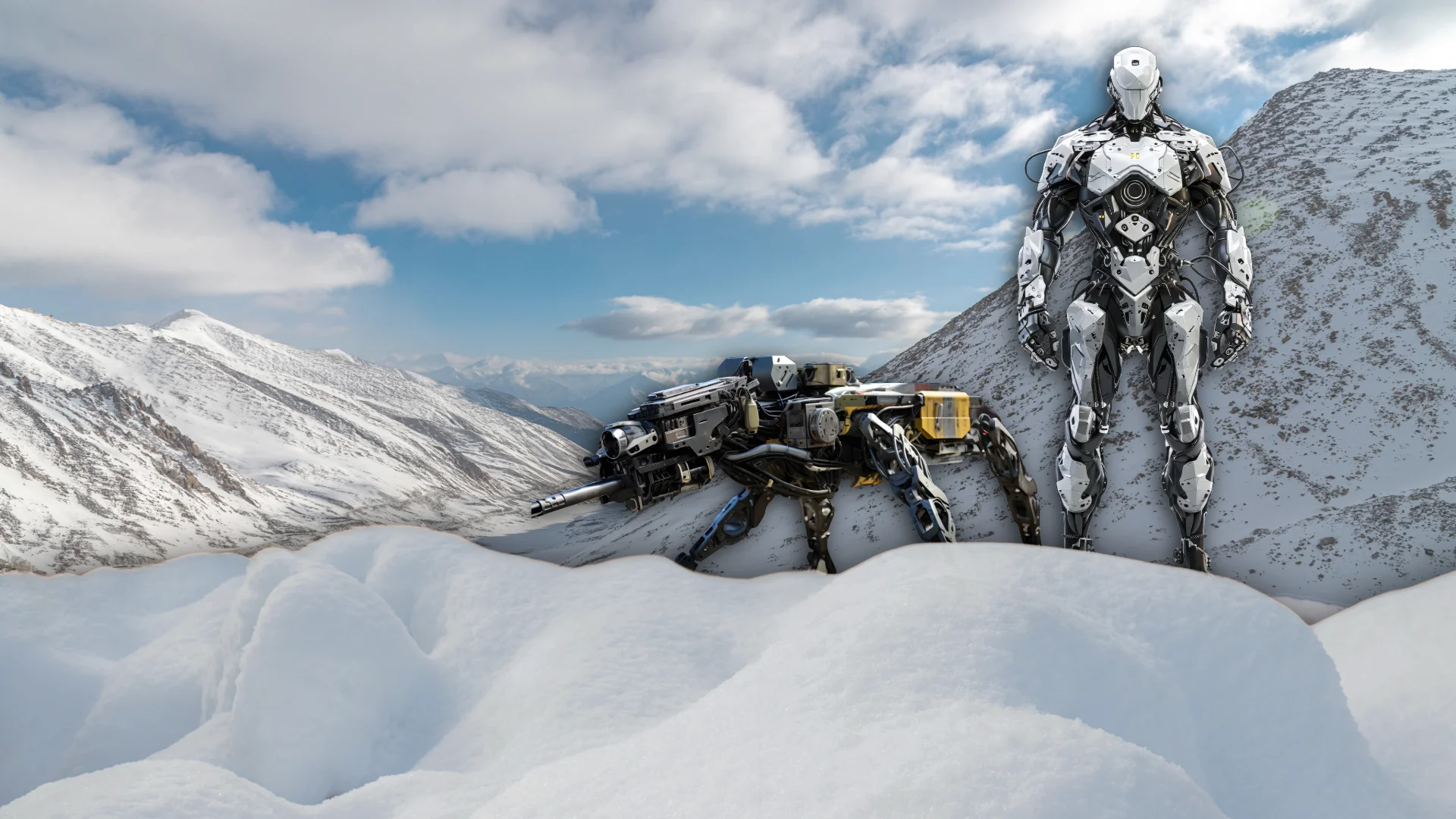
India’s defence industry has started investing heavily in autonomous systems, raising an important question: Can Military Robots Protect Siachen? It is no longer a futuristic idea. With companies announcing investments in military robots, Unmanned Ground Vehicles (UGVs), drones and AI-enabled systems, India is preparing for a new era of high-altitude warfare. But before discussing technology, it is important to understand why Siachen presents a challenge unlike any other battlefield in the world.
Siachen Has a Problem That Weapons Alone Cannot Solve
When people think of Siachen Glacier, they usually imagine soldiers exchanging fire across icy mountains. In reality, nature is often the toughest enemy.
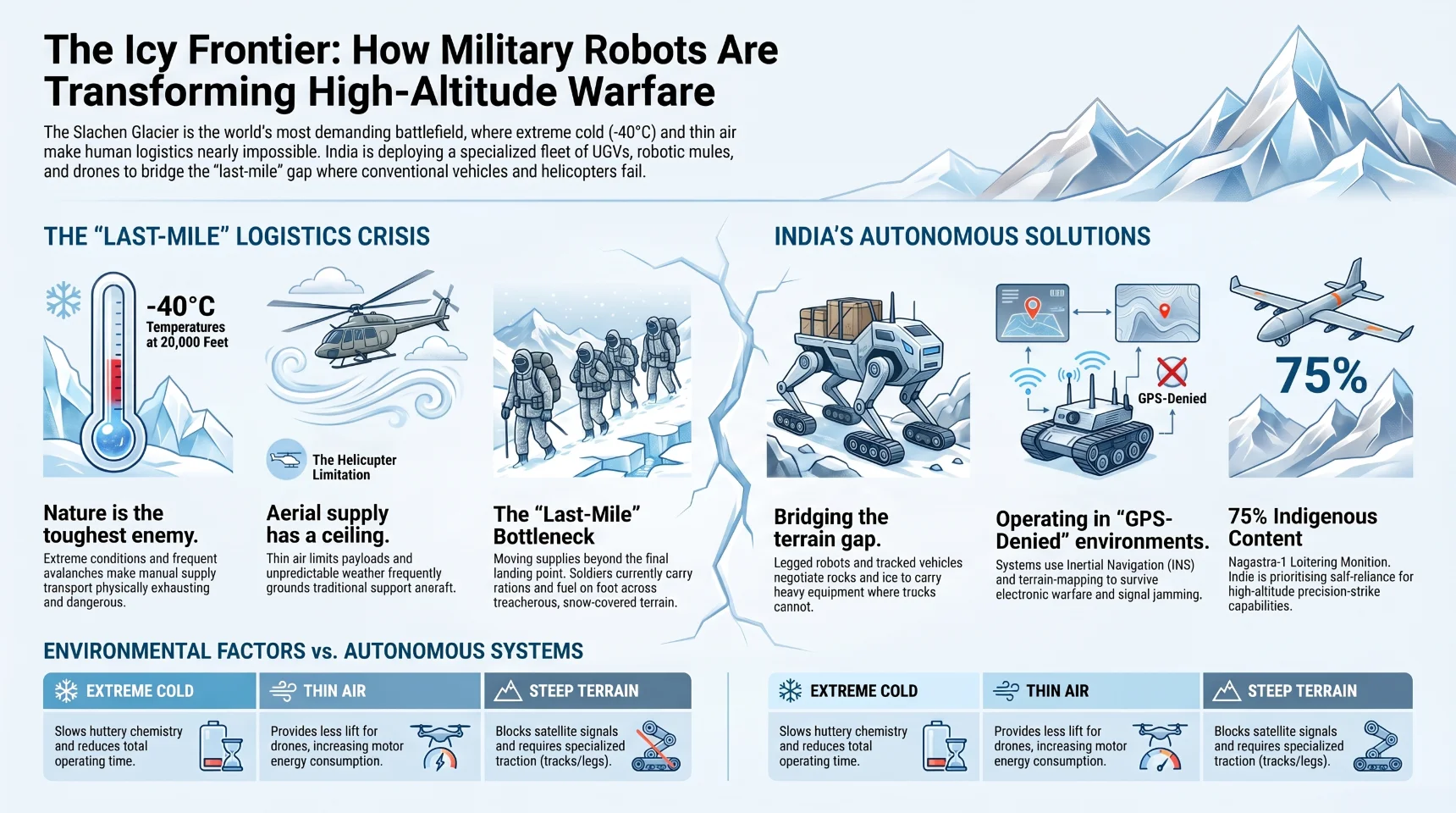
Situated at altitudes reaching nearly 20,000 feet, Siachen experiences temperatures below -40°C, thin air, frequent avalanches and unpredictable weather. Simply keeping troops supplied is a military operation in itself. Every ration packet, fuel canister, oxygen cylinder and ammunition box has to reach isolated posts through one of the most demanding logistics networks anywhere in the world.
Helicopters play a vital role, but they cannot solve every problem. They have payload limitations at high altitude and cannot always fly in poor weather. Beyond the last landing point, soldiers often carry heavy supplies on foot across snow-covered terrain.
Military planners describe this as the last-mile logistics challenge.
It is a problem that missiles cannot solve—but military robots might.
Can Military Robots Protect Siachen? Why India Has a Unique Operational Need
Every major military power is investing in autonomous systems.
The United States is developing autonomous logistics vehicles to reduce risks to soldiers. China has demonstrated robotic dogs, AI-enabled drone swarms and unmanned combat systems. Israel relies on autonomous technologies for surveillance and border security, while Ukraine has shown how drones and UGVs can transport supplies, evacuate casualties and support frontline operations.
India’s requirement is different.
Unlike many countries, India maintains permanent deployments across the Himalayas, including Siachen, Eastern Ladakh and Arunachal Pradesh. Here, the challenge is not only defending territory but also sustaining troops throughout the year.
This is where Military Robots in India could make the biggest difference.
Instead of replacing soldiers, autonomous systems could carry ammunition, transport food and fuel, deliver emergency medicines, inspect dangerous routes and support surveillance in areas where every movement is physically exhausting.
For India, robotics is as much about logistics as it is about warfare.
Military Robots in India: UGVs, Robotic Mules and Cargo Drones Explained
The phrase “robot soldier” often creates the image of an armed humanoid machine.
Modern militaries are moving in a different direction. Instead of replacing infantry, they are deploying specialised systems designed for specific missions.
Unmanned Ground Vehicles (UGVs)
UGVs are robotic vehicles that can transport supplies without carrying a human crew.
Their potential roles include:
- Carrying ammunition and food
- Moving communication equipment
- Casualty evacuation
- Engineering support
- Route clearance
For Siachen, UGVs could reduce the need for soldiers to carry heavy loads over steep and icy terrain.
Robotic Mules
A Robotic Mule is designed specifically for difficult terrain.
Unlike conventional vehicles, these machines can negotiate rocks, snow and narrow mountain paths while carrying heavy equipment. Their primary role is to solve the “last-mile logistics” problem where trucks and larger vehicles cannot operate.
Cargo Drones
Cargo drones are becoming increasingly capable of delivering medicines, lightweight supplies and emergency equipment to isolated locations.
For remote Himalayan posts, they could complement helicopters rather than replace them.
Loitering Munitions
India is also investing in loitering munitions.
Unlike conventional missiles, these systems remain airborne while searching for targets before carrying out precision strikes.
One example is Nagastra-1, developed by Solar Defence & Aerospace with more than 75% indigenous content. The system reflects India’s growing emphasis on indigenous precision-strike capabilities under the broader push for self-reliance in defence manufacturing.
Can Military Robots Survive in Siachen’s Extreme Conditions?
Designing a military robot is only the beginning.
Making it work in Siachen is far more difficult.
Extreme cold slows the chemical reactions inside lithium-ion batteries, reducing both available power and operating time. A drone capable of flying for nearly 40 minutes under normal conditions may experience significantly lower endurance in sub-zero temperatures.
High altitude creates another challenge.
Thin air provides less lift, forcing drone motors to work harder while carrying the same payload. This increases energy consumption and reduces operational range.
Ground systems face different obstacles.
Snow, ice and loose rocks reduce traction, making tracked vehicles or Robotic Mules more suitable than conventional wheeled platforms.
Navigation is equally challenging.
Steep mountains can interfere with satellite navigation and radio communications, while future conflicts may involve electronic warfare designed to jam GPS and other navigation signals.
Surviving Siachen Also Means Surviving Electronic Warfare
Extreme weather is only one part of the challenge. Future Military Robots in India will also need to operate in environments where GPS and communications cannot always be relied upon.
Modern defence research has repeatedly shown that Global Navigation Satellite System (GNSS) signals can be jammed or disrupted during conflict. A drone or UGV that depends entirely on satellite navigation could lose its ability to complete a mission if those signals are denied.
That is why next-generation autonomous systems increasingly combine Inertial Navigation Systems (INS) with onboard sensors, cameras and terrain-mapping software. These technologies allow autonomous platforms to continue navigating even when GPS becomes unreliable.
For India, this challenge is even greater. Siachen’s mountains already make navigation difficult. Add electronic warfare to the equation, and autonomous systems must be capable of operating with minimal external guidance.
Companies such as Zen Technologies are expanding into autonomous ground systems through platforms like Prahasta, while Indian drone manufacturers including Marut Drones are developing indigenous surveillance UAVs for demanding operational environments. The Indian Army is also encouraging innovation through initiatives such as HIM-DRONE-A-THON, where drones are tested in high-altitude conditions near Leh before being considered for operational roles.
In Siachen, mobility alone will not determine success. Reliable navigation, secure communications and cold-weather endurance may prove equally important.
Editorial Note: The ₹12,800 crore investment, production targets and project timeline are based on announcements made by Solar Defence & Aerospace. The investment represents the company’s stated plans and future roadmap. Actual implementation, production capacity and timelines may change as the project progresses.