
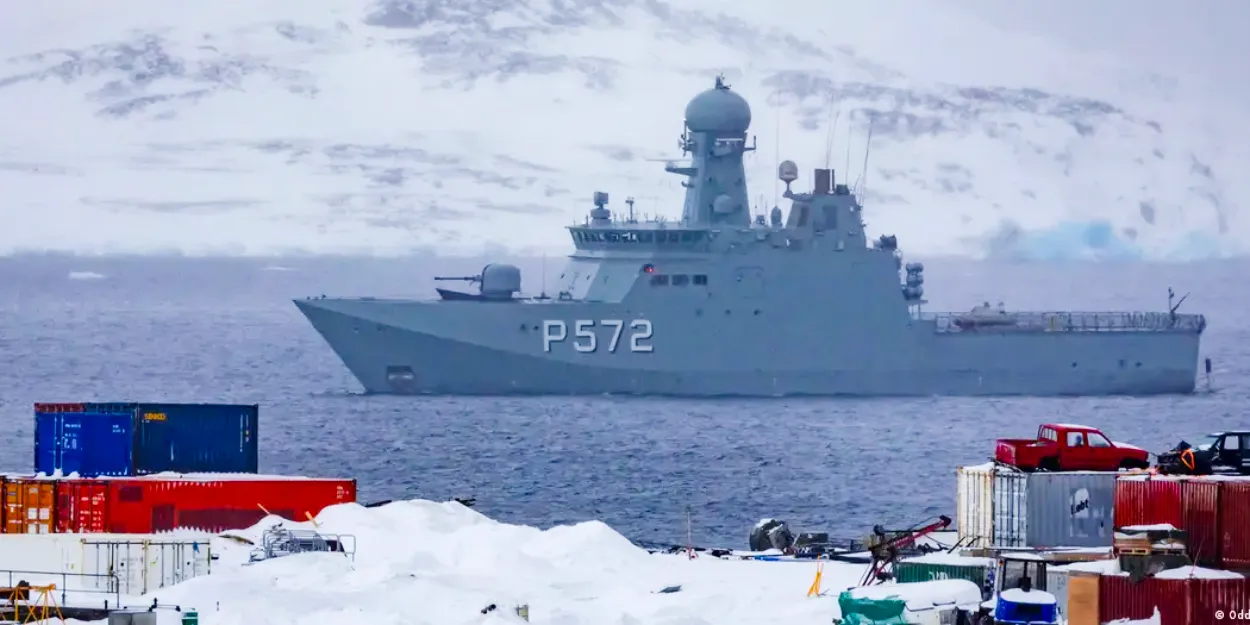
How expanded U.S. basing rights and High North surveillance tighten NATO’s grip on the GIUK Gap and challenge the Northern Fleet’s undersea transit.
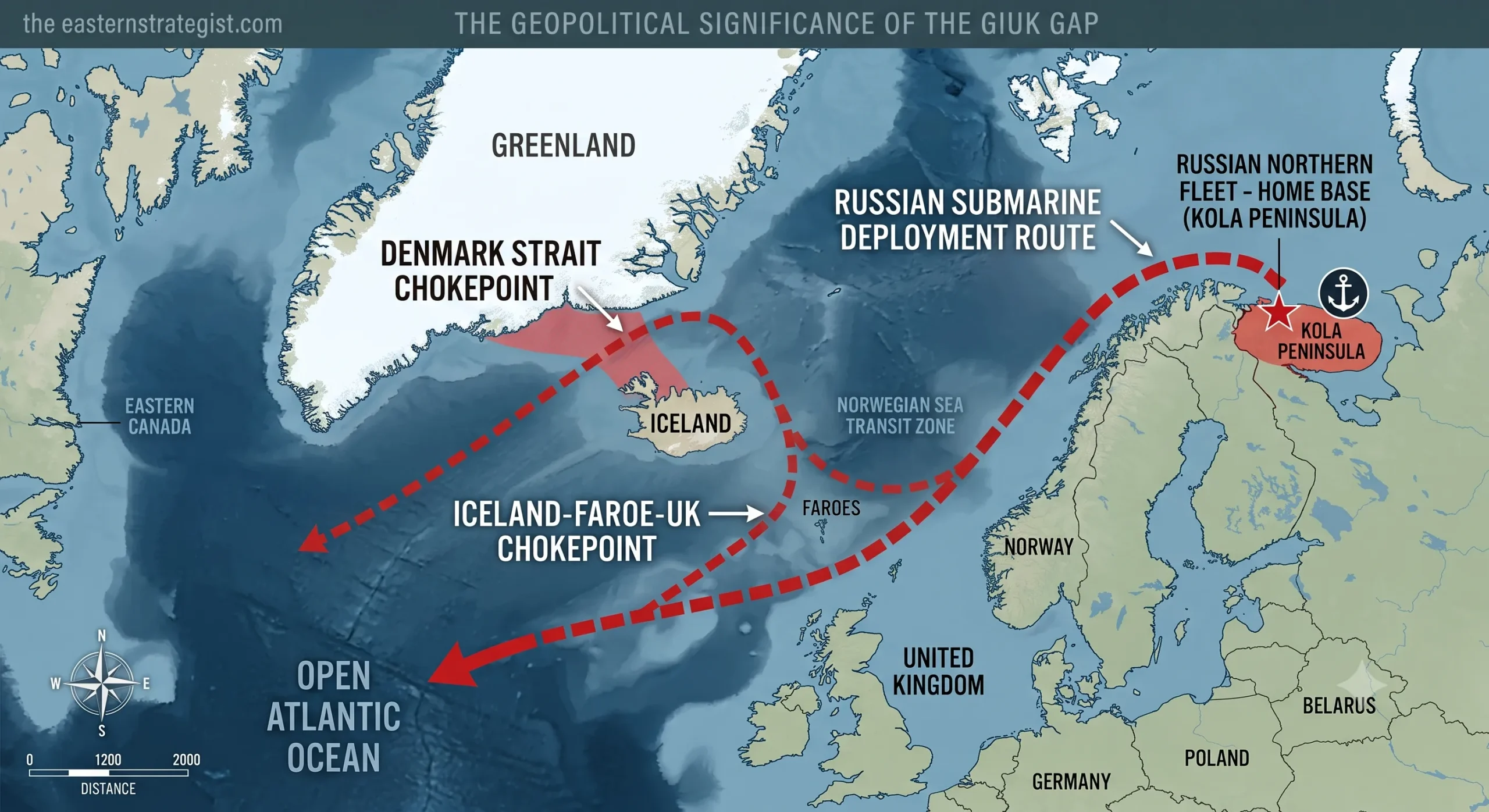
Every Russian submarine that leaves the Kola Peninsula for the open Atlantic has to pass through the same narrow stretch of ocean, anchored on one side by Greenland’s coastline. That geography has not changed since the Cold War. What changed on 18 September 2026 is who controls it, and the announcement of a new Greenland security deal between the United States, Denmark and Greenland has reopened a decades-old strategic question.
President Donald Trump announced that day that the United States had secured “permanent control over security” in Greenland — language that reads, at first glance, like a sovereignty story. It is not. The US has had military access to the island since 1951. What this deal actually does is formalise something closer to a Cold War-scale watch post over Russia’s only Atlantic gateway, at the exact moment Moscow is already being described, by the UK’s own military chief, as actively probing Western defences on multiple fronts.
What the Greenland security deal actually says
The agreement, announced by Trump on Truth Social, grants the US “permanent control over security, and all other needs” in Greenland, at what the administration describes as “no cost” to American taxpayers. Denmark and Greenland retain sovereignty. The three governments are expected to formally sign the pact next week at the United Nations General Assembly in New York, though it still requires approval from the Danish and Greenlandic parliaments before taking legal effect, according to NPR’s reporting on the announcement.
Trump said the US would “immediately” begin developing a “large military presence” on the island, and that Washington would work with Greenlanders on its construction. Danish Prime Minister Mette Frederiksen described the deal as one that “recognises the sovereignty and territorial integrity” of the Kingdom and affirms Greenlanders’ right to self-determination. Greenland’s premier, Jens-Frederik Nielsen, called it an arrangement that “strengthens our common security” for the Western alliance.
Crucially, the deal’s text — as described by US officials — bars any country considered a security risk from establishing bases, maintaining troops, or making “sensitive investments” in Greenland without Washington’s written approval. The South China Morning Post reported that China is among the adversaries the clause is aimed at, alongside Russia.
This is a meaningful walk-back from where the year began. Trump had spent early 2026 threatening to annex Greenland outright, floating the use of military force, and imposing tariff threats of 10–25 percent on eight European nations that pushed back on his ambitions — a dispute TES covered in detail in Greenland and the Battle for the High North. None of that survives in the September text. What survives is basing rights — dressed in more permanent, more exclusive language than the 1951 agreement ever used, but basing rights all the same.
TES Analytical Assessment: the shift from “acquisition” to “exclusive security control” over the course of 2026 suggests Washington recalibrated its goal once it became clear that annexation was diplomatically and legally unworkable, while the underlying strategic interest — denying the island to rivals — remained constant throughout.
Why Greenland’s geography matters more than its politics
The Greenland security deal’s basing language points directly at this stretch of ocean. Greenland forms the western anchor of the GIUK Gap — the roughly 1,800-kilometre stretch of the North Atlantic between Greenland, Iceland and the United Kingdom that Russia’s Kola Peninsula-based Northern Fleet must cross to reach open ocean. It is the last realistic point at which NATO can detect a Russian submarine before it reaches the Atlantic shipping lanes or the US Eastern Seaboard. RealClearDefense notes this is not a new concern; it was the central axis of NATO’s Cold War anti-submarine strategy, and it has regained urgency as Russian submarine activity and undersea cable interference have picked up again in the past two years. TES examined this wider militarisation trend in WWIII at Sub-Zero: Why the Arctic Is the World’s Most Dangerous New Battlefield.
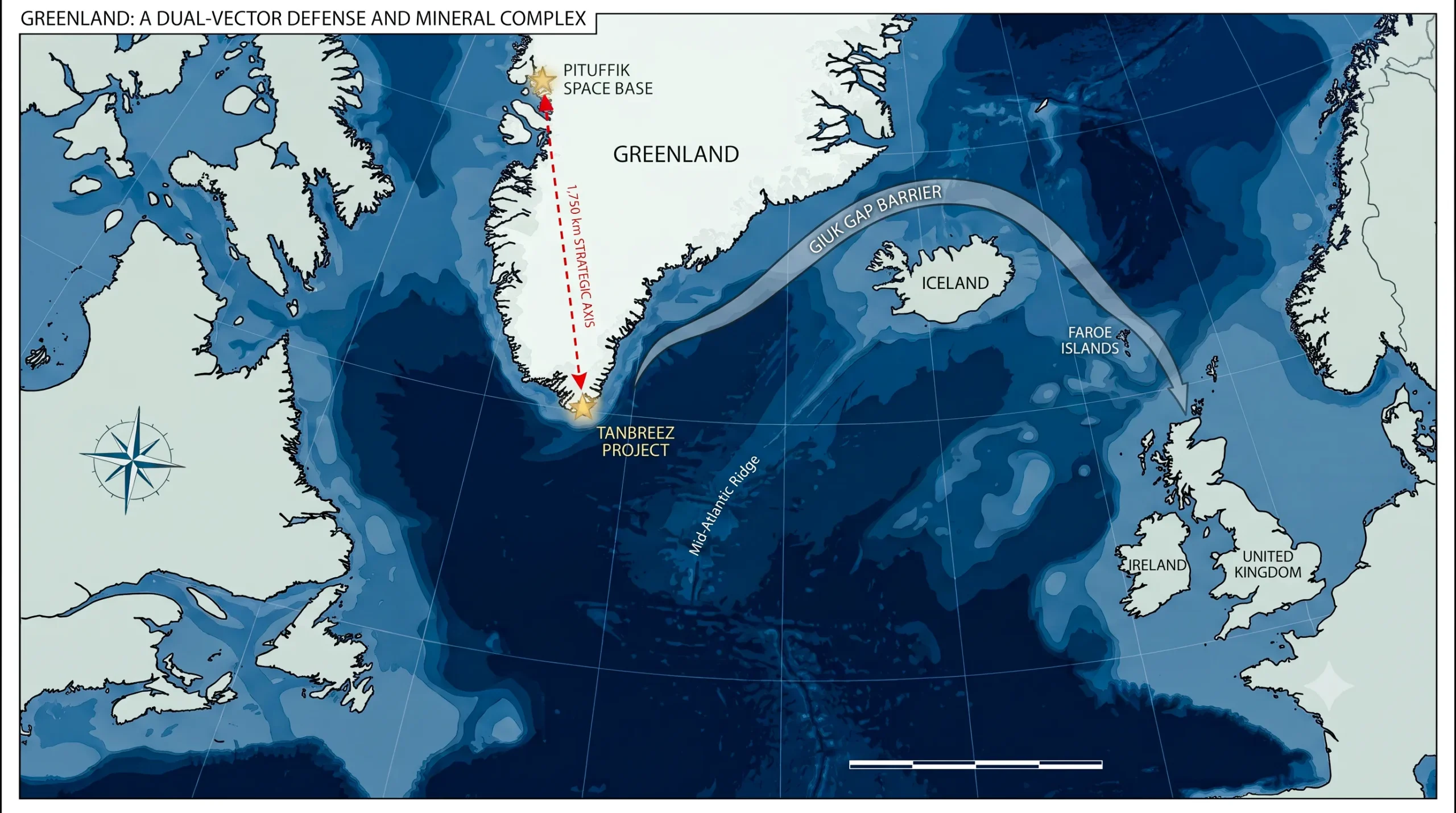
Pituffik Space Base, on Greenland’s northwestern coast, adds a second layer. It hosts ballistic missile early-warning radar tracking intercontinental missiles on Arctic trajectories — the shortest path a Russian ICBM would take toward the continental United States. Given that such a missile could reach American soil in roughly 40 minutes, the additional seconds of warning this radar provides are not a minor technical detail. The Center for Strategic and International Studies notes that Pituffik’s early-warning systems work in tandem with similar installations in Alaska and Canada.
The scale of the current US footprint makes the “large military presence” language more significant than it might first appear. Pituffik houses approximately 150 personnel today, down from roughly 15,000 across 17 installations at the height of the Cold War. A genuine expansion would represent a partial reversal of three decades of drawdown — precisely the kind of change that would show up on Russian military planning assumptions, not just in a press release.
How Russia has actually responded
Russia’s position on Greenland has shifted noticeably over the year. In January, President Vladimir Putin was almost dismissive, telling Russia’s Security Council that “what happens in Greenland is of no concern to us.” By contrast, Foreign Minister Sergei Lavrov has since warned that any militarisation of the island aimed at Russia would provoke “adequate counter-measures, including military-technical ones.”
That escalation should be read alongside a separate warning delivered just two days before the Greenland deal was announced. On 16 September, Air Chief Marshal Sir Richard Knighton, the UK’s Chief of the Defence Staff, told the BBC — as London Business News reported — that Britain faces “the most dangerous” security environment of his 35-year career, citing Russian long-range aviation incursions, cyberattacks and what he called “reckless sabotage and assassination attempts” against UK and allied defences.
Read together, the Greenland security deal is not an isolated basing-rights story. It is one data point in a wider pattern: Russia is being formally excluded from a strategically vital Arctic island at the same moment Western military leadership is describing an active, multi-domain Russian campaign against European and UK security. This tension between Washington’s basing agenda and NATO’s collective posture is one TES flagged previously in NATO Trump Tension Explodes. Lavrov’s countermeasures threat reads less like posturing and more like continuity with an already-escalating posture.
China’s position, by contrast, has stayed rhetorically consistent, not escalating. Foreign Ministry spokespeople have repeatedly said the US “should not use other countries as a pretext” for its own Arctic ambitions, framing Beijing’s Arctic activity as compliant with international law without directly addressing Greenland by name.
The minerals dimension — a parallel contest, not the main one
The military logic explains why Washington wants Greenland locked down. It does not fully explain the timing or the language of “sensitive investments” in the deal’s text — and that is where a second, quieter contest comes into view.
Greenland holds substantial rare-earth and critical-mineral deposits, and a 2019 US-Greenland memorandum on mineral surveying, signed during Trump’s first term, lapsed without renewal under the Biden administration. Washington’s broader strategy — public-private equity stakes in companies such as MP Materials, and bilateral mineral agreements with Saudi Arabia, Japan and Australia — has one consistent goal: building a rare-earth supply chain that does not run through Chinese-controlled processing, which remains the real chokepoint even where mining itself is diversified.
China’s advantage in rare earths is not primarily geological. It is that most of the world’s rare-earth material, wherever mined, still has to pass through Chinese refining before manufacturers can use it. Finding new deposits in Greenland does not solve that problem on its own — building Western processing capacity does, and that is the slower, more expensive half of the supply chain Washington is trying to construct.
This is where Critical Metals Corp (NASDAQ: CRML) enters the picture. The company holds the Tanbreez project in southern Greenland, one of the world’s largest rare-earth deposits, and has built a 15-year offtake agreement with REalloys tied to US defence-industrial supply chains, alongside a reported joint venture for rare-earth processing with a Saudi partner. Historically, CRML has moved sharply on Greenland-related headlines — a documented 13 percent jump in March 2026 alongside a smaller move in MP Materials, on similar news.
This is where the pattern breaks, and the break is more interesting than the pattern.
Why the market didn’t react the way you’d expect
On 18 September, the day of the announcement, CRML traded between $6.61 and $6.95 — close to its 52-week low of $5.12, and roughly 70 percent below its 52-week high of $32.13. It did not rally.
Two company-specific factors explain part of this. CRML is mid-process on a proposed acquisition of European Lithium, with court-ordered scheme meetings and a shareholder vote reportedly scheduled for 22 October — the kind of corporate overhang that dominates a small-cap miner’s share price regardless of unrelated geopolitical news. The company also carries a going-concern flag from its auditors, adding company-specific risk that a pure Greenland thesis does not capture.
But the more revealing explanation is sector-level. The same day, news broke that China Rare Earth Group is negotiating to acquire a stake in Shenghe Resources, which itself holds a position in MP Materials — a company in which the US Department of Defense is the largest shareholder. That is a direct threat to the West’s rare-earth strategy: Chinese influence reaching into a DoD-backed supplier through a minority stake. Rare-earth investors’ attention that week appears to have gone to that story, not to Greenland.
TES Analytical Assessment: this suggests the market currently treats supply-chain consolidation risk — China buying influence over Western suppliers — as a more immediate threat to the rare-earth strategy than basing-rights announcements in Greenland, even when the two stories are, in policy terms, two sides of the same containment effort.
Europe’s conditional relief
European reaction to the Greenland security deal has been shaped by a year of friction that this agreement does not fully erase. The European Commission, under President Ursula von der Leyen, pledged €200 million ($232 million) in direct investment to Greenland during a 7 September visit to Nuuk — eleven days before the security deal — and has proposed a further €530 million under the EU’s 2028–2034 budget, according to Al Jazeera’s coverage of the visit. The same week, eleven NATO countries ran “Arctic Shield” military exercises in Greenland involving roughly 400 personnel from Canada, Denmark and Finland. Notably, no US troops took part.
That absence is worth sitting with. If the US’s primary Arctic security commitment is a bilateral arrangement with Denmark rather than a coordinated NATO framework, European allies are left hoping that Washington’s basing-and-minerals agenda happens to align with their own defence planning, instead of having negotiated that alignment directly. Frederiksen’s careful language — sovereignty, self-determination, benefit to NATO and Europe “as well” — reads as relief that the annexation threat has receded, not celebration of a jointly designed outcome.
What to watch
Will the Danish and Greenlandic parliaments ratify the Greenland security deal, and on what timeline?
Both legislatures must approve the deal before it takes legal effect. Domestic sentiment in Greenland, following a year of “Hands Off Greenland” protests, remains a genuine variable.
Does next week’s UN General Assembly signing produce binding treaty text, or another framework statement?
Prior Greenland announcements in 2026 — including the January “framework” from Davos — were later described by critics as offering few specifics. Whether this agreement crosses that threshold will only be clear once the text is public.
Will rare-earth-linked equities move on confirmation of expanded US basing activity, or does the sector’s attention remain fixed on Chinese supply-chain manoeuvres?
The 18 September divergence between Greenland headlines and rare-earth stock movement may or may not persist once construction plans, if any, become concrete.
The takeaway
Sovereignty theatre aside, this deal’s core logic is a Cold War one: close the gap Russia’s Northern Fleet has always needed to cross, and extend the warning time against a Russian ICBM by however many seconds Pituffik’s radar can buy. The GIUK Gap and Lavrov’s countermeasures threat explain why Moscow is reacting with more than words. The minerals contest — and the market’s apparent indifference to it this week — is real, but it is riding on top of a security rationale that would exist with or without a single rare-earth deposit under the ice.
Source transparency note: This article distinguishes verified facts (drawn from official statements, government sources and named wire reporting) from TES Analytical Assessment, which is clearly labelled where the connection between events is inferred, not officially confirmed. No unnamed sources have been used. Company and government statements are attributed to their original speakers throughout.