Officers from four countries spent 13 days on one Indian Coast Guard vessel this autumn, yet the Quad leaders’ summit still has no date in any official text. The Quad Atlanta meeting of 31 October made that contrast plain. Its joint press release credits India with hosting the second Quad-at-Sea mission, leading the first response in Nepal and receiving US funding for minerals recycling, then points to a leaders’ summit without naming a day.
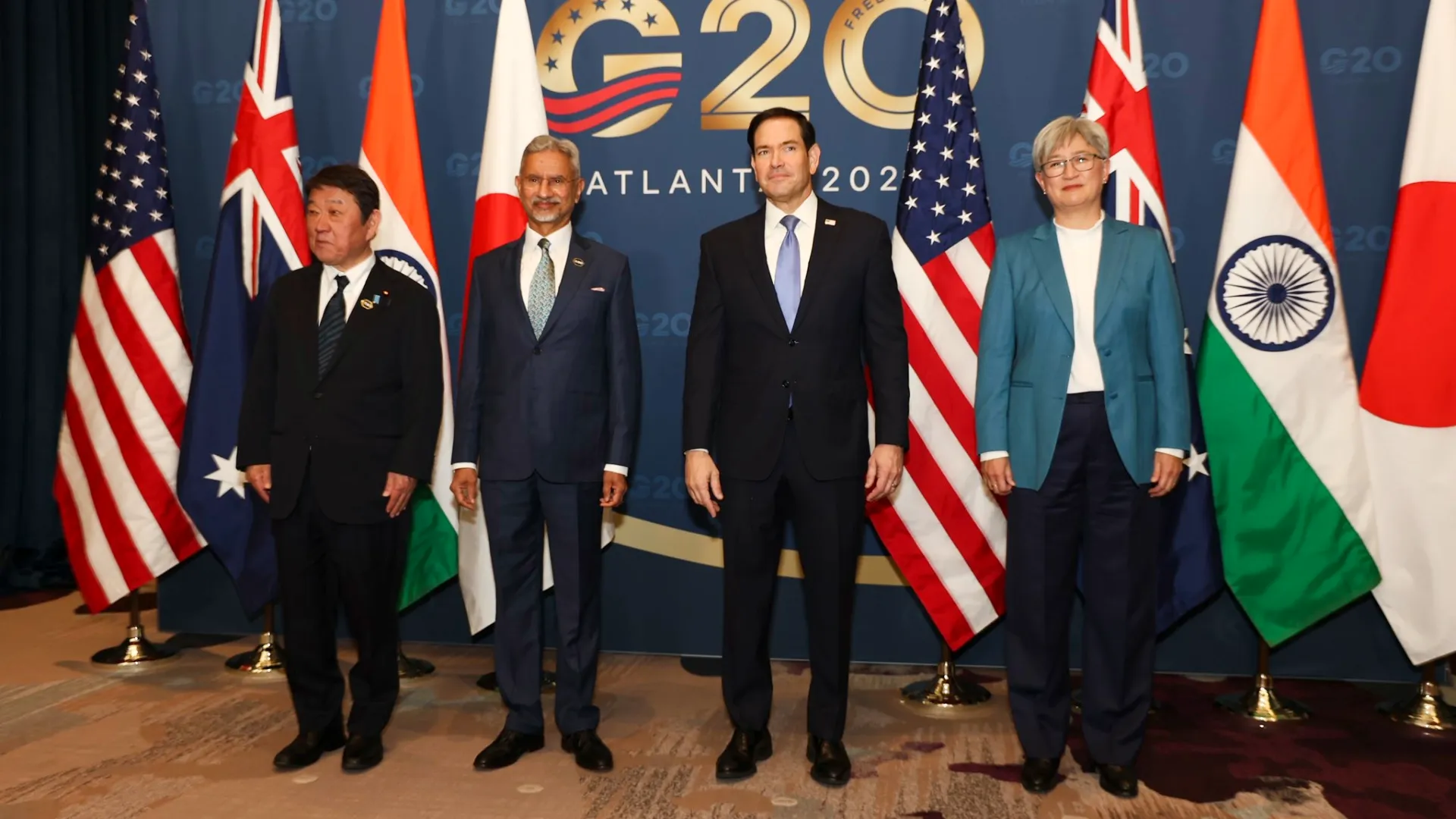
External Affairs Minister S Jaishankar, Australia’s Penny Wong, Japan’s Toshimitsu Motegi and US Secretary of State Marco Rubio met on the sidelines of the G20 Foreign Ministers’ Meeting in Atlanta. Jaishankar called it the third Quad foreign ministers’ meeting of 2026, after New Delhi in May and Manila in July. Japan’s foreign ministry readout puts the session at about 40 minutes.
Three strands in the text touch India directly: the Coast Guard at sea, a minerals-recycling grant, and the sea lanes the ministers named.
Why does the Quad Atlanta meeting put the Indian Coast Guard at the centre?
The joint press release records that the second Quad-at-Sea Ship Observer Mission sailed from Chennai to Perth between 25 September and 7 October, with representatives of all four countries aboard an Indian Coast Guard Offshore Patrol Vessel. Ministers called it a significant step towards maritime interoperability against unlawful maritime activities. The first mission, in July 2025, ran from Palau to Guam. India hosted this one.
The Australian Border Force, whose officers were aboard, says the crews worked through search and rescue, marine pollution response, maritime law enforcement and boarding operations before the vessel reached Fremantle on 7 October. It adds that its Maritime Border Command signed a memorandum of understanding with the Indian Coast Guard in July 2026.
More is dated. The first Quad exercise under the Indo-Pacific Maritime Surveillance Collaboration is set for Sea Dragon 2027, with a maritime domain awareness symposium in early 2027. The Ministry of External Affairs (MEA) said in May that the surveillance initiative should not be read as a militarisation of the Quad. The activity so far sits with coast guards and border agencies, which is consistent with that position.
What does India get from the Quad’s critical minerals commitment?
On minerals, the Quad Atlanta meeting welcomed a US commitment of $10 million to promote infrastructure and facilities in India and the countries of the Association of Southeast Asian Nations (ASEAN) that recover critical minerals from waste. It falls under the Quad Critical Minerals Initiative Framework announced in May and centres on electronics waste and scrap, with private-sector investment in collection networks, processing plants and refineries. The text gives no split between India and ASEAN, no site and no timeline.
The sum is modest, and it is American money, not a pooled Quad fund.
India pursues the subject on other tracks. At the G20 energy plenary, Jaishankar said India’s national critical minerals mission spans exploration to recycling, and that India has proposed a G20 Critical Minerals Circularity Initiative. The Australia-Canada-India Technology and Innovation (ACITI) Partnership, which Prime Minister Narendra Modi, Anthony Albanese and Mark Carney agreed in November 2025, covers resilient supply chains including critical minerals, the MEA said then. Jaishankar took it up with Canada’s Anita Anand and Wong in Atlanta on 30 October.
Ministers also said they would explore easing export and import procedures for the cross-border movement of recyclable materials, which bears directly on recyclers who move scrap across borders. Commercial follow-up is dated: a first Quad Business Leaders’ Forum is announced, and Quad export credit agencies meet in Tokyo on 18 November.
How does Jaishankar’s Atlanta agenda compare with the joint text?
Jaishankar’s own summary on X of the Quad Atlanta meeting lists stability, prosperity and freedom of choice, supply chain resilience across technology, critical minerals and energy, countering non-market practices, and taking forward agreements on counter-terrorism, maritime security and capacity building. He asked for a more contemporary Quad agenda with a practical approach. The joint release covers every item except counter-terrorism, which it does not mention.
Counter-terrorism did feature in May, when the Quad’s documents announced a counter-terrorism tabletop exercise in Australia for June 2026. At the G20 plenary in Atlanta, Jaishankar said tactical calculations should not lead the world to overlook terrorism, a high-risk activity that has “come back to bite even the practitioners.” He named no country, and the joint release names none as the source of the coercion or overcapacity it criticises.
On shipping the two texts align. The release asks for navigational rights to be preserved in the Strait of Hormuz, the Red Sea and the Bab el-Mandeb Strait under the United Nations Convention on the Law of the Sea (UNCLOS), with passage for vessels and crews “without the imposition of tolls.” That wording lands on the unresolved Hormuz toll dispute. Jaishankar told the G20 that the Global South bears a disproportionate cost of attacks on civilian shipping, and noted that India and Liberia have launched a joint initiative to safeguard seafarers.
Energy completes the set. The first Quad Fuel Security Forum met in September and discussed strengthening strategic petroleum reserves and stockholdings, according to the release. For India’s side of that equation, see the earlier analysis of India-US energy ties during the Hormuz crisis.
Why is Washington pressing the Quad now, and will it last?
Before the Quad Atlanta meeting, the US Embassy in India said the Quad is more than four countries on a map. The release backs that with delivery items: port modernisation projects in Fiji at Suva, Lautoka and Rokobili, more than $85 million for access to trusted artificial intelligence, and an effort to map semiconductor and AI hardware chokepoints. Why Washington is pressing now is analysis, not record, and analysts differ. The text also notes work on trusted undersea cable routes, a subject explained in TES’s piece on submarine cable geopolitics.
Reports said President Donald Trump was initially reluctant to attend the leaders’ summit India was to host in 2025, and it did not take place. Secretary of State Marco Rubio then revived the ministerial track.
He did so during his May visit to New Delhi, and Ambassador Sergio Gor had called the Quad’s revival a priority in March. Some analysts tie the renewed attention to energy, minerals and the West Asia war, as TES noted when the messaging sharpened. Others doubt Washington will sustain the effort. Atlanta settles neither view but shows where India stands in several deliverables: host of the sea mission, first responder in Nepal, recipient of minerals funding and host of this month’s disaster exercise.
What to watch after the Quad Atlanta meeting
When will the Quad leaders meet after the Quad Atlanta meeting?
The joint release says only that ministers look forward to the Quad Leaders’ Summit and the next foreign ministers’ meeting, with no date or venue. ANI reported that the leaders’ summit is expected in the Philippines next month. No official text yet confirms a date.
Which dated Quad commitments follow the Quad Atlanta meeting?
India hosts the Annual Joint Humanitarian Assistance and Disaster Relief Exercise (AJHE-26) this month, with Australian, Japanese and US observers. Quad export credit agencies meet in Tokyo on 18 November. A maritime domain awareness symposium follows in early 2027, and the first maritime surveillance exercise is set for Sea Dragon 2027.
Is the $10 million for critical minerals recycling Indian or Quad money?
It is a US commitment, according to the joint release, meant for facilities in India and ASEAN countries that recover critical minerals from waste. The text gives no split between the two, no site and no timeline.
The Quad began with relief work, and Atlanta returns to it
After the tsunami of 26 December 2004, the United States, India, Japan and Australia formed a core group to organise aid, and the Quad grew from it. The Quad Atlanta meeting comes back to it on India’s ground: the release recognises India as first responder in Nepal after the flash floods of 26 August 2026, and three partners will send observers to India’s Annual Joint Humanitarian Assistance and Disaster Relief Exercise (AJHE-26) this month. If the leaders meet in Manila as reported, dated, India-linked items will be waiting for endorsement. If they do not, the ministerial track now carries its own deliverables.
Source note: Quad joint press release of 31 October 2026 as published by the US, Australian and Japanese governments; Australian Border Force; Ministry of External Affairs releases and the External Affairs Minister’s public statements; wire reporting. Assessments are TES’s own.