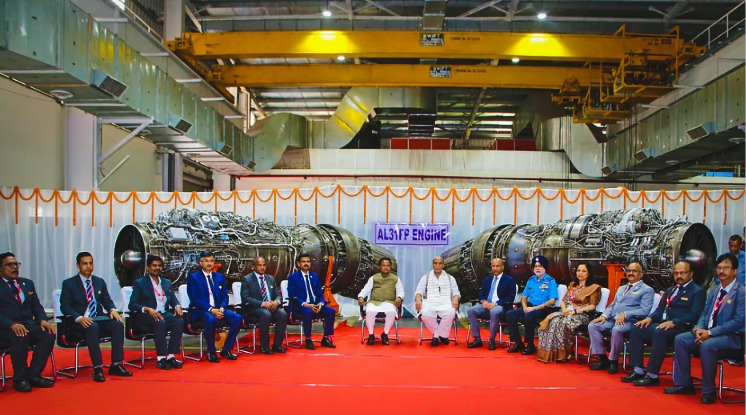
On 6 October 2026, HAL’s Koraput division handed over its 2,000th aero-engine. A smaller number in the Defence Ministry’s statement says more. HAL has delivered 63 AL-31FP engines for the Su-30MKI against a target of 60 at the end of the contract’s second year.
The factory is three engines ahead, and the government is now putting ₹335 crore behind lifting HAL Koraput AL-31FP production capacity from 30 engines a year to 50, though the contract only requires 30.
What did HAL Koraput announce on 6 October 2026?
Defence Minister Rajnath Singh announced three investments at Koraput in Odisha: a ₹335 crore expansion of AL-31FP output from 30 to 50 engines a year, a ₹218 crore second production line for the Shakti helicopter engine, and a proposed ₹5,000 crore push towards an indigenous high-thrust engine for the Advanced Medium Combat Aircraft (AMCA), according to the Press Information Bureau (PIB) release of 6 October 2026 (release ID 2319668). The Statesman reported the same milestone.
| Programme | Capacity or aim | Investment | Timeline |
|---|---|---|---|
| AL-31FP (Su-30MKI) | 30 to 50 engines a year | ₹335 crore | Not stated |
| Shakti (Dhruv ALH, Prachand LCH) | Second line, up to 100 engines a year | ₹218 crore | Fully established by 2028-29 |
| Indigenous high-thrust engine (AMCA) | Engine, materials and first indigenous high-thrust test facility | About ₹5,000 crore (proposed) | Not stated |
The Koraput division was set up in 1964. Its engines have powered the MiG-21, MiG-27, MiG-29 and Su-30MKI, and it has overhauled more than 9,000 engines, according to the PIB release.
Why raise HAL Koraput AL-31FP production capacity above the contract rate?
The contract signed on 9 September 2024 requires 30 AL-31FP engines a year, so capacity of 50 exceeds what the Indian Air Force has ordered. The release does not explain the gap, so TES offers three readings, each an assessment and none a reported fact.
The Ministry of Defence (MoD) signed a ₹26,000 crore contract with HAL for 240 engines, to be supplied over eight years at 30 a year. At signing, the ministry said indigenous content would exceed 54 per cent, according to The Tribune. HAL delivered the first engine on 30 September 2024, less than a month after the signing, as FlightGlobal reported.
The arithmetic is simple. With 63 delivered, 177 engines remain. At 30 a year, that is about six more years. At 50 a year, it is about three and a half.
Three possible explanations:
- Faster delivery. The IAF may accept earlier deliveries to rebuild engine stocks for a fleet that depends on a Russian-origin engine.
- Further orders. Capacity of 50 a year would suit a follow-on order, or engines for upgraded aircraft. TES has reported on the Super Sukhoi upgrade cleared by the Defence Acquisition Council.
- Exports and overhaul. The Defence Production Secretary said in 2024 that Koraput could play a role in exporting engines, according to FlightGlobal.
One risk deserves attention. The 2024 contract left a large share of content to come from outside India, and the minister himself referred to “global supply-chain disruptions and raw-material challenges”. A factory can build to 50 engines a year only if the imported kits and superalloys arrive at the same rate.
What does the second Shakti line serve?
The second Shakti line serves two helicopter fleets: the Advanced Light Helicopter (ALH) Dhruv and the Light Combat Helicopter (LCH) Prachand. The MoD signed contracts worth ₹62,700 crore for 156 Prachand helicopters on 28 March 2025, and each helicopter has two Shakti engines.
The Prachand order is the main driver. According to Deccan Herald, the contracts cover 156 LCH, 66 for the Air Force and 90 for the Army. Deliveries are reported to run from 2027-28 to 2033, at about 30 helicopters a year.
TES arithmetic puts the engine demand at 312 Shakti engines for the new helicopters (156 times two), or about 60 a year at the delivery pace. A second line of up to 100 engines a year leaves headroom for Dhruv production, spares and overhaul. The line is due by 2028-29, which matches the start of heavy Prachand deliveries.
The Shakti is the Indian production name of the Safran Ardiden 1H1, co-developed with HAL, and more than 500 had been built by early 2025, according to The Tribune.
What does the high-thrust engine plan add?
It adds the ambition that matters most and the detail that matters least so far. The Defence Minister said the government is pursuing an indigenous high-thrust engine with an investment of about ₹5,000 crore, working with Mishra Dhatu Nigam Limited (MIDHANI) on raw materials and building India’s first indigenous high-thrust engine testing facility, in support of AMCA.
The PIB release names no foreign partner, a timeline or a thrust class. TES has reported on India’s talks with Safran on a future engine and on the wider propulsion picture, and both remain unresolved publicly. The same applies to the GE F414 co-production programme and to the debate over who builds the airframe in the AMCA programme.
The test facility and the materials work are the concrete items. The minister himself named superalloys, thermal-barrier coatings and cooling systems as the hard parts of engine making, which is why the MIDHANI link carries weight.
Why does Odisha matter to the plan?
Odisha is being positioned as a propulsion cluster. The Defence Minister cited the state’s coastline, ports, minerals and workforce, DRDO’s Integrated Test Range at Chandipur, and the Odisha government’s approval of an Aerospace and Defence Equipment Manufacturing Complex at Gajamara, Dhenkanal. Chief Minister Mohan Charan Majhi attended.
He also asked HAL to develop Koraput into an ecosystem of suppliers, MSMEs, start-ups and research partners, not only an engine factory. TES reads that request as a signal that future work may flow to smaller suppliers of engine components.
What should investors and planners watch?
The announced spending is modest. TES arithmetic puts the two capacity investments at ₹553 crore in total. The large numbers sit in the contracts these lines serve, and in the engine programme that has no price attached yet.
Five markers will show whether the Koraput plan holds:
- AL-31FP deliveries. Whether HAL keeps running ahead of the 30-a-year schedule, and whether a delivery acceleration or new order follows.
- Input supply. Whether Russian kits and raw materials arrive fast enough for 50 a year.
- Shakti line progress. Whether the line is fully established by 2028-29, ahead of the main Prachand deliveries.
- The engine partner. Whether the government names a foreign partner for the high-thrust engine, and what technology transfer it includes.
- MIDHANI’s role. Whether the raw-material work produces certified superalloy supply.
HAL entered FY2025 with an order book close to ₹1.9 lakh crore, as TES reported in its analysis of the engine programme. Engine overhaul and spares create revenue that outlasts the original production run, which is the long-term logic behind these lines.
Common questions about HAL Koraput and the AL-31FP
How many AL-31FP engines has HAL delivered?
HAL has delivered 63 AL-31FP engines against a target of 60 by the end of the second year of the 2024 contract, according to the Defence Ministry on 6 October 2026.
What is the AL-31FP engine?
It is the Russian-designed turbofan that powers the Su-30MKI, produced under licence by HAL at Koraput. HAL’s contract covers 240 engines over eight years.
What is the Shakti engine?
Shakti is the Indian production name of the Safran Ardiden 1H1 turboshaft, co-developed with HAL. It powers the Dhruv helicopter and the Prachand light combat helicopter.
When will the second Shakti line be ready?
The Defence Ministry said the line will be fully established by 2028-29, with a capacity of up to 100 engines a year.
The takeaway
An engine factory that is ahead of its contract has little to prove, so a decision to lift HAL Koraput AL-31FP production capacity says something about what comes next. The 2,000th engine is the celebration. The ₹553 crore of capacity, the 312-engine helicopter demand and the unnamed partner for a high-thrust engine are the part that will shape India’s propulsion capacity into the 2030s.
Source transparency note
Official statements: the PIB release of 6 October 2026 (Ministry of Defence) for all Koraput numbers, the 63-against-60 delivery record, the investments and the Odisha initiatives; the MoD announcement of 9 September 2024 on the AL-31FP contract, via The Tribune.
Third-party reporting: the first-engine delivery date and the eight-year schedule (FlightGlobal); the Prachand contract split and delivery window (Deccan Herald and other outlets); Shakti production count (The Tribune).
TES arithmetic and assessment: the 177 remaining engines and the years at 30 and 50 a year, the 312-engine and 60-a-year Shakti figures, the ₹553 crore total, and the three readings of the capacity gap.
Not available in the release: the AL-31FP timeline for capacity, the high-thrust engine partner and thrust class, and the 2024 contract’s import share beyond the 54 per cent indigenous content stated at signing.
Disclaimer: This article is analysis, not investment advice. Company names appear only as operators or suppliers.