Strategic Feature Memorandum • June 14, 2026
The Great Engine Auction
Why the UK and France are Outbidding the US for India’s AMCA
The Billion-Dollar Bottleneck
For decades, the “hot engine core” was the forbidden fruit of military diplomacy. Following the March 2024 Cabinet Committee on Security (CCS) approval of the Advanced Medium Combat Aircraft (AMCA) program managed by DRDO (Official), and the June 2026 conclusion of technical talks for the GE-F414 power plant, the battle for India’s 5th and 6th-generation fighter propulsion has taken a historic shift.
At the heart of this geopolitical chess match is the high-stakes issue of AMCA engine technology transfer.
While the immediate goal centers on acquiring standard gas turbine designs, India is leveraging its massive purchasing power to bypass decades of stalled engine programs. Readers tracking the long-term industrial impact of these military negotiations can explore our analysis of HAL’s extensive aero engine program to see how domestic infrastructure is preparing for the influx of new aerospace capabilities.
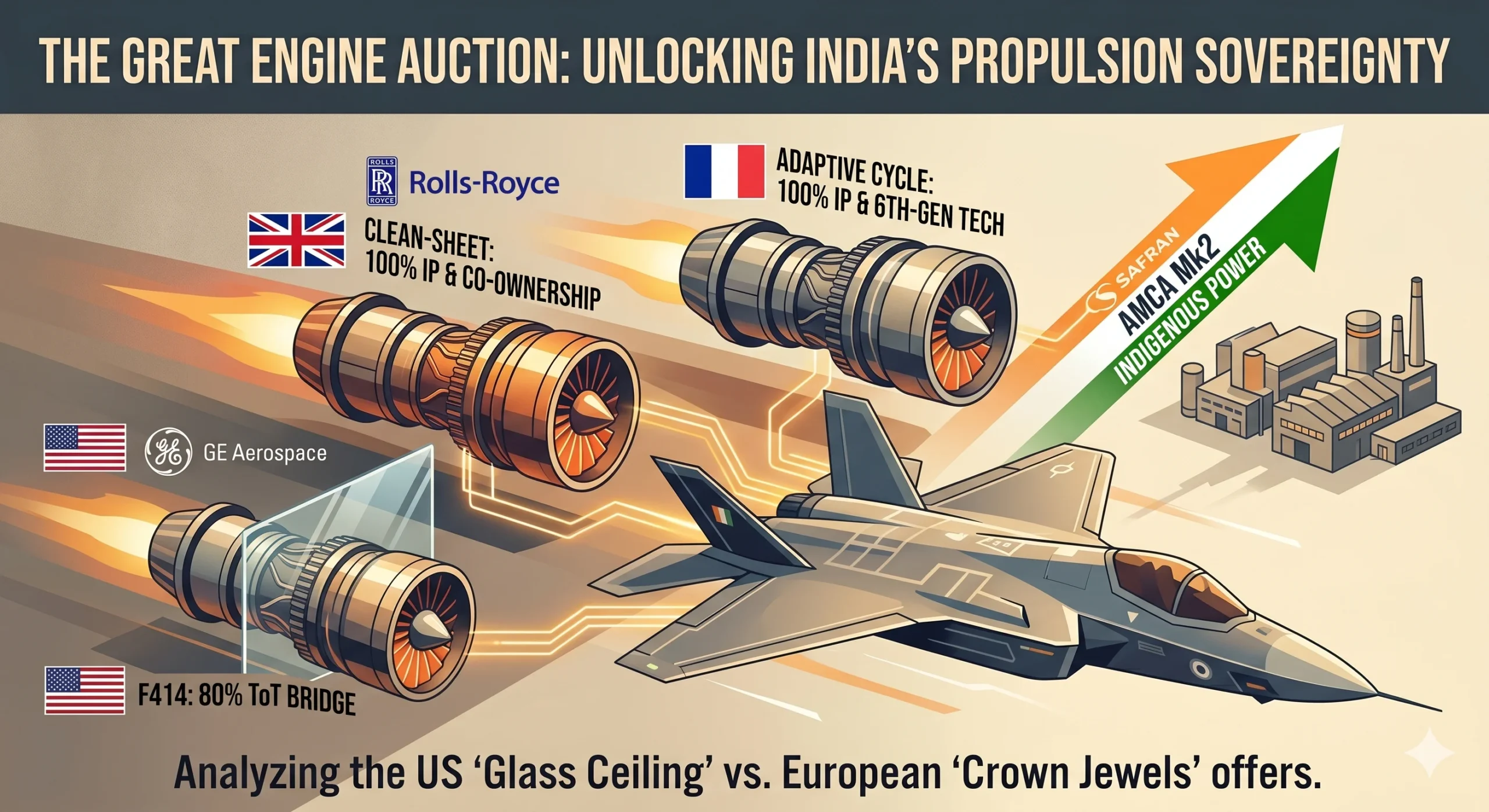
While the US GE-F414 deal serves as a vital bridge for the initial variants, it has reached a “strategic ceiling.” By refusing 100% Intellectual Property (IP) transfer, the US has opened the door for Rolls-Royce and Safran to launch aggressive, “crown jewel” counter-offers that transform India from a buyer into a co-owner of 6th-generation propulsion technology.
The Bidders’ Arena
Select a geopolitical partner below to analyze the specifics of their propulsion proposals and inspect how the dynamics of AMCA engine technology transfer change depending on each country’s political restrictions.
The Strategic Ceiling & Market Realities
The GE Paradox
As commercial negotiations progress, the strategic limits of the landmark GE-HAL F414 engine deal have become obvious. While the US offers an unprecedented 80% transfer of manufacturing blueprints, it stops short of passing over the “know-why” of the core metallurgy.
This leaves the foundational technologies under Washington’s regulatory surveillance, establishing a “glass ceiling” for Indian aerospace sovereignty as they look toward future, more complex variants.
The European Counter-Offer
Recognizing this gap, European players are aggressively bidding the “crown jewels” of 6th-generation propulsion to secure India as a foundational partner. Rolls-Royce and Safran are capitalizing on this window to offer complete, unrestricted intellectual property rights.
This strategic push aims to anchor European engineering within India’s next-generation platforms, which are outlined in detail in our tracker on India’s indigenous fighter jet programs.
Quantitative Strategic Analysis
The comparative charts below highlight the quantitative and qualitative variables of the current bidding war, illustrating how crucial complete IP access is to achieving absolute self-reliance.
Technology Transfer Cap
The GE “Glass Ceiling” vs European 100% IP
Strategic Sovereignty Index
Qualitative comparison of autonomy & core access
From Procurement to Propulsion Sovereignty
The current military auction isn’t strictly about thrust-to-weight ratios; it’s about who controls the “Source Code” of Indian air power for the next 50 years. True strategic independence relies on a localized AMCA engine technology transfer structure.
By leveraging the massive scale of their planned 400+ engine requirements for the AMCA Mk2 and TEDBF variants, HAL (Official) and the defense establishment are effectively buying a generation of technical R&D through targeted market access.
The Investor Briefing
Strategic Impact
These landmark localization contracts will reshape the financial trajectory of domestic manufacturing giants for decades.
Read Stock Investment Guide1. India’s Next-Gen Fighter Jet Programs
A detailed breakdown of the AMCA, TEDBF, and Tejas Mk2 roadmaps.
2. The GE-HAL F414 Engine Agreement
Inspecting the limits, licensing hurdles, and scope of the US F414 partnership.
3. HAL’s Indigenization Engine Efforts
How India’s state-owned manufacturing hub is scaling up for local engine builds.
4. Indian Defence Stocks Investment Guide
Identifying the public-sector defense entities set to benefit from global co-development.

1 thought on “The Great Engine Auction: AMCA”