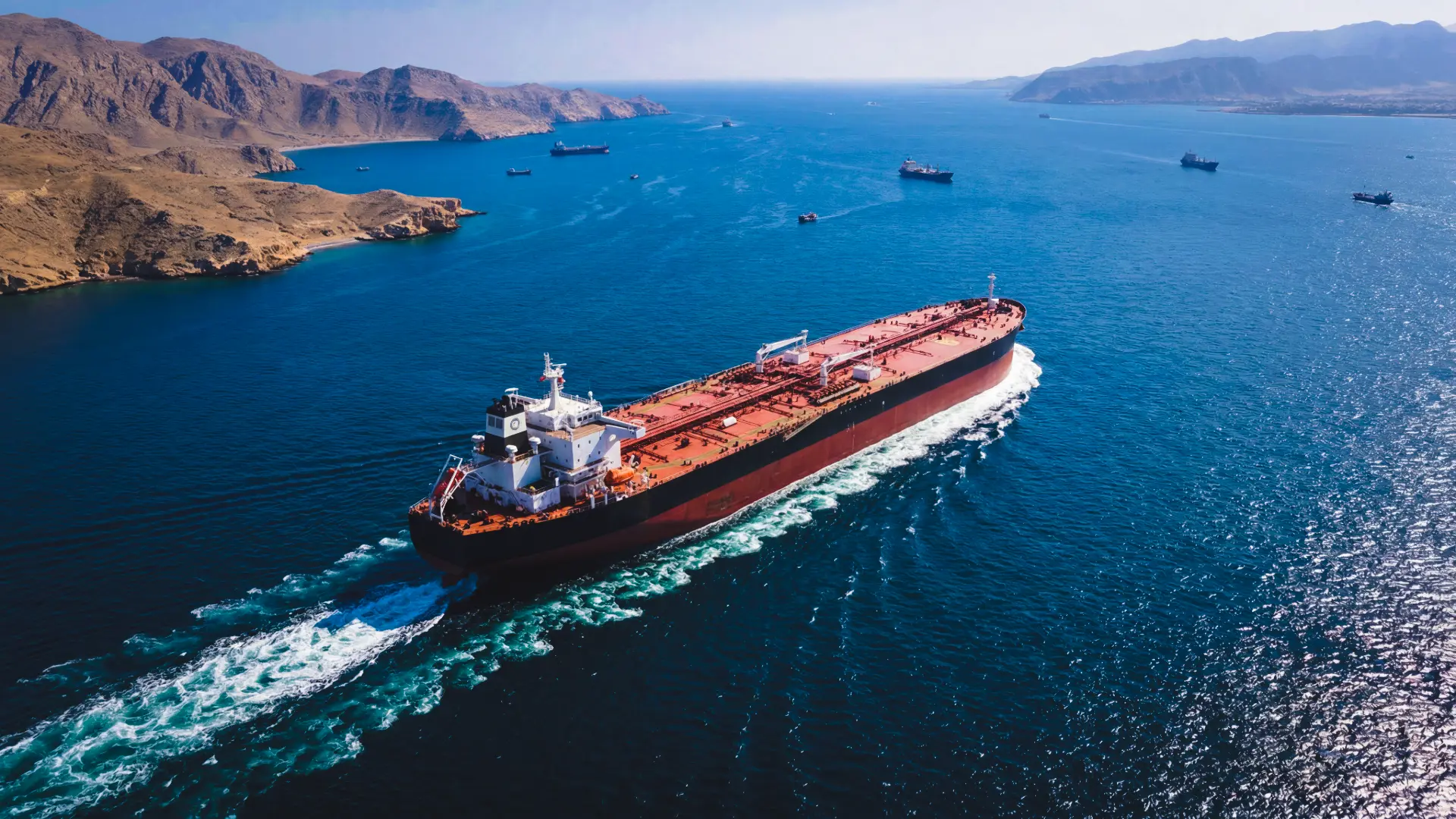
Iran has rejected a US ceasefire proposal carried by Iraq’s prime minister, retaliated with drone strikes on American-linked sites in Bahrain and Jordan, and President Trump says he is close to ordering a “massive attack” — even as Brent crude sits above $100 a barrel on a widening two-chokepoint crisis spanning Hormuz and the Red Sea.
Strait of Hormuz Crisis: The Latest, as of 24 July
President Trump told Axios he is weighing a strike larger than anything seen so far in the campaign, saying Tehran has “not received enough pain yet” and that he is “close to making a decision.” Iranian Foreign Minister Abbas Araghchi responded on state television that continued aggression would only raise the price Washington eventually pays for a settlement, and separately said the obstacle is not communication but substance — a pointed dismissal of Baghdad’s mediating role.
On the ground, Iran’s military said it struck U.S.-linked facilities and bases in Bahrain and Jordan on 24 July in retaliation for the latest American strikes. Kuwait and Bahrain both reported intercepting incoming Iranian missiles and drones the same day, and unclaimed blasts were reported near Erbil airport in Iraqi Kurdistan, which hosts U.S.-led coalition forces. Iran issued no claim of responsibility for the Erbil incident; Kurdish-Iranian opposition bases in the region are a recurring target of Iranian and Iranian-linked strikes, so the attribution remains unconfirmed.
Oman Iran Hormuz talks: What Actually Happened at the Negotiating Table
Iranian Foreign Minister Abbas Araghchi travelled to Muscat on 11 July, not the other way round. He met Omani Foreign Minister Sayyid Badr bin Hamad Al Busaidi to discuss shipping-management mechanisms for the Strait of Hormuz, a day after Qatari-mediated talks in Tehran. Both sides described the meeting as consultative rather than conclusive.
Oman’s proposal, drafted around the same period and reported by CNN and the Jerusalem Post, envisaged two separately governed corridors:
| Corridor | Waters | Access Rule | Tolls |
|---|---|---|---|
| Southern Corridor | Omani territorial waters | Free navigation, pre-war conditions | None |
| Northern Corridor | Iranian territorial waters | Prior Iranian approval required | None (at time of drafting) |
Iranian Foreign Ministry spokesman Esmaeil Baqaei confirmed on 13 July that Tehran and Muscat would continue talks “at the political and technical-legal levels,” while Ebrahim Rezaei, spokesman for the Iranian Parliament’s National Security and Foreign Policy Commission, asserted separately that Tehran considers itself in control of the strait — a claim Washington and Gulf partners reject outright.
Why the Talks Stalled
That framework never became an agreement. Three separate mediation efforts have now failed on the identical sticking point — who controls the northern shipping corridor:
| Mediation Track | Mediator(s) | Date | Outcome |
|---|---|---|---|
| Memorandum of Understanding | Pakistan (Islamabad MOU) | Signed 17 June | Deferred the Hormuz question to future Iran-Oman talks; collapsed within days after Iran struck three commercial vessels |
| Temporary ceasefire proposal | Iraq (PM Ali al-Zaidi) | Carried to Tehran 23 July | Rejected by Iran — leaves strait control unresolved |
| Ten-day ceasefire proposal | Qatar, Pakistan, Egypt | Ongoing through July | Stalled on the same sovereignty question |
Al-Zaidi’s mission followed his own visit to Washington the previous week, where he had pledged to intensify efforts against Iran-backed Iraqi militias and to prevent Iraqi territory being used to attack Iran. In Tehran, he met President Masoud Pezeshkian, Parliament Speaker Mohammad Baqer Ghalibaf and Araghchi — all three declined the proposal on the same ground listed above.
From Washington’s position, any arrangement must guarantee unimpeded multinational access, consistent with decades of U.S. Navy Fifth Fleet-backed freedom-of-navigation practice in the Gulf; Trump has at various points also floated the more maximalist idea of the United States itself taking over management of the strait and charging transit tolls. From Tehran’s position, sovereignty over the northern shipping corridor is non-negotiable and is treated as the one durable strategic gain of the war — a senior Iranian negotiator, Ghalibaf, has described it on state television as a “strategic instrument of power” that Iran will manage in coordination with Oman rather than surrender to outside powers.
The Numbers Behind the 13th Night
U.S. Central Command confirmed on 23 July that its forces had completed a 13th consecutive night of strikes against Iranian targets, the latest lasting more than two hours.
- Targets struck: military command centres, drone storage facilities, communications networks, coastal surveillance sites and maritime capabilities, per CENTCOM’s public release.
- Stated objective: to “diminish threats from the Islamic Revolutionary Guard Corps (IRGC) to commercial shipping” in the Strait of Hormuz.
- Blockade context: CENTCOM says its naval blockade of Iranian ports, reinstated roughly nine days earlier, has redirected 12 commercial vessels and disabled one attempting to breach it.
- Traffic impact: only one vessel transited the Strait of Hormuz on 23 July — the lowest daily count since 7 May — despite CENTCOM’s insistence that the waterway remains technically open.
- Force posture: more than 50,000 U.S. service members are currently deployed across the Middle East in connection with the campaign.
President Donald Trump added a financial dimension on 23 July, posting that any damage to ships or cargo “will be paid for by Iranian Money that the United States has in its possession, and controls” — an implicit reference to frozen Iranian assets under U.S. jurisdiction.
The Second Chokepoint: Why Bab el-Mandeb Now Matters
Markets that had priced Hormuz risk in isolation were forced to reprice on 23 July, when the Houthi Ansarallah movement claimed responsibility for drone-and-missile strikes on two Saudi Arabian tankers near Bab el-Mandeb, the strait separating Yemen from the Horn of Africa. The Houthis framed the attack as enforcement of a “blockade” against Saudi ports, reopening a front that had been largely dormant since a 2025 ceasefire with Washington.
Trump had, hours earlier, warned that the U.S. would strike an Iranian bridge or power plant every time Tehran’s forces hit a vessel in the Strait of Hormuz — a threat that now sits alongside a second, geographically distant flashpoint Washington did not choose the timing of.
This is the “two-chokepoint” framing that regional analysts began using around 23 July: Hormuz and Bab el-Mandeb now move together in traders’ risk models, even though the actors, waters and even the combatants (IRGC-linked forces in one case, the Houthi movement in the other) are entirely distinct.
What This Did to Oil Markets
Brent crude briefly broke above $100 a barrel on 23 July for the first time since May, before easing to roughly $97 on 24 July — still a gain of close to 10 percent for the week, per CNBC. West Texas Intermediate traded near $89 over the same period. Goldman Sachs analyst Daan Struyven has flagged the possibility of Brent returning above $120 in the fourth quarter if Hormuz access remains impaired, though he notes softer Chinese demand may cap the upside compared with earlier scares this year.
A separate factor is compounding the squeeze: Kazakhstan has suspended crude exports through the Caspian Pipeline Consortium terminal following drone attacks linked to the Russia-Ukraine war, removing further barrels from a market already nervous about two Middle Eastern chokepoints simultaneously.
The India Angle: Why This Is Not Just a Gulf Story
India sources an estimated 40–50 percent of its crude imports, roughly 60 percent of its LNG and close to 90 percent of its LPG through the Strait of Hormuz corridor, making it one of the most exposed large economies to any sustained disruption, even without direct exposure to Iran itself. India’s crude oil import bill has already risen sharply in the first quarter of FY 2026–27 as benchmark prices climbed, according to provisional petroleum ministry data reported by OilPrice.com.
New Delhi has partly insulated itself through diversification. Russian crude now accounts for roughly half of India’s oil imports in July, supplemented by Venezuelan, West African and Latin American cargoes — a hedge built over the past three years specifically against Gulf-chokepoint risk. Iraqi supply to India, by contrast, has fallen to near-negligible levels this month, squeezed out by transit difficulty through the strait and the absence of bypass pipeline infrastructure comparable to Saudi Arabia’s or the UAE’s east-west links.
That diversification blunts the impact on crude but does little for LPG and LNG, where Gulf dependence remains structural and substitution options are thinner — a distinction analysts consistently flag as India’s real vulnerability in this cycle, more than crude oil itself.
Historical Context: This Is Not the First Time Hormuz Has Been a Bargaining Chip
Chokepoint brinkmanship in the Gulf has a long precedent. During the 1980s “Tanker War,” both Iran and Iraq attacked neutral shipping to pressure the other, prompting the United States to reflag Kuwaiti tankers and, in April 1988, launch Operation Praying Mantis — the U.S. Navy’s largest surface engagement since the Second World War — after a mine damaged the USS Samuel B. Roberts. That episode ended with Iranian naval assets destroyed and no lasting change to who controlled the strait’s shipping lanes.
The current standoff differs in one important respect: this time, Iran is negotiating for formal, acknowledged co-management of a shipping corridor rather than simply threatening closure and backing down. Whether that distinction survives the next round of strikes is, at this point, an open question rather than a settled one.
What to Watch
Does Trump follow through on the “massive attack” threat, or is this negotiating pressure? Trump has framed the threatened strike explicitly as a tool to force Tehran back to the table, not as an end in itself. Whether it materialises — and at what scale — will shape everything downstream, from oil prices to whether Baghdad or Doha attempt a third mediation try.
Will Iran accept any ceasefire that leaves Strait of Hormuz control unresolved? Araghchi’s “problem is not passing messages” remark suggests Tehran now sees the obstacle as substantive, not procedural — a harder position than a simple rejection of one envoy. Watch whether Baghdad or Doha return with a revised text that addresses sovereignty over the northern corridor explicitly, rather than deferring it.
Does the Bab el-Mandeb front stay contained, or does it merge fully with the Hormuz crisis? Houthi attacks on Saudi tankers introduce a second actor and a second waterway into an already volatile risk calculus. A sustained Houthi campaign would likely keep Brent crude structurally higher regardless of what happens in direct US-Iran talks.
How long can India’s diversification strategy absorb a dual-chokepoint shock? Crude substitution from Russia, Venezuela and West Africa has worked so far, but LPG and LNG dependence on the Gulf remains largely unhedged — a gap that will matter more the longer both chokepoints stay contested.
Editorial transparency note: Figures on troop numbers, blockade interceptions, strike counts and vessel-transit data are drawn directly from CENTCOM public releases and Reuters/CNBC wire reporting and are treated as verified fact. Statements attributed to Iranian officials (Araghchi, Baqaei, Ghalibaf, Rezaei) and to President Trump (via Axios) are official statements, not independently verified claims of fact, and are labelled as such. The Erbil blasts are reported but unclaimed, and are flagged as unconfirmed attribution rather than settled fact. Market projections (Goldman Sachs’ $120 scenario) are analyst forecasts, not confirmed outcomes. Sourcing for the 24 July developments includes Axios, Bloomberg, CNBC, Time, Fortune and KPBS reporting, cross-checked against the live-blog updates supplied by the editor; the original Al Jazeera and CNN URLs could not be fetched directly due to site restrictions, so their content is corroborated rather than directly cited. This piece will be updated if the Iraqi- or Qatar-Pakistan-Egypt-brokered proposals are revived, if Trump orders or shelves the threatened strike, or if CENTCOM confirms a change in strike cadence.