
In 1981, as tankers burned in the Gulf during the Iran-Iraq War, Saudi Arabia’s oil planners made a quiet bet. They built a 1,200-kilometre pipeline across the Arabian Peninsula, from the Abqaiq processing complex on the Gulf coast to the Red Sea terminal at Yanbu, on the theory that a day might come when the Strait of Hormuz simply could not be trusted. For most of the pipeline’s life, that day never really arrived. The Petroline, as it is known, ran comfortably under capacity for four decades, a contingency plan gathering dust in the desert.
That day arrived this year. And now the contingency plan is under missile fire too.
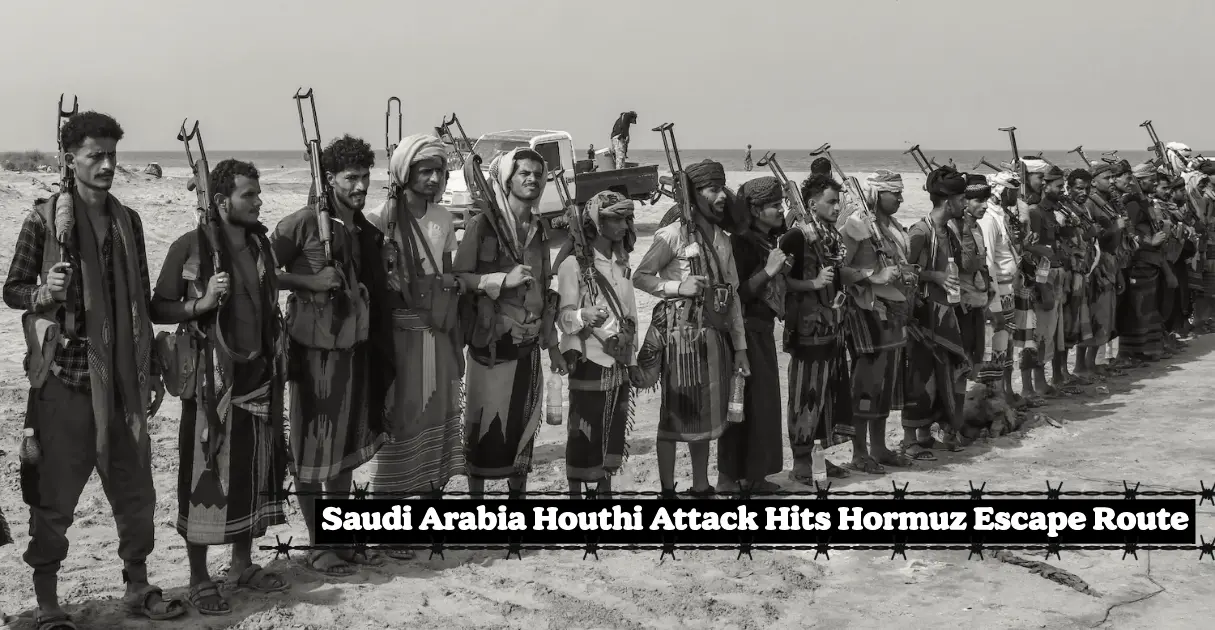
On 25 July, Houthi forces in Yemen struck Aramco’s Jizan refinery and the Yanbu export terminal with what the group’s military spokesman, Yahya Saree, described as dozens of ballistic missiles, cruise missiles and drones. A fire broke out at Jizan within hours. Saudi air defences, including a Patriot battery operated by Greek forces under an agreement with Riyadh, intercepted two ballistic missiles aimed at Yanbu’s oil installations. Brent crude, which had been drifting in the high $80s only weeks earlier, touched $102 a barrel — a two-month high — before easing back toward $100 on hopes that renewed Oman-mediated talks might yet calm the Strait of Hormuz.
The strikes matter for a reason that has little to do with Yemen’s civil war and everything to do with geography. Yanbu was not just another Saudi facility. It was the release valve.
Why the truce collapsed now
A four-year informal truce between Riyadh and the Houthis unravelled after Saudi-backed Yemeni government forces struck Sanaa International Airport on 13 July to block an Iranian aircraft from landing — an operation Saudi officials briefed Washington on in advance. The Houthis retaliated within days, firing missiles at Abha International Airport in southern Saudi Arabia and declaring, through spokesman Yahya Saree, that the “de-escalation phase” the two sides had maintained since 2022 was over.
The timing was not incidental. The truce had held since 2022 as one of the few stable features of an otherwise combustible region, but it existed inside a wider American-Iranian standoff that was itself falling apart. Washington and Tehran had signed an interim ceasefire in June, only for it to collapse in early July after both sides traded fire near the Strait of Hormuz. Iran, whose longtime leader Ayatollah Ali Khamenei was killed in the war’s opening strikes in February, has since cited internal factional struggles for the attacks it says undermined its own ceasefire commitments.
Analysts at the Yemen-focused research group MERIP have argued that the underlying truce was never a settlement — merely a pause imposed by mutual exhaustion, with the Houthis retaining both the intent and the missile inventory to reopen the conflict whenever regional conditions allowed. Regional conditions, in July, allowed.
By 20 July, the Houthis had declared a full “maritime embargo” on Saudi-linked shipping, framing it as retaliation for what they called a decade-long Saudi blockade of Yemeni ports. Riyadh responded on 24 July with air strikes on the Houthi-held port city of Hodeidah, hitting telecommunications infrastructure, a naval base and facilities on Kamaran Island. The Aramco strikes followed the next day.
The double chokepoint
Here is the mechanism that turns a regional flare-up into a global one. Roughly 20 million barrels of oil a day, about a fifth of world consumption, ordinarily moves through the Strait of Hormuz, according to the US Energy Information Administration. Iran has kept that route in a state of effective closure since the war’s escalation, intercepting tankers attempting what its Revolutionary Guard calls “illegal and unsafe” transit and pushing vessels toward Omani-flagged safe corridors instead.
Saudi Arabia’s answer was Yanbu. Aramco chief executive Amin Nasser confirmed in March that the kingdom had pushed the East-West Pipeline to its full 7-million-barrel-a-day capacity — up from a design limit of 5 million bpd set in 1981 — by converting parallel natural gas liquids lines to crude service. It was the second time the pipeline had been pressed into emergency service: the first major expansion followed the 14 September 2019 drone and missile strikes on Abqaiq and Khurais, which briefly knocked out 5.7 million bpd of Saudi production and demonstrated, for the first time, how exposed the kingdom’s oil infrastructure was to exactly this kind of attack.
Every barrel that reaches Yanbu, though, still has to leave through the Bab al-Mandeb — the 29-kilometre strait at the foot of the Red Sea. That is the seam the Houthis have now attacked directly, and it is why S&P Global Market Intelligence analysts describe the risk as no longer confined to a single target set but as a broadening of the threat environment across the entire Yemen-Saudi border and the Red Sea shipping lanes beyond it.
Shipping data tell the story starkly. Fewer than ten commercial vessels transited the Strait of Hormuz over the weekend of 25-26 July, CNN reported, against a pre-war average of roughly 100 ships a day. Tankers now face a double gauntlet: a Gulf route Iran has made deliberately unreliable, and a Red Sea route the Houthis have just demonstrated they can strike at will.
For the first time since the crisis began in February, Saudi Arabia’s primary hedge against Strait of Hormuz and its exposure to a second, independent conflict are the same infrastructure.
What the markets are actually pricing
Brent’s move above $100 was not really about Yemen. It was about the market recognising that Saudi Arabia had lost its spare capacity to absorb bad news. Oil prices have surged by roughly 40 percent this month, according to Trading Economics data, as disruption spread outward from Strait of Hormuz to the Red Sea, even as prices have swung by 10 to 15 percent within single trading weeks depending on whether diplomacy or missiles dominate the headlines.
That volatility is itself a signal. Markets that once treated Strait of Hormuz disruptions as a binary — closed or open — are now pricing in a more complicated reality: partial closures, partial bypasses, and a second front that can flare up independent of anything Washington or Tehran does. Deutsche Bank analysts flagged this directly in a note this week, warning of the prospect of simultaneous disruption to both Gulf and Red Sea export routes — precisely the scenario now unfolding.
None of this is abstract for India.
New Delhi’s exposure runs deeper than the headlines suggest
India imports roughly 85 to 88 percent of the crude oil it consumes, and depending on the estimate, somewhere between 30 and 40 percent of that volume has historically transited the Strait of Hormuz. The Petroleum Ministry told reporters in March that India had pushed the share of crude routed outside Strait of Hormuz to 70 percent, up from 55 percent before the crisis, partly through increased Russian crude purchases and partly by leaning on Saudi Arabia’s own Red Sea diversion — the same Yanbu corridor now under Houthi fire.
The bill for that diversification has already arrived. India’s crude oil import bill rose 61.2 percent year-on-year to $49.8 billion in the April-June quarter, according to provisional Petroleum Ministry data, even as import volumes fell slightly. That is the paradox of the past six months in one statistic: India bought less oil and paid dramatically more for it. LPG remains a sharper vulnerability still — roughly 90 percent of India’s LPG imports move through Strait of Hormuz, a dependency that prompted the government to invoke the Essential Commodities Act in March to direct refineries toward maximising domestic LPG output for households.
Indian refiners and oil marketing companies now face a second-order risk that has received less attention than the headline price moves: if Yanbu’s throughput is disrupted or its Red Sea exit becomes militarily contested, the very bypass capacity India has been counting on could itself become unreliable, at the same time as Strait of Hormuz remains constrained. India is the second-largest destination for Strait of Hormuz-transited crude and condensate globally, behind only China, according to trade-flow data — which means a genuine double-chokepoint scenario would land on New Delhi with a force matched by almost no other importer except Beijing.
The story Indian coverage keeps missing
Most Indian coverage of this crisis has been an oil-price story: crude benchmarks, import bills, retail pump prices. That framing misses the channel through which the war is actually reaching Indian households first — not barrels, but people. India supplies close to 3.2 lakh seafarers to the world’s merchant fleet, nearly 12 percent of the global maritime workforce, according to the Seafarer Workforce Report 2026. Almost 90 percent of them serve on foreign-flagged ships, which means Indian consular missions frequently have no jurisdiction over the vessel and no advance knowledge that an Indian national is aboard until something has already gone wrong.
Something has already gone wrong more than once. India’s Directorate General of Shipping confirmed in March that three Indian seafarers, all serving on foreign-flagged vessels, had been killed amid escalating West Asia tensions, prompting the government to stand up a dedicated Quick Response Team. At the height of the Strait of Hormuz disruption in mid-March, roughly 23,000 Indian seafarers were reported in some state of operational uncertainty across the Gulf; by June, that figure had eased to about 18,000, with 562 crew aboard 13 Indian-flagged vessels split between the Persian Gulf and the Gulf of Oman. On 24 July, the day before the Aramco strikes, the LPG carrier Disha was hit by a missile near Iran and briefly lost manoeuvrability. The Directorate has since widened its maritime security advisory beyond the Strait of Hormuz to explicitly cover the Bab al-Mandeb, the southern Red Sea and Yemeni waters.
There is a workforce detail buried in this that rarely makes it into general reporting. India’s officer-to-rating ratio among seafarers has flipped over the past decade and a half, from roughly 60:40 in 2010 to 35:65 in 2024, meaning a growing share of Indian crew are lower-ranked “ratings” rather than officers — typically younger, less senior, and with less say over which routes their employer sails them through.
The remittance side of this is arguably larger, and even less discussed. Gulf-based Indians — concentrated overwhelmingly in Saudi Arabia and the UAE, which together host most of the roughly 9.7 million Indians living in GCC countries — send home close to 40 percent of India’s total remittances, against a record $137-140 billion expected for the current financial year, according to State Bank of India research. That research also recorded something worth watching closely: a 30-35 percent spike in remittances specifically from West Asia in March 2026, driven by precautionary transfers as Indian workers, fearing evacuation, moved savings home faster than usual. It is a real-time stress indicator hiding inside routine banking data, and it has already fired once this year.
The Yemen front has now added a second, independent source of regional instability on top of the one that triggered March’s spike. Whether the remittance data moves again is arguably a better early gauge of how Indian households are actually experiencing this war than another day of Brent headlines — and it is not a number financial television checks in real time.
Where diplomacy stands, and where it doesn’t
There is, unusually, a live diplomatic track running in parallel with the missiles. Iranian and Omani officials have been meeting in Muscat this week to establish what Iran’s foreign ministry spokesman Esmail Baghaei called a mechanism for “safe shipping in the Strait of Hormuz” that respects both countries’ sovereignty. American officials, speaking anonymously, described the mediation progress as “significant,” though Washington and Tehran are not directly negotiating; Baghaei was explicit that Iran currently has “no negotiations with the United States.” Qatar and Pakistan have been the connecting tissue, pushing to restore the ceasefire framework that broke down in early July.
Pakistan’s involvement here is not incidental diplomacy. Prime Minister Shehbaz Sharif has spoken separately with Iran’s president and Qatar’s ruling emir, while Pakistan’s foreign minister has been in direct contact with his Saudi counterpart on containing the Red Sea and Gulf tensions simultaneously — a reminder that Islamabad has built itself a genuine mediating role in a conflict with obvious stakes for its own energy imports and expatriate labour force in the Gulf.
What does not yet exist is any comparable channel for the Saudi-Houthi conflict specifically. Iran’s foreign minister, Abbas Araghchi, said on 26 July that there was “no military solution” to the fighting between Riyadh and the Houthis — a notable admission from Tehran, given its backing of the Houthi movement — but an admission is not a framework. Unless and until Riyadh and the Houthis find their own Oman, the Red Sea front will keep moving on a timeline independent of whatever happens between Washington, Tehran and Muscat on Strait of Hormuz.
It is worth remembering, too, that the Saudi-led coalition’s own cohesion is not what it was. A UAE-backed secessionist push by Yemen’s Southern Transitional Council briefly captured the oil-rich Hadhramaut governorate in December 2025 before Saudi-backed government forces retook Aden in January and expelled STC figures from the ruling council. That episode is closed for now, but it is a reminder that the “Saudi side” of this war is a coalition managing its own internal fractures even as it fights a two-front conflict against the Houthis and, indirectly, Iran.
What to Watch
Will the Oman-Iran mechanism actually restore Strait of Hormuz traffic, or just formalise a slower, Iran-supervised transit regime? The talks in Muscat are aimed at reopening the strait, but Gulf officials briefed on the discussions have cautioned that expectations should stay limited, since Washington and its partners are unlikely to accept any arrangement granting Tehran unilateral control over routing or fees.
Does a separate Saudi-Houthi track emerge, or does the Red Sea front simply run on its own clock? With Araghchi’s own acknowledgment that neither side can win militarily, the absence of a formal mediation channel for this specific conflict — distinct from the Hormuz talks — is the clearest gap in the current diplomatic architecture.
How will Aramco’s damage assessment at Jizan and Yanbu shape the next price move? Neither Aramco nor the Saudi government had issued an official damage or output assessment as of this writing, and that silence is itself informative: markets tend to price the worst case until an operator says otherwise, which means the next verified update from Aramco could move Brent as much as the original strikes did.
Editorial transparency note: Verified facts in this article — dates, attack locations, official statements and market prices — are drawn from and attributed to Al Jazeera, Reuters, CBS News, CNN, Gulf News, The National, Foreign Policy, MERIP, Trading Economics and Petroleum Ministry briefings, among others cited above. Seafarer casualty and deployment figures are drawn from India’s Directorate General of Shipping and Ministry of External Affairs statements as reported by All India Radio (newsonair.gov.in) and maritime trade press; remittance figures are drawn from State Bank of India research, Reserve Bank of India survey data and the Ministry of External Affairs. Assessments of strategic significance and forward-looking implications for India are The Eastern Strategist’s own analysis and should be read as such. Saudi Aramco and the Saudi government had not issued an official damage assessment for the Jizan and Yanbu strikes at the time of writing; figures on damage extent are based on independent satellite and open-source verification, not official confirmation.