Opinion · Space Governance & Emerging Technology
When the SpainSat NG II satellite went dark 50,000 kilometres above Earth in January 2026, nobody could say with certainty what had hit it. That gap — between a congested orbital environment and the international community’s ability to see inside it — is the problem this piece addresses. Not with a new treaty, but with better eyes.
This article is the result of an enriching exchange of perspectives with engineers, legal scholars, scientists, and leaders from the aerospace industry. Framing this proposal through such technical and legal plurality allows us to address the governance of outer space from a genuine perspective: the intersection of public international law, multilateral diplomacy, and technological acceleration.
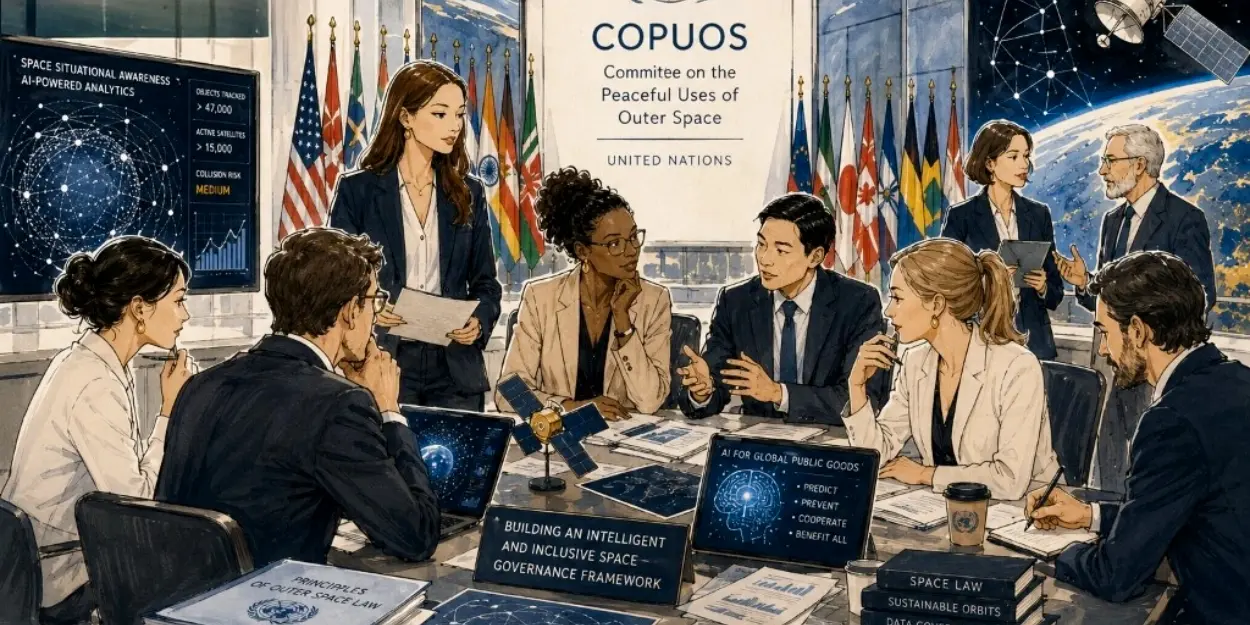
For over six decades, the United Nations Committee on the Peaceful Uses of Outer Space (COPUOS) has demonstrated that reaching international consensus in one of humanity’s most strategic domains is possible. Born at the height of the Cold War to keep space exploration dedicated to peaceful purposes for the benefit of all humankind, the Committee has built the space governance architecture we have today through the progressive development of international law, scientific and technical cooperation, and principles widely accepted across the international community.
Today’s space ecosystem, however, demands that we transcend mechanisms inherited from the last century. The rise of the New Space era, the scale of private capital now involved, the proliferation of megaconstellations, and the growing strategic value of data generated and processed in orbit have profoundly transformed the landscape. Far from diminishing COPUOS’s relevance, this reality is an opportunity to equip the Committee with sharper tools — allowing it to evolve from a largely reactive body toward one built on strategic anticipation.
From Bilateral Diplomacy to Orbital Density
Governing space in the second half of the 20th century meant managing a relatively stable environment dominated by a small number of spacefaring states. Governance focused primarily on negotiating international treaties, registering space objects, fostering scientific cooperation, and coordinating international frequencies and orbital positions through the International Telecommunication Union (ITU) to avoid harmful interference.
Today’s scenario is qualitatively different. More than 15,000 active satellites orbit the Earth today — compared to barely 2,000 in 2019 — driven by massive commercial constellations in Low Earth Orbit (LEO), alongside inhabited infrastructures like the International Space Station, China’s Tiangong station, and future cislunar architectures planned under the Artemis Accords and the International Lunar Research Station (ILRS) programme. India’s own renewed push into crewed missions sits within this same shift toward permanent, contested orbital and cislunar infrastructure, a trend examined in TES’s earlier look at the return of human deep-space flight.
Added to this are tens of thousands of cataloged objects and over a million fragments of space debris too small to be systematically tracked. This growing orbital density exponentially increases the risk of incidents.
An illustrative example of the current ecosystem’s vulnerability occurred with the SpainSat NG II satellite — a high-security military and governmental communications infrastructure operated by Hisdesat and launched in October 2025 — which suffered irreparable damage in January 2026 after being struck by an uncataloged space particle. Hisdesat and its majority owner, Indra Group, confirmed on 16 January that the damage was non-recoverable and initiated procurement for a replacement, SpainSat NG III, after the impact occurred roughly 50,000 kilometres above Earth during the satellite’s transfer to its final orbital slot. In this increasingly congested environment, Earth observation infrastructures, navigation systems, telecommunications, and dual-use capabilities converge, making their stability critical for global security and economic development.
A Paradigm Shift: Artificial Intelligence as a Tool to Strengthen Multilateralism
The primary challenge is no longer merely negotiating agreements faster, but managing a growing volume of data and variables that make informed, real-time decision-making extraordinarily difficult. When collision-avoidance manoeuvres, radio spectrum coordination, and the evolution of space capabilities occur at an unprecedented pace, traditional negotiation cycles hit clear limits. Artificial Intelligence is poised to become a powerful analytical tool in service of multilateralism — not to replace political consensus or dilute state sovereignty, but to provide objective evidence, predictive analysis, and decision-support capabilities that improve the quality of international dialogue.
Integrating Space Situational Awareness (SSA) systems is particularly relevant here. SSA enables the detection, tracking, characterisation and prediction of orbital objects, as well as monitoring of space-environment phenomena. India’s own military-facing SSA architecture, built around ISRO’s tracking network, offers a useful domestic parallel — TES has previously explained how the NETRA programme approaches the same detection problem from a national-security angle rather than a multilateral one.
Incorporating advanced AI-driven analysis can significantly reduce analytical asymmetries among states, allowing nations with fewer resources to access high-quality technical evaluations, increasing transparency around dual-use activities, and anticipating scenarios likely to trigger international tensions. At the same time, integrating AI into space governance must rest on shared ethical principles, such as those in UNESCO’s Recommendation on the Ethics of Artificial Intelligence, ensuring that data processing adheres to standards of transparency, accountability, fairness and the common good.
Co-Design Between Technology and Law
Closing the gap between technological innovation and legal frameworks does not require turning diplomats into engineers or engineers into lawyers. The real work lies in bringing the legal dimension into the earliest design stages of space missions. Aerospace engineering has worked for decades under integrated methodologies where safety, reliability and systems engineering are embedded into design from day one; the next step is extending that logic into the legal and institutional spheres.
Using AI-based analytical tools can facilitate advanced simulation environments where engineers, operators, data analysts, legal experts and policymakers can jointly evaluate the technical, economic and legal impacts of new projects before operational deployment.
The Role of Private Industry and COPUOS’s Regulatory Capacity
The transition from a nearly exclusive state-dominated domain to an ecosystem led by private companies has deeply transformed how space sovereignty is exercised. The rising weight of commercial actors introduces new incentives for innovation, but also raises questions of international coordination, transparency and the public interest.
This raises a fundamental question: does integrating advanced AI tools require negotiating a new international treaty, or can COPUOS leverage its capacity to develop new normative instruments within the existing legal framework? The historical track record of international law shows its evolution rarely rests on grand treaties alone. Progress has often come through gradual consensus-building — non-binding principles, guidelines and best practices, driven by states’ shared interest in preserving stability, predictability and security. Developing flexible instruments backed by technical evidence and scientific consensus would let the international community absorb knowledge generated by industry and academia without touching the foundational principle of state responsibility already established under Space Law.
Toward Intelligent Space Governance
The history of COPUOS demonstrates its extraordinary capacity to adapt across different eras of spaceflight. Artificial Intelligence, framed as an institutional support tool, does not replace political negotiation or the principle of consensus; it enhances the collective ability to understand an increasingly dynamic, complex and strategic orbital environment.
Its practical application could take shape through tools capable of simulating regulatory scenarios before new guidelines are adopted, evaluating the impact of future megaconstellations, identifying emerging risks to orbital sustainability, or supporting the work of COPUOS’s Scientific and Technical, and Legal Subcommittees. India’s own experiments with AI-assisted space situational tools, discussed alongside missions like ShakthiSAT, point to the same direction from a national vantage point that COPUOS is now being asked to take multilaterally.
Ultimately, outer space governance will increasingly depend on the ability to integrate technological, legal and analytical dimensions from the initial phases of mission and policy design. It is not merely about adopting new software, but about building institutions that are more anticipatory, transparent and effective. Enhancing the intelligence — both human and artificial — with which we govern space is perhaps the best guarantee that innovation, multilateral diplomacy and sustainable development will advance hand in hand for the benefit of all humanity.
What to Watch
Does using AI for space governance require a new international treaty?
Not necessarily. COPUOS has historically advanced space law through non-binding principles, guidelines and best practices rather than new grand treaties. AI-support tools could follow the same path, through gradual consensus-building, without altering the state-responsibility framework already established under existing space law.
Does AI replace political negotiation in COPUOS decision-making?
No. AI is framed as a decision-support and evidence-generation tool, not a substitute for consensus among member states. It narrows the analytical gap between well-resourced and less-resourced states, but sovereignty and negotiation stay with governments.
Why does the SpainSat NG II incident matter for space governance?
The satellite sustained irreparable damage in January 2026 after being struck by an uncatalogued space particle, and its operator, Hisdesat, could not identify the object in advance. The episode illustrates how thin tracking coverage remains even for high-value government assets, strengthening the case for AI-assisted Space Situational Awareness.
Editorial Transparency Note
- Verified fact: Active satellite counts (roughly 2,000 in 2019 to over 15,000 in 2026) and the SpainSat NG II impact and non-recoverable damage timeline (2 January and 16 January 2026 disclosures) are corroborated across multiple independent outlets, including SpaceNews, Aviation Week, Space.com and Hisdesat/Indra’s own statements.
- Official statement: COPUOS’s mandate and history are drawn from UNOOSA’s own description of the Committee; the Artemis Accords and UNESCO’s AI ethics framework are cited from their respective official pages.
- Author’s analysis: The argument that AI-enabled SSA can substitute for new treaty-making, and the specific COPUOS subcommittee applications proposed, reflect the author’s own policy reasoning rather than an official COPUOS position.

Rocío Caparrós is a Spanish expert in space policy, international relations, and aerospace governance. She works in institutional and political affairs within the aerospace sector and has previously worked with the European Space Agency, UNESCO, and the International Astronautical Federation, focusing on space law, international cooperation, and global space governance.
Connect on LinkedIn →