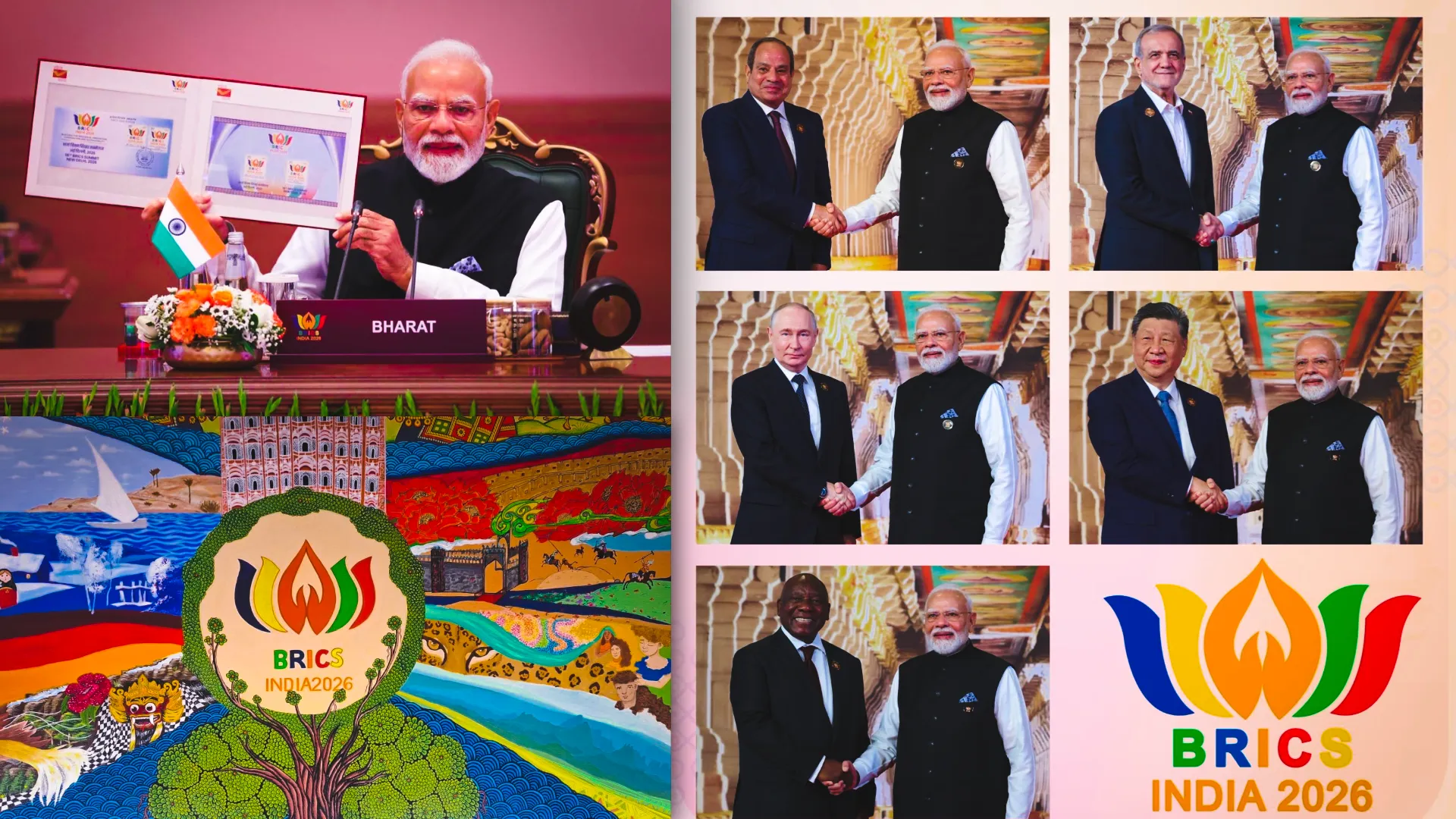
Forty-eight hours before leaders gathered at Bharat Mandapam, diplomatic consensus inside BRICS appeared clinically dead. Two of the bloc’s newest regional members were separated not merely by diplomatic friction, but by the physical shockwaves of active ballistic exchanges in the Persian Gulf. Yet, as dawn broke on 12 September 2026, the 18th BRICS Summit concluded with the unanimous adoption of the New Delhi Declaration 2026. Conventional coverage has framed this late-night breakthrough as an exercise in high-table pageantry. That reading misjudges both the stakes and the mechanism. The unanimous declaration was not born of ideological brotherhood; it was hammered out through exhaustive negotiations running until 4:00 AM because New Delhi recognized that an institutional rupture would shatter its domestic energy corridors and leave its export economy exposed to punitive Western trade retaliation.
The geopolitical dynamic confronting Indian negotiators in the capital bore a striking historical operational parallel to the turbulent Organization of the Petroleum Exporting Countries (OPEC) ministerial sessions of the early 1980s. Throughout the Iran-Iraq War, official delegations from Tehran and Baghdad traded artillery barrages across the Shatt al-Arab by day, yet dispatched oil ministers to sit in the same Swiss conference rooms by evening to coordinate production quotas. They stayed inside the tent because unilateral exit meant fiscal collapse. In New Delhi, the imperative was similarly existential. By engineering a compromise text that navigated the bitter rift between the United Arab Emirates and the Islamic Republic of Iran, Indian diplomacy preserved the institutional framework required to execute its primary geoeconomic objective: establishing a World Trade Organization (WTO)-compliant tariff shield and bilateral currency clearing corridor that avoids triggering Washington’s punitive 100% tariff tripwire.
What Was Actually Signed in the New Delhi Declaration 2026
To evaluate the document accurately, strategic analysts must first cut through administrative ambiguity across Indian multilateral communiqués. The document signed this weekend represents a distinct legal and diplomatic instrument from prior instruments bearing identical geography:
- New Delhi Declaration 2026 (12 September 2026): The comprehensive 18th BRICS Summit outcome document focusing on multilateral institutional reform, WTO trade defense, and bilateral currency settlements.
- New Delhi Declaration on AI Impact (21 February 2026): Adopted during the global AI Impact Summit and endorsed by over 88 nations, establishing sovereign compute norms and democratic artificial intelligence frameworks.
- XIII BRICS Summit New Delhi Declaration (9 September 2021): The virtual summit text chaired by India during the COVID-19 pandemic, primarily addressing counter-terrorism action plans and intra-BRICS public health coordination.
The substantive spine of the official summit text centers on Prime Minister Narendra Modi’s proposal to transform the international architecture from an antiquated “pyramid of privilege” into a functional “platform of partnership.” China and Russia, operating in their capacities as permanent members of the United Nations Security Council, reiterated their explicit backing for the permanent aspirations of India and Brazil within an expanded Council. Furthermore, reflecting Indian national security redlines, the declaration included an unhedged condemnation of the April 2025 cross-border terrorist attack in Pahalgam, Jammu and Kashmir, demanding absolute zero-tolerance toward state-sponsored extremism.
On economic governance, the New Delhi Declaration 2026 adopted aggressive defensive language against rising Western protectionism. The member states expressed serious joint concern over the proliferating use of unilateral tariff and non-tariff measures. The declaration noted that such extra-jurisdictional economic penalties distort established supply networks and violate foundational WTO disciplines. This formulation lays the groundwork for member states to construct coordinated legal challenges against arbitrary external trade sanctions.
The 4:00 AM Iran–UAE Compromise and Persian Gulf Energy Security
The core crisis threatening the New Delhi summit originated on 19 August 2026, when the United Arab Emirates suspended all trade, commercial, and banking transactions with the Islamic Republic of Iran following retaliatory missile strikes across the Gulf. Because the expanded BRICS apparatus enforces strict consensus decision-making, either Abu Dhabi or Tehran possessed the procedural authority to single-handedly veto the joint declaration. An earlier ministerial gathering chaired by India had already collapsed without an agreed communiqué, creating acute urgency for the leaders’ summit.
As documented by diplomatic reporting in the Times of India and ANI, negotiations stretched through the night until 4:00 AM on Saturday. Indian interlocutors formulated the West Asia provisions of the New Delhi Declaration 2026 to address regional hostilities without assigning state-level blame. The final clause condemned unilateral military force, affirmed the inviolability of nuclear safety safeguards during armed conflict, and demanded adherence to the United Nations Charter. Crucially, it omitted direct attribution for the August strikes, enabling both Emirati and Iranian delegations to sign without diplomatic retreat.
For New Delhi, mediating this consensus was an absolute operational necessity. India imports approximately 60% of its crude oil requirements through the Strait of Hormuz, flanked by Iranian territory to the north and Emirati ports to the south. India has long managed this geographic vulnerability through distinct diplomatic tracks, maintaining comprehensive economic partnership with Abu Dhabi while operating the Shahid Beheshti terminal at Chabahar Port in Iran. Had the summit collapsed into a public brawl over West Asian hostilities, India’s balancing strategy—previously examined in our analysis of India’s pre-summit alignment—would have suffered immense reputational and logistical damage. Furthermore, direct escalation would have triggered prohibitive marine hull insurance premiums for Indian-flagged tankers operating under the Indian Navy’s Operation Sankalp escort umbrella.
Markets and Currency: Local Currency Settlements vs De-Dollarisation
For corporate treasuries and institutional investors preparing for market opening on Monday, 14 September 2026, the financial subtext of the New Delhi Declaration 2026 is far more significant than its diplomatic rhetoric. Since late 2024, US political leadership—spearheaded by repeated statements from Donald Trump—warned that any BRICS initiative to float a shared currency or actively dismantle the supremacy of the US Dollar would be met with immediate 100% punitive tariffs on imports into the American market.
Russian and Iranian delegates consistently advocated for an aggressive, collective anti-dollar architecture. New Delhi firmly rejected this posture. The finalized text in the New Delhi Declaration 2026 deliberately decouples pragmatic transaction clearance from geopolitical currency warfare:
- The De-Dollarisation Fallacy: The declaration contains no commitment to launch a gold-backed or synthetic BRICS currency unit. Such a mechanism would have placed India’s $75 billion trade surplus with the United States directly into the crosshairs of US trade enforcement.
- The Local Currency Settlement Reality: The text encourages the expansion of bilateral local-currency invoicing networks, directly endorsing the Reserve Bank of India’s (RBI) Special Rupee Vostro Account (SRVA) infrastructure and the India-UAE Local Currency Settlement (LCS) system.
This technical distinction, previously evaluated in our deep dive into the mechanics of India’s rupee settlement push, allows Indian commercial banks to settle bilateral energy shipments in national currencies without exposing broader industrial exporters to third-party secondary sanctions.
Sector Positioning Ahead of Monday’s Opening Bell
Equity and commodity market trading desks analyzing the New Delhi Declaration 2026 will calibrate their opening positions across three primary sectors on Monday morning:
- Upstream Exploration and Oil Marketing Companies (OMCs): Shares of Oil and Natural Gas Corporation (ONGC), Oil India Limited, and downstream refiners including Indian Oil Corporation (IOCL) and Bharat Petroleum Corporation (BPCL) will trade based on reduced immediate escalation risk in the Strait of Hormuz. A stabilized diplomatic corridor mitigates immediate spikes in Brent freight landing costs.
- Public Sector Banks with Vostro Exposure: State Bank of India (SBI) and UCO Bank, which manage the bulk of dedicated trade clearing accounts with Gulf and Eurasian counterparties, gain regulatory breathing room as the declaration establishes multilateral legitimacy for bilateral clearing.
- Engineering Goods and Pharmaceutical Exporters: Sectors heavily reliant on the North American market avoid the immediate valuation overhang of prospective US Section 301 tariff investigations, which would have accompanied any summit move toward an anti-dollar currency regime.
The Modi–Xi Dimension: A $112.16 Billion Asymmetry Behind the Bonhomie
The visual centerpiece of the summit was the bilateral interaction between Prime Minister Modi and President Xi Jinping at Bharat Mandapam—the Chinese leader’s first visit to Indian soil since the October 2019 informal summit in Mamallapuram. While official remarks celebrated the resumption of direct commercial flights, streamlined business visas, and the reopening of historic trans-Himalayan trade routes through the Lipulekh and Nathu La Passes, the commercial fundamentals tell a much harsher story.
According to bilateral trade registries analyzed by The Silicon Review, two-way commerce expanded to $151.1 billion in the latest fiscal cycle. However, Indian exports contracted relative to imports, widening India’s bilateral trade deficit to an unprecedented $112.16 billion. This imbalance is structural. Indian manufacturing programs across solar photovoltaics, electric vehicle batteries, and active pharmaceutical ingredients (APIs) remain critically dependent on Chinese upstream materials.
Nowhere is this vulnerability more pronounced under the New Delhi Declaration 2026 than in critical minerals and heavy rare earths. While the New Delhi Declaration 2026 advocates for resilient, diversified supply networks, China continues to enforce stringent export licensing controls on processed gallium, germanium, and dysprosium. As examined in our field investigation into critical mineral competition across the Myanmar frontier, Indian high-technology manufacturing cannot achieve genuine strategic autonomy through multilateral communiqués alone. The summit bonhomie stabilized the northern border militarily, but left the industrial leverage firmly in Beijing’s hands.
Strategic Outlook: What Changes and What to Watch Next
1. Will the 10-point Reform Roadmap produce tangible UNSC movement before 2027?
Assessment: Unlikely in the near term. While the declaration records formal support from permanent members China and Russia for India and Brazil’s aspirations, the broader institutional mechanics of UN Charter reform remain deadlocked. The 10-point roadmap functions primarily as a coalition-building instrument for New Delhi across the Global South rather than an immediate blueprint for text-based intergovernmental negotiations in New York.
2. Does the local currency settlement clause protect Indian exporters from US trade retaliation?
Assessment: Yes, provided implementation remains strictly bilateral. Washington’s stated tariff tripwire specifically targets collective attempts to build an alternative multilateral clearing union designed to bypass the SWIFT messaging architecture. By restricting intra-BRICS language to bilateral currency arrangements governed by existing central bank accords, Indian exporters preserve their access to Western markets while securing cost-efficient clearing for critical raw materials.
3. Can the Iran–UAE consensus survive outside the summit chamber?
Assessment: Highly precarious. The New Delhi consensus was achieved by stripping specific culpability from the final communiqué. However, should ballistic strikes resume or maritime traffic in the Strait of Hormuz face renewed harassment, commercial realities will override diplomatic phrasing. India must keep naval assets deployed under Operation Sankalp on high alert regardless of summit declarations.
Moving forward, the strategic test for the New Delhi Declaration 2026 lies in whether the 10-point reform roadmap can generate real traction across multilateral forums. The ultimate significance of the New Delhi Declaration 2026 does not reside in the fact that ten nations sat in New Delhi and attached signatures to a sixty-page communiqué. In modern multilateral diplomacy, ambiguous joint texts can always be purchased through sufficiently broad drafting. The genuine achievement of New Delhi’s chairship was defensive. Confronted by an active shooting war between key energy partners and aggressive tariff warnings from its primary export market, Indian statecraft built a text that averted institutional fragmentation in the East without triggering economic retribution from the West. For Indian industry and capital markets, that quiet protection is the only consensus that truly matters.