
Defence Analysis · Indian Navy · Shipbuilding
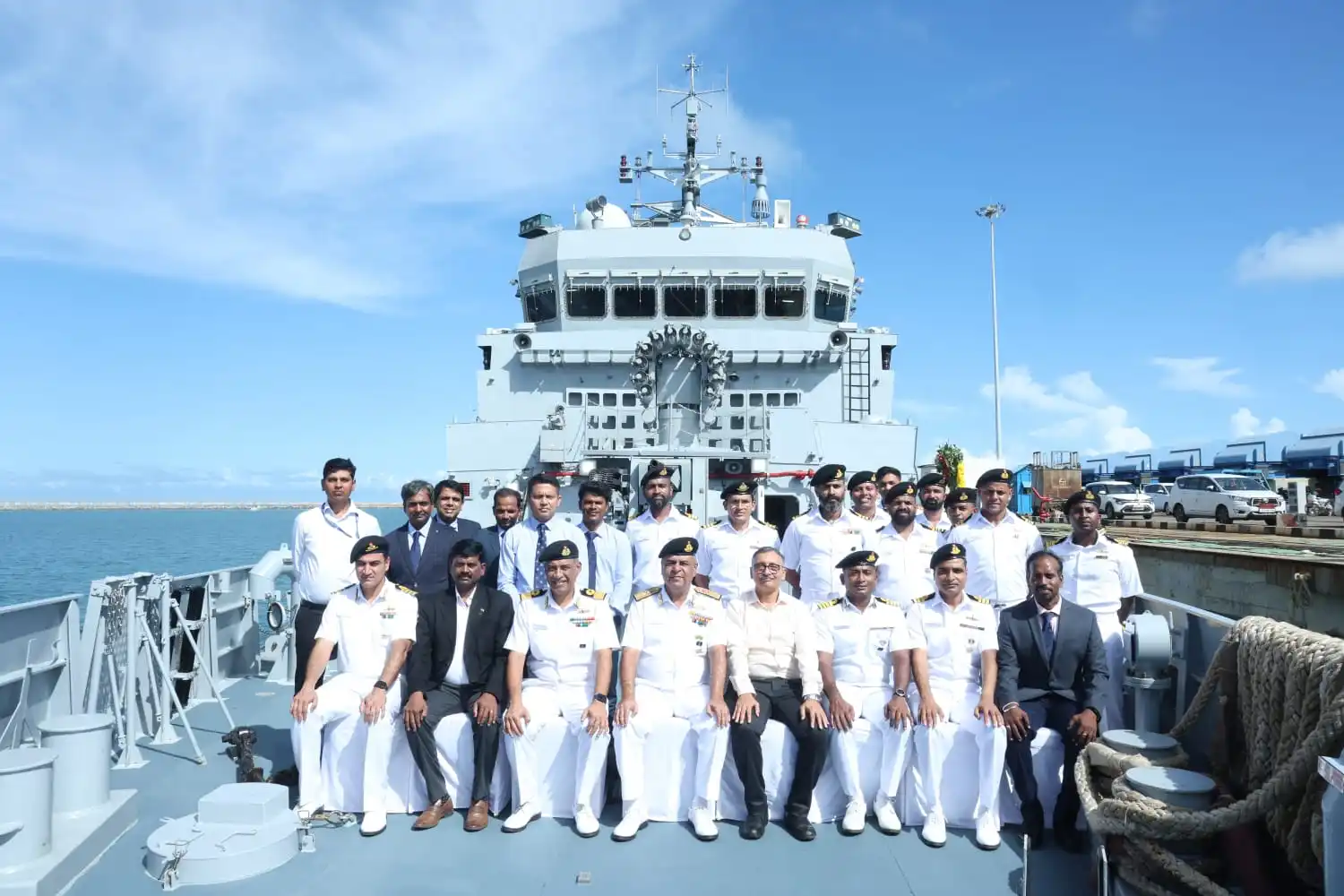
Amini, the fifth ASW shallow water craft delivered by Garden Reach Shipbuilders and Engineers (GRSE), reached the Indian Navy on 5 November 2026. The class delivered nothing before 8 May 2025. Five ships in 18 months is the pace a programme contracted in 2019 has now reached.
According to the Ministry of Defence, Amini is indigenously designed and built, carries over 80 per cent indigenous content, and adds anti-submarine, coastal surveillance and mine-laying capability. Three more GRSE ships are still to come, and the longest gap in the series sits just before this one.
What the Navy Gets From Amini: A Coastal Submarine Hunter, Not a Frigate
The Ministry says Amini was built to Indian Register of Shipping classification rules and is one of the largest Indian naval warships propelled by waterjets. Its listed fit is lightweight torpedoes, indigenous rocket launchers and sonars, meant for detecting and engaging underwater threats. In short, the ASW shallow water craft (ASW SWC) is a coastal anti-submarine ship.
Defence trade press reports the class at about 77.6 metres and 750 to 900 tonnes, and GRSE has said the ships reach about 25 knots. Trade reports also say the Arnala class replaces the Abhay-class corvettes, in service since 1989. The Ministry’s release gives no dimensions, speed or endurance for Amini, so these figures stay attributed to those sources.
This is TES’s assessment: frigates and destroyers hunt in deep water, while the approaches to ports and straits favour small, quiet hulls that can work close inshore. That is the gap this class is meant to fill.
Five Deliveries in 18 Months Follow a Schedule That Began Later Than Planned
When construction began, trade-press timelines expected the first Arnala-class ship in August 2024 and the rest by April 2026, as Naval Technology records. Arnala was delivered on 8 May 2025 and commissioned on 18 June 2025. Four more followed: Androth on 13 September 2025, Anjadip on 22 December 2025, Agray on 30 March 2026 and Amini on 5 November 2026.
The first four gaps ran roughly four, three and three months. The interval before Amini, about seven months, was the longest. GRSE said it delivered four ASW SWCs in FY 2025-26, according to company figures as reported by BusinessToday. Amini was the fourth ship launched, on 16 November 2023, but the fifth delivered, after Agray.
In February 2026, GRSE Chairman and Managing Director Commodore PR Hari (Retd) said the remaining ships were progressing well and the project would be completed in FY 2026-27, as Aviation and Defence Universe reported. All eight GRSE hulls have been launched, the last, Ajay, on 21 July 2025. TES reads that as a programme in outfitting and trials, where each remaining delivery depends on testing, not construction.
How GRSE, L&T and Cochin Shipyard Share the 16-Ship Programme
The Navy ordered 16 ships: eight from GRSE, the Arnala class, and eight from Cochin Shipyard, the Mahe class, according to GRSE. The Ministry signed the GRSE contract on 29 April 2019. Defence trade reports put its value at ₹6,311.32 crore for eight ships, an average of about ₹789 crore a ship on TES’s arithmetic. GRSE designed the class in-house, per its own statements.
Amini was launched at Larsen & Toubro’s Kattupalli yard, according to the Ministry’s 2023 release, and the Navy said it took delivery there. TES has covered that yard’s role in the Samarthak delivery. GRSE has put Anjadip at nearly 88 per cent indigenous content with a GRSE-made 30 mm gun; that is a company claim for a sister ship, not a figure for Amini. Press reports say Cochin Shipyard has delivered its second ship, Malvan.
The name carries a lineage. GRSE says the first INS Amini joined the Navy on 12 December 1974; the Ministry says that Petya III-class corvette was decommissioned in 2002. The eighth GRSE ship, Ajay, recalls INS Ajay, which GRSE describes as India’s first indigenously built warship in 1961. The series therefore begins and ends on names from the Navy’s earlier shipbuilding history.
What GRSE’s Order Book Says About the Next Twelve Months
In December 2025, GRSE said it had built 115 warships and delivered 77 to the Navy, and that its order book held 12 more for the Navy: two Project 17A frigates, five more of the craft, one large survey vessel and four next-generation offshore patrol vessels, as Maritime Gateway reported. Agray and Amini have since been delivered, which leaves three of the craft by TES’s count.
For the wider picture of GRSE’s position, see TES’s analysis of GRSE’s Navratna status and of the record pace of naval commissioning. Wider Indian naval coverage sits in the India maritime security hub.
This article is analysis, not investment advice. It does not recommend buying or selling any security. Order-book figures are company statements and can change.
What to Watch Now That Amini Is Delivered
Three things will show whether the ASW shallow water craft programme holds its recent pace.
Will GRSE finish the ASW shallow water craft series in FY 2026-27?
In February 2026 GRSE’s chairman and managing director said the remaining ships were progressing well and that the project was expected to be completed in FY 2026-27. Amini’s delivery on 5 November 2026 leaves three of GRSE’s eight still to come, by TES’s count.
Will the next delivery come after three months or seven?
The gaps between deliveries ran about four months, three months and three months, then seven months before Amini. The interval to the sixth ship shows whether the earlier cadence returns.
Will Cochin Shipyard’s Mahe class keep pace with GRSE’s Arnala class?
Press reports say Cochin Shipyard has delivered a second ship, Malvan. Together the two yards are building 16 ships, and TES has not found an official joint delivery schedule.
If GRSE meets its FY 2026-27 target, the Navy will have half of its 16-ship coastal anti-submarine force in service, with the Mahe class deciding the rest. If the seven-month gap becomes the norm, the target will slip, and the final ship, Ajay, will arrive later than its namesake’s story suggests.
Source note: Ministry of Defence (PIB) release of 6 November 2026, GRSE statements as reported by trade and business press, and defence trade publications.