
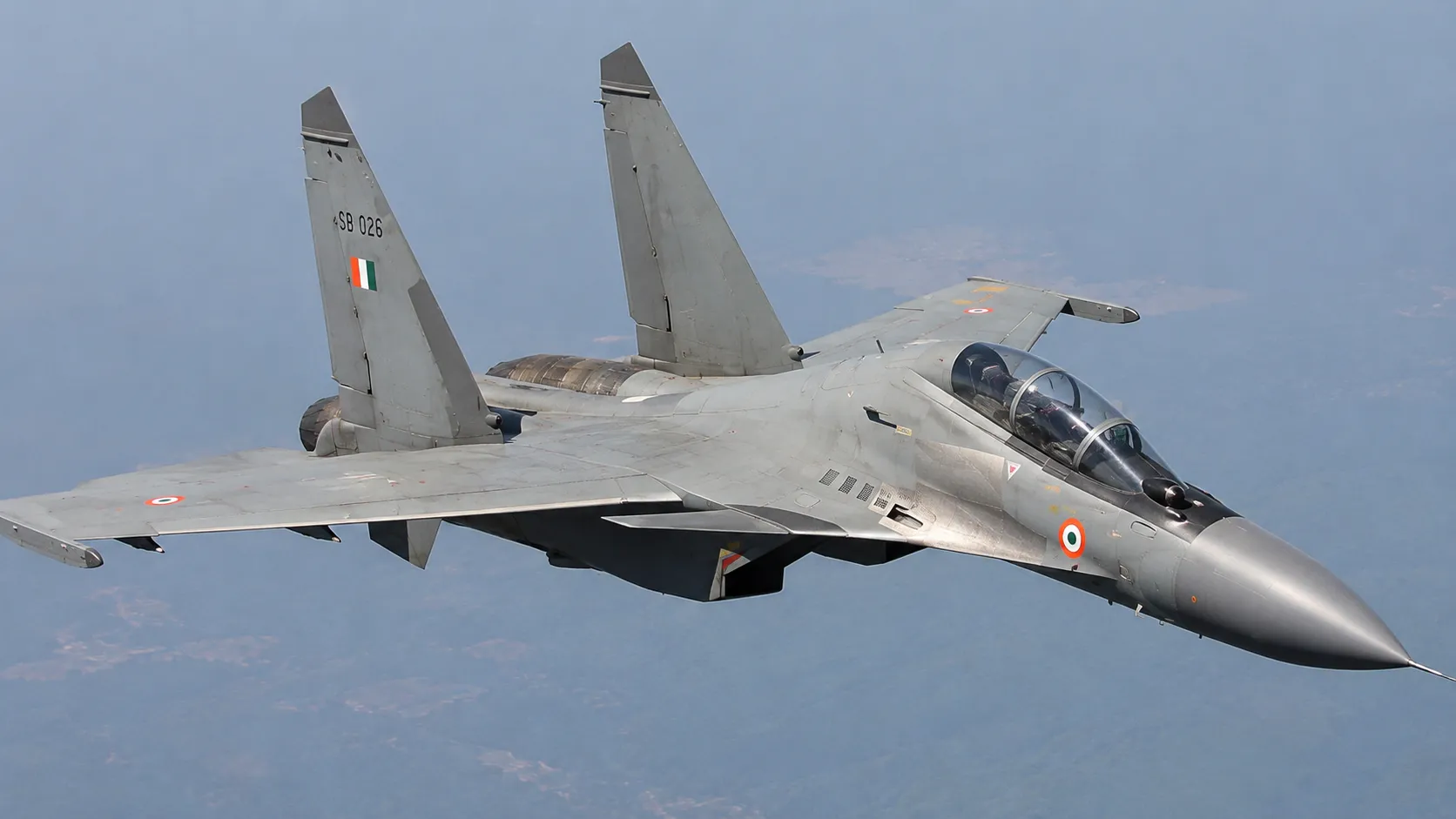
Super Sukhoi and India’s Future Air Combat Strategy
For years, the Su-30MKI has been the Indian Air Force’s workhorse. Large, heavily armed and built for range, the aircraft formed the backbone of India’s combat fleet as older MiG variants gradually aged out.
Now the Air Force wants to keep it flying for another three decades.
That decision says something about where Indian military planning is headed. Replacing more than 250 heavy fighters with new stealth aircraft would be enormously expensive and time-consuming. India’s indigenous stealth fighter program, the AMCA, is still years away from operational service. Squadron strength remains below the Air Force’s sanctioned requirement.
So instead of retiring the Sukhoi, India is trying to remake it.
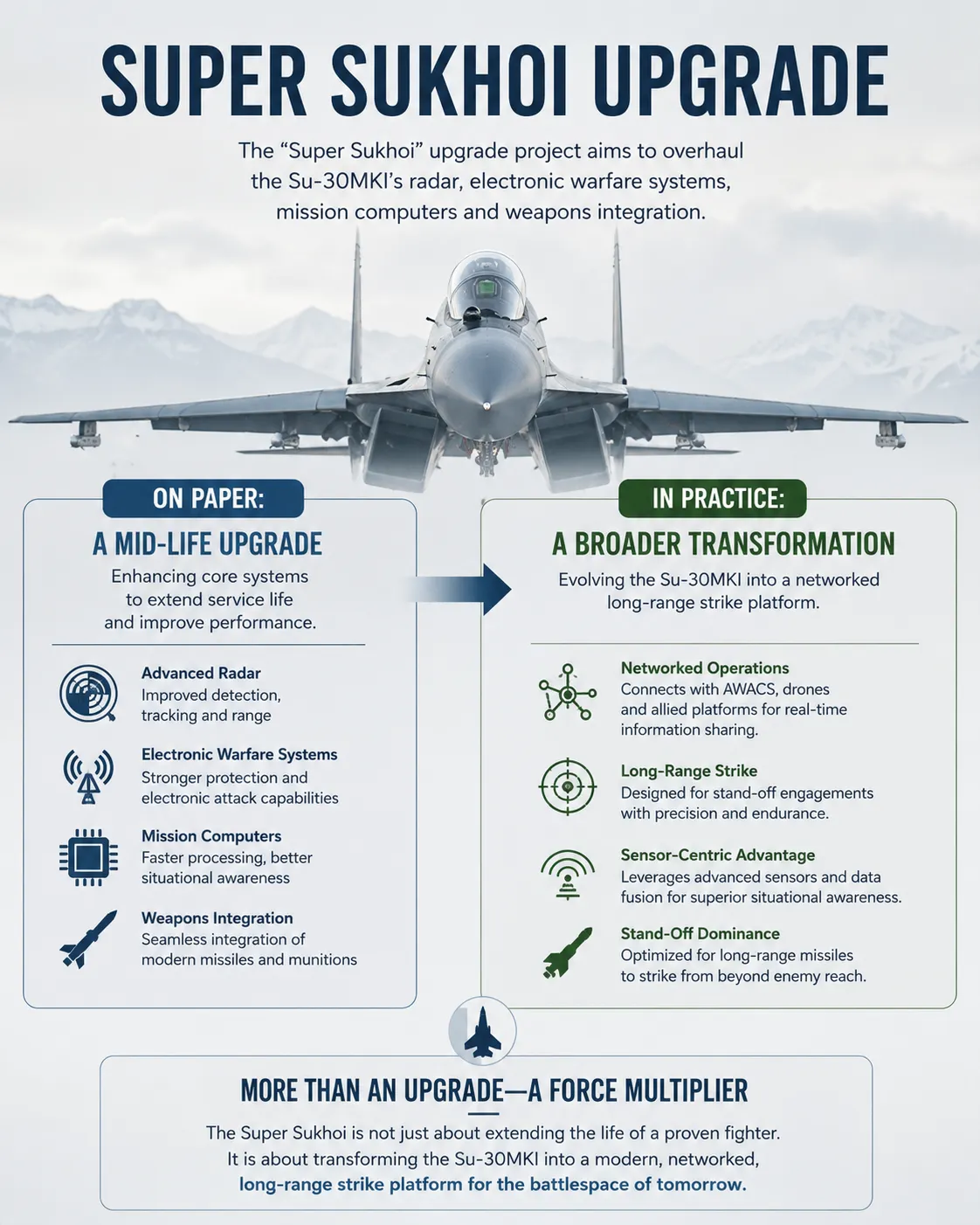
The “Super Sukhoi” upgrade project aims to overhaul the Su-30MKI’s radar, electronic warfare systems, mission computers and weapons integration. On paper, it is a mid-life upgrade. In practice, the project appears to be moving toward something broader — turning the aircraft into a networked long-range strike platform built around sensors, electronic warfare and stand-off missiles.
From Russian Fighter to Indian Platform
The aircraft itself is not new. The Su-30MKI entered Indian service in the early 2000s after India signed a deal with Russia for what eventually became the largest Sukhoi fleet outside Russia.
Over time, the aircraft evolved into a uniquely Indian platform. Russian airframe, French avionics, Israeli systems, Indian software and weapons integration. Hindustan Aeronautics Limited gradually moved from assembly to deeper manufacturing work at its Nashik facility, while engine production expanded through HAL’s Koraput division.
That process mattered more than it appeared at the time.
HAL officials have said India made more than 100 modifications to the aircraft over the years. Integrating the BrahMos missile alone required extensive structural and software changes. The experience gave Indian engineers a level of familiarity with the platform that few foreign operators typically get with Russian fighters.
The Super Sukhoi project seems to build on that foundation.
The Shift Toward Indian Systems
A large part of the focus is on replacing older Russian-origin systems with Indian alternatives. The planned Virupaksha AESA radar is central to the upgrade. So are indigenous electronic warfare suites, mission computers and weapons integration.
There is also another shift underway, though it receives less public attention.
The Indian Air Force increasingly appears to be thinking in terms of networked warfare rather than platform-versus-platform combat. In that environment, the Sukhoi’s size becomes an advantage rather than a liability. The aircraft can carry large missile loads, additional fuel and powerful sensors.
Some defence analysts describe the future role of the upgraded Sukhoi as a “missile truck”. The term sounds simplistic, but the idea behind it is significant.
India’s Emerging ‘Missile Truck’ Strategy
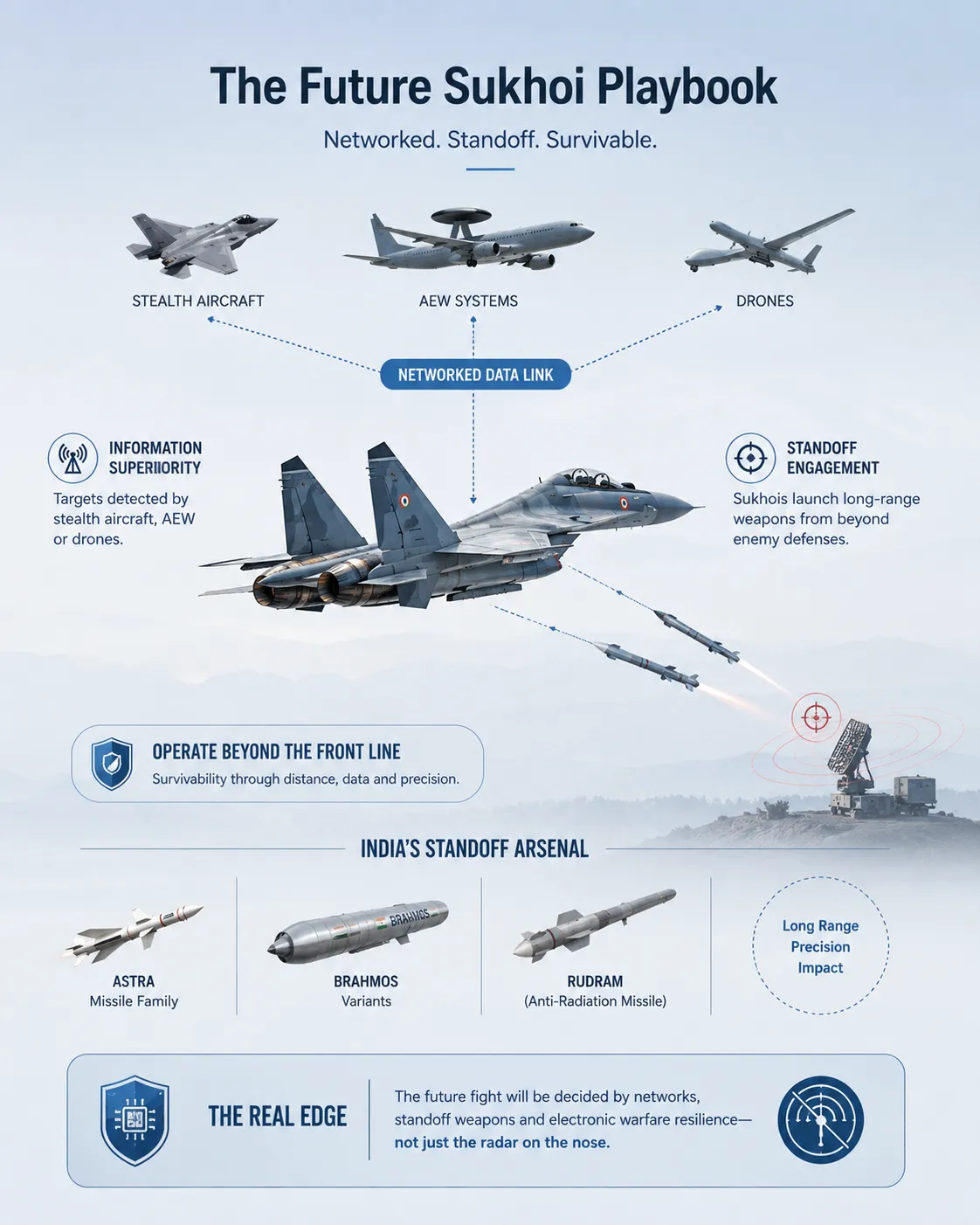
Future combat scenarios may involve stealth aircraft, drones or airborne early warning systems detecting targets while Sukhois operate farther behind the front line carrying long-range missiles.
Instead of relying entirely on their own radar, aircraft could receive targeting information through networked systems and engage enemy targets from standoff distances.
The concept is already visible in US and Chinese air combat thinking.
India’s version would likely revolve around the Astra missile family, BrahMos variants and anti-radiation weapons such as Rudram. The emphasis appears to be shifting from close-range maneuvering toward long-range engagements and electronic warfare resilience.
That last point may prove more important than the radar itself.
Lessons From Ukraine and Electronic Warfare
The war in Ukraine reinforced how vulnerable modern military systems are to jamming, spoofing and electronic disruption. Indian procurement documents in recent years show growing attention toward anti-jamming navigation systems and electronic protection suites.
The Super Sukhoi upgrade increasingly looks shaped by those lessons.
None of this turns the Su-30MKI into a true stealth aircraft. The airframe was never designed for low observability in the way the F-35 or J-20 were. Its physical size alone limits how far radar reduction measures can go.
Still, stealth is only one part of modern air combat.
A heavily networked fighter with powerful sensors, long-range weapons and strong electronic warfare capability can remain dangerous even in contested airspace. That may be the calculation driving the program.
A Different Path From Russia
Russia’s own modernization path offers some clues. The newer Su-30SM2 variant adopted several technologies from the Su-35, including upgraded engines and radar systems.
India appears to be taking a different route — retaining the Russian airframe while steadily replacing key systems with domestic ones.
There is also a geopolitical layer to the project.
The Ukraine war exposed the risks of long-term dependence on foreign defence supply chains. India still relies heavily on Russian-origin equipment across its armed forces, but New Delhi has been trying to reduce that dependence gradually.
The Super Sukhoi program fits into that broader pattern of selective indigenisation rather than abrupt replacement.
Why the Timing Matters
For the Air Force, the timing matters.
India’s fighter squadron numbers remain well below target levels, while China continues expanding both conventional and stealth airpower capabilities. Building entirely new fleets takes time. Upgrading existing aircraft is faster, cheaper and operationally less disruptive.
The Su-30MKI was once built for air dominance in a different era.
The Super Sukhoi project suggests India now sees the aircraft differently — less as a classic dogfighter and more as a long-range airborne weapons and sensor platform designed for the next phase of Asian air warfare.