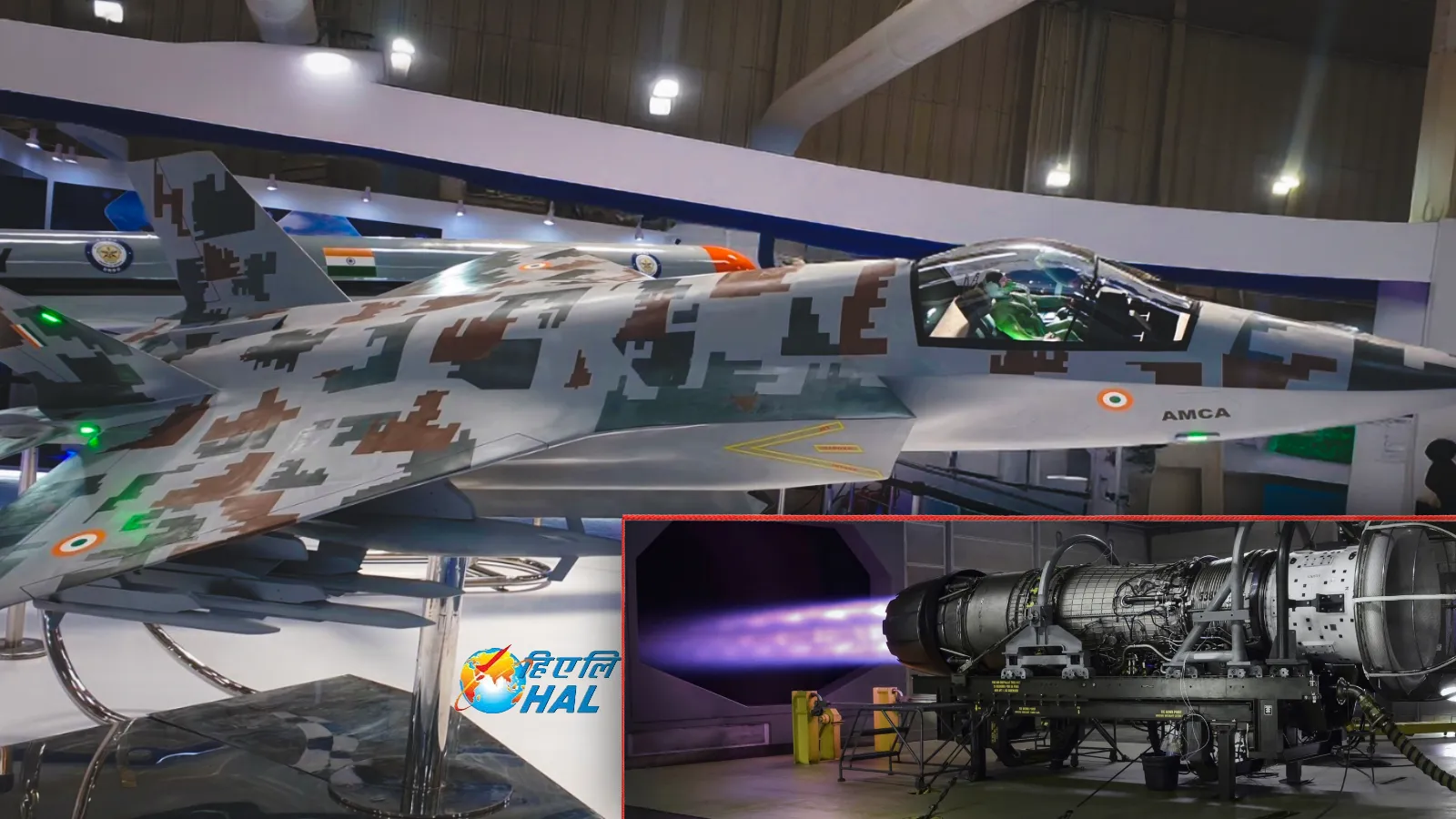
Key Insight: The debate around AMCA has focused on who will build India’s next fighter aircraft. The more important question may be who will power it. India’s Aero Engine Program suggests HAL remains central to that answer.
When reports emerged that private companies would take the lead in building India’s Advanced Medium Combat Aircraft (AMCA), the reaction across much of the media was immediate. Headlines suggested that Hindustan Aeronautics Limited (HAL) had been sidelined. Some even portrayed the development as a major setback for the state-owned aerospace giant.
Yet there was something strange about that narrative.
At the very moment HAL was supposedly losing relevance, it remained at the center of nearly every major propulsion initiative underway in India. From the proposed co-production of GE’s F414 fighter engine to future engine-development discussions with France’s Safran, the company continues to occupy a position that few other Indian aerospace firms can match.
That contradiction raises a bigger question.
If HAL has been sidelined, why does nearly every major propulsion initiative in India still run through HAL?
The answer lies in a story that extends far beyond a single fighter aircraft. India’s Aero Engine Program is increasingly becoming one of the country’s most important strategic-industrial projects, and HAL sits at the heart of it.
Airframes win contracts. Engines create strategic autonomy.
How India’s Aero Engine Program Is Evolving Beyond Aircraft Manufacturing
For decades, India’s military aviation challenge was never simply about building fighter jets.
Airframes can be designed. Avionics can be integrated. Weapons can be developed or procured. Propulsion, however, remains one of the most difficult technological domains on Earth.
Modern fighter engines operate in conditions that push the boundaries of physics and materials science. Turbine blades routinely function in gas streams hotter than the melting point of the metals from which they are made. Achieving this requires advanced metallurgy, thermal barrier coatings, precision manufacturing, cooling technologies and decades of engineering experience.
This is why only a handful of nations have mastered high-performance military jet engines.
Many countries can build aircraft.
Very few can build engines.
That distinction is important because it explains why propulsion has become one of the most strategically valuable parts of India’s defence-industrial ambitions.
The Lessons Of Kaveri
India’s current aero-engine ambitions cannot be understood without looking at the Kaveri programme.
Although Kaveri failed to achieve the operational performance required for frontline fighter aircraft, it generated valuable expertise in testing, materials science, aerodynamics and systems integration.
More importantly, it exposed a critical reality.
Engine sovereignty requires more than engineering talent. It requires manufacturing ecosystems, testing facilities, certification frameworks, metallurgy infrastructure and industrial depth accumulated over decades.
The lessons of Kaveri continue to shape India’s Aero Engine Program today.
Rather than pursuing engine development in isolation, India is now attempting to build an entire propulsion ecosystem.
HAL’s Propulsion Ecosystem Is Decades Old
One of the biggest misconceptions surrounding India’s Aero Engine Program is that the country is starting from zero.
HAL’s own facilities tell a different story.
For more than five decades, the company has accumulated expertise across multiple military and industrial engine families.
At Koraput, HAL supports the AL-31FP engine that powers the Indian Air Force’s Su-30MKI fleet. The division also handles the RD-33 family associated with the MiG-29 and has extensive experience with legacy combat-engine programmes such as the R-29B.
Meanwhile, Bengaluru serves as another critical node in India’s propulsion ecosystem. HAL’s engine divisions support platforms including the Adour and TM333 engine families while maintaining extensive overhaul, refurbishment and lifecycle-support capabilities.
Beyond aviation, HAL’s industrial turbine divisions support Industrial Avon and Industrial 501K engines, further expanding the company’s experience with high-performance turbine systems.
Viewed individually, these programmes may appear disconnected.
Viewed collectively, they reveal something far more important.
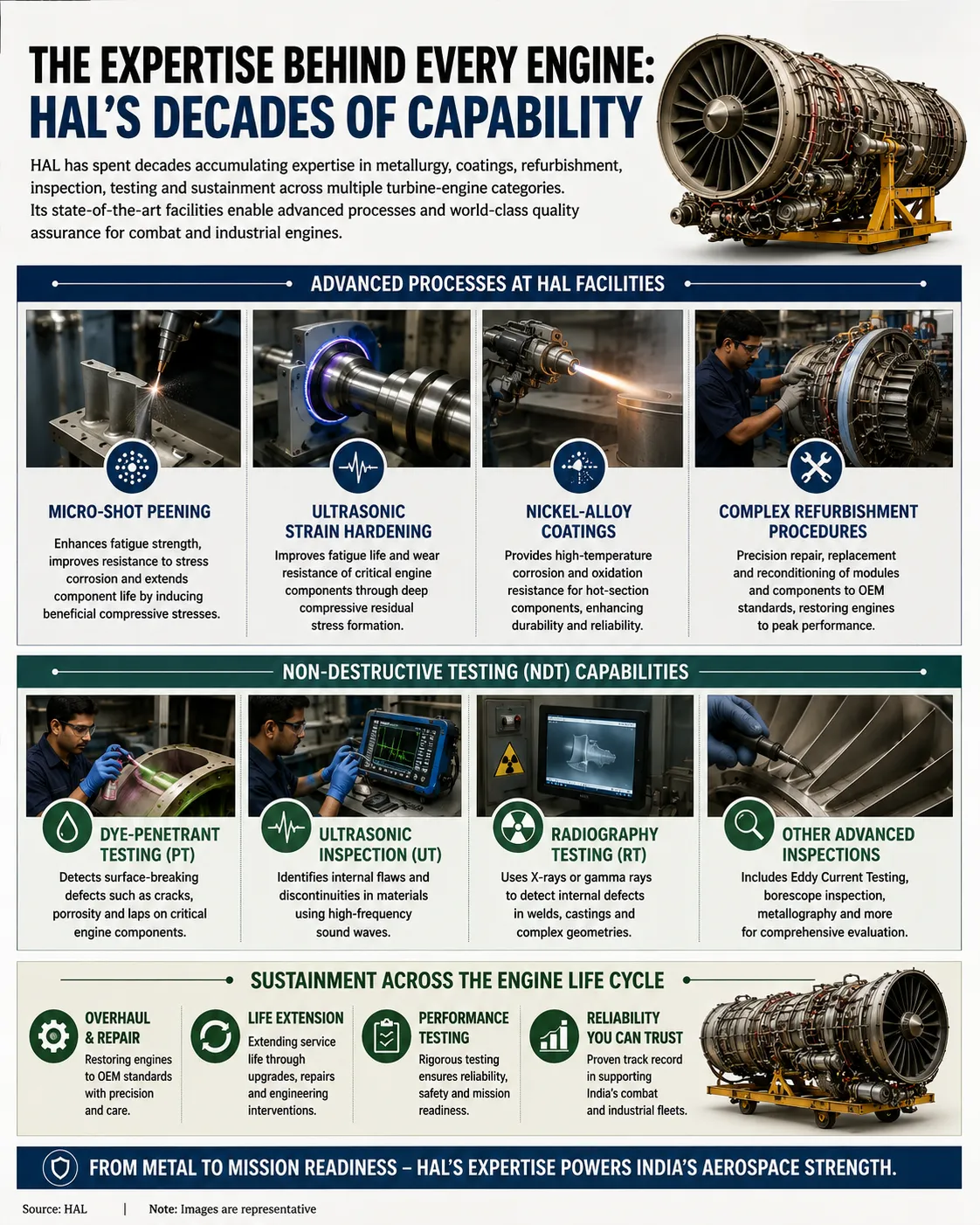
HAL has spent decades accumulating expertise in metallurgy, coatings, refurbishment, inspection, testing and sustainment across multiple turbine-engine categories.
Its facilities perform advanced processes including micro-shot peening, ultrasonic strain hardening, nickel-alloy coatings and complex refurbishment procedures. Non-destructive testing capabilities include radiography, ultrasonic inspection, dye-penetrant testing and other advanced inspection techniques.
Engine divisions conduct hot tests, endurance tests, acceptance tests and gas-dynamic stability trials using sophisticated computerized monitoring systems.
This is not the profile of a company starting from scratch.
It is the profile of an organization preparing to move further up the propulsion value chain.
The GE F414 Program Is About More Than Engines
The most visible pillar of India’s Aero Engine Program is the proposed co-production of the GE F414 engine.
Much of the public discussion surrounding the project focuses on technology-transfer percentages.
That may be missing the larger story.
The true significance of the F414 programme lies in capability absorption.
Possessing access to technical documentation is one thing. Building manufacturing processes, testing infrastructure, quality-control systems and skilled engineering teams is something entirely different.
The F414 programme gives India an opportunity to deepen participation across the propulsion value chain rather than simply import finished engines.
For HAL, this represents a chance to leverage decades of accumulated sustainment and manufacturing experience while advancing toward higher-value propulsion activities.
The Safran Factor
If GE addresses India’s near-term requirements, Safran could influence its long-term ambitions.
Discussions between India and France regarding a future high-thrust engine are widely viewed as a potential pathway toward deeper propulsion capabilities.
The attraction is not simply another engine programme.
The attraction is access to critical knowledge involving metallurgy, thermal management, manufacturing processes and development methodologies that remain concentrated among a small group of aerospace powers.
Yet significant uncertainties remain.
Questions involving intellectual property, export arrangements and technology-sharing frameworks have not been fully disclosed.
For that reason, Safran should be viewed as a strategic opportunity rather than a guaranteed outcome.
AMCA And The Reorganization Of India’s Aerospace Industry
This brings us back to the question that inspired this article.
Why was HAL portrayed as the loser when private firms were invited into the AMCA programme?
The answer may be that India is not reducing HAL’s importance.
It is redefining it.
The emerging structure suggests that private companies will play larger roles in airframe manufacturing, composites production and large-scale manufacturing execution.
HAL, meanwhile, continues to strengthen its position in propulsion, testing, sustainment and lifecycle support.
A stealth fighter cannot fly without an engine.
No matter who manufactures the airframe, propulsion remains one of the most strategic and technically demanding components of military aviation.
Seen through that lens, the AMCA programme looks less like HAL’s exclusion and more like a broader restructuring of India’s aerospace ecosystem.
Why Investors Should Pay Attention
The investment case surrounding India’s Aero Engine Program is often overlooked.
Aircraft production is cyclical.
Engine support is not.
Military engines require decades of maintenance, overhaul, refurbishment, upgrades and spare-parts support.
This creates recurring revenue streams that can outlast the original production programme by decades.
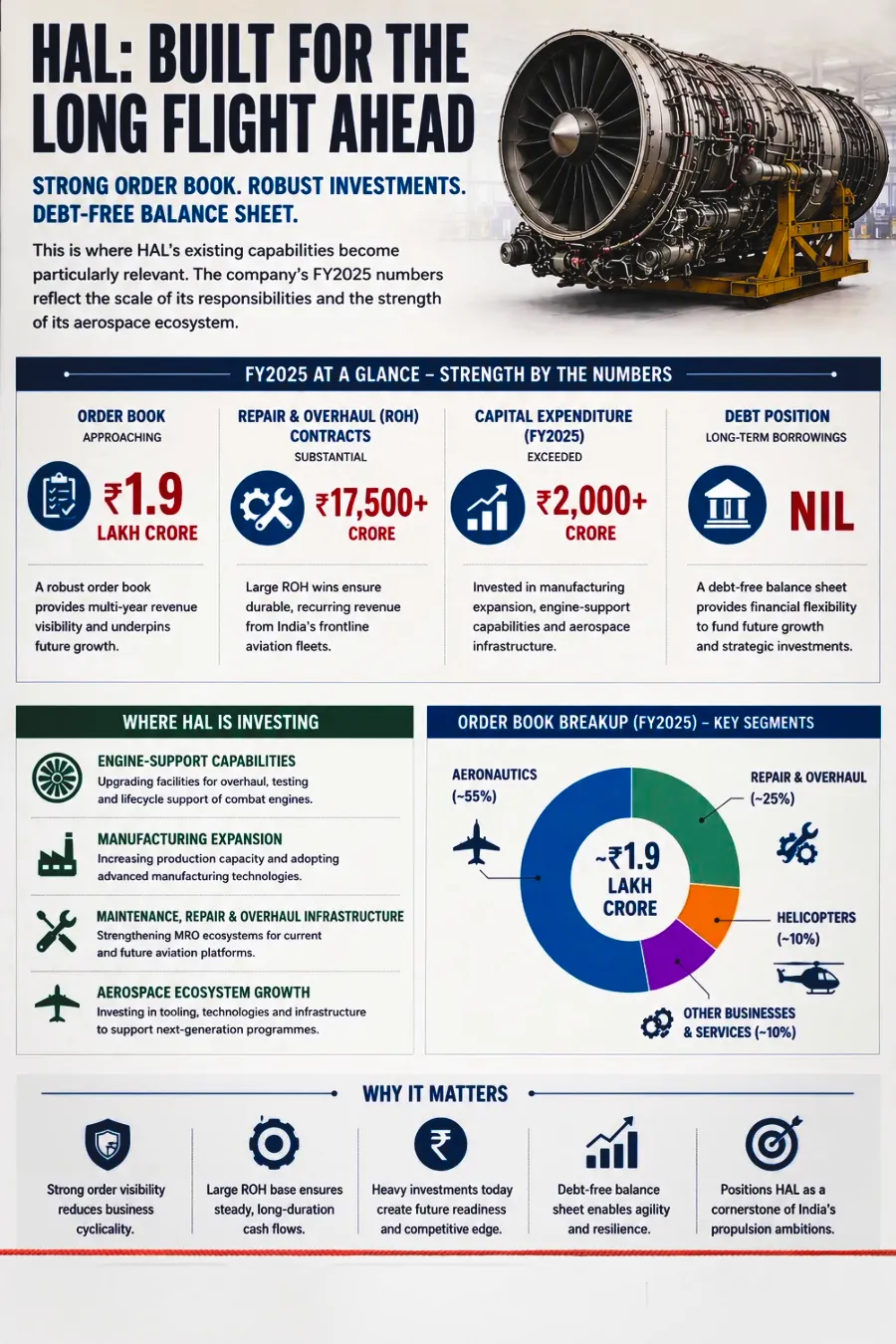
HAL entered FY2025 with an order book approaching ₹1.9 lakh crore. The company secured substantial repair and overhaul contracts while continuing to invest heavily in manufacturing and sustainment infrastructure. Capital expenditure exceeded ₹2,000 crore during the year, including investments linked to engine-support capabilities and aerospace expansion.
The company also maintains a debt-free balance sheet.
For long-term investors, the most important question may not be how many aircraft HAL produces.
It may be how much value the company captures across the lifecycle of India’s future engine fleet.
The Bigger Story
The debate surrounding AMCA has largely focused on who will build India’s next fighter.
The more important question may be who will power it.
HAL’s existing divisions already demonstrate significant capabilities in manufacturing, overhaul, testing and sustainment across multiple turbine-engine families.
The real challenge is whether India can climb the next rung of the propulsion ladder—from maintenance and licensed production to advanced manufacturing, metallurgy and eventually engine design.
If that transition succeeds, the significance will extend far beyond HAL, GE Aerospace or even the AMCA programme.
India will have taken a meaningful step toward joining one of the world’s most exclusive technological clubs: nations capable of sustaining an independent military propulsion ecosystem.
If the answer to India’s future propulsion ambitions continues to run through HAL, then the company is not being pushed to the margins of India’s aerospace future.
It is being repositioned at the center of its most difficult technological challenge.
Is HAL out of the AMCA programme?
No. HAL is not leading the current AMCA airframe bidding process, but it remains central to propulsion, testing, sustainment and future engine-related activities connected to India’s combat aviation ecosystem.
Why are fighter jet engines harder to build than aircraft?
Jet engines require mastery of advanced metallurgy, thermal management, precision manufacturing, coatings and testing technologies that only a handful of countries possess.
What is the significance of the GE F414 deal?
The strategic value lies not just in producing engines but in absorbing manufacturing know-how, testing capabilities and industrial expertise that can strengthen India’s aerospace ecosystem.
Why is the Safran partnership important?
Future cooperation with Safran could potentially help India gain deeper expertise in high-thrust engine development, advanced materials and propulsion technologies.
Why does propulsion matter more than many investors realize?
Unlike aircraft production, which is cyclical, engine maintenance, repair and overhaul generate recurring revenue for decades, creating long-term visibility and cash flows.
What is the ultimate goal of India’s Aero Engine Program?
The long-term objective is propulsion sovereignty—the ability to design, manufacture, test and sustain advanced military jet engines with reduced dependence on foreign suppliers.
If India’s Aero Engine Program succeeds, the country will move closer to joining the small group of nations capable of sustaining an independent military propulsion ecosystem.