
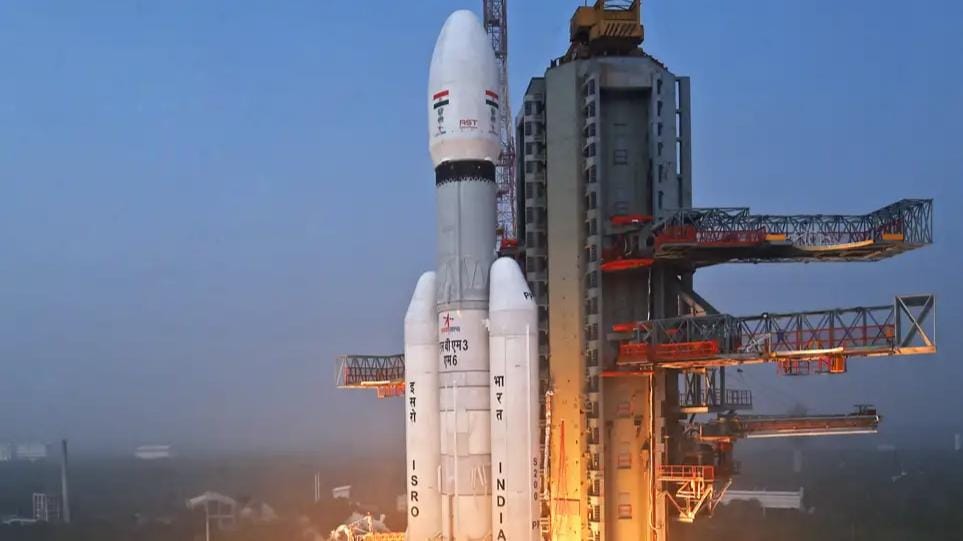
What Is Driving India Space Program Beyond the Moon? How has ISRO evolved from a launch agency into a full-spectrum space power? Why do Gaganyaan, the Bharatiya Antariksha Station, and lunar exploration matter for national security and economic growth? And can India compete with the United States and China in the emerging space race?
India is building a comprehensive space ecosystem that extends far beyond exploration. Through human spaceflight, advanced satellite infrastructure, private-sector reforms, lunar research, and future orbital platforms, New Delhi is positioning itself for a world where economic competitiveness, military capability, and geopolitical influence increasingly depend on access to space.
When Prime Minister Narendra Modi used his latest Mann Ki Baat address to highlight the growing popularity of astronomy clubs across India, the remarks appeared to be a simple celebration of scientific curiosity. In reality, they reflected a much larger national effort.
Over the past decade, India has steadily expanded its ambitions in space. What began as a development-focused programme centred on communications and remote sensing satellites is evolving into a strategic ecosystem spanning science, education, industry, human spaceflight, national security, and future lunar infrastructure.
The transformation is being driven not only by ISRO but also by the Department of Space, IN-SPACe, IIST, YUVIKA, private startups, and a growing network of research institutions. Together, they form the foundation of India’s long-term space strategy.
Why It Matters
- Space-based infrastructure supports communications, navigation, banking, agriculture, weather forecasting, and disaster management.
- Military forces increasingly depend on satellites for surveillance, targeting, navigation, and secure communications.
- India’s space sector is expanding beyond government missions into a broader commercial ecosystem.
- Future competition may increasingly revolve around orbital infrastructure, lunar resources, and space-based industries.
- Nations that build sustainable space capabilities will enjoy economic and strategic advantages for decades.
India’s Emerging Space Ecosystem
| Pillar | Institution or Programme |
|---|---|
| Space Agency | ISRO |
| Policy Leadership | Department of Space |
| Private Sector Promotion | IN-SPACe |
| Human Spaceflight | Gaganyaan |
| Future Orbital Infrastructure | Bharatiya Antariksha Station |
| Higher Education | IIST |
| Youth Talent Pipeline | YUVIKA |
| Solar Research | Aditya-L1 |
| Lunar Exploration | Chandrayaan Programme |
How Has ISRO Expanded Beyond Traditional Space Exploration?
India’s space programme has evolved from a cost-effective launch operation into one of the world’s most ambitious emerging space ecosystems. Recent achievements demonstrate the breadth of that transformation.
India’s Major Space Missions
| Mission | Strategic Significance |
|---|---|
| Chandrayaan-1 | First confirmed evidence of water molecules on the Moon |
| Mars Orbiter Mission | First nation to reach Mars on a maiden attempt |
| Chandrayaan-3 | Successful south polar lunar landing |
| Aditya-L1 | India’s first solar observatory |
| Gaganyaan | Indigenous human spaceflight capability |
| Bharatiya Antariksha Station | Planned long-term orbital platform |
Recent findings from Chandrayaan-2’s Dual Frequency Synthetic Aperture Radar (DFSAR) have strengthened India’s position in lunar science. The orbiter has identified evidence suggesting the presence of subsurface water ice near the Moon’s south pole, a region increasingly viewed as one of the most strategically important destinations in future space exploration.
At the same time, ISRO’s Research Areas in Space Science roadmap highlights future work in lunar science, planetary exploration, solar physics, space weather, earth observation, and satellite technologies. The message is clear: India is preparing not only for future missions but also for long-term scientific leadership.
Why Is Space Becoming a National Security Priority?
Space is no longer simply a scientific domain. Modern military operations depend heavily on satellite infrastructure for communications, navigation, intelligence gathering, surveillance, and targeting.
Space and Defence Integration
| Capability | Strategic Use |
|---|---|
| NavIC Navigation Satellites | Precision targeting and navigation |
| Communication Satellites | Secure military communications |
| Earth Observation Satellites | Border surveillance and monitoring |
| Intelligence Satellites | Reconnaissance and threat assessment |
| Space Situational Awareness | Tracking satellites and orbital threats |
Recent conflicts have demonstrated that uninterrupted access to satellite networks can provide a decisive operational advantage. For India, strengthening orbital infrastructure increasingly supports both civilian resilience and national defence.
As strategic competition intensifies across the Indo-Pacific, space capabilities are becoming as important as traditional military assets. Nations that control information in orbit gain advantages on the ground.
How Is India Building a Long-Term Space Ecosystem?
India’s ambitions extend far beyond individual missions. The country is investing in the institutions required to sustain a major space power over decades.
Programmes such as YUVIKA aim to inspire future scientists, while IIST provides specialised education in aerospace engineering, avionics, and space science. Student interactions with India’s Gaganyatris are helping create public interest in human spaceflight, while ISRO’s expanding research programmes continue to strengthen the country’s scientific base.
The result is a talent pipeline designed to support future lunar missions, space stations, advanced satellite systems, and emerging technologies.
Great space powers are not built through rockets alone. They are built through universities, research institutions, industrial ecosystems, and generations of scientific talent.
How Are Space Startups Transforming India’s Space Sector?
One of the most significant developments in recent years has been the rise of India’s private space industry.
The creation of IN-SPACe and broader space-sector reforms have encouraged startups to enter areas once dominated by government agencies.
Indian companies are now working on:
- Launch vehicles
- Satellite manufacturing
- Earth observation services
- Geospatial intelligence
- Space-data analytics
- Advanced aerospace technologies
This shift matters because long-term leadership in space depends not only on government investment but also on commercial innovation. Countries that successfully develop competitive space industries are better positioned to capture economic opportunities in the rapidly expanding global space economy.
Why Are Gaganyaan and the Bharatiya Antariksha Station Important?
The Gaganyaan programme represents India’s next major leap in space capability.
The mission aims to place Indian astronauts into orbit aboard an indigenous spacecraft, marking India’s entry into independent human spaceflight.
Beyond Gaganyaan lies an even more ambitious objective: the Bharatiya Antariksha Station.
A permanent orbital platform would allow India to conduct long-duration microgravity research, develop advanced life-support systems, test new technologies, and prepare for future deep-space missions. Only a handful of nations have successfully operated space stations, making the programme strategically significant.
The station would provide India with a permanent foothold in orbit and greater autonomy in future human spaceflight operations.
Why Is the Lunar South Pole Becoming a Geopolitical Battleground?
The Moon’s south pole has emerged as one of the most strategically important regions in space because scientists believe it contains significant deposits of water ice.
Why the Lunar South Pole Matters
| Resource | Potential Use |
|---|---|
| Water Ice | Drinking water |
| Hydrogen | Rocket fuel production |
| Oxygen | Life support systems |
| Strategic Location | Future lunar infrastructure |
India’s successful south polar landing through Chandrayaan-3, combined with ice observations from Chandrayaan-2, has positioned the country as a serious participant in future lunar exploration.
The competition is not about planting flags. International agreements prohibit national ownership of the Moon.
Instead, the race is increasingly about infrastructure, logistics, scientific presence, and resource utilisation.
The first countries to establish sustainable lunar infrastructure may enjoy strategic advantages similar to those once gained by maritime powers that controlled critical sea routes.
Can India Become a Leading Space Power?
India has already established itself as one of the world’s leading spacefaring nations. The next challenge is converting scientific achievements into long-term strategic influence.
Unlike many countries, India is simultaneously investing in scientific research, human spaceflight, education, commercial innovation, national security, and orbital infrastructure.
That combination is significant.
The country’s future influence in space will depend not only on launching successful missions but also on building institutions capable of sustaining innovation for decades. If current trends continue, India could emerge as one of the defining space powers of the twenty-first century.
Frequently Asked Questions
Why is Prime Minister Modi emphasizing space and astronomy?
Space increasingly influences economic growth, technological innovation, scientific development, and national security. Encouraging public interest helps create the future workforce needed for India’s expanding space ambitions.
Why is the Moon’s south pole important?
Scientists believe it contains water ice deposits that could support future lunar settlements, generate rocket fuel, and reduce the cost of deep-space exploration.
How does space technology support national defence?
Satellites provide communications, surveillance, navigation, intelligence gathering, and early warning capabilities that are essential for modern military operations.
Strategic Outlook
The first space race was defined by reaching orbit and planting flags. The next one is likely to be defined by infrastructure, resources, technology, and influence.
India is no longer merely launching satellites. Through ISRO, Gaganyaan, IN-SPACe, YUVIKA, IIST, the proposed Bharatiya Antariksha Station, and a growing private-sector ecosystem, New Delhi is assembling the foundations of a long-term space power.
The twentieth century was shaped by industrial powers, naval powers, and nuclear powers. The twenty-first century may increasingly be shaped by space powers. India’s challenge is no longer reaching orbit. It is turning orbital access into lasting strategic advantage.