
DEFENCE ECONOMY & ARMOURED WARFARE
The Ministry of Defence’s formal execution of the ₹586-crore T-72 T-90 APU contract landed on a Monday afternoon in New Delhi—at the precise moment the Indian Army’s mechanised formations confront an operational dilemma: how to preserve the readiness of a ~4,000-hull Russian-origin fleet while its foreign manufacturing base remains diverted by wartime replenishment and constrained by secondary sanctions. The timing and the procurement route deserve forensic scrutiny.
EXECUTIVE BRIEF
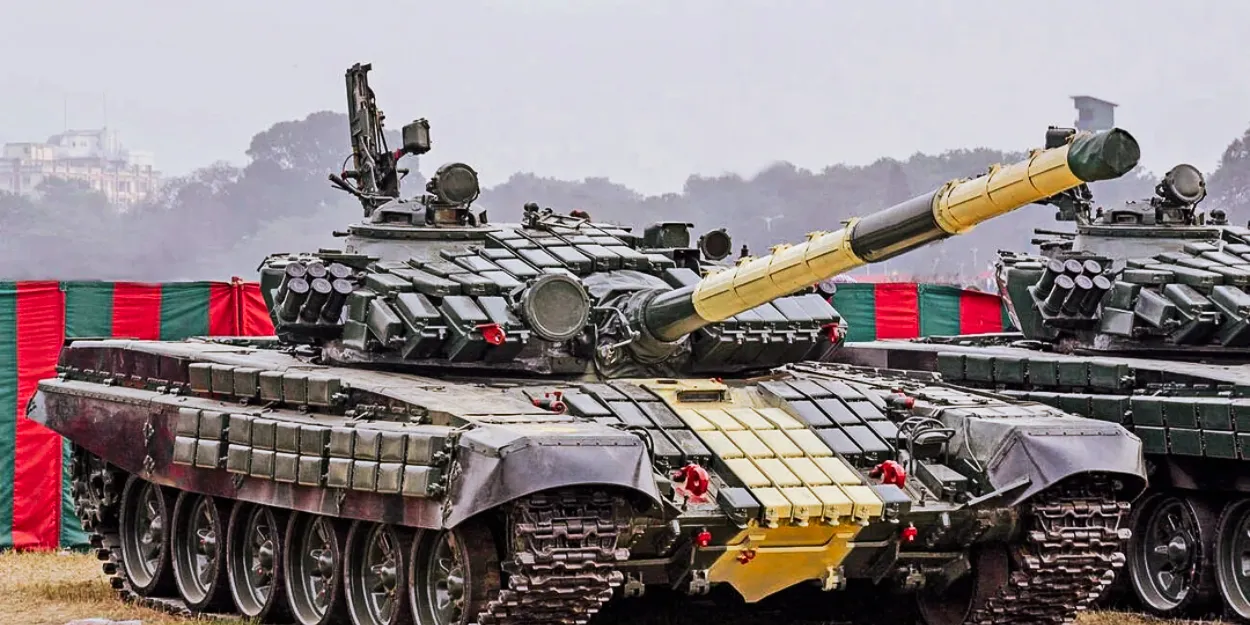
The Ministry of Defence (MoD) has executed a ₹586-crore contract with Pune-based private contractor Accurate Industrial Controls Private Limited to procure indigenously developed Auxiliary Power Units (APUs) for the Indian Army’s T-72 and T-90 main battle tanks. Signed in New Delhi in the presence of Defence Secretary Rajesh Kumar Singh, the acquisition operationalises an industry-funded research and development project under the Make-II procurement category of the Defence Acquisition Procedure (DAP). The system provides an independent electric generation source for the tank’s fire control system, firing circuits, gun stabilisation systems, and optoelectronic ancillaries.
Beyond the tactical mandate of enabling a low-signature “silent watch,” the contract represents an industrial turning point. India’s Armoured Corps has historically expended finite primary engine hours simply to keep onboard electronics powered during static border vigils. With Russian OEM Uralvagonzavod absorbed by domestic tank attrition in Ukraine and bilateral trade clearing hampered by Western financial sanctions, New Delhi is deploying private-sector design authority to extend engine life, insulate frontline strike corps from foreign component bottlenecks, and convert domestic R&D into serial production.
Beyond the South Block Signing
On 21 September 2026, the Ministry of Defence formally signed the contract with Accurate Industrial Controls. The official communication framed the milestone around Aatmanirbharta and the Viksit Bharat @2047 industrial vision, highlighting the successful translation of indigenous innovation into service induction.
In combat doctrine, however, the power architecture of an armoured platform dictates its survivability.
In standard factory configurations of the Russian-designed T-72M1 Ajeya and T-90S/MS Bhishma, auxiliary electrical power generation is tied directly to the main propulsion engine—the 780-horsepower V-46-6 in the T-72 or the 1,000-horsepower supercharged V-92S2 in the T-90. When an armoured troop occupies static battle positions, takes up hull-down surveillance along the Line of Control (LoC), or holds high-altitude choke points along the Line of Actual Control (LAC), it requires continuous electricity. Modern sub-systems—such as Thermal Imaging Fire Control Systems (TIFCS), ballistic computers, laser rangefinders, radio nets, and gun drives—exhaust internal lead-acid battery banks in under four hours of continuous operation.
Without a dedicated APU, crews have historically had to keep the primary diesel engine idling. Idling a 1,000 hp engine to run a ~5 kW electronics load creates three acute tactical liabilities:
- Acoustic and Thermal Exposure: Massive multi-cylinder diesel engines generate significant engine noise and an exhaust heat bloom readily detected by adversary mid-wave infrared (MWIR) sensors mounted on loitering munitions and reconnaissance drones.
- Logistical Drag: Continuous engine idling burns tens of litres of high-grade diesel per hour per vehicle, placing a severe logistical burden on forward fuel supply convoys.
- Premature Engine Wear: Running primary engines as stationary power generators burns down Mean Time Between Overhauls (MTBO), exhausting cylinder liners, fuel injectors, and turbochargers long before the tank maneuvers in combat.
The integration of an APU decouples mission-critical electronics from the tank’s main automotive plant. It equips Indian armour with genuine “silent watch” capability: the turret traverses, the sensors track targets, and the main gun remains stabilized and ready to fire while the primary engine remains cold and silent.
The Industrial Arithmetic: Protecting the Core
The numbers underpinning the procurement outline the scope of India’s fleet-wide overhaul strategy:
The arithmetic of depot-level maintenance underscores the operational necessity. Engine Factory Avadi (EFA) and Heavy Vehicles Factory (HVF)—operating under the corporatised Defence Public Sector Undertaking (DPSU) Armoured Vehicles Nigam Limited (AVNL)—face a base overhaul requirement of roughly 200 to 230 tanks annually across the two fleets. Installed throughput has historically hovered around 150 tanks per year. Reducing primary engine idling hours cuts down intermediate maintenance cycles, alleviating pressure on sovereign depot lines.
TES ANALYTICAL ASSESSMENT
The official MoD release presents this procurement as an operational readiness upgrade and a success for the Make-II framework. Two analytical readings contextualise the timing and strategic significance of the contract:
- The Conventional Reading: The tender is a routine technology upgrade to address legacy design limitations. Modern main battle tanks globally—from the American M1A2 SEPv3 to the German Leopard 2A7—rely on auxiliary power units to support complex digital computing and optronics. India’s deployment of APUs simply aligns its mechanised formations with modern power-distribution standards.
- The Strategic De-Risking Reading: The procurement is a structural workaround for a fractured foreign supply corridor. Russian state enterprise Uralvagonzavod remains on a wartime production footing dedicated to replacing battlefield losses in Ukraine, delaying contracted deliveries of knocked-down kits, sub-assemblies, and precision spares to foreign export clients. Compounding this, Western secondary sanctions and commercial banking risks continue to complicate Rupee-Rouble settlement mechanisms through Special Rupee Vostro Accounts (SRVA).
The strategic reality supports the second reading. Unable to rely on foreign OEMs for fast-turnaround engine replacements or spare parts, the Indian Army must preserve its current propulsion inventory. Shifting electrical generation from imported propulsion blocks to an indigenous private-sector APU mitigates supply-chain exposure through targeted engineering.
The High-Altitude Variable: Eastern Ladakh and the LAC
While auxiliary power reduces thermal signatures in the desert expanses of Rajasthan, it serves as a critical cold-weather operational asset across the high-altitude terrain of Eastern Ladakh.
Following the 2020 border standoff, the Indian Army positioned multiple tank regiments at elevations exceeding 14,000 feet, including forward deployments at Nyoma, Chushul, and the Depsang Plains. Russian diesel engines, developed primarily for European plains, encounter cold-start complications in thin, freezing air. At sub-zero temperatures, battery output drops precipitously, and main engine starts require extensive pre-heating to prevent catastrophic starter-generator burnout.
An indigenous APU certified for extreme weather addresses these environmental challenges. By providing independent electrical generation, it maintains constant heating for fluids, keeps digital sighting systems calibrated, and preserves battery charge, ensuring platforms remain combat-ready on high-altitude frontlines.
Defence Industrial Shift: The Make-II Precedent
The award to Accurate Industrial Controls Private Limited reflects a maturing dynamic within the domestic Defence Industrial Base (DIB):
- Risk Absorption by Private Industry: Under the Make-II framework, the Ministry of Defence provides no initial government funding for prototype research, development, and testing. The private vendor absorbs the initial capital expenditure, with cost recovery and returns realised only when the design clears military trials and secures a production contract. The ₹586-crore order demonstrates that mid-tier Indian engineering firms can finance and execute complex defense electromechanical projects.
- Moving Beyond Build-to-Print: Heavy armoured vehicle manufacturing was long restricted to licensed public-sector assembly lines at HVF Avadi. This contract transfers design authority for a core operational subsystem to an Indian private enterprise, granting domestic control over intellectual property and production modifications.
- Tier-2 Supply Chain Expansion: A sub-system contract of this scale generates downstream requirements for regional engineering hubs. Precision components, alternator assemblies, microcontrollers, and military-grade cabling will flow through small-and-medium enterprise (MSME) clusters in Pune, Coimbatore, Bengaluru, and Chennai—redirecting capital that previously flowed to foreign original equipment manufacturers into the domestic industrial base.
THE VIEW FROM NEW DELHI
The ₹586-crore APU contract aligns with three primary strategic requirements for India’s defence planning:
Eliminates acoustic noise and exhaust thermal plumes, drastically reducing detection risks from overhead loitering munitions and modern drone reconnaissance.
Bypasses foreign OEM manufacturing backlogs and frozen Rupee-Vostro trade settlement corridors by securing complete domestic design and manufacturing control[cite: 1].
Eliminates non-operational engine idling hours, reducing maintenance strain on Engine Factory Avadi (EFA) and mitigating depot overhaul capacity gaps.
For South Block, this procurement underscores that strategic readiness is maintained through incremental, high-impact subsystems as much as major platform acquisitions. While the Future Ready Combat Vehicle (FRCV) program defines India’s long-term armoured doctrine for the late 2030s, the T-72 and T-90 will remain the Army’s primary deterrence force for the coming decade. Keeping those platforms mission-capable and sensor-ready through domestic engineering ensures operational deterrence remains credible.
WHAT HAPPENS NEXT
- Integration and Field Induction: Track the phased delivery timeline and fitment schedules of the APU units across front-line strike corps formations and forward border garrisons.
- HVF Avadi Line Coordination: Monitor the workflow coordination between Accurate Industrial Controls and Heavy Vehicles Factory (HVF) Avadi to integrate APUs during routine scheduled overhauls.
- Mechanised Infantry Adaptations: Watch for potential follow-on procurement tenders under Make-II to design and integrate dedicated APUs onto the Indian Army’s ~2,500 BMP-2/2K Sarath infantry combat vehicles.
- Foreign Export Potential: Observe whether this indigenously certified auxiliary system is offered as a retrofit package to friendly foreign nations operating Russian-origin armor (such as Armenia or Vietnam) facing similar component crunches.
- Private Sector Defense Pipeline: Assess incoming quarterly capital expenditure allocations among mid-cap defense engineering firms competing for sub-assembly indigenisation programs listed under the MoD’s Positive Indigenisation Lists.
SOURCES & TRANSPARENCY
Reporting on this contract is based on primary documentation: Ministry of Defence Press Information Bureau (PIB) Release ID: 2313016, published on 21 September 2026; the Defence Acquisition Procedure (DAP) Make-II framework provisions; and published operational guidelines for Indian Army Mechanised Formations. Passages labelled “TES Analytical Assessment” reflect editorial deduction and strategic analysis rather than official government statements.
The evidence connecting this acquisition to the Russian industrial squeeze is structural, not formally cited in South Block press statements. The MoD frames the tender strictly under self-reliance and operational sustainability metrics. What is documented is the strategic dilemma: Russian OEM plants committed to wartime replacement schedules, payment settlements strained by secondary sanctions, and a ~4,000-hull Indian fleet that cannot afford premature engine wear. Two readings emerge: the first views this as a standard modernisation catch-up; the second views it as an operational shield against foreign supply paralysis. The first requires no background reading; the second explains why this project was pushed through as a priority domestic contract.